Venogel
Poland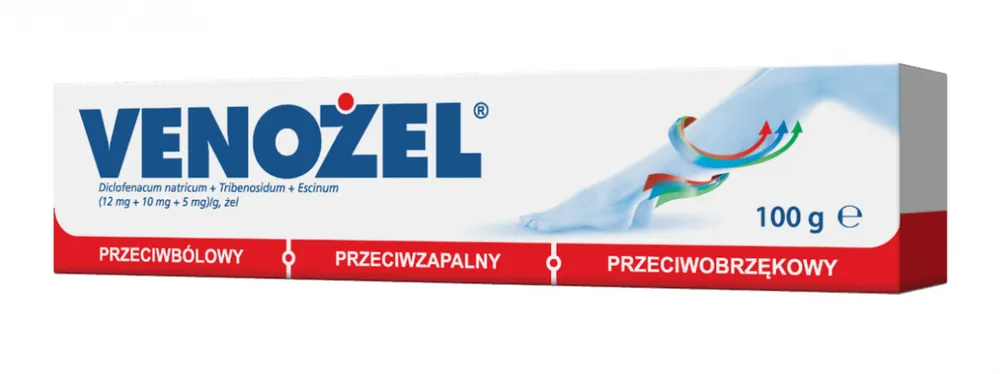
Table of Contents
Package leaflet: information for the patient
Venogel, (12 mg + 10 mg + 5 mg)/g, gel
Diclofenacum natricum + Tribenosidum + Escinum
Please read the entire leaflet carefully before using the medicine, as it contains important information for the patient.
This medicine should always be used exactly as described in this patient leaflet or as directed by a physician or pharmacist.
- Keep this leaflet, as you may need to read it again.
- If you need advice or further information, please consult your pharmacist.
- If you experience any adverse reactions, including any possible adverse reactions not listed in this leaflet, inform your doctor or pharmacist. See section 4.
- If there is no improvement after 7 days, or if your condition worsens, consult your doctor.
Table of contents:
- What Venogel is and what it is used for
- Important information before using Venogel
- How to use Venogel
- Possible adverse reactions
- How to store Venogel
- Contents of the pack and other information
1. What Venogel is and what it is used for
Venogel is a topically applied medicine. It is a white gel.
It has analgesic, anti-inflammatory, and anti-edematous properties.
Indications:
- Inflammation of veins in the lower limbs;
- Postoperative and traumatic edema, congestive edema of the lower limbs;
- Pain syndromes associated with spinal diseases;
- Traumatic pain in muscles and joints (contusions, dislocations, strains);
- Mild and localized forms of joint inflammation.
2. Important information before using Venogel
When not to use Venogel:
- if the patient is allergic to diclofenac, tribenoside, escin, or any of the other ingredients of this medicine (listed in section 6);
- in case of skin injuries, inflammatory skin conditions, or open wounds;
- during the last three months of pregnancy and during breastfeeding;
- if asthma attacks, urticaria, or acute rhinitis occur after taking acetylsalicylic acid or other non-steroidal anti-inflammatory drugs.
Warnings and precautions
Before starting to use Venogel, consult your doctor or pharmacist.
Exercise particular caution when using the product long-term or over large areas of skin.
Do not use Venogel:
- on mucous membranes or near the eyes; if the gel gets into the eyes or onto mucous membranes, remove it immediately by thoroughly rinsing with water;
- under dressings (bandages, plasters); orally.
During treatment and for 2 weeks after treatment ends, avoid direct sunlight (including solarium).
Do not use Venogel if the appearance or smell of the gel has changed.
Children and adolescents
Use in children under 12 years of age is not recommended.
Venogel and other medicines
Inform your doctor or pharmacist about all medicines you are currently taking or have recently taken, as well as any medicines you plan to use.
When used correctly, interactions between the active substances of Venogel and other medicines are unlikely.
Venogel may be used simultaneously with other pharmaceutical forms of diclofenac, tribenoside, and escin (e.g. tablets, suppositories, etc.). However, with prolonged use over large areas of skin, interactions between the components of Venogel and other medicines cannot be completely ruled out.
Pregnancy, breastfeeding and effects on fertility
If the patient is pregnant or breastfeeding, suspects she may be pregnant, or is planning to become pregnant, she should consult a doctor or pharmacist before using this medicine.
Pregnancy
Do not use Venogel during the last three months of pregnancy.
Due to insufficient clinical data, Venogel should not be used during the first six months of pregnancy unless necessary and specifically recommended by a doctor. If use is necessary, the lowest possible dose should be administered for the shortest possible duration. In such cases, Venogel should only be used if, in the doctor's opinion, the benefit to the mother outweighs the potential risk to the fetus.
Oral formulations containing diclofenac (e.g. tablets) may cause adverse effects in the unborn child. It is unknown whether the same risk applies to Venogel when applied to the skin.
Breastfeeding
Use of Venogel in breastfeeding women is contraindicated.
Driving and operating machinery
Venogel has no influence on the ability to drive or operate machinery.
Venogel contains methyl parahydroxybenzoate and propyl parahydroxybenzoate, which may cause allergic reactions (delayed-type reactions possible).
3. How to use Venogel
This medicine should always be used exactly as described in this patient information leaflet or as directed by a doctor or pharmacist. If in doubt, consult a doctor or pharmacist.
Venogel should be applied topically to the skin, 3 to 4 times daily, at several-hour intervals.
The amount of gel used should be adjusted according to the size of the affected area. Usually, a single application consists of a strip of gel approximately 4 cm in length.
After application, the gel should be spread and gently massaged into the skin until completely absorbed.
After applying the medicine, hands should be washed, unless the hands are the area being treated.
The duration of treatment depends on the type of pathological changes and the response to treatment. Typically, treatment lasts no longer than several weeks (usually up to 4 weeks). If no improvement is observed or if symptoms worsen, a medical check-up is recommended after 7 days of using the gel.
If there is no improvement after 7 days of using the gel, or if the patient feels worse, medical advice should be sought.
Use of more than the recommended dose of Venogel
There are no known cases of overdose with topical application of this medicine.
If the medicine is accidentally swallowed, seek immediate medical advice.
Missed application of Venogel
If a dose is missed, continue treatment as recommended (see section 3).
4. Possible adverse effects
Like all medicines, this medicine can cause adverse effects, although not everyone will experience them.
Adverse effects may occur with the following frequency:
very common: more than 1 in 10 people
common: 1 to 10 in 100 people
uncommon: 1 to 10 in 1,000 people
rare: 1 to 10 in 10,000 people
very rare: less than 1 in 10,000 people
frequency not known: frequency cannot be estimated from the available data
Skin and subcutaneous tissue disorders
Frequency rare: Local skin irritation (erythema, burning, itching, rash, photosensitivity reactions, swelling), which resolves after discontinuation of the medicine.
With prolonged use of the medicine on large areas of skin, adverse symptoms resulting from systemic action of diclofenac may occur (e.g. nausea, diarrhoea, abdominal pain, headache, skin inflammation, angioedema, papular rash). The frequency of these reactions is unknown.
In such cases, a doctor should be consulted.
Reporting of adverse effects
If any adverse effects occur, including any adverse effects not listed in this leaflet, inform your doctor or pharmacist. Adverse effects can be reported directly to the Department of Monitoring of Adverse Drug Reactions of the Office for Registration of Medicinal Products, Medical Devices and Biocidal Products
Al. Jerozolimskie 181C, 02-222 Warsaw
Phone: +48 22 49 21 301, Fax +48 22 49 22 21 309
Website: https://smz.ezdrowie.gov.pl
Reporting adverse effects helps to provide more information on the safety of the medicine.
Adverse effects can also be reported to the responsible entity.
5. How to store Venogel
Store below 25°C. Do not store in the refrigerator or freeze.
Keep the medicine in a place invisible and inaccessible to children.
Do not use this medicine after the expiry date stated on the packaging. The expiry date refers to the last day of the stated month.
Medicines must not be disposed of via the sewage system or household waste bins. Ask a pharmacist how to dispose of medicines no longer in use. This will help protect the environment.
6. Contents of the packaging and other information
What Venogel contains
- The active substances are: diclofenac sodium (12 mg/g), troxerutin (10 mg/g), and aescin (5 mg/g).
- The other components are: methyl parahydroxybenzoate, propyl parahydroxybenzoate, carbomer, sodium hydroxide, purified water.
What Venogel looks like and contents of the pack
Venogel is a white gel in an aluminium tube, packed in a cardboard box.
The pack contains 50 g or 100 g of gel.
Marketing Authorisation Holder
Bausch Health Ireland Limited
3013 Lake Drive
Citywest Business Campus
Dublin 24, D24PPT3
Ireland
Tel: +48 17 865 51 00
Manufacturer
EMO-FARM Sp. z o.o.
Łódzka Street 52
95-054 Ksawerów