Trabectedin ever pharma
Poland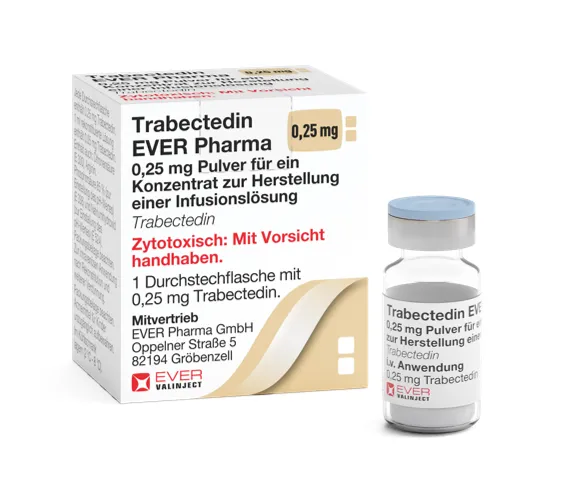
Table of Contents
Package leaflet: Information for the patient
Trabectedin EVER PHARMA, 0.25 mg, powder for solution for concentrate for infusion
Trabectedin EVER PHARMA, 1 mg, powder for solution for concentrate for infusion
Trabectedinum
Please read this leaflet carefully before using this medicine because it contains important information for you.
- Keep this leaflet as you may need to read it again.
- If you have any further questions, please consult your doctor.
- If you experience any adverse reactions, including any not listed in this leaflet, inform your doctor. See section 4.
Leaflet contents
- What Trabectedin is and what it is used for
- Important information before using Trabectedin
- How to use Trabectedin
- Possible side effects
- How to store Trabectedin
- Contents of the pack and other information
1. What Trabectedin is and what it is used for
Trabectedin contains the active substance trabectedin. Trabectedin is an antineoplastic medicine that works by preventing the growth of tumour cells.
Trabectedin is used to treat patients with advanced soft tissue sarcoma when previous treatments have failed or are not suitable. Soft tissue sarcoma is a malignant disease that starts in soft tissues such as muscle, fat, or other tissues (e.g. cartilage or blood vessels).
Trabectedin in combination with pegylated liposomal doxorubicin (PLD – another antineoplastic medicine) is used to treat patients with relapsed ovarian cancer after at least one prior completed therapy and which is platinum-sensitive.
2. Important information before using Trabectedin
When not to use Trabectedin
- if the patient is allergic to trabectedin or any of the other ingredients of this medicine (listed in section 6)
- if the patient has a severe infection
- if the patient is breastfeeding
- if the patient is scheduled to receive the yellow fever vaccine.
Warnings and precautions
Before starting treatment with Trabectedin, discuss this with your doctor.
Trabectedin, either alone or in combination with PLD, must not be used in patients
with severe liver, kidney or heart impairment.
Before starting treatment with Trabectedin, inform your doctor about any existing or suspected:
- Liver or kidney function disorders.
- Current or past heart function disorders.
- Left ventricular ejection fraction (LVEF) below the lower limit of normal.
- Prior treatment with high-dose anthracyclines.
Seek immediate medical advice if any of the following conditions occur:
- If the patient develops fever, as Trabectedin may cause adverse effects affecting blood composition or liver function.
- If the patient experiences nausea, vomiting or inability to take fluids, resulting in reduced urine output despite antiemetic treatment.
- If the patient develops severe muscle pain or weakness, which may be symptoms of muscle damage (rhabdomyolysis; see section 4).
- If Trabectedin solution leaks outside the vein during infusion. Extravasation may lead to tissue damage and cell death at the injection site (tissue necrosis, see also section 4) and may require surgical intervention.
- If the patient experiences an allergic (hypersensitivity) reaction. In such case, the patient may develop one or more of the following symptoms: fever, breathing difficulties, skin redness or flushing, rash, nausea or vomiting (see section 4).
- If the patient develops unexplained localized or generalized swelling, possibly accompanied by a feeling of emptiness in the head, dizziness or thirst (low blood pressure). This may indicate capillary leak syndrome, which may cause excessive fluid accumulation in tissues and requires immediate medical evaluation by a physician.
Children and adolescents
Trabectedin should not be used in children under 18 years of age
with diagnosed sarcoma.
Trabectedin and other medicines
Inform your doctor about all medicines currently or recently taken by the patient,
as well as any medicines the patient plans to take.
Trabectedin must not be used if the patient is receiving the yellow fever vaccine, and
the use of Trabectedin is not recommended if the patient is to receive a vaccine containing live viruses.
The effect of medicines containing phenytoin (an antiepileptic) may be reduced when Trabectedin is used concomitantly, and therefore such combination is not recommended.
If the patient is taking any of the following medicines during Trabectedin treatment,
close monitoring may be necessary, as the effect of Trabectedin may be:
- reduced [e.g. medicines containing rifampicin (used in bacterial infections), phenobarbital (antiepileptic) or St John's wort (Hypericum perforatum, herbal medicine used in depression treatment)] or
- increased [e.g. medicines containing ketoconazole or fluconazole (fungal infection treatment), ritonavir (HIV infection treatment), clarithromycin (bacterial infection treatment), aprepitant (prevents nausea and vomiting), cyclosporine (suppresses immune system function), or verapamil (used in hypertension and heart diseases)].
Whenever possible, concomitant administration of Trabectedin with any of these medicines should be avoided.
If the patient receives Trabectedin alone or in combination with PLD, together with a medicine that may damage the liver or muscles (rhabdomyolysis), close monitoring may be required due to increased risk of liver or muscle damage.
Medicines containing statins (lower cholesterol levels and prevent cardiovascular disease) are examples of medicines that may cause muscle damage.
Use of Trabectedin with alcohol
Alcohol must not be consumed during treatment with Trabectedin due to the risk of liver damage.
Pregnancy, breastfeeding and effects on fertility
Pregnancy
Trabectedin must not be used during pregnancy. If the patient is pregnant, suspects she may be pregnant, or is planning to become pregnant, she should consult her doctor before using this medicine.
Women of childbearing potential must use an effective method of contraception during and for 3 months after the treatment period with Trabectedin.
If pregnancy occurs, the doctor must be informed immediately and genetic counselling is recommended, as Trabectedin may cause genetic changes.
Breastfeeding
Trabectedin must not be administered to women who are breastfeeding. Therefore, breastfeeding must be discontinued before starting treatment and must not be resumed until the physician considers it safe.
Effect on fertility
Men of reproductive potential must use an effective method of contraception during and for 5 months after the treatment period with Trabectedin.
Patients should seek advice regarding preservation of oocytes or sperm before starting treatment due to the risk of irreversible infertility caused by Trabectedin.
Genetic counselling is also recommended for patients planning to have children after completion of treatment.
Driving and operating machinery
During treatment with Trabectedin, the patient may feel tired and weak.
If such symptoms occur, the patient must not drive or operate machinery.
Trabectedin contains sodium
The medicine contains less than 1 mmol (23 mg) of sodium per vial, meaning the medicine is considered "sodium-free".
3. How to use Trabectedin
Trabectedin is administered exclusively under the supervision of a physician experienced in the use of chemotherapy. Administration of the drug should be restricted to qualified oncologists or other healthcare professionals specialized in administering cytotoxic drugs.
The typical dose for soft tissue sarcoma is 1.5 mg/m² of body surface area. During treatment, the patient will be closely monitored and the physician will determine the dose most appropriate for the individual patient. The recommended dose for Japanese patients is lower than the standard dose for patients of all other races and is 1.2 mg/m².
For ovarian cancer, the typical dose is 1.1 mg/m², administered after prior treatment with PLD at a dose of 30 mg/m².
Trabectedin is dissolved and diluted before intravenous administration. Each administration of Trabectedin for soft tissue sarcoma takes approximately 24 hours, allowing the complete infusion to be delivered to the patient. In the treatment of ovarian cancer, the infusion takes 3 hours.
To avoid irritation at the infusion site, Trabectedin should be administered through a central venous catheter.
Before administration and, if necessary, during infusion of Trabectedin, the patient will receive medication to protect the liver and reduce the risk of adverse effects such as nausea and vomiting.
Infusions are given every 3 weeks; however, delaying doses may sometimes be recommended to ensure the administered Trabectedin dose is optimal.
The total duration of treatment depends on the patient's progress and overall condition. The physician will inform the patient about the expected treatment period. If you have any further questions regarding the use of this medicine, consult your doctor.
4. Possible adverse reactions
Like any medicine, this medicine, administered alone or in combination with PLD, may cause adverse reactions, although not everyone will experience them.
If the patient has any doubts regarding the adverse reactions listed below, they should consult a doctor for a detailed explanation.
Severe adverse reactions caused by Trabectedin administration
Very common: may affect more than 1 in 10 people
- The patient may experience an increase in blood levels of the yellow pigment bilirubin, which may lead to jaundice (yellowing of the skin, mucous membranes, and eyes).
- The doctor will recommend regular blood tests to detect any abnormalities in the blood.
Common: may affect no more than 1 in 10 people
- If the patient has significant immune system suppression, blood infection (sepsis) may occur. If the patient develops fever, they should immediately consult a doctor.
- The patient may also experience muscle pain. In addition, muscle damage may occur, causing muscle pain, weakness, and numbness. Generalized swelling or swelling of the limbs and a tingling sensation on the skin may occur.
- Reactions at the injection site may occur. The Trabectedin solution may leak outside the vein during infusion, leading to tissue damage and cell death at the injection site (tissue necrosis; see also section 2 "Warnings and precautions"), and surgical intervention may be necessary.
- The patient may experience an allergic reaction. In such a case, fever, breathing difficulties, skin redness or flushing, rash, nausea, or vomiting may occur.
- If Trabectedin is used in combination with pegylated liposomal doxorubicin (PLD), the patient may experience fainting. In addition, the patient may feel too strong or too rapid heartbeat (palpitations), impaired function of the main blood-pumping heart chambers (left ventricular dysfunction), or sudden blockage of the pulmonary artery (pulmonary embolism).
Uncommon: may affect no more than 1 in 100 people
- The patient may experience severe muscle pain, stiffness, and muscle weakness. Darker urine may occur. All of the above symptoms may indicate muscle damage (rhabdomyolysis).
- In certain situations, the doctor may order blood tests to prevent muscle damage (rhabdomyolysis). In very severe cases, this may lead to kidney failure. If the patient experiences severe muscle pain or muscle weakness, they should immediately consult a doctor.
- The patient may experience breathing difficulties, heart rhythm disturbances, reduced urine output, sudden change in mental status, patchy skin areas, extremely low blood pressure accompanied by abnormal laboratory results (decreased platelet count). If any of the above symptoms or signs occur, the patient should immediately consult a doctor.
- The patient may develop abnormal fluid accumulation in the lungs, leading to swelling (pulmonary edema).
- The patient may notice localized or generalized swelling of unknown cause, possibly accompanied by a feeling of emptiness in the head, dizziness, or thirst (low blood pressure). This may be a sign of capillary leak syndrome, resulting in excessive fluid accumulation in tissues. If any of the above symptoms occur, the patient should immediately consult a doctor.
- During Trabectedin infusion, the patient may notice leakage of the drug from the vein (extravasation). The patient will then notice redness, swelling, itching, and discomfort at the injection site. If any of these symptoms occur, the patient should immediately inform the nurse or doctor.
This may cause tissue damage or cell death around the injection site (tissue necrosis), which may require surgical intervention.
Some extravasation symptoms may only become visible several hours after occurrence. Blisters, skin peeling, and darkening may appear at the site.
The full extent of tissue damage may not be apparent until several days later.
If any of the previously described symptoms occur, the patient should immediately consult a doctor.
Rare: may affect no more than 1 in 1000 people
- The patient may develop yellowing of the skin and whites of the eyes (jaundice), pain in the upper right abdomen, nausea, vomiting, general malaise, difficulty concentrating, disorientation or confusion, and drowsiness. These symptoms may indicate impaired liver function. If any of the above symptoms occur, the patient should immediately consult a doctor.
Other, less serious adverse reactions
Very common: may affect more than 1 in 10 people
- The patient may experience:
- fatigue
- difficulty breathing or coughing
- back pain
- sensation of excess fluid in the body (swelling)
- increased tendency to bruise
- nosebleeds
- increased susceptibility to infections; infection may also cause elevated body temperature (fever). If the patient experiences any of these symptoms, they should immediately consult a doctor.
- In addition, gastrointestinal symptoms such as loss of appetite, nausea or vomiting, abdominal pain, diarrhea, or constipation may occur. If the patient experiences nausea, vomiting, or inability to take fluids, resulting in reduced urine output, despite antiemetic treatment, they should immediately consult a doctor for assistance.
- The patient may experience headache.
- Mucositis may occur, manifesting as swollen redness in the mouth, progressing to painful ulcers and sores (oral mucositis), or as gastrointestinal tract inflammation when Trabectedin EVER PHARMA is used in combination with PLD.
- Female patients receiving Trabectedin in combination with PLD for ovarian cancer treatment may develop palmar-plantar erythrodysesthesia, characterized by redness of the palms, fingers, and soles of the feet, which may subsequently progress to swelling and cyanosis.
Affected areas may become dry and flaky, or blisters and ulceration may develop.
Common: may affect no more than 1 in 10 people
- Dehydration, weight loss, digestive disturbances, and changes in taste perception may occur.
- Hair loss (alopecia) may occur.
- The patient may experience dizziness, low blood pressure, sudden facial flushing, or skin rash.
- Female patients receiving Trabectedin in combination with PLD for ovarian cancer treatment may develop excessive skin pigmentation.
- The patient may experience joint pain.
- The patient may experience sleep disturbances.
Reporting of adverse reactions
If any adverse reactions occur, including any not listed in this leaflet, the patient should inform their doctor. Adverse reactions can be reported directly to the Department of Monitoring of Adverse Drug Reactions, Office for Registration of Medicinal Products, Medical Devices and Biocidal Products, Al. Jerozolimskie 181 C, 02-222 Warsaw, tel.: +48 22 49 21 301, fax: +48 22 49 21 309, website: https://smz.ezdrowie.gov.pl
Adverse reactions can also be reported to the marketing authorization holder.
Reporting adverse reactions helps to gather more information on the safety of the medicine.
5. How to store Trabectedin
Keep this medicine out of the sight and reach of children.
Do not use this medicine after the expiry date stated on the outer carton and vial label after "Expiry date (EXP)". The expiry date refers to the last day of the specified month.
Store in a refrigerator (2ºC – 8ºC).
Information on the stability of the solution after reconstitution and dilution is provided in the section intended for healthcare professionals.
Do not use this medicine if particulate matter is observed after reconstitution or dilution of the medicine.
Any unused medicine or waste material must be disposed of in accordance with local regulations regarding cytotoxic drugs.
6. Contents of the pack and other information
What Trabectedin contains
- The active substance is trabectedin. Trabectedin 0,25 mg: One vial of powder contains 0.25 mg of trabectedin. Trabectedin 1 mg: One vial of powder contains 1 mg of trabectedin.
- The other ingredients are: citric acid, arginine, phosphoric acid (concentrated, for pH adjustment) and sodium hydroxide (for pH adjustment).
What Trabectedin looks like and contents of the pack
Trabectedin is a powder for concentrate for infusion solution. The powder is white or off-white and is contained in a glass vial.
The glass vial containing 0.25 mg of trabectedin is closed with a rubber stopper and a light blue aluminium flip-off cap.
The glass vial containing 1 mg of trabectedin is closed with a rubber stopper and a pink aluminium flip-off cap.
Each cardboard box contains 1 vial containing 0.25 mg or 1 mg of trabectedin.
Vials may, but do not necessarily, be protected with a protective cap.
Marketing Authorisation Holder
EVER Valinject GmbH
Oberburgau 3
4866 Unterach am Attersee
Austria
Manufacturer
EVER Pharma Jena GmbH
Otto-Schott-Straße 15
07745 Jena
Germany
EVER Pharma Jena GmbH
Brüsseler Straße 18
07747 Jena
Germany
For further information about this medicinal product, please contact the local representative of the Marketing Authorisation Holder:
EVER Pharma Poland Sp. z o.o.
e-mail: [email protected]
This medicinal product is authorised in the European Economic Area countries under the following names:
Austria Trabectedin EVER Pharma 0.25 mg Powder for a concentrate for solution for infusion
Trabectedin EVER Pharma 1 mg Powder for a concentrate for solution for infusion
Belgium Trabectedin EVER Pharma 0.25 mg powder for concentrate for solution for infusion
Trabectedin EVER Pharma 0.25 mg powder for solution for dilution for infusion
Trabectedin EVER Pharma 0.25 mg powder for a concentrate for solution for infusion
Trabectedin EVER Pharma 1 mg powder for concentrate for solution for infusion
Trabectedin EVER Pharma 1 mg powder for solution for dilution for infusion
Trabectedin EVER Pharma 1 mg powder for a concentrate for solution for infusion
Croatia Trabectedin EVER Pharma 0.25 mg powder for concentrate for infusion solution
Trabectedin EVER Pharma 1 mg powder for concentrate for infusion solution
Finland Trabectedin EVER Pharma 0.25 mg dry substance for intermediate concentrate for infusion solution
Trabectedin EVER Pharma 1 mg dry substance for intermediate concentrate for infusion solution
France Trabectedine EVER Pharma 0.25 mg powder for solution for dilution for infusion
Trabectedine EVER Pharma 1 mg powder for solution for dilution for infusion
Spain Trabectedina EVER Pharma 0.25 mg powder for concentrate for perfusion solution
Trabectedina EVER Pharma 1 mg powder for concentrate for perfusion solution
Netherlands Trabectedine EVER Pharma 0.25 mg powder for concentrate for solution for infusion
Trabectedine EVER Pharma 1 mg powder for concentrate for solution for infusion
Germany Trabectedin EVER Pharma 0.25 mg Powder for a concentrate for solution for infusion
Trabectedin EVER Pharma 1 mg Powder for a concentrate for solution for infusion
Norway Trabectedin EVER Pharma
Trabectedin EVER Pharma
Poland Trabectedin EVER PHARMA
Trabectedin EVER PHARMA
Portugal Trabectedin EVER Pharma 0.25 mg powder for concentrate for perfusion solution
Trabectedin EVER Pharma 1 mg powder for concentrate for perfusion solution
Czech Republic Trabectedin EVER Pharma
Romania Trabectedin EVER Pharma 0.25 mg powder for concentrate for perfusable solution
Trabectedin EVER Pharma 1 mg powder for concentrate for perfusable solution
Slovakia Trabectedin EVER Pharma 0.25 mg powder for concentrate for infusion solution
Trabectedin EVER Pharma 1 mg powder for concentrate for infusion solution
Slovenia Trabektedin EVER Pharma 0.25 mg powder for concentrate for infusion solution
Trabektedin EVER Pharma 1 mg powder for concentrate for infusion solution
Sweden Trabectedin EVER Pharma 0.25 mg powder for concentrate for infusion solution, solution
Trabectedin EVER Pharma 1 mg powder for concentrate for infusion solution, solution
Italy Trabectedina EVER Pharma
Hungary Trabectedin EVER Pharma 0.25 mg powder for concentrate for aqueous infusion
Trabectedin EVER Pharma 1 mg powder for concentrate for aqueous infusion
Information intended exclusively for healthcare professionals:
Instructions for use – preparation of the medicinal product for administration, handling and disposal of waste
Appropriate procedures for safe handling and disposal of cytotoxic medicinal products must be observed. Any unused medicinal product or waste material must be disposed of in accordance with local regulations for cytotoxic medicinal products.
Personnel should be trained in the correct techniques for reconstitution and dilution of Trabectedin, either alone or in combination with PLD, and should wear protective clothing including mask, goggles and gloves. In case of accidental contact with skin, eyes or mucous membranes, the affected area should be immediately rinsed thoroughly with water. Pregnant women must not handle this medicinal product.
Preparation of intravenous infusion
Trabectedin must be reconstituted and then diluted prior to administration (see also section 3). Aseptic technique must be used.
Trabectedin must not be administered mixed with other medicinal products in the same infusion set, except for the diluent. No incompatibilities have been observed between Trabectedin and Type I glass bottles, polyvinyl chloride (PVC) and polyethylene (PE) bags and tubing, polyisoprene containers or titanium implantable venous access systems.
If Trabectedin is administered in combination with PLD, the intravenous line must be thoroughly flushed with 50 mg/ml (5%) glucose solution for infusion after administration of PLD and before administration of Trabectedin. A glucose concentration for infusion other than 50 mg/ml (5%) may cause precipitation of PLD. (Detailed preparation instructions are provided in the Product Characteristics of PLD.)
Reconstitution instructions
Trabectedin 0.25 mg: Inject 5 ml of sterile water for injections into the vial.
Trabectedin 1 mg: Inject 20 ml of sterile water for injections into the vial.
Use a syringe to inject the appropriate volume of sterile water for injections into the vial. Shake the vial until complete dissolution. The solution after reconstitution is a clear, colourless or slightly yellow solution, free from visible particles. This reconstituted solution contains 0.05 mg/ml of trabectedin. It requires further dilution and is intended for single use only.
Dilution instructions
The reconstituted solution must be diluted with 9 mg/ml (0.9%) sodium chloride solution for infusion or 50 mg/ml (5%) glucose solution for infusion. The required volume should be calculated as follows:
Volume (ml) = body surface area (m²) × individual dose (mg/m²)
0.05 mg/ml
Withdraw the appropriate volume of reconstituted solution from the vial. If the drug is administered intravenously via a central venous catheter, the reconstituted solution should be added to an infusion bag containing ≥ 50 ml of diluent (9 mg/ml (0.9%) sodium chloride solution for infusion or 50 mg/ml (5%) glucose solution for infusion), resulting in a trabectedin concentration in the infusion solution ≤ 0.030 mg/ml.
If central venous access is not available and peripheral veins are to be used, the reconstituted solution should be added to an infusion bag containing ≥ 1,000 ml of diluent (9 mg/ml (0.9%) sodium chloride solution for infusion or 50 mg/ml (5%) glucose solution for infusion).
Parenteral solutions should be visually inspected for particulate matter prior to intravenous administration. The infusion should be administered immediately after preparation.
Stability of the reconstituted solution
Reconstituted solution
After reconstitution, the medicinal product has been shown to be chemically and physically stable for 30 hours at temperatures up to 25°C.
From a microbiological standpoint, the reconstituted solution should be diluted and used immediately. If the product is not diluted and used immediately, the user is responsible for the storage time and conditions, which should generally not exceed 24 hours at 2°C to 8°C, unless reconstitution was carried out under controlled and validated aseptic conditions.
Diluted solution
After dilution, chemical and physical stability has been demonstrated for 30 hours at temperatures up to 25°C.