Titlodine
Poland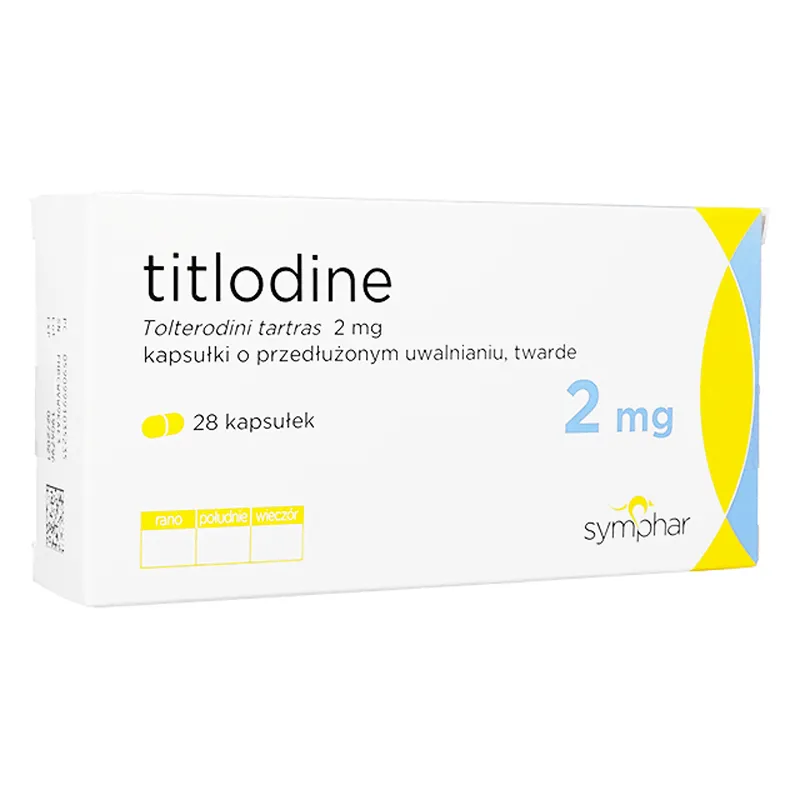
Table of Contents
Patient Information Leaflet
Titlodine, 2 mg, prolonged-release capsules, hard
Titlodine, 4 mg, prolonged-release capsules, hard
Tolterodini tartras
Please read all of this leaflet carefully before taking this medicine, as it contains important information for you.
- Keep this leaflet, as you may need to read it again.
- If you have any further questions, please ask your doctor or pharmacist.
- This medicine has been prescribed for a specific individual. Do not pass it on to others. It may harm other people, even if their symptoms are the same.
- If you experience any side effects, including any not listed in this leaflet, tell your doctor or pharmacist. See section 4.
Contents of the leaflet:
- What Titlodine is and what it is used for
- What you need to know before taking Titlodine
- How to take Titlodine
- Possible side effects
- How to store Titlodine
- Contents of the pack and other information
1. What Titlodine is and what it is used for
The active substance in Titlodine is tolterodine. Tolterodine belongs to a group of medicines called antimuscarinic agents.
Titlodine is used to treat the symptoms of overactive bladder syndrome. In patients with overactive bladder syndrome, the following symptoms may occur:
- Inability to control urination;
- Sudden, strong need to rush to the toilet immediately, or frequent need to urinate.
2. Information before taking Titlodine
When not to take Titlodine:
- if the patient is allergic to tolterodine or any of the other ingredients of this medicine (listed in section 6);
- if the patient is unable to pass urine (urinary retention);
- if the patient has uncontrolled narrow-angle glaucoma (high pressure in the eye with risk of vision loss, which has not been adequately treated);
- if the patient has myasthenia gravis (severe muscle weakness);
- if the patient has acute ulcerative colitis (ulceration and inflammation of the colon);
- if the patient has toxic megacolon (acute dilation of the colon).
Warnings and precautions
Exercise caution:
-
if the patient has difficulty passing urine and/or passes urine in a weak stream;
-
if the patient has gastrointestinal disorders affecting food passage and/or digestion;
-
if the patient has kidney problems (renal failure);
-
if the patient has liver disorders;
-
if the patient has neurological disorders affecting blood pressure, intestines, or sexual function (any autonomic neuropathy);
-
if the patient has hiatal hernia (protrusion of an abdominal organ through the diaphragm);
-
if the patient has reduced intestinal motility or severe constipation (decreased gastrointestinal motility);
-
if the patient has any of the following heart conditions:
-
abnormal heart rhythm (EKG changes);
-
slow heart rate (bradycardia);
-
significant, previously diagnosed heart diseases such as: cardiomyopathy (weakened heart muscle), myocardial ischemia (reduced blood flow to the heart), arrhythmia (irregular heartbeat), heart failure;
-
if the patient has abnormally low levels of potassium (hypokalemia), calcium (hypocalcemia), or magnesium (hypomagnesemia) in the blood.
Before starting treatment with Titlodine, discuss with a doctor or pharmacist if any of the above conditions may apply to the patient.
Titlodine with other medicines
Inform the doctor about all medicines currently taken or recently used, including those the patient plans to take.
Tolterodine – the active substance in Titlodine – may interact with other medicines.
Concomitant use of Titlodine is not recommended with:
- certain antibiotics (containing, for example, erythromycin, clarithromycin);
- medicines used to treat fungal infections (containing, for example, ketoconazole, itraconazole);
- medicines used in the treatment of HIV.
Exercise caution when using Titlodine together with:
- medicines affecting gastrointestinal motility (containing, for example, metoclopramide or cisapride);
- medicines used to treat irregular heartbeat (containing, for example, amiodarone, sotalol, quinidine, procainamide);
- other medicines with similar effects to Titlodine (antimuscarinic properties) or those with opposing effects (cholinergic properties). If in doubt, consult a doctor.
Titlodine with food and drink
Titlodine may be taken before, after, or during meals.
Pregnancy and breastfeeding
If the patient is pregnant or breastfeeding, suspects she may be pregnant, or is planning to have a child, she should consult a doctor or pharmacist before using this medicine.
Pregnancy
Titlodine should not be used during pregnancy.
Breastfeeding
It is unknown whether tolterodine, the active substance in Titlodine, is excreted in breast milk. The use of Titlodine is not recommended during breastfeeding.
Driving and operating machinery
Titlodine may cause dizziness, fatigue, or affect vision or the patient's ability to drive or operate machinery.
Titlodine contains lactose monohydrate
If the patient has previously been diagnosed with intolerance to certain sugars, he or she should consult a doctor before taking this medicine.
Titlodine contains sodium
The medicine contains less than 1 mmol (23 mg) of sodium per extended-release hard capsule, meaning the medicine is considered "sodium-free".
3. How to take Titlodine
Dosage
This medicine should always be taken according to the doctor's instructions. If in doubt, consult
your doctor or pharmacist.
Extended-release hard capsules are intended for oral use
and must be swallowed whole.
Do not chew the capsules.
Adults
The recommended dose is one 4 mg extended-release hard capsule once daily.
Patients with liver or kidney disease or concerning adverse effects
Your doctor may reduce the dose of Titlodine to 2 mg once daily.
Use in children
Use of Titlodine is not recommended in children.
Taking more Titlodine than prescribed
If too many extended-release capsules are taken, contact your doctor or pharmacist immediately.
Symptoms of overdose include: hallucinations, severe agitation, rapid heartbeat, dilated pupils,
difficulty urinating and breathing.
Missing a dose of Titlodine
If a dose is missed, take it as soon as possible, unless it is almost time for the next dose. In that case,
skip the missed dose and continue with the regular dosing schedule. Do not take a double dose
to make up for a missed dose.
Stopping Titlodine treatment
Your doctor should inform you how long treatment with Titlodine should last. Do not stop treatment
early due to lack of immediate effect. Time is needed for the bladder to adapt. Continue taking
the extended-release capsules as directed by your doctor. Contact your doctor if no effect has been
observed by that time.
Treatment outcomes should be evaluated after 2–3 months. Always consult your doctor if you are
considering stopping treatment.
If you have any further questions about the use of this medicine, consult your doctor or pharmacist.
4. Possible adverse effects
Like all medicines, this medicine can cause adverse effects, although not everyone will experience them.
Seek medical attention or go to the emergency room if symptoms of angioedema occur, such as:
- swelling of the face, tongue or throat;
- difficulty swallowing;
- hives and breathing difficulties.
Contact a doctor if symptoms of hypersensitivity reactions occur (e.g. rash, itching, hives, breathing difficulties). These reactions occur uncommonly (in less than 1 in 100 patients).
Seek medical attention or go to the emergency room if any of the following occur:
- chest pain, shortness of breath, easy fatigue (even at rest), difficulty breathing while lying down, swelling of the legs. These may be symptoms of heart failure. This occurs uncommonly (in less than 1 in 100 patients).
During treatment with tolterodine, the following adverse effects have been observed with the frequency specified below:
Very common adverse effects (occur in more than 1 in 10 patients):
- dry mouth.
Common adverse effects (occur in less than 1 in 10 patients):
- sinusitis;
- drowsiness;
- dry eyes;
- indigestion (dyspepsia);
- abdominal pain;
- painful or difficult urination;
- fluid retention causing swelling (e.g. in the ankles);
- dizziness;
- headache;
- blurred vision;
- constipation;
- excessive gas in the stomach or intestines;
- diarrhoea;
- fatigue.
Uncommon adverse effects (occur in less than 1 in 100 patients):
- hypersensitivity (allergic) reactions;
- nervousness;
- palpitations;
- inability to empty the bladder;
- sensation of spinning;
- heart failure;
- irregular heartbeat;
- chest pain;
- tingling sensation in hands and feet;
- memory impairment.
Additional reported reactions include severe allergic reactions, confusion, hallucinations, rapid heartbeat, skin redness, heartburn, vomiting, angioedema, dry skin and disorientation. Worsening of dementia symptoms has also been reported in patients being treated for this condition.
Reporting of adverse effects
If any adverse effects occur, including those not listed in this leaflet, inform your doctor or pharmacist. Adverse effects can be reported directly to the Department for Monitoring of Adverse Drug Reactions at the Office for Registration of Medicinal Products, Medical Devices and Biocidal Products, Al. Jerozolimskie 181C, 02-222 Warsaw, Tel.: +48 22 49 21 301, Fax: +48 22 49 21 309, website: https://smz.ezdrowie.gov.pl.
Adverse effects can also be reported to the marketing authorization holder.
Reporting adverse effects helps provide more information on the safety of this medicine.
5. How to store Titlodine
Keep this medicine out of the sight and reach of children.
Do not use this medicine after the expiry date stated on the outer packaging,
blister, and bottle following: EXP. The expiry date refers to the last day of the stated month.
Do not store above 25°C.
HDPE bottle: the shelf life after first opening is 200 days.
Medicines must not be disposed of via wastewater or household waste. Ask your
pharmacist how to dispose of medicines no longer required. Proper disposal helps protect
the environment.
6. Contents of the pack and other information
What Titlodine contains
The active substance in Titlodine 2 mg, prolonged-release capsules, hard, is 2 mg of tolterodine tartrate, equivalent to 1.37 mg of tolterodine.
The active substance in Titlodine 4 mg, prolonged-release capsules, hard, is 4 mg of tolterodine tartrate, equivalent to 2.74 mg of tolterodine.
The other ingredients are:
monohydrate lactose, microcrystalline cellulose, polyvinyl acetate, povidone, anhydrous colloidal silica, sodium lauryl sulfate, sodium docucinate, magnesium stearate, hydroxypropylmethylcellulose.
Capsule shell composition: indigo carmine (E132), quinoline yellow (only in 2 mg capsules) (E104), titanium dioxide (E171), gelatin.
Inner tablet coating composition: ethylcellulose, triethyl citrate, copolymer of methacrylic acid and ethyl acrylate, propylene glycol.
What Titlodine looks like and contents of the pack
Titlodine is available as hard, prolonged-release capsules for once-daily administration.
Titlodine 2 mg, prolonged-release capsules, hard, are opaque green – opaque green hard gelatin capsules (size 1) containing two white, round, biconvex film-coated tablets.
Titlodine 4 mg, prolonged-release capsules, hard, are light blue – opaque light blue – light blue – opaque hard gelatin capsules (size 1) containing four white, round, biconvex film-coated tablets.
Titlodine 2 mg, prolonged-release capsules, hard, is available in the following pack sizes:
Blister packs containing: 14, 28, 30, 50, 84, 100 prolonged-release, hard capsules.
HDPE bottle containing: 30, 100 and 200 prolonged-release, hard capsules.
Titlodine 4 mg, prolonged-release capsules, hard, is available in the following pack sizes:
Blister packs containing: 7, 14, 28, 49, 84, 98 prolonged-release, hard capsules.
HDPE bottle containing: 30, 100 and 200 prolonged-release, hard capsules.
Not all pack sizes may be marketed.
Marketing Authorisation Holder and Manufacturer:
Marketing Authorisation Holder
Farmak International Sp. z o.o.
ul. Koszykowa 65
00-667 Warsaw, Poland
Manufacturer/Importer
Pharmathen S.A.
6, Dervenakion St., 15351 Pallini Attiki, Greece
Pharmathen International S.A.
Sapes Industrial Park
Block 5, 69300 Rodopi, Greece
This medicinal product is authorised in the European Economic Area countries under the following names:
PL: Titlodine