Tersilat
Poland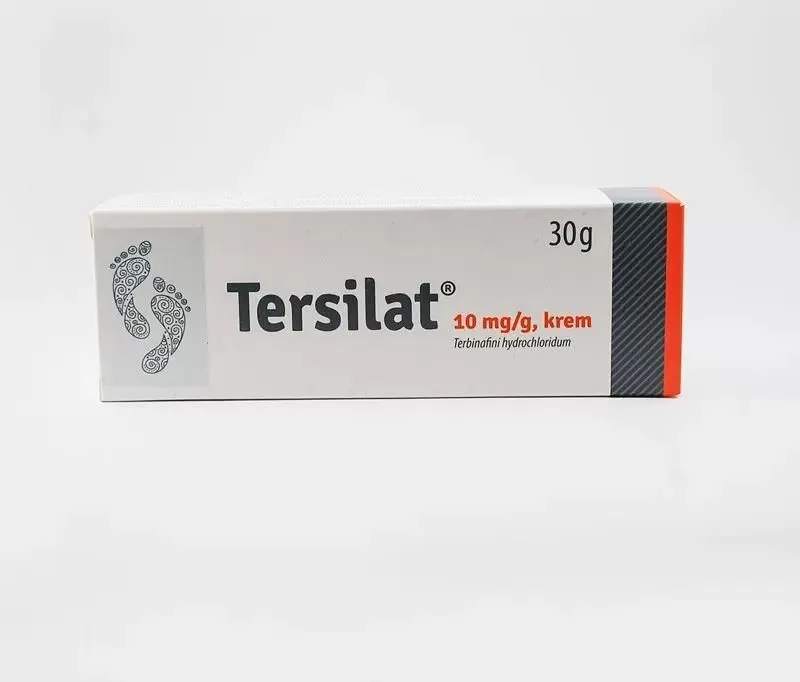
Table of Contents
Package leaflet: Information for the user
Tersilat, 10 mg/g, cream
Terbinafini hydrochloridum
Please read all of this leaflet carefully before using this medicine, because it contains
important information for the patient.
This medicine should always be used exactly as described in this patient leaflet or as directed by
the doctor or pharmacist.
- Keep this leaflet so that you can read it again if necessary.
- If you need advice or further information, please consult your pharmacist.
- If you experience any adverse reactions, including any possible adverse reactions not listed in this leaflet, inform your doctor or pharmacist. See section 4.
- If there is no improvement after 14 days of treatment, or if your condition worsens, consult your doctor.
Table of contents
- What Tersilat is and what it is used for
- Important information before using Tersilat
- How to use Tersilat
- Possible side effects
- How to store Tersilat
- Contents of the pack and other information
1. What Tersilat is and what it is used for
Tersilat is a white cream containing 10 mg/g of the active substance terbinafini hydrochloridum.
Tersilat is used topically to treat fungal or yeast skin infections, such as athlete's foot (tinea pedis).
2. Important information before using Tersilat
When not to use Tersilat
- Do not use Tersilat if the patient is allergic to terbinafine or any of the other ingredients of this medicine (listed in section 6). Hypersensitivity may manifest, for example, as red patches or swelling of the skin and (or) itching.
Warnings and precautions
Before starting to use Tersilat, discuss this with your doctor or pharmacist.
- Tersilat is for external use only.
- Do not apply the medicine inside the mouth or swallow it.
- If application around the face is necessary, avoid contact with the eyes. The medicine may cause eye irritation. If the medicine accidentally gets into the eyes, wipe them and rinse thoroughly with running water.
- Infants must not have access to skin treated with this medicine, including the breast skin.
- Tersilat must be stored out of the sight and reach of children.
Children
Tersilat is not recommended for children under 12 years of age. Data on use in children are limited.
Tersilat and other medicines
There are no data indicating that Tersilat cream has a negative effect on other medicines.
Tell your doctor or pharmacist about all medicines the patient is currently using or has recently used, as well as any medicines the patient plans to use.
Pregnancy and breastfeeding
If the patient is pregnant or breastfeeding, suspects she may be pregnant, or is planning to have a baby, she should consult a doctor or pharmacist before using this medicine.
Pregnancy
Do not use Tersilat cream during pregnancy unless absolutely necessary.
Breastfeeding
Do not use Tersilat during breastfeeding, as terbinafine passes into human milk. Infants must not have access to skin treated with this medicine, including the breast skin.
Driving and operating machinery
This medicine has no effect or has a negligible effect on the ability to drive and operate machinery.
Tersilat contains cetearyl alcohol.
Cetearyl alcohol may cause local skin reactions (e.g. contact dermatitis).
Tersilat contains benzyl alcohol.
This medicine contains 15 mg of benzyl alcohol in 1 g of cream.
Benzyl alcohol may cause mild local irritation. Benzyl alcohol may cause allergic reactions.
Tersilat contains polysorbate 60 (E435).
Polysorbate may cause allergic reactions.
3. How to use Tersilat
Instructions for use
This medicine should always be used exactly as described in this patient leaflet or as directed by your doctor or pharmacist. If in doubt, consult your doctor or pharmacist.
The tube is sealed with an aluminium closure. The seal can be broken by gently pressing with the cap turned upside down.
It is important to use Tersilat correctly. Follow the instructions carefully.
In case of fungal nail infection (fungal infection within or under the nail plate), associated with discolouration and/or structural changes of the nail (thickening, brittleness, fragility), consult your doctor. Tersilat is not effective in treating this type of infection.
For external use only.
- Wash and thoroughly dry the affected skin areas and your hands before application.
- Take a small amount of cream on your fingertip and close the tube.
- Apply a thin layer of cream to the infected skin areas and surrounding regions, and gently rub in.
- After touching the infected area, wash your hands thoroughly to prevent spreading the infection. When applying the medicine to skin folds (under the breasts, between fingers, between buttocks, between thighs), cover these areas with gauze, especially at night. Always use fresh, clean gauze.
Consult your doctor before using Tersilat cream on large areas of skin (larger than 10% of body surface area, corresponding to approximately the area of 10 palms).
Adults and children over 12 years of age:
Duration of treatment and frequency of application
- Athlete's foot (interdigital tinea pedis): Once daily for one week.
- Moccasin-type tinea pedis (sole of the foot): Twice daily for two weeks.
- Dermatophyte infections (fungal skin infections of skin folds, smooth skin): Once daily for one week.
- Fungal skin infections (cutaneous candidiasis): Once or twice daily for 1 to 2 weeks.
- Pityriasis versicolor: Once or twice daily for two weeks.
Infections caused by yeasts (cutaneous candidiasis) may present as fungal or ringworm-like skin lesions and commonly occur in elderly patients or those with obesity—in moist areas within skin folds—or in patients with other conditions such as diabetes. A longer treatment period (2 weeks) may be required for candidiasis.
Continue treatment for the recommended duration, even if symptoms improve within a few days. Symptoms usually improve within a few days, but may recur if the cream is not used regularly or if treatment is stopped too early.
Skin condition should improve within a few days after starting Tersilat cream. However, complete healing of the affected skin after resolution of the disease may take up to four weeks. Tersilat cream will continue to act after treatment is stopped, so skin condition should continue to improve.
If there is no improvement in symptoms within two weeks of starting treatment, consult your doctor or pharmacist for advice.
Supporting treatment
To support treatment, maintain proper hygiene by regularly washing the affected area. Dry the area carefully—gently, without rubbing. Avoid scratching the skin when it itches, as this may cause further skin damage, delay healing, or spread the infection.
Regularly change towels, clothing, and stockings that come into contact with the affected skin area, and wash them at a temperature of at least 60°C. If this is not possible, use a disinfectant solution. Choose natural fabrics such as cotton. This helps prevent spreading the infection to other parts of the body or to other people.
Elderly patients
There are no data indicating the need for dosage adjustment in elderly patients or a different risk of adverse effects compared to younger patients.
Use in children
Due to limited available information on the use of Tersilat cream in children under 12 years of age, its use is not recommended in this age group.
Use of more than the recommended dose of Tersilat
There are no known cases of overdose with Tersilat when used topically.
If you have any doubts about use, contact your doctor or pharmacist.
In case of accidental ingestion of Tersilat cream, for example by a child, adverse effects are expected to be similar to those seen with overdose of terbinafine tablets (such symptoms may include headache, nausea, dizziness, and abdominal pain). In such a case, contact your doctor or go to the hospital emergency department.
In case of accidental contact with eyes, rinse thoroughly with clean, running water.
Missed dose of Tersilat
If you miss a dose, apply it as soon as possible and then continue using the medicine as directed. If you do not remember the missed dose until it is time for the next dose, apply the usual amount and continue treatment as normal. Do not use a double dose to make up for a missed dose.
Use the cream as directed in the leaflet. This is particularly important because repeated missed doses increase the risk of infection recurrence.
Stopping Tersilat treatment prematurely
If Tersilat cream is discontinued before the end of the treatment period, initial symptoms may return.
If you have any further questions about the use of this medicine, consult your doctor or pharmacist.
4. Possible adverse reactions
Like all medicines, this product can cause adverse reactions, although not everyone experiences them.
You should stop using the cream and contact your doctor immediately if any of the following symptoms of an allergic reaction occur:
- persistent itching with red rash or lumps, hives, or blisters,
- difficulty breathing or swelling of the lips, face, mouth, tongue, or throat.
The frequency of these allergic reactions is unknown (cannot be estimated from available data).
The following adverse reactions have also been reported:
Frequent (may affect up to 1 in 10 people): skin peeling, itching.
Uncommon (may affect up to 1 in 100 people): skin changes, crusts, skin disorders, pigment disorders, redness (erythema), burning sensation of the skin, pain, pain at application site, irritation at application site.
Rare (may affect up to 1 in 1,000 people): dry skin, contact dermatitis, rash, exacerbation of fungal infection.
Frequency not known (frequency cannot be estimated from available data): hypersensitivity, rash.
If Tersilat cream comes into contact with the eyes, eye irritation may rarely occur.
Reporting of adverse reactions
If any adverse reactions occur, including those not listed in this leaflet, inform your doctor or pharmacist. Adverse reactions can be reported directly to the Department of Monitoring of Adverse Drug Reactions at the Office for Registration of Medicinal Products, Medical Devices and Biocidal Products:
Al. Jerozolimskie 181C
02-222 Warsaw
Phone: +48 22 49 21 301
Fax: +48 22 49 21 309
Website: https://smz.ezdrowie.gov.pl
Adverse reactions can also be reported to the marketing authorization holder.
Reporting adverse reactions helps provide more information on the safety of this medicine.
5. How to store Tersilat
Keep the medicine out of the sight and reach of children.
Do not use this medicine after the expiry date stated on the tube and carton after "EXP".
The expiry date refers to the last day of the stated month.
No special storage conditions apply.
Medicines must not be disposed of via wastewater or household waste. Ask your pharmacist
how to dispose of medicines no longer in use. Proper disposal helps protect the
environment.
Instructions regarding shelf-life after first opening
Shelf-life after first opening of the tube: 6 months.
6. Contents of the pack and other information
What Tersilat contains
The active substance is terbinafine hydrochloride.
1 g of cream contains 10 mg of terbinafine hydrochloride.
The other ingredients are:
purified water, cetostearyl alcohol, isopropyl myristate, cetyl palmitate, sorbitan
stearate, benzyl alcohol, polysorbate 60, sodium hydroxide.
What Tersilat looks like and contents of the pack
Tersilat is a white cream.
The medicine is available in tubes of 15 g and 30 g.
Marketing Authorisation Holder and Manufacturer
Marketing Authorisation Holder
SUN-FARM Sp. z o.o.
ul. Dolna 21
05-092 Łomianki
Manufacturer
mibe GmbH Arzneimittel
Münchener Straße 15
06796 Brehna
Germany
SUN-FARM Sp. z o.o.
ul. Dolna 21
05-092 Łomianki