Tamsiger
Poland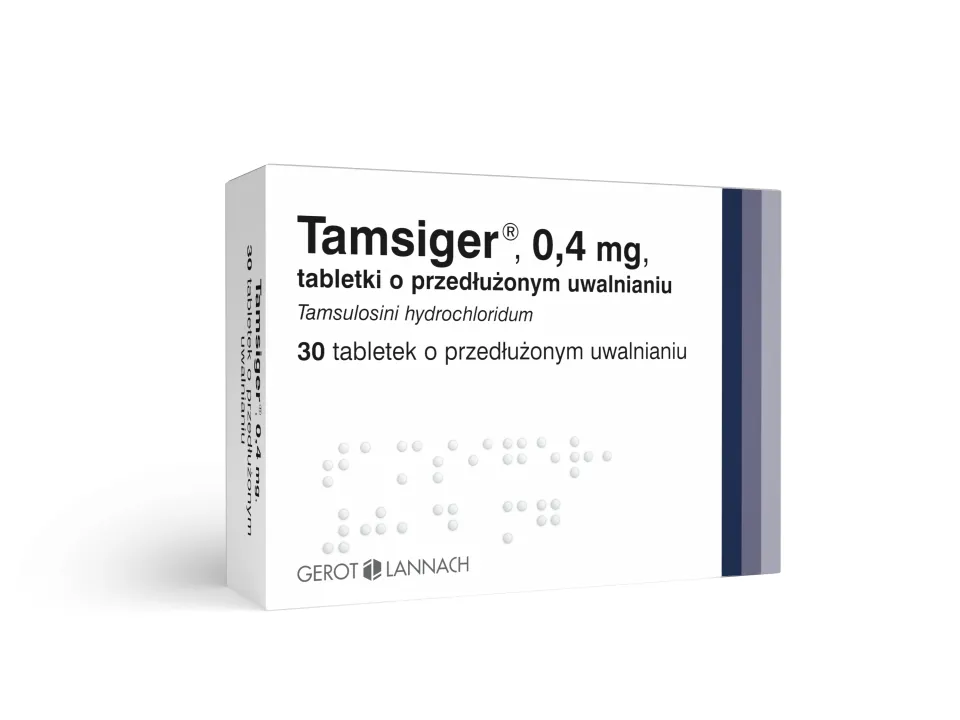
Table of Contents
Package leaflet: Information for the patient
Tamsiger, 0.4 mg, prolonged-release tablets
Tamsulosini hydrochloridum
Please read carefully the entire leaflet before taking this medicine, because it contains
important information for the patient.
- Keep this leaflet, as you may need to read it again.
- If you have any doubts, please consult your doctor or pharmacist.
- This medicine has been prescribed for a specific individual. Do not pass it on to others. The medicine may harm another person, even if their symptoms are identical.
- If you experience any adverse effects, including any not listed in this leaflet, inform your doctor or pharmacist. See section 4.
Contents of the leaflet
- What Tamsiger is and what it is used for
- Important information before taking Tamsiger
- How to take Tamsiger
- Possible side effects
- How to store Tamsiger
- Contents of the pack and other information
1. What Tamsiger is and what it is used for
Tamsulosin reduces the tension of the muscles in the prostate gland and urinary tract, facilitating urine flow and urination. Additionally, the medicine reduces the sensation of urgency to urinate.
Tamsulosin is used in men to alleviate symptoms associated with an enlarged prostate gland (benign prostatic hyperplasia), such as: difficulty in urinating (reduced urine stream), dribbling after urination, sudden urge to urinate, and frequent urination, both during the night and throughout the day.
2. Important information before taking Tamsiger
When not to take Tamsiger
- if you are allergic to tamsulosin or to any of the other ingredients of this medicine (listed in section 6). Hypersensitivity may manifest as sudden localized swelling of soft tissues (e.g. throat or tongue), difficulty breathing and/or itching, and rash (angioedema).
- if you have experienced drops in blood pressure upon changing body position to standing, causing dizziness, sensation of "emptiness in the head", or fainting.
- if you have severe liver function disorders.
Warnings and precautions
Before starting treatment with Tamsiger, discuss the following with your doctor or pharmacist:
- if you experience dizziness or sensation of "emptiness in the head", especially when changing body position to standing. Tamsulosin may lower blood pressure, causing such symptoms. If these occur, you should sit or lie down until the symptoms subside.
- if you have severe kidney function disorders, you should inform your doctor.
- if you are undergoing or are scheduled for eye surgery due to cataract or increased intraocular pressure (glaucoma). During surgery, intraoperative floppy iris syndrome (IFIS) may occur (see section 4, "Possible side effects"). You must inform your ophthalmologist that you are currently taking, have recently taken, or plan to take tamsulosin hydrochloride. The ophthalmologist may take appropriate precautions regarding medications and surgical techniques. If you are preparing for cataract surgery or glaucoma surgery, ask your doctor whether you should postpone or temporarily discontinue the medicine. Regular medical check-ups are necessary to monitor the course of the disease.
You may notice remnants of the tablet in your stool. However, since the active substance has already been released, there is no risk that the tablet will be less effective.
Children and adolescents
Tamsiger must not be used in children and adolescents under 18 years of age, as it has not been shown to be effective in this patient group.
Tamsiger and other medicines
Tamsulosin may affect other medicines, and other medicines may affect the efficacy of tamsulosin. Tamsulosin may interact with:
- diclofenac, a pain-relieving and anti-inflammatory medicine. This medicine may accelerate the elimination of tamsulosin from the body, thereby shortening its duration of action.
- warfarin, a medicine used to prevent blood clots. This medicine may accelerate the elimination of tamsulosin from the body, thereby shortening its duration of action.
- other alpha-adrenergic receptor blockers. Concurrent use with tamsulosin may lower blood pressure, causing dizziness or sensation of "emptiness in the head".
- ketoconazole, a medicine used to treat fungal skin infections. This medicine may enhance the effect of tamsulosin.
You must inform your doctor or pharmacist about all medicines you are currently taking or have recently taken, as well as any medicines you plan to take, including those available without a prescription.
Food, drink and alcohol
Tamsiger may be taken independently of meals.
Pregnancy, breastfeeding and fertility
Tamsulosin is not indicated for use in women.
In men, disorders of ejaculation (ejaculation disorders) have been reported, characterized by semen not being expelled from the body through the urethra but instead flowing backward into the bladder (retrograde ejaculation), or by reduced ejaculate volume or absence of ejaculation (anejaculation). This phenomenon does not pose a health risk to the patient.
Driving and operating machinery
There are no data confirming the effect of tamsulosin on the ability to drive or operate machinery. However, you should remember that Tamsiger may cause dizziness or sensation of "emptiness in the head"; therefore, driving and operating machinery should only be undertaken if you feel well.
3. How to take Tamsiger
This medicine should always be taken according to the doctor's instructions. In case of any doubts,
you should consult your doctor or pharmacist.
The usual dose is one tablet per day. The medicine can be taken with or without food, preferably at the same time each day.
The tablet should be swallowed whole. It is important not to crush or chew the tablets, as this
may affect the efficacy of tamsulosin.
Tamsiger is not intended for use in children.
Taking more than the recommended dose of Tamsiger
If more than the recommended dose of Tamsiger is taken, a sudden drop in blood pressure may occur.
Symptoms may include: dizziness, weakness, vomiting, diarrhoea, and fainting. You should lie down to reduce the effects of low blood pressure and then contact your doctor.
Missing a dose of Tamsiger
If the patient forgets to take the medicine at the scheduled time, they may take it later the same day.
If the patient forgets to take the medicine on a given day, the next dose should be taken the next day at the usual time. Do not take a double dose to make up for a missed dose.
Stopping treatment with Tamsiger
If treatment with Tamsiger is stopped too early, symptoms of the disease may return.
Therefore, the medicine should be taken for as long as your doctor has instructed, even if symptoms have improved.
Always consult your doctor before stopping treatment.
If you have any further doubts regarding the use of this medicine, consult your doctor or pharmacist.
4. Possible adverse reactions
Like all medicines, this medicine can cause adverse reactions, although not everyone experiences them.
Serious adverse reactions are rare. You should seek immediate medical help
if the patient experiences a severe allergic reaction presenting as swelling of the face or
throat (angioedema).
Common adverse reactions (may occur in less than 1 in 10 patients)
- dizziness
- abnormal ejaculation (ejaculation disorder). This means semen does not exit externally through the urethra, but instead enters the bladder (retrograde ejaculation) or is released in reduced amounts or not at all (absence of ejaculation). This phenomenon is harmless.
Uncommon adverse reactions (may occur in less than 1 in 100 patients)
- headache
- palpitations
- low blood pressure upon changing to an upright position, which may cause dizziness, feeling faint, or fainting (orthostatic hypotension)
- nasal congestion or irritation of the nasal mucosa (rhinitis)
- constipation
- diarrhoea
- nausea
- vomiting
- rash
- itching
- urticaria
- feeling of weakness (asthenia)
Rare adverse reactions (may occur in less than 1 in 1,000 patients)
- fainting
Very rare adverse reactions (may occur in less than 1 in 10,000 patients)
- painful penile erection (priapism)
- severe illness characterized by blistering rash on the skin, around the mouth, eyes, and genital organs (Stevens-Johnson syndrome)
Adverse reactions with unknown frequency (frequency cannot be estimated from available data)
- blurred vision
- loss of vision
- nosebleeds
- dry mouth
- severe skin rashes (erythema multiforme, exfoliative dermatitis)
- irregular heartbeat
- arrhythmic heartbeat
- rapid heartbeat
- breathing difficulties
During eye surgery due to cataract or increased intraocular pressure (glaucoma), a condition called intraoperative floppy iris syndrome (IFIS) may occur: during surgery, the pupil may dilate poorly and the iris (the coloured, circular part of the eye) may become floppy. For further information, see section 2 "Warnings and precautions".
Reporting of adverse reactions
If any adverse reactions occur, including any not listed in this leaflet, you should inform your doctor or pharmacist. Adverse reactions can be reported directly to:
Department of Monitoring Adverse Drug Reactions
Office for Registration of Medicinal Products, Medical Devices and Biocidal Products
Al. Jerozolimskie 181 C
02-222 Warsaw
Tel.: +48 22 4921 301
Fax: +48 22 4921 309
Website: https://smz.ezdrowie.gov.pl
Adverse reactions can also be reported to the marketing authorization holder.
Reporting adverse reactions helps provide more information on the safety of this medicine.
5. How to store Tamsiger
Keep the medicine out of sight and reach of children.
Do not use this medicine after the expiry date stated on the packaging after EXP.
The first two digits indicate the month, and the last four digits indicate the year.
The expiry date refers to the last day of the stated month.
Store in the original packaging to protect from light.
Medicines must not be disposed of via wastewater or household waste. Ask your pharmacist how to dispose of medicines no longer in use. This will help protect the environment.
6. Contents of the packaging and other information
What Tamsiger contains
- The active substance is 0.4 mg of tamsulosin hydrochloride (equivalent to 0.367 mg of tamsulosin).
- The other components are:
Tablet core
Microcrystalline cellulose
Hypromellose
Carbomer
Colloidal anhydrous silica
Iron oxide red (E 172)
Magnesium stearate
Coating
Microcrystalline cellulose
Hypromellose
Carbomer
Colloidal anhydrous silica
Magnesium stearate
What Tamsiger looks like and contents of the pack
White, round tablets with "T9SL" embossed on one side and "0.4" on the other side.
The medicine is available in blister packs containing 30 or 90 tablets, packed in a cardboard box.
Not all pack sizes may be marketed.
Marketing Authorisation Holder
G.L. Pharma GmbH
Schlossplatz 1
8502 Lannach
Austria
Manufacturers
G.L. Pharma GmbH
Schlossplatz 1
8502 Lannach
Austria
Synthon Hispania SL
Calle Castelló 1
08830 Sant Boi de Llobregat, Barcelona
Spain
Synthon B.V.
Microweg 22
6545 CM Nijmegen
Netherlands
Genericon Pharma Gesellschaft m.b.H.
Hafnerstrasse 211
8054 Graz
Austria
Industria Química y Farmacéutica VIR, S.A.
Calle Laguna 66-68-70
Poligono Industrial Urtinsa II
28923 Alcorcón, Madrid
Spain
For further information and information on the product names in other countries of the European Economic Area, please contact the representative of the Marketing Authorisation Holder:
G.L. PHARMA POLAND Sp. z o.o.
Al. Jana Pawła II 61/313
01-031 Warsaw, Poland
Tel: 022/ 636 52 23; 636 53 02
[email protected]