Tachyben
Poland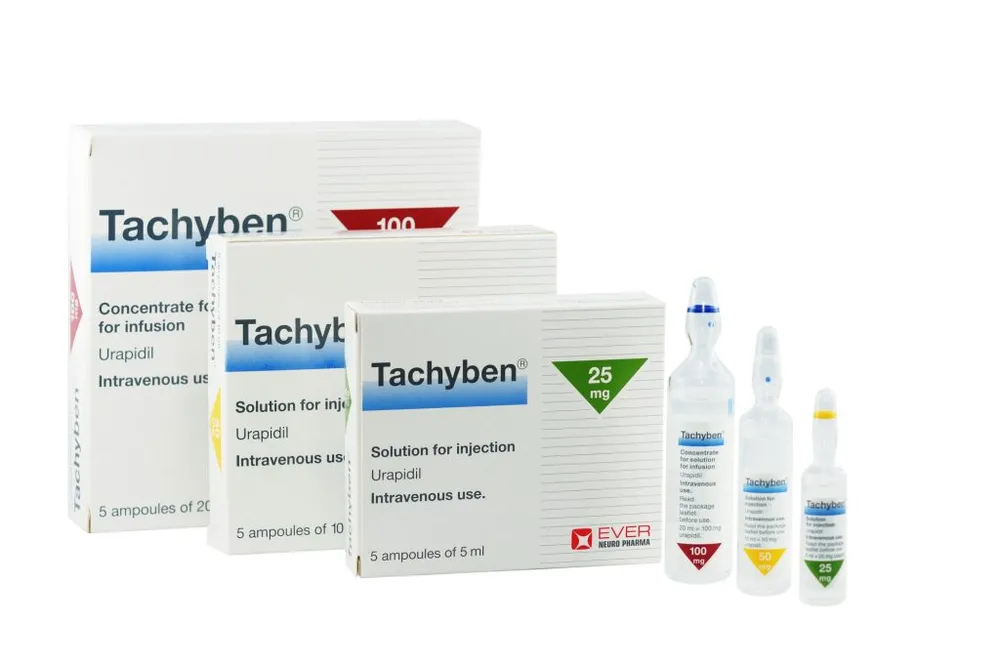
Table of Contents
- Package leaflet: Information for the patient
- 1. What Tachyben is and what it is used for
- 2. Important information before using Tachyben
- 3. How to use Tachyben
- 4. Possible adverse reactions
- 5. How to store Tachyben
- 6. Contents of the pack and other information
- Information intended exclusively for healthcare professionals:
Package leaflet: Information for the patient
Tachyben, 25 mg, injection solution
Tachyben, 50 mg, injection solution
Urapidyl
Please read carefully the entire leaflet before using this medicine, as it contains
important information for the patient.
- Keep this leaflet, as you may need to read it again.
- If you have any further questions, please consult your doctor.
- If you experience any adverse reactions, including any not listed in this leaflet, inform your doctor. See section 4.
Table of contents of the leaflet:
- What Tachyben is and what it is used for
- Important information before using Tachyben
- How to use Tachyben
- Possible side effects
- How to store Tachyben
- Contents of the pack and other information
1. What Tachyben is and what it is used for
Tachyben contains the active substance urapidil.
Tachyben belongs to a group of medicines called alpha-blockers. These medicines act on blood vessels (i.e. arteries and veins). They reduce blood pressure by decreasing the tension in the walls of blood vessels.
Tachyben is used to treat sudden, severe increases in blood pressure:
- in cases of acute hypertensive crisis threatening damage to sensitive organs;
- during and after surgical procedures.
2. Important information before using Tachyben
When not to use Tachyben:
- if the patient is allergic to urapidil or any of the other ingredients of this medicine (listed in section 6);
- if the patient has a heart condition called aortic stenosis or vascular abnormalities known as fistula (except arteriovenous fistula in dialysis patients).
Warnings and precautions
Before starting treatment with Tachyben, the doctor will check:
- whether the patient has had diarrhoea or vomiting (or other conditions causing reduced fluid volume in the body);
- whether there is reduced sodium concentration in the blood.
Tachyben with other medicines
You must tell the doctor about all medicines the patient is currently taking or has recently taken, as well as any medicines the patient plans to take, because they may interact with Tachyben, potentially altering its effectiveness or increasing the risk of adverse effects:
- Medicines belonging to the group of alpha-receptor blockers used to treat urinary problems caused by prostate disease;
- Any medicines that lower blood pressure;
- Baclofen (used to treat muscle spasms);
- Cimetidine (used to inhibit gastric acid production);
- Imipramine and neuroleptic medicines (used to treat depression);
- Corticosteroids (anti-inflammatory medicines, sometimes called steroids).
Tachyben and alcohol
Caution should be exercised when using Tachyben and consuming alcohol. This may enhance the effect of urapidil.
Pregnancy, breastfeeding and fertility
Tachyben is not recommended for women of childbearing age who are not using an effective method of contraception.
There are insufficient data to assess the safety of urapidil use in pregnant women.
Tachyben is not recommended during pregnancy unless the physician considers that the benefit to the mother outweighs the potential risk to the foetus.
It is not known whether Tachyben passes into breast milk. For safety reasons, breastfeeding is not recommended during treatment with Tachyben.
The effect of Tachyben on fertility is unknown.
If the patient is pregnant or breastfeeding, suspects she may be pregnant, or is planning to have a child, she should consult a doctor before using this medicine.
Driving and operating machinery
Tachyben may affect the ability to drive and operate machinery, particularly:
- at the beginning of treatment or when the dose is changed;
- when alcohol or alcoholic beverages are consumed.
If any discomfort occurs, the patient should not drive or operate machinery until symptoms have resolved.
Tachyben 25 mg contains sodium
Tachyben 25 mg, solution for injection, contains less than 1 mmol (23 mg) of sodium per ampoule, meaning the medicine is considered "sodium-free".
Tachyben 25 mg contains propylene glycol
Tachyben 25 mg, solution for injection, contains 500 mg of propylene glycol per ampoule, which may cause symptoms similar to those after alcohol consumption and may increase the likelihood of adverse effects.
This medicine must not be used in children under 5 years of age.
This medicine must only be used on a doctor's prescription.
The doctor may decide to perform additional tests in patients receiving this medicine.
Tachyben 50 mg contains sodium
Tachyben 50 mg, solution for injection, contains less than 1 mmol (23 mg) of sodium per ampoule, meaning the medicine is considered "sodium-free".
Tachyben 50 mg contains propylene glycol
Tachyben 50 mg, solution for injection, contains 1000 mg of propylene glycol per ampoule, which may cause symptoms similar to those after alcohol consumption and may increase the likelihood of adverse effects.
This medicine must not be used in children under 5 years of age.
This medicine must only be used on a doctor's prescription.
The doctor may decide to perform additional tests in patients receiving this medicine.
3. How to use Tachyben
Tachyben will be prescribed by a doctor and administered by a physician or qualified medical personnel.
Dosage
The appropriate dose of the medicine will be determined by the doctor, depending on the patient's condition.
Special patient groups
- Use in children and adolescents under 18 years of age is not recommended due to lack of data on efficacy and safety.
- In elderly patients (over 65 years of age), a dose reduction may be necessary.
- If the patient has liver disease (severe hepatic impairment), a dose reduction may be necessary.
- If the patient has kidney disease (severe renal impairment), tests to assess blood circulation may be required.
- If the patient has heart failure caused by disorders of mechanical function, caution should be exercised.
Method of administration
Tachyben is administered intravenously.
Duration of therapy
The duration of treatment with Tachyben should not exceed 7 days.
Use of a higher than recommended dose of Tachyben
The most likely consequence of overdose is a sudden drop in blood pressure, which when the patient is standing may cause dizziness, disturbances of consciousness or fainting (orthostatic hypotension). In such a case, the patient should be laid on their back with legs elevated. If symptoms do not resolve, immediate contact with a physician is required.
If you have any further questions regarding the use of this medicine, consult your doctor.
4. Possible adverse reactions
Like all medicines, this medicine can cause adverse reactions, although not everyone experiences them.
The following adverse reactions may occur during treatment. You should inform your doctor,
who will decide whether to discontinue or continue treatment.
Common: may occur in 1 out of 10 patients: nausea, dizziness, and headache.
Uncommon: may occur in 1 out of 100 patients: palpitations, decreased or increased heart rate,
feeling of pressure or pain behind the breastbone (as in angina pectoris), and breathing difficulties,
drop in blood pressure upon changing body position (orthostatic hypotension), vomiting, fatigue,
irregular heartbeat, and sweating.
Rare: may occur in 1 out of 1,000 patients: prolonged and painful penile erection (priapism), nasal
mucosa congestion, skin allergic reactions (itching, sudden reddening of the skin, rash).
Very rare: may occur in 1 out of 10,000 patients: decrease in platelet count (blood cells involved in
blood clotting), restlessness.
Frequency not known: cannot be estimated from the available data: swelling of the face, lips,
tongue, and throat, urticaria (hives).
If any adverse reactions not listed in this leaflet occur, inform your doctor.
Reporting of adverse reactions
If any adverse reactions occur, including any adverse reactions not listed in this leaflet, tell your
doctor or nurse. Adverse reactions can be reported directly to the Department of Monitoring of
Adverse Drug Reactions of the Office for Registration of Medicinal Products, Medical Devices and
Biocidal Products,
Al. Jerozolimskie 181C, 02-222 Warsaw, tel.: + 48 22 49 21 301, fax: + 48 22 49 21 309,
Website: https://smz.ezdrowie.gov.pl
Adverse reactions can also be reported to the marketing authorization holder.
By reporting adverse reactions, additional information on the safety of this medicine can be
collected.
5. How to store Tachyben
Keep the medicine out of the sight and reach of children.
Do not use this medicine after the expiry date stated on the carton and ampoule following: EXP.
The expiry date refers to the last day of the stated month.
Store below 30°C.
After first opening and (or) dilution:
The infusion solution has been shown to be chemically and physically stable for 50 hours at
15–25°C.
To maintain microbiological stability, the solution should be used immediately after preparation.
If the solution is not administered immediately after preparation, the person responsible for
storage prior to administration is the medical personnel, and storage should generally not exceed
24 hours at a temperature of 2 to 8°C, unless the solution has been prepared under controlled
and validated aseptic conditions.
For single use only.
Must be used immediately after first opening of the ampoule.
Medicines must not be disposed of via wastewater or household waste. Ask your pharmacist how to dispose of medicines no longer required. These measures will help protect the environment.
6. Contents of the pack and other information
What Tachyben contains
The active substance is urapidil.
One 5 ml ampoule contains 25 mg of urapidil.
One 10 ml ampoule contains 50 mg of urapidil.
The other ingredients are:
propylene glycol (see section 2)
disodium dihydrogen phosphate dihydrate
hydrochloric acid (37% w/w)
disodium phosphate dihydrate
hydrochloric acid (3.7% w/w)
sodium hydroxide (4% w/w)
water for injections
What Tachyben looks like and contents of the pack
Tachyben 25 mg is a solution for injection which may also be diluted for intravenous infusion.
Tachyben 50 mg is a solution for injection which may also be diluted for intravenous infusion.
A clear, colourless solution with a pH between 5.6 and 6.6.
Free from visible particles.
Pack contains 5 ampoules.
Marketing Authorisation Holder and Manufacturer
Marketing Authorisation Holder
EVER Neuro Pharma GmbH
Oberburgau 3
4866 Unterach
Austria
Manufacturer
EVER Neuro Pharma GmbH
Oberburgau 3
4866 Unterach
Austria
CENEXI
52, rue Marcel et Jacques Gaucher
94120 Fontenay Sous Bois
France
This medicinal product is authorised in the European Economic Area countries under the following names:
Austria Urapidil EVER Pharma 25 mg Injektionslösung
Urapidil EVER Pharma 50 mg Injektionslösung
Czech Republic Tachyben i.v. 25 mg Injekční roztok
Tachyben i.v. 50 mg Injekční roztok
Germany Urapidil Stragen i.v. 25 mg Injektionslösung
Urapidil Stragen i.v. 50 mg Injektionslösung
Portugal Urapidilo EVER Pharma 25 mg Solução injetável
Urapidilo EVER Pharma 50 mg Solução injetável
Romania Tachyben, 25 mg, Soluţie injectabilă
Tachyben, 50 mg, Soluţie injectabilă
Slovakia Tachyben 25 mg Injekčný roztok
Tachyben 50 mg Injekčný roztok
Hungary Uratens i.v. 25 mg Oldatos injekció
Uratens i.v. 50 mg Oldatos injekció
Italy Urapidil Stragen 50 mg Soluzione iniettabile
Information intended exclusively for healthcare professionals:
Pharmaceutical incompatibilities
Do not mix this medicinal product with other medicinal products, except those listed below.
The following active substances (or solutions for dissolution or dilution) should not be administered simultaneously:
injectable solutions and infusion solutions with an alkaline pH.
This may cause turbidity or precipitation.
Special precautions for disposal
The 100 mg vial may only be used for blood pressure stabilization in the form of an infusion.
For initiating treatment, vials containing 25 mg and 50 mg of urapidil are available. These doses, after dilution, may also be administered as an infusion.
Dilution must be performed under aseptic conditions.
Before administration, check the solution for discoloration and presence of particulate matter. Only a clear, colorless solution should be administered.
Preparation of the solution:
- Intravenous injection: add 250 mg of urapidil (2 vials containing 100 mg urapidil + 1 vial containing 50 mg urapidil) to 500 ml of one of the following diluents.
- Syringe pump: draw 100 mg of urapidil into a syringe and dilute to a final volume of 50 ml with one of the following diluents.
Diluents:
- sodium chloride 9 mg/ml (0.9%) solution
- glucose 50 mg/ml (5%) solution
- glucose 100 mg/ml (10%) solution
For single use only.
Any unused portions of the solution and packaging materials must be disposed of in accordance with local regulations.