Symflusal
PolandTable of Contents
Package leaflet: Information for the patient
Symflusal, (50 micrograms + 250 micrograms)/dose, inhalation powder, divided
Symflusal, (50 micrograms + 500 micrograms)/dose, inhalation powder, divided
Salmeterolum + Fluticasoni propionas
Please read this leaflet carefully before using the medicine, as it contains important information for the patient.
- Keep this leaflet, as you may need to read it again.
- If you have any further questions, please consult your doctor or pharmacist.
- This medicine has been prescribed for a specific individual. Do not pass it on to others. The medicine may harm others, even if their symptoms are the same.
- If you experience any adverse reactions, including those not listed in this leaflet, inform your doctor or pharmacist. See section 4.
Contents of the leaflet
- What Symflusal is and what it is used for
- Important information before using Symflusal
- How to use Symflusal
- Possible side effects
- How to store Symflusal
- Contents of the pack and other information
1. What Symflusal is and what it is used for
Symflusal contains two active substances, salmeterol and fluticasone propionate:
- Salmeterol is a long-acting bronchodilator. Bronchodilators help keep the airways open, making it easier for air to flow into the lungs. The effect lasts for at least 12 hours.
- Fluticasone propionate is a corticosteroid that reduces swelling and irritation in the lungs.
Your doctor has prescribed this medicine to prevent breathing problems associated with:
- Asthma.
- Chronic obstructive pulmonary disease (COPD). Symflusal at the dose of 50 micrograms + 500 micrograms reduces the number of COPD exacerbations.
To ensure proper control of asthma or COPD, Symflusal must be used every day as directed by your doctor.
Symflusal helps prevent episodes of breathlessness and wheezing, but it must not be used to relieve sudden attacks of breathlessness or wheezing.
In such cases, a fast-acting inhaled medicine, such as salbutamol, should be used. The patient should always carry a fast-acting inhaled medicine for immediate use.
2. Important information before using Symflusal
When not to use Symflusal:
If the patient is allergic to salmeterol and (or) fluticasone propionate, or to any of the other
ingredients of this medicine (listed in section 6).
Warnings and precautions
Before starting treatment with Symflusal, discuss with your doctor or pharmacist if the patient has:
- heart disease, including irregular or rapid heartbeat,
- hyperthyroidism,
- high blood pressure,
- diabetes (Symflusal may increase blood glucose levels),
- low blood potassium levels,
- active or past tuberculosis, or other lung infections.
If the patient experiences blurred vision or any other visual disturbances, contact a doctor.
Symflusal and other medicines
Inform your doctor or pharmacist about all medicines the patient is currently taking or has recently taken, as well as any medicines planned for use, including those used for asthma treatment and any over-the-counter medicines.
Before starting Symflusal, inform your doctor if the patient is taking any of the following medicines:
- Beta-adrenergic blocking agents – β-blockers (e.g. atenolol, propranolol, sotalol). Beta-blockers are commonly used in the treatment of high blood pressure or other heart conditions.
- Medicines used to treat infections (e.g. ketoconazole, itraconazole, erythromycin), including certain medicines used in the treatment of HIV (e.g.: ritonavir, drugs containing cobicistat). Some of these medicines may increase the levels of fluticasone propionate or salmeterol in the body. This may increase the risk of adverse effects associated with Symflusal, including irregular heartbeat, or may worsen existing side effects. Your doctor may wish to closely monitor the patient’s condition when taking such medicines.
- Corticosteroids (administered orally or by injection). If the patient has recently taken these medicines, this may increase the risk of adrenal dysfunction.
- Diuretics, also known as water tablets used in the treatment of high blood pressure.
- Other bronchodilators (such as salbutamol).
- Medicines containing xanthine derivatives, often used in the treatment of asthma.
Pregnancy and breastfeeding
If the patient is pregnant or breastfeeding, suspects she may be pregnant, or is planning to have a child, she should consult her doctor or pharmacist before using this medicine.
Driving and operating machinery
It is unlikely that Symflusal affects the ability to drive or operate machinery.
Symflusal contains lactose monohydrate
The amount of lactose contained in the medicine usually does not cause problems in individuals with lactose intolerance. Lactose contains small amounts of milk proteins, which may cause allergic reactions.
3. How to use Symflusal
This medicine should always be used according to the instructions given by your doctor or pharmacist. If you have any doubts,
you should consult your doctor or pharmacist.
-
Symflusal should be used daily until your doctor advises otherwise. Do not take a higher dose than recommended. If in doubt, consult your doctor or pharmacist.
-
Do not stop using Symflusal or reduce the dose without first consulting your doctor.
-
Symflusal should be inhaled into the lungs through the mouth.
-
After using the medicine, rinse your mouth with water and then spit the water out.
Adults with asthma
- Symflusal 50 micrograms + 250 micrograms/dose: one inhalation twice daily.
- Symflusal 50 micrograms + 500 micrograms/dose: one inhalation twice daily.
Adults with chronic obstructive pulmonary disease (COPD)
Symflusal 50 micrograms + 500 micrograms/dose: one inhalation twice daily.
Use in children and adolescents
Symflusal should not be used in children and adolescents.
If asthma symptoms are well controlled while using Symflusal twice daily,
your doctor may recommend reducing the frequency of Symflusal to once daily. The dose
can be administered:
- once daily in the evening – if the patient experiences symptoms at night,
- once daily in the morning – if the patient experiences symptoms during the day. It is very important to follow your doctor's instructions regarding the number of inhalations and frequency of use.
If the patient is using Symflusal for asthma treatment, the doctor will regularly monitor the symptoms
of the disease.
If asthma symptoms worsen or breathing becomes difficult, you should contact your doctor immediately.
There may be an increase in wheezing, more frequent chest tightness, or the need to use a higher dose of a fast-acting, inhaled medicine to relieve breathing. In such a case, continue using Symflusal, but do not increase the number of inhalations. Symptoms may worsen and the patient's condition may deteriorate. Contact your doctor, as the patient may require additional treatment.
Instructions for using the inhaler device
- Your doctor, nurse, or pharmacist should instruct you on how to properly use the inhaler device (Elpenhaler). They should periodically check whether you are using the inhaler correctly. Incorrect use of Symflusal or improper use of the inhaler device may result in the medicine not producing the expected improvement in asthma or COPD.
INSTRUCTIONS FOR USE AND HANDLING OF THE ELPENHALER INHALER
The following instructions are for patients on the correct use of a single-dose dry powder inhaler containing two medicinal substances packed in two blisters on a strip (strips with dual-chamber blisters), which are stored in the Elpenhaler inhaler.
DESCRIPTION
Elpenhaler is a device for the simultaneous inhalation of both active substances in powder form. Both active substances together constitute one medicinal dose. Each active substance is packed separately in one of the two chambers of a specially designed strip with dual-chamber blisters.
The strip with dual-chamber blisters contains one (1) medicinal dose.
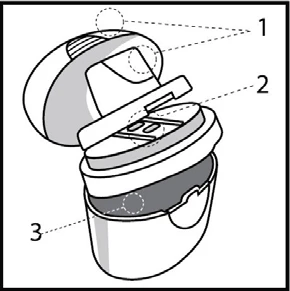
The Elpenhaler inhaler consists of three parts:
- Mouthpiece and its cover (1).
- Surface (2) where the strip with dual-chamber blisters is placed (carrier surface).
- Compartment (3) for storing strips.
The above three parts are connected together, but can be opened separately.
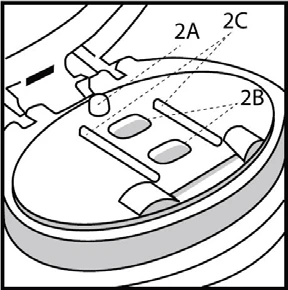
The carrier surface consists of:
- Attachment point (2A) for placing the blister strip.
- Two recesses (2B) to fit the two blister chambers.
- Two guide strips (2C) that ensure the strip with dual-chamber blisters is correctly positioned on the carrier surface.

The strip with dual-chamber blisters contains:
- Two aluminium foils (4).
- Two blister chambers (5), one containing salmeterol and the other fluticasone propionate.
- Hole (6).
Using the Elpenhaler inhaler
A. Preparing the device
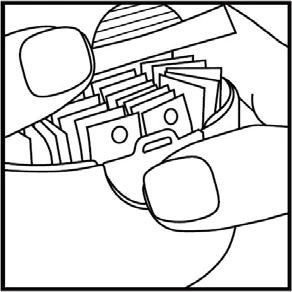
Open the compartment by pressing as shown in the
illustration, remove the strip and close the compartment again.
Completely uncover the protective cover of the mouthpiece
by gently pressing the striped surface.
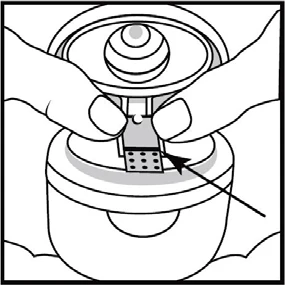
Unlock and press the mouthpiece backwards to expose
the carrier surface.
Hold the strip with dual-chamber blisters with the shiny
side up, so that the blue line is visible as indicated by the
arrow in the illustration. The printed side of the strip should face downwards.
Place the hole of the strip around the attachment point on
the carrier surface using light pressure, and ensure the strip
is properly fitted onto the attachment point.
The strip with dual-chamber blisters will fit into the recesses
on the carrier surface, and the guide strips will ensure
the strip remains in the correct position.
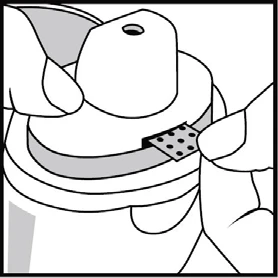
Close the mouthpiece and pull horizontally the protruding
end of the strip. The dose of medicine is now ready for use.
B. Performing inhalation
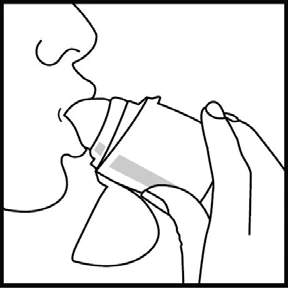
Hold the device away from your mouth.
Breathe out fully. Be careful not to breathe out onto
the mouthpiece of the device.
Place the Elpenhaler inhaler into your mouth and
seal your lips tightly around the mouthpiece.
Slowly inhale deeply through your mouth (not your
nose) until your lungs are full.
Hold your breath for about 5 seconds or as long as
you can, and then remove the device from your mouth.
Breathe out and continue breathing normally.
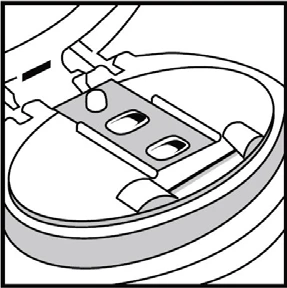
Open the mouthpiece. You will notice that all the powder
has been used and that the blister chambers are empty.
Remove the empty strip and proceed to step C.
C. Cleaning the inhaler
After each use, wipe the mouthpiece and carrier surface with a dry cloth or dry paper tissue. Do not use water to clean the device.
Close the mouthpiece and place the protective cover around it.
Accidental overdose of Symflusal
It is important to use the inhaler according to the instructions. If you accidentally use more than the recommended dose, consult your doctor or pharmacist.
The patient may experience: rapid heartbeat and tremors. Other possible symptoms include:
dizziness, headache, muscle weakness, and joint pain.
If higher doses are used for a prolonged period, contact your doctor or pharmacist for advice, as higher doses of Symflusal may reduce the production of steroid hormones by the adrenal glands.
Missed dose of Symflusal
Do not take a double dose to make up for a missed dose. Take the next dose at the usual time.
Stopping treatment with Symflusal
It is very important to take Symflusal every day as directed by your doctor.
You should continue taking the medicine until your doctor advises you to stop. Do not suddenly stop taking Symflusal or reduce the dose on your own,
as breathing problems may worsen.
Additionally, abruptly stopping or reducing the dose of Symflusal may (very rarely) cause adrenal gland dysfunction (adrenal insufficiency), which may sometimes lead to adverse effects.
Adverse effects may include the following:
- abdominal pain,
- fatigue and loss of appetite, nausea,
- vomiting and diarrhoea,
- weight loss,
- headache or drowsiness,
- low blood sugar,
- low blood pressure and seizures (convulsions).
When the body is under stress, for example due to fever, injury (e.g. car accident), infection, or surgery, adrenal insufficiency may worsen and any of the adverse effects listed above may occur.
If the patient experiences any of these adverse effects, inform your doctor or pharmacist. To prevent these symptoms, your doctor may prescribe additional corticosteroids in tablet form (e.g. prednisolone).
If you have any further questions about the use of this medicine, consult your doctor or pharmacist.
4. Possible adverse reactions
Like all medicines, this medicine can cause adverse reactions, although not everyone will experience them.
To reduce the risk of adverse reactions, your doctor will recommend the lowest dose of
Symflusal that provides control of asthma or COPD.
Allergic reactions: patients may experience sudden breathing difficulties immediately after
taking Symflusal. Wheezing, coughing, or shortness of breath may occur. In addition, itching, rash (urticaria), swelling (usually of the face, lips, tongue, or throat), or a sensation of very rapid heartbeat, weakness, or dizziness (which may lead to falling or loss of consciousness) may occur. If any of the above symptoms occur, or occur suddenly after using Symflusal, treatment with Symflusal must be stopped immediately and medical advice must be sought without delay. Allergic reactions following administration of Symflusal occur uncommonly (may affect less than 1 in 100 patients).
Pneumonia (lung infection) in patients with chronic obstructive pulmonary disease (COPD)
(common adverse reaction)
Inform your doctor if any of the following symptoms occur during treatment with Symflusal – these may be signs of lung infection:
- fever or chills,
- increased mucus production, change in mucus colour,
- worsening cough or increased difficulty in breathing.
Other adverse reactions described below:
Very common (may affect more than 1 in 10 patients):
- headache – this usually decreases with continued treatment;
- upper respiratory tract infections have been reported more frequently in patients with COPD.
Common (may affect less than 1 in 10 patients):
- oral candidiasis (painful, creamy-white, raised lesions in the mouth and throat), as well as tongue pain, hoarseness, and throat irritation. Rinsing the mouth with water and spitting it out, and/or brushing teeth immediately after each inhalation may be helpful. Your doctor may prescribe an antifungal medicine to treat oral candidiasis;
- joint pain, joint swelling, and muscle pain;
- muscle cramps.
In patients with chronic obstructive pulmonary disease (COPD), the following adverse reactions have also been observed:
- bruising and fractures;
- sinusitis (feeling of pressure and fullness in the nose, cheeks, and behind the eyes, sometimes with pulsating pain);
- decreased blood potassium levels (patients may experience irregular heartbeat, muscle weakness, cramps).
Uncommon (may affect less than 1 in 100 patients):
- increased blood sugar (glucose) levels (hyperglycaemia). In diabetic patients, more frequent monitoring of blood glucose levels and adjustment of the dose of currently used antidiabetic medicines may be necessary;
- cataract (clouding of the eye lens);
- very fast heartbeat (tachycardia);
- sensation of tremor (shakiness) and rapid or irregular heartbeat (palpitations) – these symptoms are usually harmless and resolve during treatment;
- chest pain;
- feeling of anxiety (this effect occurs mainly in children);
- sleep disturbances;
- allergic skin rash.
Rare (may affect less than 1 in 1000 patients):
-
breathing difficulties or wheezing, worsening immediately after taking Symflusal. In such a case, treatment with Symflusal must be stopped, a fast-acting inhaled medicine to relieve breathing should be used, and medical advice must be sought immediately;
-
Symflusal may affect the body's normal production of steroid hormones, particularly when high doses are taken for prolonged periods, leading to:
- slowed growth in children and adolescents;
-
decreased bone mass;
-
glaucoma;
-
weight gain;
-
rounding (moon-shaped) of the face (Cushing's syndrome). Your doctor will regularly check whether any of the above adverse reactions occur and will ensure that the patient uses the lowest effective dose of Symflusal to control asthma;
- behavioural changes such as excessive excitability and irritability (these symptoms occur mainly in children);
- irregular heartbeat or occurrence of extra beats (arrhythmia); inform your doctor, but do not stop using Symflusal unless instructed by your doctor;
- fungal infection of the oesophagus, which may cause difficulty in swallowing.
Frequency not known (frequency cannot be estimated from available data):
- depression or aggression. These adverse reactions are more likely in children;
- blurred vision.
Reporting of adverse reactions
If any adverse reactions occur, including any not listed in this leaflet, inform your doctor or pharmacist. Adverse reactions can be reported directly to the Department of Monitoring Adverse Drug Reactions, Office for Registration of Medicinal Products, Medical Devices and Biocidal Products, Al. Jerozolimskie 181C, 02-222 Warsaw, tel.: +48 22 49 21 301, fax: +48 22 49 21 309, e-mail: [email protected].
Adverse reactions can also be reported directly to the Marketing Authorisation Holder.
Reporting adverse reactions helps provide more information on the safety of the medicine.
5. How to store Symflusal
Keep this medicine out of sight and reach of children.
Do not store above 25°C.
Do not use this medicine after the expiry date stated on the label and packaging
after: EXP. The expiry date refers to the last day of the stated month.
Medicines must not be disposed of via wastewater or household waste. Ask your pharmacist how to dispose of medicines no longer required. This will help protect the environment.
6. Contents of the pack and other information
What Symflusal contains
The active substances in Symflusal are salmeterol and fluticasone propionate.
Each ready-to-use dose of Symflusal contains:
50 micrograms of salmeterol (as salmeterol xinafoate) and 250 micrograms
of fluticasone propionate
or
50 micrograms of salmeterol (as salmeterol xinafoate) and 500 micrograms
of fluticasone propionate.
The other ingredient is lactose monohydrate.
What Symflusal looks like and contents of the pack
The medicinal substances in Symflusal, salmeterol and fluticasone propionate, are placed
separately in two chambers of a blister. The blister is located on a foil strip and contains one
medicinal dose. The strips are stored in the Elpenhaler inhalation device, which is placed
in a cardboard box.
The foil protects the inhalation powder from atmospheric influences.
Each dose, in the form of a strip with a dual-chamber blister, is ready for use.
Pack sizes:
- Each cardboard pack contains one Elpenhaler inhalation device with 60 strips of dual-chamber blisters. Pack: 60 doses.
- Each cardboard pack contains one Elpenhaler inhalation device with 30 dual-chamber blister strips of Aluminium/Aluminium type and one storage compartment with 30 additional dual-chamber blister strips of Aluminium/Aluminium type. Pack: 60 doses.
- Each cardboard pack contains one Elpenhaler inhalation device with 30 dual-chamber blister strips of Aluminium/Aluminium type. Pack: 30 doses (single pack).
- Each pack contains three Elpenhaler inhalation devices with 60 dual-chamber blister strips of Aluminium/Aluminium type. Pack: 180 doses.
Not all pack sizes may be marketed.
Marketing Authorisation Holder and Manufacturer
Marketing Authorisation Holder
Symphar Sp. z o.o.
ul. Koszykowa 65
00-667 Warsaw, Poland
Manufacturer
ELPEN Pharmaceutical Co. Inc.
95, Marathonos Ave.
GR-19009 Pikermi, Attica
Greece
This medicinal product is authorised in the European Economic Area under the following names:
Finland Salmeson esiannosteltu 50 mikrogramman/250 mikrogramman/annos
inhalaatiojauhe
Salmeson esiannosteltu 50 mikrogramman/500 mikrogramman/annos
inhalaatiojauhe
France Salmeson 50 microgram/250 microgram/dose poudre pour inhalation en
récipient unidose.
Salmeson 50 microgram/500 microgram/dose poudre pour inhalation en
récipient unidose.
Norway Salmeson 50 mikrogram/250 mikrogram/doseinhaleringspudder
forhåndsdispensert.
Salmeson 50 mikrogram/500 mikrogram/doseinhaleringspudder
forhåndsdispensert.
Poland Symflusal
Sweden Salmeson 50 mikrogram/250 mikrogram/dos inhalationspulver, avdelad dos
Salmeson 50 mikrogram/500 mikrogram/dos inhalationspulver, avdelad dos