Sufentanil kalceks
PolandTable of Contents
Package leaflet: Information for the user
Sufentanil Kalceks, 5 micrograms/mL, solution for injection / for infusion
Sufentanil Kalceks, 50 micrograms/mL, solution for injection / for infusion
Sufentanilum
Please read all of this leaflet carefully before this medicine is administered, because it contains
important information for you.
- Keep this leaflet. You may need to read it again.
- If you have any further questions, please ask your doctor or nurse.
- If you experience any side effects, including any not listed in this leaflet, tell your doctor or nurse. See section 4.
Contents of the leaflet
- What Sufentanil Kalceks is and what it is used for
- What you need to know before you are given Sufentanil Kalceks
- How Sufentanil Kalceks is given
- Possible side effects
- How to store Sufentanil Kalceks
- Contents of the pack and other information
1. What Sufentanil Kalceks is and what it is used for
Sufentanil Kalceks contains the active substance sufentanil. It belongs to a group of medicines called
"opioid anaesthetics". Sufentanil is used as a pain-relieving medicine during or after surgery or to reduce pain during childbirth. Sufentanil is used as an anaesthetic in ventilated patients undergoing surgical procedures.
Adults
Intravenously (administered into a vein):
- to prevent pain during induction and maintenance of general anaesthesia in combination with other anaesthetic medicines;
- as an induction and maintenance agent for general anaesthesia during major surgical procedures.
Epidurally (administered into the epidural space of the spine):
- to prevent postoperative pain and pain after caesarean section;
- for pain relief during labour.
Children
Sufentanil administered intravenously is indicated as an analgesic for use during induction and/or maintenance of general anaesthesia in children over 1 month of age.
Sufentanil administered epidurally is indicated for the management of postoperative pain following general surgery, thoracic surgery, or orthopaedic procedures in children aged 1 year and older.
2. Important information before using Sufentanil Kalceks
When not to use Sufentanil Kalceks
- if the patient is allergic to sufentanil or any of the other ingredients of this medicine (listed in section 6);
- if the patient has any disease causing breathing difficulties (e.g. asthma or chronic bronchitis);
- if the patient has a liver enzyme disorder known as "acute hepatic porphyria";
- if the patient is taking any medicines used to treat depression known as monoamine oxidase inhibitors (MAOIs). MAOI treatment must be discontinued 2 weeks before surgery (see "Sufentanil Kalceks and other medicines");
- if the patient is taking or has recently taken other strong painkillers (e.g. nalbuphine, buprenorphine, pentazocine) (see "Sufentanil Kalceks and other medicines").
- intravenously
- if the patient is in labour or before clamping the umbilical cord during caesarean section.
- epidurally
- if the patient has severe bleeding or shock;
- if the patient has a severe infection;
- if the patient has impaired wound healing;
- if the patient has an infection at the injection site;
- if the patient has abnormalities in blood cell counts or if the patient is being treated with anticoagulant medicines (blood thinners).
Warnings and precautions
Sufentanil Kalceks must be administered only by trained anaesthesiologists in hospitals or other facilities equipped with devices for assisted ventilation and postoperative monitoring.
Before starting treatment with Sufentanil Kalceks, discuss with your doctor or nurse if:
- the patient has abnormally slowed intestinal peristalsis;
- the patient has diseases of the gallbladder or pancreas;
- the patient or any of their relatives have ever abused alcohol, prescription medicines or drugs ("addiction");
- the patient smokes tobacco;
- the patient has ever had mood problems (depression, anxiety or personality disorder) or has been treated by a psychiatrist for other mental illnesses.
This medicine contains sufentanil, which is an opioid medicine. Repeated use of opioid painkillers may result in reduced effectiveness (the patient becomes tolerant to it). This may also lead to dependence and misuse of the medicine, which could result in life-threatening overdose. If the patient is concerned about the possibility of becoming addicted to Sufentanil Kalceks, it is important to consult a doctor.
During treatment with Sufentanil Kalceks, consult a doctor if:
- the patient experiences pain or increased sensitivity to pain (hyperalgesia) that does not respond to a higher dose of medicine prescribed by the doctor.
While receiving this medicine, as with all strong painkillers of this type, breathing rate may decrease. This may persist until awakening or may recur during this period. Therefore, the patient's condition will be closely monitored after surgery.
Sufentanil Kalceks may cause sleep-related breathing disorders, such as sleep apnoea (pauses in breathing during sleep) and sleep-related hypoxemia (low oxygen levels in the blood). Symptoms of these disorders may include pauses in breathing during sleep, nocturnal awakenings due to breathlessness, difficulty maintaining sleep, or excessive daytime sleepiness. If these symptoms are observed, contact a doctor. The doctor may consider reducing the dose.
This medicine will not be used in patients with myasthenia gravis (a chronic muscle disease), as muscle rigidity may occur after intravenous administration.
Involuntary muscle spasms may occur.
This medicine should be used with special caution:
- in patients with impaired lung, liver, kidney or thyroid function;
- in patients with increased intracranial pressure or patients with brain or skull injuries;
- in patients with reduced blood volume (administration of this medicine may cause low blood pressure and slow heart rate);
- in elderly and debilitated patients (the dose may be reduced). Close medical supervision may be necessary.
Newborns/infants
Newborns, like with other opioids, are sensitive to breathing difficulties after administration of sufentanil. Only limited data are available on sufentanil administered intravenously in infants. Therefore, the doctor will carefully assess the benefit-risk ratio before administering this medicine to newborns and infants.
Due to the risk of administering too high or too low a dose, intravenous use of sufentanil is not recommended in the neonatal period.
Epidural use of sufentanil is not recommended in children under 1 year of age.
Sufentanil Kalceks and other medicines
Tell your doctor or nurse about all medicines the patient is currently taking or has recently taken, as well as any medicines the patient plans to take. It is especially important if the patient is taking or has recently taken any of the following medicines:
- strong painkillers such as opioids (e.g. nalbuphine, buprenorphine, pentazocine) (see "When not to use Sufentanil Kalceks");
- medicines used to treat depression known as monoamine oxidase inhibitors (MAOIs). These medicines must not be taken within 2 weeks before administration of Sufentanil Kalceks or at the same time as Sufentanil Kalceks (see "When not to use Sufentanil Kalceks").
- medicines used to treat depression known as selective serotonin reuptake inhibitors (SSRIs) and serotonin-noradrenaline reuptake inhibitors (SNRIs). Concurrent use of these medicines with Sufentanil Kalceks is not recommended.
- sedatives and anti-anxiety medicines such as barbiturates, sedatives or benzodiazepines (e.g. diazepam, midazolam);
- muscle relaxants (e.g. vecuronium, suxamethonium);
- medicines used in general anaesthesia (e.g. thiopental, etomidate, nitrous oxide);
- medicines used to treat psychiatric disorders (antipsychotics);
- antibiotics used to treat bacterial infections (erythromycin);
- medicines used to treat fungal infections (e.g. ketoconazole, itraconazole);
- medicines used to treat viral infections (e.g. ritonavir used in the treatment of HIV/AIDS).
Concomitant use of opioids and medicines used to treat epilepsy, neuropathic pain or anxiety (gabapentin and pregabalin) increases the risk of opioid overdose and respiratory depression, which may be life-threatening.
Concomitant use of Sufentanil Kalceks and sedative medicines such as benzodiazepines or related medicines increases the risk of drowsiness, breathing difficulties (respiratory depression), coma and may be life-threatening. For this reason, concomitant use should only be considered when other treatment options are not possible.
If, however, the doctor prescribes Sufentanil Kalceks together with sedative medicines, the dose and duration of concomitant treatment should be determined by the doctor.
Inform the doctor about all sedative medicines being taken and strictly follow the doctor's dosing instructions. It may be helpful to inform friends or family members about the signs and symptoms listed above. If such symptoms occur, contact a doctor.
Sufentanil Kalceks and alcohol
Alcohol may intensify some of the adverse effects of sufentanil. Therefore, alcohol should not be consumed before or after administration of this medicine.
Pregnancy and breastfeeding
If the patient is pregnant or breastfeeding, suspects she may be pregnant, or is planning to have a child, she should consult a doctor or nurse before using this medicine.
Sufentanil Kalceks must not be administered intravenously during labour, as it crosses the placenta and may affect the baby's breathing.
Sufentanil Kalceks may be administered epidurally during labour.
Sufentanil passes into human milk. Caution should be exercised when administering sufentanil to a breastfeeding woman. Breastfeeding may be resumed 24 hours after the last administration of sufentanil.
Driving and operating machinery
This medicine has a major influence on the ability to drive and operate machinery. Do not drive or operate machinery until sufficient time has passed after receiving this medicine. The patient should leave the hospital accompanied by a companion and avoid consuming alcohol.
Sufentanil Kalceks contains sodium
The medicine contains 3.54 mg of sodium (the main component of table salt) per mL of solution. This corresponds to 0.18% of the maximum recommended daily intake of sodium in the diet for adults.
3. How to use Sufentanil Kalceks
Sufentanil Kalceks will be injected by an experienced doctor into a vein (intravenously) or into the space surrounding the spinal cord (epidurally).
During treatment with Sufentanil Kalceks, specially trained healthcare personnel will closely monitor the patient, and emergency equipment will be available if needed.
Dosage
The treating physician will decide the dose and duration of treatment with this medicine for the patient (or child). The dose depends on age, body weight, physical condition, type of surgical procedure, and required depth of anesthesia.
- The dose should be carefully adjusted in patients with hypothyroidism, impaired lung function, obesity, or alcoholism. Extended monitoring after surgery is recommended for these patients.
- Patients with impaired liver or kidney function will require lower doses.
- Elderly and debilitated patients will require lower doses.
Use in children over 1 month of age and adolescents
Intravenous administration
Sufentanil is administered slowly into a vein by an anesthesiologist. The dosage depends on the dose of other anesthetic agents used, and the type and duration of the surgical procedure, and will be determined by the anesthesiologist.
Use in children over 1 year of age and adolescents
Epidural administration
Sufentanil is administered slowly into the epidural space (part of the spine) by an anesthesiologist experienced in pediatric anesthetic techniques. The dosage depends on whether local anesthetics are used concomitantly and on the required duration of analgesia.
Children must be monitored for signs of abnormally slow and shallow breathing (respiratory depression) for at least 2 hours after epidural administration of sufentanil.
Administration of a higher than recommended dose of Sufentanil Kalceks
Since this medicine is usually administered by a doctor under carefully controlled conditions, it is unlikely that an overdose will occur. However, if a patient accidentally receives too much sufentanil, breathing difficulties may occur (weak or slow breathing, or even temporary cessation of breathing). In such a case, inform the doctor or nurse immediately.
If you have any further questions concerning the use of this medicine, consult your doctor or pharmacist.
4. Possible adverse reactions
Like all medicines, this medicine can cause adverse reactions, although not everyone will experience them.
The most common adverse reactions are excessive sedation, itching, nausea, and vomiting.
You should immediately inform your doctor or seek medical help if any of the following adverse reactions occur (frequency cannot be determined from available data):
- breathing difficulties
- severe allergic reactions, which may cause skin rash, swelling of the face, lips, tongue or throat, breathing difficulties, loss of consciousness and shock (anaphylactic or anaphylactoid reaction, anaphylactic shock)
Very common (may affect more than 1 in 10 patients)
- excessive sedation
- itching
Common (may affect less than 1 in 10 patients)
- dizziness, headache
- fast heartbeat
- high or low blood pressure, pallor
- nausea, vomiting
- skin discoloration
- muscle tremors
- urinary retention or difficulty passing urine
- fever
- in newborns: involuntary muscle twitching, bluish skin due to low blood oxygen levels
Uncommon (may affect less than 1 in 100 patients)
- runny or stuffy nose (rhinitis)
- hypersensitivity
- lack of interest (apathy), nervousness
- muscle twitching (intraoperative muscle movements), lack of voluntary muscle coordination, sustained muscle contractions causing twisting and repetitive movements, hyperactive reflexes, abnormal increase in muscle tone, drowsiness
- visual disturbances
- heart rhythm disorders (atrioventricular block), bluish skin due to low blood oxygen levels, slow heart rate, irregular heartbeat, abnormal electrocardiogram, absence of heartbeat
- bronchospasm, abnormally shallow or slow breathing, hoarseness, cough, hiccups, breathing disorders
- skin allergic reactions, abnormal sweating, rash, dry skin
- back pain, muscle stiffness, including stiffness of the chest wall, which may cause breathing difficulties
- chills, increased or decreased body temperature, reaction at injection site, pain at injection site, pain
- in newborns: involuntary muscle movements, reduced body movements, rash, reduced muscle tone
Frequency not known (frequency cannot be estimated from available data)
- involuntary muscle spasms, overwhelming sense of well-being (euphoria), sensation of "spinning" (dizziness), stupor, convulsions
- constricted pupils
- cardiac arrest (the doctor has medicines available to reverse this effect)
- shock
- cessation of breathing, pulmonary edema, spasm of throat muscles
- skin redness
- muscle spasms
Adverse reactions in children and adolescents
The frequency, type and severity of adverse reactions in children are expected to be the same as in adults.
Reporting of adverse reactions
If any adverse reactions occur, including any not listed in this leaflet, inform your doctor or nurse. Adverse reactions can be reported directly to the Department of Monitoring Adverse Drug Reactions at the Office for Registration of Medicinal Products, Medical Devices and Biocidal Products:
Al. Jerozolimskie 181C
02-222 Warsaw
Tel.: +48 22 49 21 301
Fax: +48 22 49 21 309
Website: https://smz.ezdrowie.gov.pl
Adverse reactions can also be reported directly to the marketing authorization holder.
Reporting adverse reactions helps provide more information on the safety of the medicine.
5. How to store Sufentanil Kalceks
The medicine should be stored out of the sight and reach of children.
Do not use this medicine after the expiry date stated on the vial label after “EXP”
and on the carton after “Expiry date (EXP)”. The expiry date refers to the last day
of the stated month.
No special storage conditions are required for this medicine.
Duration of use after opening the vial
The medicine should be used immediately after opening.
Duration of use after dilution
Chemical and physical stability has been demonstrated for 72 hours when used at 20–25°C
and at 2–8°C.
From a microbiological point of view, the diluted solution should be used immediately. If the solution
is not used immediately, the responsibility for storage conditions and duration prior to use
lies with the user and usually should not exceed 24 hours at 2–8°C, unless dilution occurred under
controlled and validated aseptic conditions.
Medicines must not be disposed of via wastewater or household waste. Ask your pharmacist how to
dispose of medicines no longer required. Such measures help protect
the environment.
6. Contents of the pack and other information
What Sufentanil Kalceks contains
- The active substance is sufentanil (as sufentanil citrate).
Sufentanil Kalceks 5 micrograms/mL
Each mL of solution contains 5 micrograms of sufentanil as sufentanil citrate.
Each 2 mL of solution contains 10 micrograms of sufentanil as sufentanil citrate.
Each 10 mL of solution contains 50 micrograms of sufentanil as sufentanil citrate.
Sufentanil Kalceks 50 micrograms/mL
Each mL of solution contains 50 micrograms of sufentanil as sufentanil citrate.
Each 5 mL of solution contains 250 micrograms of sufentanil as sufentanil citrate.
Each 10 mL of solution contains 500 micrograms of sufentanil as sufentanil citrate.
Each 20 mL of solution contains 1000 micrograms of sufentanil as sufentanil citrate.
- Other ingredients are: sodium chloride, monohydrate citric acid (for pH adjustment), water for injections.
What Sufentanil Kalceks looks like and contents of the pack
Clear, colourless solution free from visible particles.
Ampoules made of colourless type I glass with a capacity of 2 mL, 5 mL, 10 mL or 20 mL, each with one point cut.
The ampoules are packed in protective sleeves. The sleeves are packed in cardboard boxes.
Pack sizes:
Sufentanil Kalceks 5 micrograms/mL
5 or 10 ampoules of 2 mL
5 or 10 ampoules of 10 mL
Sufentanil Kalceks 50 micrograms/mL
5 or 10 ampoules of 5 mL
5 or 10 ampoules of 10 mL
5 or 10 ampoules of 20 mL
Not all pack sizes may be marketed.
Marketing Authorisation Holder and Manufacturer
AS KALCEKS
Krustpils iela 71E
LV-1057 Rīga
Latvia
Tel.: +371 67083320
E-mail: [email protected]
This medicinal product is authorised in the Member States of the European Economic Area under the following names:
Denmark, Czech Republic, Italy, Poland, Slovakia: Sufentanil Kalceks
Austria: Sufentanil Kalceks 5 Mikrogramm/ml, 50 Mikrogramm/ml Injektions-/Infusionslösung
Belgium: Sufentanil Kalceks 5 microgrammes/ml, 50 microgrammes/ml, solution injectable/pour perfusion
Sufentanil Kalceks 5 microgram/ml, 50 microgram/ml oplossing voor injectie/infusie
Sufentanil Kalceks 5 Mikrogramm/ml, 50 Mikrogramm/ml Injektions-/Infusionslösung
France: SUFENTANIL KALCEKS 5 microgrammes/ml, solution injectable/pour perfusion
SUFENTANIL KALCEKS 50 microgrammes/ml, solution injectable/pour perfusion
Germany: Sufentanil Kalceks 5 Mikrogramm/ml Injektions-/Infusionslösung
Sufentanil Kalceks 50 Mikrogramm/ml Injektions-/Infusionslösung
Latvia: Sufentanil Kalceks 5 mikrogrami/ml, 50 mikrogrami/ml šķīdums injekcijām/infūzijām
Netherlands: Sufentanil Kalceks 5 microgram/ml, 50 microgram/ml oplossing voor injectie/infusie
------------------------------------------------------------------------------------------------------------------------
Information intended for healthcare professionals only:
Pharmaceutical incompatibilities
This medicinal product must not be mixed with other medicinal products except those listed below.
Special precautions for disposal and preparation of the medicinal product for administration
Sufentanil must be administered only by anaesthesiologists or physicians familiar with its use and effects, or under their supervision. Epidural administration must be performed by a physician experienced in epidural techniques.
The correct position of the needle or catheter must be verified before administration.
For single use only. Any unused portions of the solution must be discarded.
This medicinal product should be inspected visually before use. Do not use if signs of degradation are present (e.g. particulate matter or discoloration).
May be diluted with:
- 9 mg/mL (0.9%) sodium chloride solution for injection
- 50 mg/mL (5%) glucose solution for injection
- Ringer's solution
- Ringer's lactate solution
For epidural administration, the medicinal product may be mixed with 9 mg/mL (0.9%) sodium chloride solution and/or bupivacaine solution.
Instructions for opening the ampoule
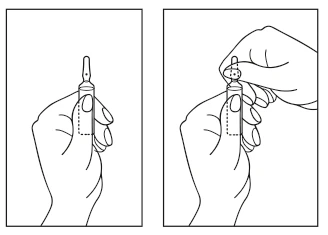
- Turn the ampoule with the coloured dot facing upwards. If solution is present in the upper part of the ampoule, gently tap with the finger to move all the solution to the lower part.
- Use both hands to open the ampoule: hold the lower part of the ampoule in one hand and snap off the top part in the direction away from the coloured dot (see figure below).
Any unused medicinal product or waste material should be disposed of in accordance with local regulations.