Seretide 50
Poland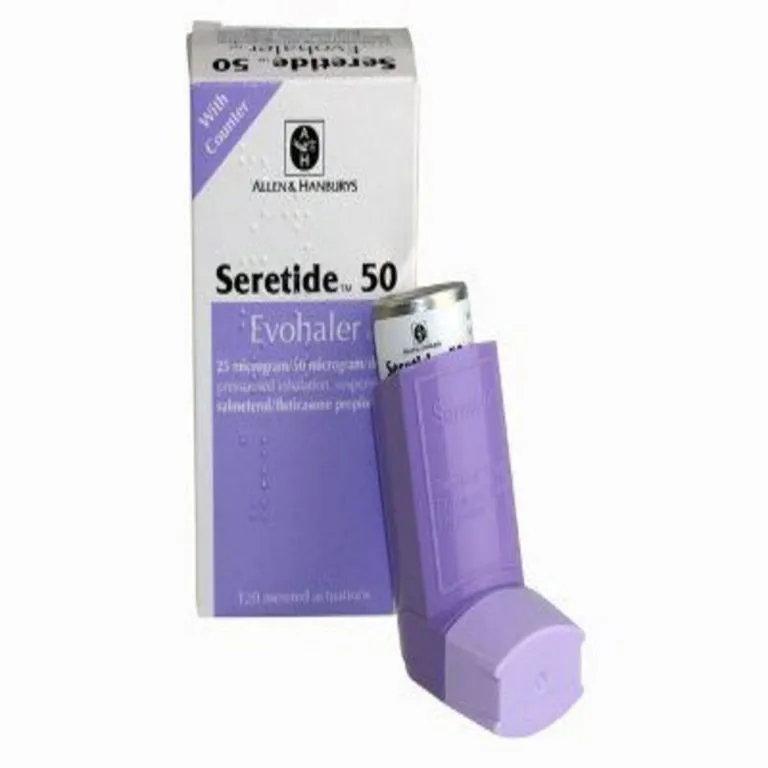
Instructions for Use
Patient Information Leaflet
Seretide 50, (50 g + 25 g)/inhalation dose, inhalation aerosol, suspension
Seretide 125, (125 g + 25 g)/inhalation dose, inhalation aerosol, suspension
Seretide 250, (250 g + 25 g)/inhalation dose, inhalation aerosol, suspension
Fluticasone propionate + Salmeterol
Please read this leaflet carefully before using this medicine, as it contains important
information for you.
- Keep this leaflet, as you may need to read it again.
- If you have any further questions, please ask your doctor or pharmacist.
- This medicine has been prescribed for a specific individual. Do not pass it on to others. It may harm other people, even if their symptoms are the same.
- If you experience any adverse reactions, including any not listed in this leaflet, inform your doctor or pharmacist. See section 4.
Table of contents:
- What Seretide is and what it is used for
- Important information before using Seretide
- How to use Seretide
- Possible side effects
- How to store Seretide
- Contents of the pack and other information
1. What Seretide is and what it is used for
Seretide contains two active substances: salmeterol and fluticasone propionate.
- Salmeterol is a long-acting bronchodilator. Bronchodilators help keep the airways open. This makes it easier for air to flow into and out of the lungs. The effect lasts for at least 12 hours.
- Fluticasone propionate is a corticosteroid that reduces swelling and irritation in the lungs.
Your doctor has prescribed this medicine to prevent breathing problems associated with asthma.
To ensure proper asthma control, Seretide must be used every day as directed by your doctor.
Seretide helps prevent episodes of breathlessness and wheezing. However, it should not be used
to relieve sudden asthma attacks or sudden wheezing. If such an attack occurs, a fast-acting
bronchodilator, such as salbutamol, should be used immediately. You should always have this
medicine available.
2. Important information before using Seretide
When not to use Seretide
- if the patient is allergic to salmeterol, fluticasone propionate, or norflurane (HFA 134a), an excipient of the medicine.
Warnings and precautions
Talk to your doctor before starting treatment with Seretide if the patient has:
- heart disease, including irregular or rapid heartbeat,
- hyperthyroidism,
- high blood pressure,
- diabetes (Seretide may increase blood glucose levels),
- low blood potassium levels,
- active or past tuberculosis, or other lung infections.
If the patient experiences blurred vision or other visual disturbances, contact a doctor.
Seretide and other medicines
Tell the doctor about all medicines the patient is currently taking or has recently taken, as well as any medicines the patient plans to take, including those used for asthma and over-the-counter medicines. Seretide should not be used with certain medicines. Before starting Seretide, inform the doctor if the patient is taking any of the following medicines:
- Medicines from the -adrenolytic group (e.g. atenolol, propranolol, and sotalol). -Adrenolytics are commonly used to treat high blood pressure or other heart conditions.
- Medicines used to treat infections (e.g. ketoconazole, itraconazole, and erythromycin), including certain medicines used to treat HIV (e.g. ritonavir, drugs containing cobicistat). Some of these medicines may increase the levels of fluticasone propionate or salmeterol in the body. This may increase the risk of adverse effects, including irregular heartbeat, or may worsen existing adverse effects. The doctor may wish to closely monitor the patient taking such medicines.
- Corticosteroids (taken orally or by injection). If the patient has recently taken such medicines, this may increase the risk of adrenal dysfunction.
- Diuretics used to treat high blood pressure.
- Other bronchodilators (such as salbutamol).
- Medicines containing xanthine derivatives, often used in the treatment of asthma.
Pregnancy and breastfeeding
If the patient is pregnant or breastfeeding, suspects she may be pregnant, or is planning to become pregnant, she should consult her doctor before using this medicine. The doctor will assess whether the patient can take Seretide during this period.
Driving and operating machinery
It is unlikely that Seretide will affect the ability to drive or operate machinery.
3. How to use Seretide
Seretide must always be used exactly as directed by your doctor. If you are unsure, consult your doctor or pharmacist.
- Seretide should be used daily until your doctor advises otherwise. Do not take more than the recommended dose. If in doubt, consult your doctor or pharmacist.
- Do not stop using Seretide or reduce the dose without first consulting your doctor.
- Seretide should be inhaled into the lungs through the mouth.
Adults and adolescents aged 12 years and older:
- Seretide 50: two inhalations twice daily.
- Seretide 125: two inhalations twice daily.
- Seretide 250: two inhalations twice daily.
Children aged 4 to 12 years:
- Seretide 50: two inhalations twice daily.
- Seretide is not recommended for use in children under 4 years of age.
If asthma symptoms are well controlled while taking Seretide twice daily, your doctor may recommend reducing the frequency of Seretide to once daily. The dose may be administered:
- once daily in the evening, if the patient’s symptoms occur at night,
- once daily in the morning, if the patient’s symptoms occur during the day.
It is very important that your doctor instructs you how many inhalations to take and how often. If you are using Seretide for asthma, your doctor will regularly monitor your symptoms. If asthma symptoms worsen or asthma control deteriorates, you must
contact your doctor immediately. This may include worsening wheezing, more frequent chest tightness, or the need to use a higher dose of a fast-acting, inhaled medicine to relieve breathing difficulties. In such a case, continue using Seretide, but do not increase the number of inhalations. Your symptoms may worsen and your condition may deteriorate. Contact your doctor, as you may require additional treatment.
Instructions for using the inhaler
- Your doctor, nurse, or pharmacist should instruct you on the correct use of the inhaler. They should periodically check that you are using the inhaler correctly. Incorrect use of Seretide or improper use of the inhaler may result in the medicine not providing the expected improvement in asthma.
- The medicine is contained under pressure in a plastic casing with a mouthpiece.
- On the back of the inhaler there is a dose counter showing how many doses of medicine remain. Each time the canister is pressed, a dose is released and the counter decreases by one.
- Be careful not to drop the inhaler, as this may cause the counter to decrease incorrectly.
Checking the inhaler
- Before first use, check that the inhaler is working. Remove the mouthpiece cap by gently pressing the sides of the cap with your thumb and index finger.
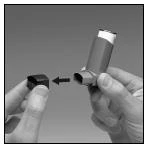
- To ensure the inhaler works properly, shake it vigorously, point the mouthpiece away from you, and release one dose into the air. Repeat this, shaking the inhaler immediately before releasing each dose, until the counter displays 120. If the inhaler has not been used for one week or longer, remove the mouthpiece cap, shake the inhaler vigorously, and release two doses into the air.
Using the inhaler
It is important to begin breathing slowly and as steadily as possible even before using the inhaler.
- Use the inhaler while standing or sitting.
- Remove the mouthpiece cap (as shown in Figure 1). Check the mouthpiece inside and outside to ensure it is clean and free of foreign objects.
- Shake the inhaler 4 or 5 times to remove any foreign particles and ensure the contents are evenly mixed.
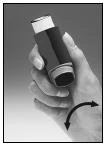
- Hold the inhaler upright with your fingers, placing your thumb on the base of the inhaler, below the mouthpiece. Breathe out fully, as deeply as possible.
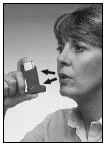
- Place the mouthpiece in your mouth and close your lips tightly around it. Do not bite the mouthpiece.
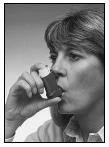
- Begin a slow and deep inhalation. Immediately after starting to inhale through your mouth, press down on the inhaler to release a dose of Seretide, then continue a steady, deep inhalation.
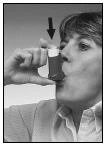
- Hold your breath, remove the inhaler from your mouth, and remove your finger from the canister. Hold your breath for several seconds, or as long as is comfortable, then breathe out slowly.
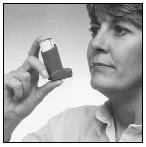
- If your doctor has prescribed two inhalations, wait approximately 30 seconds before repeating steps 3–7.
- Rinsing your mouth with water and spitting it out and/or brushing your teeth after inhalation helps prevent hoarseness and oral thrush.
- After inhalation, always replace the mouthpiece cap to prevent dust from entering. Push the cap into place firmly. If you do not hear a click when attaching the cap, remove it, turn it around, and try again. Do not use excessive force.
Do not rush through steps 4, 5, 6, and 7. It is important to breathe as slowly as possible immediately before inhalation. To ensure correct technique, initially practice in front of a mirror. If a "mist" is seen escaping from the inhaler, mouth, or nose during inhalation, this indicates incorrect technique. Repeat the steps starting from step 3.
As with all inhalers, caregivers should ensure that children prescribed Seretide use the inhaler correctly, as described above.
If you have difficulty coordinating your breath with inhalation from the inhaler, your doctor may recommend using a spacer device. Your doctor, nurse, or pharmacist should instruct you on the correct use of the inhaler with a spacer, how to maintain the spacer, and answer any related questions. If you use a spacer, it is important not to stop using it without consulting your doctor or nurse. It is also important not to change the type of spacer without consulting your doctor. If you stop using a spacer or change its type, your doctor may decide to adjust the dose of medicine needed to control your asthma symptoms. Always consult your doctor before making any changes to your asthma treatment.
Older children or people with weak hands may find it easier to hold the inhaler with both hands. Hold the inhaler with both index fingers on top and both thumbs underneath the mouthpiece.
If the counter displays 020, remember that a new inhaler will soon be needed. Replace the inhaler when the counter reads 000, as the remaining medicine may be insufficient for a full dose. Never attempt to increase the counter reading, as it cannot be reset.
Cleaning the inhaler
To prevent blockage, clean the inhaler at least once a week.
To clean the inhaler:
- Remove the mouthpiece cap.
- Do not remove the metal canister from the plastic casing during cleaning or at any other time.
- Wipe the mouthpiece inside and outside, and the outside of the plastic casing, with a dry cloth or tissue.
- Replace the mouthpiece cap. When properly attached, you should hear a click. If you do not hear a click, remove the cap, turn it around, and try again. Do not use excessive force.
Do not immerse the metal canister in water.
Accidental overdose of Seretide
It is important to use the inhaler exactly as instructed. If you accidentally use more than the recommended dose, inform your doctor or pharmacist.
Symptoms may include: faster than normal heartbeat, tremors, dizziness, headache, muscle weakness, and joint pain.
If higher doses have been used for a prolonged period, contact your doctor or pharmacist for advice, as high doses of Seretide may reduce the production of steroid hormones by the adrenal glands.
Missed dose of Seretide
Do not take a double dose to make up for a missed dose. Take the next dose at the scheduled time.
Stopping Seretide
It is very important to take Seretide every day as directed. You should continue taking the medicine until your doctor advises you to stop. Do not suddenly stop
taking Seretide or reduce the dose, as your symptoms may worsen.
Additionally, abruptly stopping or reducing the dose of Seretide may (very rarely) lead to adrenal gland dysfunction (adrenal insufficiency), which may cause adverse effects.
These adverse effects may include any of the following:
- abdominal pain,
- fatigue and loss of appetite, nausea,
- vomiting and diarrhoea,
- weight loss,
- headache and drowsiness,
- low blood sugar,
- low blood pressure and seizures.
When the body is under stress due to fever, injury (such as a car accident), infection, or surgery, adrenal insufficiency may worsen and any of the adverse effects listed above may occur.
If you experience any of these adverse effects, inform your doctor or pharmacist. To prevent these symptoms, your doctor may prescribe additional corticosteroids in tablet form (e.g. prednisolone).
If you have any further questions about the use of this medicine, consult your doctor, nurse, or pharmacist.
4. Possible adverse effects
Like all medicines, this medicine can cause adverse effects, although not everyone will experience them.
To reduce the risk of adverse effects, your doctor will recommend the lowest dose of
Seretide that provides control of asthma.
Allergic reactions: The patient may experience sudden difficulty in breathing immediately
after using Seretide. Worsening of wheezing, coughing, or shortness of breath may occur,
as well as itching, rash (urticaria), and swelling (usually of the face, lips, tongue,
or throat). There may also be a sensation of very rapid heartbeat, weakness, or dizziness
(which may lead to falling or loss of consciousness). If any of these symptoms occur suddenly
after using Seretide, stop using Seretide immediately and contact your doctor without delay.
Allergic reactions to Seretide occur uncommonly (may occur in 1 to 10 out of 1000 patients taking the medicine).
Other adverse effects:
Very common adverse effects (may affect more than 1 in 10 patients):
- Headache – this adverse effect usually decreases over time with continued treatment.
- Increased incidence of colds has been reported in patients with COPD.
Common adverse effects (may affect 1 to 10 out of 100 patients):
- Oral thrush (painful, creamy-white lesions in the mouth and throat), as well as tongue pain, hoarseness, loss of voice, and throat irritation. Rinsing the mouth with water and spitting it out and/or brushing teeth immediately after each inhalation may help. Your doctor may prescribe an antifungal medicine to treat oral thrush.
- Joint pain, joint swelling, and muscle pain.
- Muscle cramps.
The following adverse effects have been reported in patients with chronic obstructive pulmonary disease (COPD):
- Pneumonia (lung infection). Inform your doctor if any of the following symptoms occur while using Seretide – they may be signs of lung infection: fever or chills, increased mucus production, change in mucus colour, worsening cough, or increased difficulty in breathing.
- Easy bruising and traumatic fractures.
- Sinusitis (feeling of pressure and fullness in the nose, cheeks, and behind the eyes, sometimes with pulsating pain).
- Decreased blood potassium levels (the patient may experience irregular heartbeat, muscle weakness, or cramps).
Uncommon adverse effects (may affect 1 to 10 out of 1000 patients):
- Increased blood sugar (glucose) levels (hyperglycaemia). In patients with diabetes, more frequent monitoring of blood sugar levels may be necessary, and the dose of currently used antidiabetic medicines may need to be adjusted.
- Cataract (clouding of the eye lens).
- Very rapid heartbeat (tachycardia).
- Tremor and rapid or irregular heartbeat (palpitations) – these symptoms are usually not serious and tend to decrease with continued treatment.
- Atrial fibrillation.
- Ischaemic heart disease, characterised by chest pain or tightness, and shortness of breath.
- Sleep disturbances.
- Anxiety.
- Allergic skin rash.
Rare adverse effects (may affect 1 to 10 out of 10,000 patients):
- Wheezing or breathing difficulties that worsen immediately after taking Seretide. If such symptoms occur, stop using Seretide immediately, use a fast-acting inhaled medicine to relieve breathing, and contact your doctor immediately.
- Seretide may interfere with the body's normal production of steroid hormones, especially when high doses are used for a long time. These effects include:
- slowed growth in children and adolescents,
- reduced bone mass,
- glaucoma,
- increased body weight,
- facial rounding (moon-shaped face) (Cushing's syndrome). Your doctor will regularly check for these adverse effects and ensure that you are using the lowest dose of Seretide that controls your asthma.
- Behavioural changes such as excessive excitability and irritability (these effects occur mainly in children).
- Irregular heartbeat or extra beats (arrhythmias). Inform your doctor, but do not stop using Seretide unless instructed by your doctor.
- Fungal infection of the oesophagus, which may cause difficulty in swallowing.
Adverse effects with unknown frequency (frequency cannot be estimated from available data):
- Depression or aggression. These effects are more likely to occur in children.
- Blurred vision.
Reporting of adverse effects
If you experience any adverse effects, including any not listed in this leaflet, inform your doctor or pharmacist. Adverse effects can be reported directly to the Department of Monitoring of Adverse Drug Reactions, Office for Registration of Medicinal Products, Medical Devices and Biocidal Products, Al. Jerozolimskie 181C, 02-222 Warsaw, tel.: 22 49-21-301, fax: 22 49-21-309, website: https://smz.ezdrowie.gov.pl
Adverse effects can also be reported to the marketing authorisation holder.
Reporting adverse effects helps provide more information on the safety of the medicine.
5. How to store Seretide
- Keep the medicine out of the sight and reach of children.
- Do not use Seretide after the expiry date stated on the container. The expiry date (EXP) refers to the last day of the stated month. The Lot number indicates the batch number.
- Store at temperatures not exceeding 30°C. Do not refrigerate or freeze.
- As with most pressurised inhalation medicines, the therapeutic effect of this medicine may be reduced when the container is cold.
- The metal container holds a pressurised suspension. Do not expose to temperatures above 50°C and protect from direct sunlight. Do not pierce or burn the container, even if it seems empty. Medicines must not be disposed of via wastewater or household waste. Ask your pharmacist how to dispose of medicines no longer required. This will help protect the environment.
6. Contents of the pack and other information
What Seretide contains
- The active substances in this medicine are: salmeterol and fluticasone propionate. Each metered dose contains 25 micrograms (µg) of salmeterol (as salmeterol xinafoate) and 50, 125 or 250 micrograms (µg) of fluticasone propionate.
- The other ingredient is the propellant gas: 1,1,1,2-tetrafluoroethane (norflurane, HFA 134a).
This medicine contains fluorinated greenhouse gases.
Each inhaler contains g equivalent to
tonnes of CO₂ equivalent (global warming potential GWP = ).
What Seretide looks like and contents of the pack
- Seretide is supplied in an inhaler containing a pressurized suspension for oral inhalation into the lungs.
- The pressurized container holds a white to off-white inhalation suspension.
- Pack contents: An aluminium pressurized canister fitted with a metering valve, fitted into a plastic actuator with a dose counter, presented in a cardboard carton. One pressurized canister contains 120 doses.
Marketing Authorisation Holder and Manufacturer
Marketing Authorisation Holder: Manufacturer:
GlaxoSmithKline Trading Services Limited Glaxo Wellcome Production
12 Riverwalk Zone Industrielle No. 2
Citywest Business Campus 23, rue Lavoisier
Dublin 24 27000 Evreux
D24 YK11 France
Ireland
For more detailed information, please contact the representative of the Marketing Authorisation Holder:
GSK Services Sp. z o.o.
tel. (22) 576-90-00
{logo of the Marketing Authorisation Holder}
Similar Medications
-
Airflusal
Form: aerosol, inhalation suspension
Active substance Dosage salmeterol xinafoate 25 mcg fluticasone propionate No input provided Manufacturer: Salutas Pharma GmbH
-
Airflusal
Form: aerosol, inhalation suspension
Active substance Dosage salmeterol xinafoate 25 mcg fluticasone propionate No input provided Manufacturer: Salutas Pharma GmbH
-
Asaris pmdi
Form: aerosol, inhalation suspension
Active substance Dosage fluticasone propionate 50 mcg salmeterol xinafoate 36.32 mcg Manufacturer: Genetic S.p.A Polfarmex S.A.
-
Asaris pmdi
Form: aerosol, inhalation suspension
Active substance Dosage fluticasone propionate 125 mcg salmeterol xinafoate 36.32 mcg Manufacturer: Genetic S.p.A
-
Asaris pmdi
Form: aerosol, inhalation suspension
Active substance Dosage fluticasone propionate 250 mcg/dose salmeterol xinafoate 36.32 mcg/dose Manufacturer: Genetic S.p.A
-
Aurospira
Form: aerosol, inhalation suspension
Active substance Dosage fluticasone propionate 50 mcg/dose salmeterol 25 mcg/dose Manufacturer: Genetic S.p.A
-
Aurospira
Form: aerosol, inhalation suspension
Active substance Dosage fluticasone propionate 125 mcg salmeterol 25 mcg Manufacturer: Genetic S.p.A
-
Aurospira
Form: aerosol, inhalation suspension
Active substance Dosage fluticasone propionate 250 mcg/dose salmeterol 25 mcg/dose Manufacturer: Genetic S.p.A
-
Comboterol
Form: aerosol, inhalation suspension
Active substance Dosage Salmeterol 21 mcg Fluticasone propionate 125 mcg Manufacturer: Pharmaceutical Enterprise LEK-AM Ltd.
-
Comboterol
Form: aerosol, inhalation suspension
Active substance Dosage Salmeterol 21 mcg Fluticasone propionate 220 mcg Manufacturer: Pharmaceutical Enterprise LEK-AM Ltd.
-
Duexon
Form: aerosol, inhalation suspension
Active substance Dosage salmeterol xinafoate 36.32 mcg fluticasone propionate 50 mcg Manufacturer: Adamed Pharma S.A.
-
Duexon
Form: aerosol, inhalation suspension
Active substance Dosage salmeterol xinafoate 25 mcg fluticasone propionate 125 mcg Manufacturer: Adamed Pharma S.A.
This page has been machine-translated and may contain inaccuracies. The original data is available in the manufacturing country's language.
Last data check: June 04, 2026 · Data source: Rejestr Produktów Leczniczych (URPL)