Airflusal
Poland
Table of Contents
Patient Information Leaflet
AirFluSal, (25 micrograms + 125 micrograms)/metered dose,
inhalation aerosol, suspension
AirFluSal, (25 micrograms + 250 micrograms)/metered dose,
inhalation aerosol, suspension
Salmeterolum + Fluticasoni propionas
Please read all of this leaflet carefully before using this medicine because it contains important
information for you.
Keep this leaflet as you may need to read it again.
If you have any further questions, ask your doctor or pharmacist.
This medicine has been prescribed for a specific individual. Do not pass it on to others.
It may harm them, even if their symptoms are the same.
If you experience any side effects, including any not listed in this leaflet, tell your doctor or pharmacist. See section 4.
Contents of the leaflet:
- What AirFluSal is and what it is used for
- What you need to know before using AirFluSal
- How to use AirFluSal
- Possible side effects
- How to store AirFluSal
- Contents of the pack and other information
1. What AirFluSal is and what it is used for
AirFluSal contains two active substances: salmeterol and fluticasone propionate.
- Salmeterol is a long-acting bronchodilator. It helps keep the airways open, making it easier for air to flow into and out of the lungs. This effect lasts for at least 12 hours.
- Fluticasone propionate is a corticosteroid that reduces swelling and irritation in the lungs.
AirFluSal is not recommended for use in children.
Your doctor has prescribed this medicine to prevent breathing difficulties caused by asthma.
To properly control asthma, AirFluSal must be used every day as directed by your doctor.
AirFluSal helps prevent episodes of breathlessness and wheezing, but it should not be used to relieve sudden asthma attacks or acute wheezing.
For such episodes, a fast-acting "reliever" inhaler, such as salbutamol, must be used. Always carry your fast-acting "reliever" inhaler with you.
2. Important information before using AirFluSal
When not to use AirFluSal
if the patient is allergic to salmeterol, fluticasone propionate, or to any of the excipients
listed in section 6.
Warnings and precautions
Before using AirFluSal, talk to your doctor if the patient has:
heart disease, including irregular or rapid heartbeat
hyperthyroidism
high blood pressure
diabetes (AirFluSal may increase blood sugar levels)
low potassium levels in the blood
tuberculosis (current or past) or other lung infections
If the patient develops blurred vision or other visual disturbances, inform the doctor immediately.
AirFluSal and other medicines
Tell your doctor or pharmacist about all medicines the patient is currently taking or has recently taken, as well as any medicines planned for use. This includes medicines used to treat asthma and any over-the-counter medicines. Using AirFluSal together with other medicines may not be appropriate.
Before using AirFluSal, inform your doctor if the patient is taking any of the following medicines:
Beta-blockers (such as atenolol, propranolol, or sotalol). Beta-blockers are mainly used to treat high blood pressure or heart conditions.
Medicines used to treat infections, including some medicines used to treat HIV infection (such as ritonavir, cobicistat, ketoconazole, itraconazole, and erythromycin). Some of these medicines may increase the amount of fluticasone propionate or salmeterol in the body, thereby increasing the risk or severity of adverse effects of AirFluSal (including heart rhythm disturbances). The doctor may closely monitor treatment in patients taking these medicines.
Oral or injectable corticosteroids. In patients who have recently received them, there may be an increased risk of adrenal gland dysfunction.
Diuretics used to treat high blood pressure.
Other bronchodilators (such as salbutamol).
Medicines containing xanthine derivatives (often used in the treatment of asthma).
Pregnancy and breastfeeding
If the patient is pregnant or breastfeeding, suspects she may be pregnant, or is planning to become pregnant, she should consult her doctor or pharmacist before using this medicine.
Driving and operating machinery
It is unlikely that AirFluSal will affect the ability to drive or operate machinery.
3. How to use AirFluSal
This medicine should always be used exactly as directed by your doctor or pharmacist. If in doubt,
consult your doctor or pharmacist.
- AirFluSal should be used daily until your doctor advises stopping treatment. Do not exceed the recommended dose. If in doubt, consult your doctor or pharmacist.
- Do not stop using AirFluSal or reduce its dose without first discussing it with your doctor.
- AirFluSal should be inhaled through the mouth into the lungs.
Recommended dose:
Adults
AirFluSal (25 µg + 125 µg): 2 inhalations twice daily
AirFluSal (25 µg + 250 µg): 2 inhalations twice daily
If asthma symptoms are well controlled with AirFluSal taken twice daily, your doctor may reduce
the dose to once daily:
once in the evening, if symptoms occur at night
once in the morning, if symptoms occur during the day.
It is very important to use the number and frequency of inhalations as directed by your doctor.
If you are using AirFluSal for asthma, your doctor will regularly monitor your symptoms.
If asthma symptoms worsen or breathing becomes more difficult, seek medical advice
immediately. This may include increased wheezing, more frequent chest tightness, or the need
to use a higher dose of a fast-acting, inhaled "rescue" medicine. In such a case, continue using
AirFluSal but do not increase the number of inhalations. Symptoms may worsen and your condition
may deteriorate. Contact your doctor, as you may require additional treatment.
Use in children
AirFluSal is not recommended for use in children.
Instructions for use
- Your doctor or pharmacist should demonstrate how to use the inhaler and should periodically check your technique. Incorrect use or use in a way not described in this leaflet may result in the medicine not providing the expected improvement in asthma symptoms.
- The medicine is contained in a pressurized canister housed in a plastic casing with a mouthpiece.
- On the front of the inhaler there is a dose indicator showing how many doses of medicine remain. As the inhaler is used, the dose indicator moves every 5 to 7 inhalations to the next lower number of doses. The indicator shows the approximate number of doses remaining in the inhaler.
- Be careful not to drop the inhaler, as this may cause a reduction in the number of doses displayed.
Checking the inhaler
- Before first use, check that the inhaler is working properly. Remove the mouthpiece cap by gently squeezing its sides with your thumb and index finger.
- To ensure proper function, shake the inhaler well with the mouthpiece pointing away from you, then press the canister to release four sprays into the air. The dose indicator will show 120 – this is the number of doses of medicine in the inhaler. If the inhaler has not been used for at least one week, release two sprays into the air.
Using the inhaler
It is important to begin breathing in as slowly as possible just before using the inhaler.
- Use the inhaler while standing or sitting.
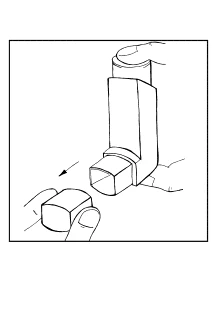
- Remove the mouthpiece cap (as described above in point 1 of the "Checking the inhaler" section). Check that the inside and outside of the mouthpiece are clean and free of foreign objects (Figure A).
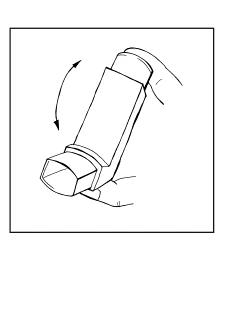
- Shake the inhaler 4 or 5 times to ensure any foreign particles are removed and the contents of the canister are evenly mixed (Figure B).
- Hold the inhaler upright with your thumb placed under the base, below the mouthpiece. Breathe out as fully as possible (Figure C).
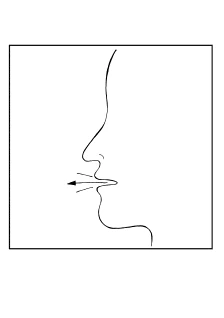
- Place the mouthpiece in your mouth between your teeth and close your lips around it without biting (Figure D).
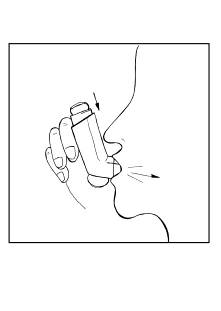
- Begin a slow and deep inhalation and immediately press down on the top of the inhaler to release a dose of medicine, then continue a steady, deep inhalation (Figure D).
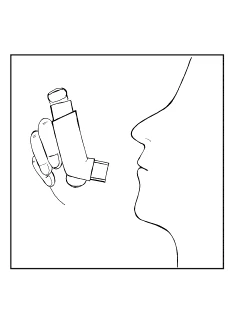
- Remove the inhaler from your mouth and take your finger off the canister while holding your breath. Hold your breath for a few seconds or as long as possible (Figure E).
- To perform a second inhalation, wait about half a minute, then repeat steps 3 to 7.
- To help prevent fungal infections (thrush) and hoarseness, rinse your mouth with water after each dose, spit it out, and (or) brush your teeth.
- After use, immediately replace the protective cap on the mouthpiece to protect it from dust. Proper placement of the cap is indicated by a click. If no audible click is heard, rotate the cap slightly and try again. Do not use excessive force.
Do not rush through steps 4, 5, 6, and 7. It is important to begin a slow inhalation just before pressing
the inhaler. The first few inhalations may be practiced in front of a mirror. If you see a "mist" escaping
from the end of the inhaler or from the corners of your mouth, restart the procedure from step 3.
If you have difficulty using the inhaler or if your doctor or another healthcare professional
recommends it, you may use a spacer device (such as Volumatic or AeroChamber Plus), in accordance
with national guidelines. Your doctor, pharmacist, or other healthcare professional should show you
how to use the inhaler with a spacer, how to clean these devices, and answer any questions. It is
important not to stop using the spacer once you have started using it with the inhaler, without first
discussing it with your doctor. It is also important not to change the type of spacer used without
consulting your doctor. If you stop using a spacer or change the type, your doctor may need to adjust
your dose of medicine to maintain control of asthma symptoms.
Any change in asthma treatment must always be discussed with your doctor.
If you have difficulty handling the inhaler with one hand, you may hold it with both hands. Place
both index fingers on top of the inhaler and both thumbs under the base, below the mouthpiece.
Consider replacing the inhaler when the indicator shows 40 and changes color from green to red.
Stop using the inhaler when the indicator shows 0, as the remaining residue in the inhaler may not
be sufficient to deliver a full dose. Never attempt to alter the number on the indicator or detach the
indicator from the metal canister. The indicator cannot be reset and is permanently attached to the
canister.
Cleaning the inhaler
To prevent blockage, clean the inhaler at least once a week.
To clean the inhaler:
- Remove the mouthpiece cap;
- Do not remove the metal canister from the plastic casing;
- Wipe the inside and outside of the mouthpiece and the plastic casing with a dry cloth or tissue;
- Replace the mouthpiece cap. Proper placement is indicated by a click. If no audible click is heard,
rotate the cap slightly and try again. Do not use excessive force.
Do not immerse the metal canister in water.
Accidental overdose of AirFluSal
It is important to use the inhaler as directed. If you accidentally use more than the recommended
dose, consult your doctor or pharmacist. You may experience a faster than usual heartbeat and
tremors. In addition, dizziness, muscle weakness, and joint pain may occur.
If higher doses are used for a prolonged period, consult your doctor or pharmacist for advice, as
higher doses of AirFluSal may reduce the production of steroid hormones by the adrenal glands.
Missed dose of AirFluSal
Do not use a double dose to make up for a missed dose. Take the next dose at the usual time.
Stopping treatment with AirFluSal
It is important to use AirFluSal daily as directed. The medicine should be used until your doctor
advises stopping. Do not stop using AirFluSal or suddenly reduce the dose without your doctor's
approval, as this may worsen breathing problems.
Additionally, abruptly stopping AirFluSal or reducing the dose may very rarely cause adrenal gland
dysfunction (adrenal insufficiency), which may lead to the following adverse effects:
- abdominal pain
- feeling of fatigue and loss of appetite, nausea
- vomiting and diarrhoea
- weight loss
- headache or drowsiness
- low blood sugar
- low blood pressure and seizures.
During periods of stress, such as fever, injury (e.g. car accident), infection, or surgery, symptoms of
adrenal insufficiency may worsen and any of the adverse effects listed above may occur. If you
experience any adverse effects, consult your doctor or pharmacist. To prevent these symptoms,
your doctor may prescribe additional corticosteroid tablets (e.g. prednisolone).
If you have any further questions about the use of this medicine, consult your doctor or pharmacist.
4. Possible adverse effects
Like all medicines, this medicine can cause adverse effects, although not everyone will experience them.
To minimise the risk of adverse effects in the patient, the doctor will prescribe the lowest dose of AirFluSal that controls asthma effectively.
Allergic reactions: the patient may experience sudden breathing difficulties immediately after
administration of AirFluSal. Wheezing, coughing, or shortness of breath may occur, as well as itching, rash (urticaria), and swelling (usually of the face, lips, tongue, or throat), including sudden sensation of very rapid heartbeat or fainting and dizziness (which may lead to falling or loss of consciousness). If any of these symptoms occur, or if they occur suddenly after using AirFluSal,
treatment with the medicine must be stopped immediately and the doctor must be informed without delay.
Allergic reactions to AirFluSal occur uncommonly (may affect fewer than 1 in 100 people).
Other adverse effects:
Very common (may affect more than 1 in 10 people)
headache (usually resolves during treatment)
increased number of colds in patients with chronic obstructive pulmonary disease (COPD)
Common (may affect fewer than 1 in 10 people)
oral and throat candidiasis (painful creamy-yellow lesions), as well as tongue pain, hoarseness, and throat irritation.
Rinsing the mouth with water and spitting it out immediately and (or) brushing teeth immediately after each inhalation may be helpful. The doctor may prescribe an antifungal medicine to treat candidiasis.
joint pain, swelling of joints, and muscle pain
muscle cramps
In patients with chronic obstructive pulmonary disease (COPD), the following adverse effects have also been reported:
pneumonia and bronchitis
Patients should inform their doctor if any of the following symptoms occur:
increased sputum production, change in sputum colour, fever, chills, worsening cough, or increased difficulty in breathing.
bruising and traumatic fractures
sinusitis (feeling of pressure or fullness in the nose, cheek, and eye areas, sometimes with pulsating pain)
decreased blood potassium levels (which may cause irregular heartbeat, weakness, and muscle cramps)
Uncommon (may affect fewer than 1 in 100 people)
increased blood sugar (glucose) levels (hyperglycaemia)
In patients with diabetes, more frequent monitoring of blood glucose levels may be necessary, and the dose of antidiabetic medicine may need to be adjusted.
cataract (clouding of the lens in the eye)
very rapid heartbeat (tachycardia)
tremor (shakiness) and sensation of rapid or irregular heartbeat (palpitations)
These are usually harmless symptoms that resolve during treatment.
chest pain
feeling of sadness (mainly in children)
sleep disturbances
allergic rash
Rare (may affect fewer than 1 in 1000 people)
difficulty breathing or wheezing that worsens immediately after using AirFluSal
In such a case, treatment with AirFluSal must be stopped immediately. To help breathing, a fast-acting "rescue" bronchodilator should be used by inhalation, and medical advice must be sought immediately.
disturbances in the body's production of steroid hormones, especially if the medicine is used in high doses for a prolonged period
Symptoms include:
- slowed growth in children and adolescents
- thinning of bone tissue
- glaucoma
- weight gain
- rounded ("moon-shaped") face (Cushing's syndrome). The doctor will systematically check whether any of these adverse effects occur and ensure that the patient is using the lowest possible dose of AirFluSal.
behavioural changes such as unusual excitability and irritability. These symptoms occur mainly in children.
irregular heartbeat or extra heartbeats (arrhythmia). The doctor should be informed, but treatment with AirFluSal should not be stopped without medical advice.
fungal infection of the oesophagus, which may cause difficulty in swallowing
Frequency not known (cannot be estimated from available data), but may also occur:
depression or aggression. These symptoms occur mainly in children.
blurred vision
Reporting of adverse effects
If any adverse effects occur, including any not listed in this leaflet, patients should inform their doctor, pharmacist, or nurse. Adverse effects can be reported directly to the Department of Monitoring Adverse Drug Reactions of the Office for Registration of Medicinal Products, Medical Devices and Biocidal Products: Al. Jerozolimskie 181C, 02-222 Warsaw
tel.: + 48 22 49 21 301, fax: + 48 22 49 21 309, website: https://smz.ezdrowie.gov.pl
Adverse effects can also be reported to the marketing authorisation holder.
Reporting adverse effects helps to provide more information on the safety of the medicine.
5. How to store AirFluSal
Keep this medicine out of the sight and reach of children.
Do not use this medicine after the expiry date stated on the label and the outer carton following EXP. The expiry date refers to the last day of the stated month.
The batch number on the packaging is marked as "Lot".
Store below 25ºC.
Keep the container in the outer packaging to protect it from light.
The container contains a pressurised suspension.
Do not expose the container to temperatures above 50°C.
Do not pierce the container.
Do not puncture, damage, or burn the container, even if it is empty.
Do not store in a refrigerator or freeze.
As with most inhaled medicines in pressurised containers, the effectiveness of this medicinal product may be reduced if the inhaler is cold.
Medicines must not be disposed of via the sewage system or household waste. Ask your pharmacist how to dispose of medicines no longer required. This will help protect the environment.
6. Contents of the packaging and other information
What AirFluSal contains
The active substances in this medicine are salmeterol (as salmeterol xinafoate) and fluticasone propionate.
AirFluSal 25 µg + 125 µg: Each metered dose contains 25 micrograms of salmeterol (as salmeterol xinafoate) and 125 micrograms of fluticasone propionate.
AirFluSal 25 µg + 250 µg: Each metered dose contains 25 micrograms of salmeterol (as salmeterol xinafoate) and 250 micrograms of fluticasone propionate.
The other ingredient is norflurane (HFA 134a) – propellant gas.
What AirFluSal looks like and contents of the pack
The inhaler consists of an aluminium container (an aerosol container coated with FCP plasma) with a suitable metering valve, a dosing unit made of polypropylene (PP), a PP cap, and a dose counter, all packed in a cardboard box.
The container holds a white, homogeneous suspension.
Each container contains 120 metered doses.
Pack sizes
1 inhaler with 120 doses of medicine.
Marketing Authorisation Holder and Manufacturer
Marketing Authorisation Holder
Sandoz GmbH
Biochemiestrasse 10
6250 Kundl, Austria
Manufacturer/Importer
Salutas Pharma GmbH
Otto-von-Guericke-Allee 1
39179 Barleben, Germany
For further information about this medicine and its trade names in the countries of the European Economic Area, please contact:
Sandoz Polska Sp. z o.o.
ul. Domaniewska 50C
02-672 Warszawa
tel. +48 22 209 70 00