Sebidin
Poland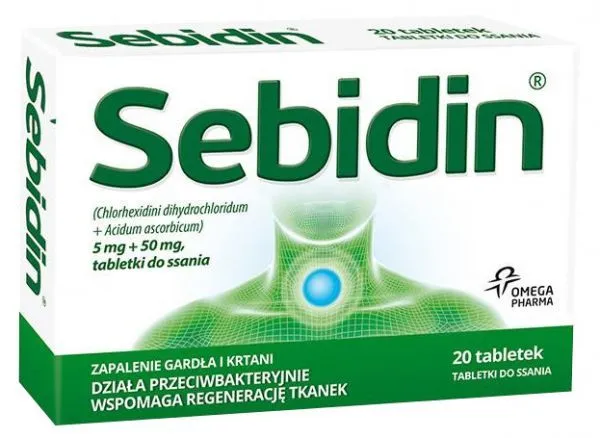
Table of Contents
Patient Information Leaflet
Sebidin, 5 mg + 50 mg, lozenges
Chlorhexidini dihydrochloridum + Acidum ascorbicum
Please read all of this leaflet carefully before taking this medicine, as it contains
important information for you.
This medicine should always be taken exactly as described in this patient leaflet or as directed by your
doctor or pharmacist.
- Keep this leaflet so that you can read it again if necessary.
- If you need advice or further information, please consult your pharmacist.
- If you experience any adverse reactions, including any not listed in this leaflet, inform your doctor or pharmacist. See section 4.
- If there is no improvement after 3 days, or if you feel worse, consult your doctor.
Table of contents
- What Sebidin is and what it is used for
- Important information before taking Sebidin
- How to take Sebidin
- Possible side effects
- How to store Sebidin
- Contents of the pack and other information
1. What Sebidin is and what it is used for
Sebidin lozenges are a combination medicine containing chlorhexidine dihydrochloride and vitamin C. Chlorhexidine dihydrochloride has antibacterial properties: it acts bacteriostatically and bactericidally against Gram-positive and Gram-negative bacteria, as well as against the yeast Candida albicans.
Vitamin C participates in collagen formation and tissue regeneration.
It helps meet the increased requirement for vitamin C occurring during inflammatory conditions of the mucous membranes of the pharynx and larynx.
Sebidin is indicated for:
- Local symptomatic treatment of inflammation of the mucous membranes of the pharynx and larynx.
2. Information before using Sebidin
When not to use Sebidin
- If the patient is allergic to chlorhexidine, vitamin C, or any of the other ingredients of this medicine (listed in section 6).
Warnings and precautions
- Before starting to use Sebidin, consult your doctor or pharmacist.
- If there is no improvement after 3 days or if the patient feels worse, contact a doctor.
- If the doctor recommends continuing treatment, do not use the medicine for longer than 14 days without consulting a doctor again.
- The medicine may cause taste disturbances, which usually resolve within 4 hours after administration.
- With prolonged use, discoloration of teeth and tongue may occur, which resolves spontaneously or may require removal by a doctor.
- In isolated cases, patients with gastrointestinal or liver disorders may experience stomach and intestinal disturbances such as nausea, vomiting, and belching. In such cases, discontinue use of the medicine.
Sebidin with other medicines
Inform your doctor or pharmacist about all medicines the patient is currently taking or has recently taken, as well as any medicines the patient plans to use.
No interactions between Sebidin and other medicines have been reported.
Sebidin with food and drink
It is recommended to take the medicine after eating.
Pregnancy and breastfeeding
During pregnancy or breastfeeding, or if pregnancy is suspected or planned, consult a doctor or pharmacist before using this medicine. If the patient is pregnant or breastfeeding, suspects she may be pregnant, or is planning to become pregnant, she should consult a doctor or pharmacist before using this medicine.
Driving and operating machinery
Sebidin has no effect on the ability to drive or operate machinery.
Sebidin contains sucrose
If the patient has previously been diagnosed with intolerance to certain sugars, the patient should consult a doctor before taking this medicine. This medicine may be harmful to teeth.
Sebidin contains a colouring agent – carmine red (E124)
This medicine may cause allergic reactions.
3. How to use Sebidin
This medicine should always be taken exactly as described in this patient information leaflet or as directed by a doctor or pharmacist. If in doubt, consult a doctor or pharmacist.
The recommended dose is 1 tablet 4 times daily (every 6 hours).
Use in children and adolescents aged 12 years and older, and adult patients
For oral mucosa. Suck 1 tablet 4 times daily (every 6 hours).
Due to the presence of sucrose, caution is advised when administering to patients with diabetes or those prone to dental caries.
It is recommended to use the medicine after a meal and after tooth cleaning. For 2 hours after application, rinsing the mouth or drinking large amounts of fluid is not recommended.
Use of a higher than recommended dose of Sebidin
If more than the recommended dose is taken, consult a doctor or pharmacist.
Missed dose of Sebidin
Continue treatment as prescribed.
Do not take a double dose to make up for a missed dose.
Stopping treatment with Sebidin
If you have any further questions regarding the use of this medicine, consult your doctor or pharmacist.
4. Possible adverse reactions
Like any medicine, this medicine can cause adverse reactions, although not everybody experiences them.
Uncommonly, the following may occur:
- allergic reactions
- skin rashes
- superficial desquamation of the oral mucosal epithelium
- swelling of the parotid glands
- irritation or inflammation of the oral mucosa
- gastric irritation and diarrhoea.
Use for more than 7 days may result in adverse reactions such as discolouration of the tongue dorsum, tooth surfaces, and acrylic-based dental prostheses, which resolve spontaneously.
Reporting of adverse reactions
If any adverse reactions occur, including any adverse reactions not listed in this leaflet, inform your doctor, pharmacist, or nurse. Adverse reactions can be reported directly to the Department of Monitoring Adverse Drug Reactions at the Office for Registration of Medicinal Products, Medical Devices and Biocidal Products:
Al. Jerozolimskie 181C, 02-222 Warsaw,
tel.: 22 49-21-301, fax: 22 49-21-309,
website: https://smz.ezdrowie.gov.pl
Adverse reactions can also be reported to the marketing authorization holder.
Reporting adverse reactions enables better assessment of the medicine's safety.
5. How to store the medicine Sebidin
Keep the medicine out of the sight and reach of children.
Store below 25°C.
Store in the original packaging to protect from light and moisture.
Do not use this medicine after the expiry date stated on the packaging after: "EXP".
The expiry date refers to the last day of the stated month.
Medicines must not be disposed of via wastewater or household waste. Ask your pharmacist how to dispose of medicines no longer required. This helps protect the environment.
6. Contents of the pack and other information
What Sebidin contains
- The active substances are: chlorhexidine dihydrochloride and L-ascorbic acid (vitamin C). Each tablet contains 5 mg of chlorhexidine dihydrochloride and 50 mg of ascorbic acid.
- Other ingredients are: sucrose, methylcellulose, talc, magnesium stearate, quinoline yellow (E104), carmine red (E124), peppermint flavour.
What Sebidin looks like and contents of the pack
Sebidin lozenges are pink-orange in colour, flat, round tablets with bevelled edges.
20 tablets. 1 blister containing 20 tablets.
PVC/PVDC/Al foil blister in a cardboard carton.
Marketing Authorisation Holder and Manufacturer
Marketing Authorisation Holder:
Perrigo Poland Sp. z o.o. [+logo]
ul. Domaniewska 48
02-672 Warsaw
tel.: +48 (22) 852 55 51
Manufacturer:
Richard Bittner AG
Ossiacherstraβe 7
9560 Feldkirchen
Austria