Rovamycine
Poland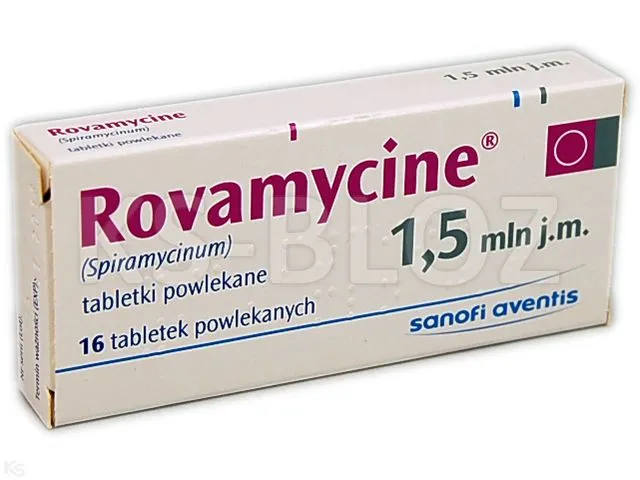
Table of Contents
Patient Information Leaflet
ROVAMYCINE, 1.5 million IU, coated tablets
ROVAMYCINE, 3 million IU, coated tablets
Spiramycinum
Please read this leaflet carefully before taking this medicine, as it contains important information for you.
- Keep this leaflet. You may need to read it again.
- If you have any further questions, please ask your doctor or pharmacist.
- This medicine has been prescribed for you only. Do not pass it on to others. It may harm them, even if their symptoms are the same as yours.
- If you experience any side effects, including any not listed in this leaflet, tell your doctor or pharmacist. See section 4.
Leaflet Contents
- What Rovamycine is and what it is used for
- Important information before taking Rovamycine
- How to take Rovamycine
- Possible side effects
- How to store Rovamycine
- Contents of the pack and other information
1. What Rovamycine is and what it is used for
Rovamycine is available as coated tablets and contains the active substance spiramycin.
Spiramycin is an antibiotic belonging to the macrolide group.
Indications for Rovamycine
- Infections of the upper and lower respiratory tract:
- Pharyngitis and tonsillitis caused by group A streptococci (Streptococcus pyogenes);
- Sinusitis caused by: Streptococcus pneumoniae, Haemophilus influenzae, Moraxella catarrhalis, Staphylococcus aureus;
- Otitis media caused by: Streptococcus pneumoniae, Haemophilus influenzae, Moraxella catarrhalis, Mycoplasma pneumoniae, Chlamydia trachomatis;
- Acute pneumonia and bronchitis caused by: Streptococcus pyogenes, Streptococcus pneumoniae, Staphylococcus aureus;
- Atypical pneumonia caused by: Legionella pneumophila, Chlamydia psittaci, Mycoplasma pneumoniae.
- Prophylaxis of congenital toxoplasmosis.
- Prophylaxis of meningococcal meningitis in carriers of Neisseria meningitidis in the nasopharynx.
- Prevention of rheumatic fever recurrences, only in patients allergic to penicillin.
- In dentistry, for acute conditions: abscesses, hyperaemic oral inflammation, acute gingivitis, ulcerative necrotizing gingivitis.
- Urethritis caused by Chlamydia trachomatis of various serotypes.
- Skin infections caused by Staphylococcus aureus and Streptococcus pyogenes.
- Cryptosporidiosis caused by Cryptosporidium muris.
- Toxoplasmosis in pregnant women.
2. Important information before using Rovamycine
When not to use Rovamycine:
- if the patient is allergic to the active substance or to any of the other ingredients of this medicine (listed in section 6).
Warnings and precautions
Before starting treatment with Rovamycine, discuss this with your doctor.
If the patient experiences symptoms of allergy while taking Rovamycine, the medicine should be discontinued and medical advice should be sought immediately.
If the patient is allergic to other antibiotics of the macrolide group, Rovamycine should be used with caution and, in case of any disturbing symptoms, medical advice should be sought.
If diarrhoea occurs during treatment, contact your doctor immediately and do not use drugs that inhibit intestinal peristalsis. Cases of pseudomembranous colitis have been reported after using broad-spectrum antibiotics; therefore, this possibility should be considered in patients who develop severe diarrhoea during or after antibiotic therapy.
Spiramycin is excreted in small amounts in urine, and dose adjustment is not necessary in renal impairment.
Use with caution in patients with hepatic insufficiency due to the possibility of increased adverse reactions.
The use of spiramycin is not recommended in patients with glucose-6-phosphate dehydrogenase deficiency, as acute haemolysis has been observed very rarely in such patients after administration of spiramycin.
QT interval prolongation
Cases of QT interval prolongation have been observed during treatment with macrolide antibiotics, including spiramycin. Therefore, caution should be exercised when using spiramycin in patients with conditions predisposing to QT interval prolongation, such as patients:
- with electrolyte imbalances (e.g., low blood potassium and/or magnesium levels),
- with congenital long QT syndrome,
- with heart diseases (e.g., heart failure, myocardial infarction, slow heart rate, i.e. bradycardia),
- concurrently taking other drugs that prolong the QT interval (such as antiarrhythmic drugs of class IA and class III, tricyclic antidepressants, certain antimicrobial agents, antipsychotic drugs). Elderly patients, newborns, and women may be more susceptible to the QT-prolonging effect.
Severe skin adverse reactions
During treatment with Rovamycine, cases of severe cutaneous adverse reactions have been reported, such as: Stevens-Johnson syndrome, toxic epidermal necrolysis, and acute generalized exanthematous pustulosis (AGEP).
Patients should be informed about the subjective and objective symptoms and should be closely monitored for any skin reactions. If symptoms of Stevens-Johnson syndrome, toxic epidermal necrolysis (e.g., progressive rash, often with blisters or mucosal lesions), or acute generalized exanthematous pustulosis occur, treatment with Rovamycine should be discontinued immediately.
Children and adolescents
Administration of tablets is not recommended in children under 6 years of age (risk of choking).
Rovamycine with other medicines
Inform your doctor about all medicines currently taken or recently taken, as well as any medicines the patient plans to use.
This particularly concerns the concomitant use of spiramycin with medicines containing levodopa and carbidopa – a modification of the levodopa dose may be required.
QT-prolonging drugs
Spiramycin, like other macrolide antibiotics, should be used cautiously in patients concurrently receiving drugs that prolong the QT interval (e.g., antiarrhythmic drugs of class IA and class III, tricyclic antidepressants, certain antimicrobial agents, antipsychotic drugs).
Hydroxychloroquine or chloroquine (medicines used to treat rheumatoid arthritis, and for treatment and prevention of malaria)
Concomitant use of hydroxychloroquine or chloroquine with Rovamycine may increase the risk of life-threatening cardiac adverse effects.
Rovamycine with food and drink
The medicine may be taken with food or independently of meals.
Pregnancy and breastfeeding
If the patient is pregnant or breastfeeding, suspects she may be pregnant, or is planning to have a baby, she should consult her doctor before using this medicine.
Rovamycine may be used in pregnant women only if clearly necessary.
If treatment with spiramycin is required, breastfeeding should be discontinued.
Driving and operating machinery
No data available.
Rovamycine contains sodium
This medicine contains less than 1 mmol (23 mg) of sodium per tablet, i.e. the medicine is considered "sodium-free".
3. How to use Rovamycine
This medicine should always be used exactly as directed by the physician. In case of doubt, consult
your doctor.
Recommended dosage
Adults
Basic dose: 6 million IU per day in two divided doses; this dose may be increased to
9 million IU per day, administered in three divided doses.
In streptococcal group A throat and tonsil infections, treatment lasts 10 days.
Prophylaxis of meningococcal meningitis: 3 million IU every 12 hours for 5 days.
Children
Basic dose: 150,000 IU/kg body weight per day in 2–3 divided doses;
this dose may be increased to 300,000 IU/kg body weight per day, administered in 2–3 divided
doses.
In streptococcal group A throat and tonsil infections, treatment lasts 10 days.
Prophylaxis of meningococcal meningitis: 75,000 IU/kg body weight every 12 hours for
5 days.
Method of administration
Tablets should be swallowed whole with a glass of water.
Use of a higher than recommended dose of Rovamycine
After taking large doses, gastrointestinal symptoms may occur: nausea, vomiting, diarrhoea.
In case of spiramycin overdose, the physician may order a heart examination (ECG), especially if the
patient has risk factors for QT interval prolongation on ECG (low blood potassium levels, congenital
QT prolongation, concomitant use of drugs prolonging the QT interval or increasing the risk of
ventricular cardiac arrhythmias).
There is no specific and effective antidote available after spiramycin overdose. In case of poisoning,
symptomatic treatment is recommended.
If an overdose has occurred, seek immediate medical advice from a doctor or pharmacist.
Missed dose of Rovamycine
If a dose is missed, take it as soon as possible, unless it is almost time for the next dose. Do not take
two doses at the same time or within a short interval.
In case of doubt, consult your doctor.
Stopping treatment with Rovamycine
Do not discontinue treatment without consulting your doctor. Continue treatment for as long as
recommended by the physician.
If you have any further questions about the use of this medicine, consult your doctor.
4. Possible adverse reactions
Like all medicines, this medicine can cause adverse reactions, although not everyone experiences them.
The following adverse reactions may occur during treatment with this medicine.
Very common adverse reactions (may affect more than 1 in 10 people):
- transient paresthesia (sensory disturbances).
Common adverse reactions (may affect up to 1 in 10 people):
- transient taste disturbances,
- abdominal pain, nausea, vomiting, diarrhea, and pseudomembranous colitis during oral treatment (symptoms include: diarrhea, abdominal pain, fever, which may lead to dehydration),
- rash.
Adverse reactions with unknown frequency (cannot be estimated from available data):
- acute hemolysis (damage to red blood cells) (see section "Warnings and precautions"), leukopenia, neutropenia (blood count abnormalities),
- anaphylactic shock (severe, life-threatening allergic reaction), vasculitis, including Henoch-Schönlein purpura (a disease whose symptoms include petechiae most commonly appearing on legs or feet, joint pain and swelling, abdominal pain),
- cardiac arrhythmias, such as ventricular arrhythmias, ventricular tachycardia, torsade de pointes type arrhythmias, which may lead to cardiac arrest (see section "Warnings and precautions"),
- cholestatic or mixed hepatitis,
- urticaria, pruritus, angioedema (swelling of skin and mucous membranes, possibly involving the respiratory tract, which may be life-threatening), Stevens-Johnson syndrome, toxic epidermal necrolysis, acute generalized exanthematous pustulosis (see section "Warnings and precautions"),
- QT interval prolongation in ECG, abnormal liver function tests.
Reporting of adverse reactions
If any adverse reactions occur, including any possible adverse reactions not listed in this leaflet, inform your doctor or pharmacist.
Adverse reactions can be reported directly to the Department of Monitoring Adverse Drug Reactions at the Office for Registration of Medicinal Products, Medical Devices and Biocidal Products:
Al. Jerozolimskie 181C, 02-222 Warsaw
Tel.: +48 22 49 21 301
Fax: +48 22 49 21 309
Website: https://smz.ezdrowie.gov.pl
Adverse reactions can also be reported to the marketing authorization holder or its representative in Poland.
Reporting adverse reactions helps provide more information on the safety of this medicine.
5. How to store Rovamycine
Store below 25°C.
Keep the medicine out of the sight and reach of children.
Do not use this medicine after the expiry date stated on the packaging after EXP.
The expiry date refers to the last day of the stated month.
Medicines must not be disposed of via wastewater or household waste. Ask your pharmacist how to dispose of medicines no longer required. This will help protect the environment.
6. Contents of the pack and other information
What Rovamycine contains
- The active substance is spiramycin. One coated tablet contains 1.5 million IU or 3 million IU of spiramycin.
- Other ingredients are: pregelatinized corn starch, hydroxypropylcellulose, sodium croscarmellose, magnesium stearate, colloidal anhydrous silica, microcrystalline cellulose; film-coating ingredients: hypromellose, macrogol 6000, titanium dioxide (E171).
What Rovamycine looks like and contents of the pack
Rovamycine, 1.5 million IU: white or cream-white, biconvex, round tablet, with the imprint "RPR 107" on one side.
Rovamycine, 3 million IU: white or cream-white, biconvex, round tablet, with the imprint "ROVA 3" on one side.
Rovamycine, 1.5 million IU: pack contains 16 coated tablets.
Rovamycine, 3 million IU: pack contains 10 coated tablets.
Marketing Authorisation Holder
The Simple Pharma Company Limited
Ground Floor, 71 Lower Baggot Street,
Dublin, D02 P593, Ireland
Manufacturer
Sanofi S.r.l.
Strada Statale 17, Km 22
67019 Scoppito (AQ)
Italy