Potassium chloride 0,15% + glucose 5% b. braun
Poland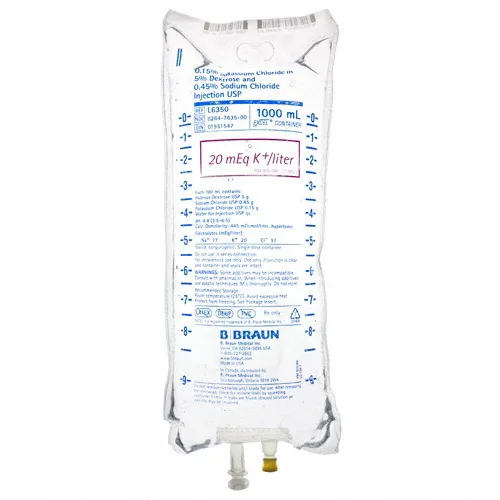
Table of Contents
- Package leaflet: Information for the user
- 1. What Potassium Chloride 0.15% + Glucose 5% B. Braun and Potassium Chloride 0.3% + Glucose 5% B. Braun are and what they are used for
- 2. Important information before using Potassium Chloride 0.15% + Glucose 5% B. Braun and Potassium Chloride 0.3% + Glucose 5% B. Braun
- 3. How to use Potassium Chloride 0.15% + Glucose 5% B. Braun and Potassium Chloride 0.3% + Glucose 5% B. Braun
- 4. Possible adverse reactions
- 5. How to store Potassium Chloride 0.15% + Glucose 5% B. Braun and Potassium Chloride 0.3% + Glucose 5% B. Braun
- 6. Contents of the packaging and other information
- Information intended exclusively for medical professionals:
Package leaflet: Information for the user
Potassium Chloride 0.15% + Glucose 5% B. Braun, 1.5 g/l + 55.0 g/l, solution for infusion
Potassium Chloride 0.3% + Glucose 5% B. Braun, 3.0 g/l + 55.0 g/l, solution for infusion
Potassium chloride + Glucose monohydrate
Please read all of this leaflet carefully before use, as it contains important information for the patient.
- Keep this leaflet for future reference.
- If you have any questions, consult your doctor or pharmacist.
- This medicine has been prescribed for a specific individual. Do not pass it on to others. This medicine may harm others, even if their symptoms are the same.
- If any side effects occur, including any not listed in this leaflet, inform your doctor or pharmacist. See section 4.
Leaflet contents:
- What Potassium Chloride 0.15% + Glucose 5% B. Braun and Potassium Chloride 0.3% + Glucose 5% B. Braun are and what they are used for
- Important information before using Potassium Chloride 0.15% + Glucose 5% B. Braun and Potassium Chloride 0.3% + Glucose 5% B. Braun
- How to use Potassium Chloride 0.15% + Glucose 5% B. Braun and Potassium Chloride 0.3% + Glucose 5% B. Braun
- Possible side effects
- How to store Potassium Chloride 0.15% + Glucose 5% B. Braun and Potassium Chloride 0.3% + Glucose 5% B. Braun
- Contents of the pack and other information
1. What Potassium Chloride 0.15% + Glucose 5% B. Braun and Potassium Chloride 0.3% + Glucose 5% B. Braun are and what they are used for
These medicines contain a solution of potassium chloride and glucose. They are administered through a thin tube directly into a vein (intravenous infusion).
These medicines will be given to maintain or restore potassium balance and to meet energy requirements.
2. Important information before using Potassium Chloride 0.15% + Glucose 5% B. Braun and Potassium Chloride 0.3% + Glucose 5% B. Braun
When not to use Potassium Chloride 0.15% + Glucose 5% B. Braun or Potassium Chloride 0.3% + Glucose 5% B. Braun
- in case of excessively high levels of potassium or chloride in the blood (hyperkalemia or severe hyperchloremia),
- in case of severe kidney disease,
- in case of head injury (during the first 24 hours following the injury),
- in case of excessive water in the body (overhydration),
- in case of excessively high blood glucose levels (hyperglycemia).
Warnings and precautions
Before starting treatment with Potassium Chloride 0.15% + Glucose 5% B. Braun or Potassium Chloride 0.3% + Glucose 5% B. Braun, discuss this with your doctor.
Before or during administration of this medicine, your doctor will pay special attention to the following:
-
Kidney function
This medicine will be administered by slow intravenous infusion, only after the doctor has confirmed normal kidney function in the patient. If kidney function abnormalities are detected, blood potassium levels and ECG results will be monitored during the infusion. If the patient's condition worsens, the infusion must be stopped. -
Heart diseases
Extreme caution must be exercised when administering this medicine to patients with heart diseases. -
Swelling of the lower limbs or fluid accumulation in the lungs (pulmonary edema)
Particular caution is required when administering large volumes of this medicine to patients who have one of the above conditions. -
Blood electrolyte (salt) levels
Patients receiving this medicine who are also in a critical condition, experiencing pain, postoperative stress, infections, burns, nervous system, heart, liver or kidney disorders, as well as patients taking drugs that enhance the action of vasopressin (a hormone responsible for regulating fluid balance in the body), are particularly at risk of developing low blood sodium levels (acute hyponatremia), which may lead to brain swelling (encephalopathy).
Children, women of childbearing age, and patients with severe brain disorders, such as meningitis (infection of the membranes surrounding the brain) or patients with brain injuries (intracranial hemorrhage, cerebral contusion), are especially vulnerable to severe and life-threatening brain swelling caused by excessive drop in blood sodium levels.
To avoid low blood sodium levels (hyponatremia), appropriate amounts of sodium may be administered additionally.
-
Certain types of diabetes
This medicine should be administered with caution in:- patients with diabetes,
- patients with carbohydrate metabolism disorders (e.g., when taking certain medications – also refer to section “Potassium Chloride 0.15% + Glucose 5% B. Braun or Potassium Chloride 0.3% + Glucose 5% B. Braun and other medicines”). Blood glucose levels should be monitored.
-
Blood transfusions
This medicine should not be administered simultaneously, immediately before, or immediately after blood transfusion through the same intravenous line. -
Patients after stroke
This medicine should generally not be administered to patients undergoing or who have recently experienced a stroke, unless the doctor considers it necessary for recovery. -
Elevated blood potassium levels
This may occur when the patient suffers from a condition causing elevated blood potassium levels, such as Addison's disease (adrenal cortex insufficiency) or sickle cell anemia (a hereditary disorder of red blood cells).
During administration of this medicine, ECG results, fluid and electrolyte balance, and blood glucose levels should be monitored regularly.
Adequate vitamin supplementation (particularly vitamin B) should be ensured.
Patients should be closely monitored and dosage adjusted when administering this medicine to elderly patients, as they are more susceptible to heart and kidney diseases.
Children and adolescents
Children are particularly susceptible to severe and life-threatening brain swelling caused by abnormally low blood sodium levels. Extreme caution should be exercised when using this medicine in children and adolescents. Fluid and electrolyte balance should be closely monitored.
Potassium Chloride 0.15% + Glucose 5% B. Braun or Potassium Chloride 0.3% + Glucose 5% B. Braun and other medicines
Inform your doctor about all medicines currently or recently taken, as well as any medicines you plan to take.
Inform your doctor if you are taking digoxin or similar heart-stimulating medicines, as Potassium Chloride 0.15% + Glucose 5% B. Braun and Potassium Chloride 0.3% + Glucose 5% B. Braun may affect their action. In such cases, dosage adjustment of Potassium Chloride 0.15% + Glucose 5% B. Braun or Potassium Chloride 0.3% + Glucose 5% B. Braun may be necessary.
Also inform your doctor if you are taking medicines containing potassium or that may increase potassium levels in the body, such as:
- potassium-sparing agents, e.g., spironolactone or triamterene (diuretics),
- ACE inhibitors (medicines used to treat hypertension or heart conditions),
- AT receptor antagonists (a type of blood pressure-lowering medicine),
- nonsteroidal anti-inflammatory drugs (used in acute or chronic pain and inflammatory conditions),
- cyclosporine, tacrolimus (medicines used after organ transplantation),
- suxamethonium (a medicine used during anesthesia).
Extreme caution is required when using potassium-retaining medicines, as this may lead to heart problems (cardiac arrhythmias). When taking certain medicines such as corticosteroids, ACTH, and loop diuretics, increased potassium excretion by the kidneys may occur.
Extreme caution is required when using the following medicines simultaneously, as they act similarly to vasopressin or enhance its action, increasing the risk of low blood sodium levels (hyponatremia):
- Carbamazepine and oxcarbazepine used in epilepsy treatment.
- Clofibrate, used to treat high blood lipid levels.
- Vincristine and ifosfamide used in anticancer therapy.
- Cyclophosphamide used in anticancer therapy and treatment of autoimmune diseases.
- Selective serotonin reuptake inhibitors (SSRIs) used in depression treatment.
- Antipsychotic medicines used in treatment of psychiatric disorders.
- Opioid analgesics used to treat severe pain.
- Nonsteroidal anti-inflammatory drugs (NSAIDs) used to treat mild to moderate pain and inflammatory conditions.
- Chlorpropamide, used in diabetes treatment (high blood glucose levels after meals).
- Desmopressin, used in treatment of diabetes insipidus (extreme thirst and excessive production of large amounts of diluted urine).
- Oxytocin, used during childbirth.
- Vasopressin and terlipressin, used in treatment of "bleeding esophageal varices" (enlarged veins in the esophagus due to liver problems).
- 3,4-methylenedioxy-N-methamphetamine (MDMA, "ecstasy"), a narcotic.
- Diuretics or water tablets (medicines that increase urine excretion).
Pregnancy and breastfeeding
If you are pregnant, breastfeeding, suspect you may be pregnant, or are planning to have a child, you should consult your doctor before using this medicine.
This medicine may be administered to pregnant or breastfeeding women if the doctor considers it necessary.
Driving and operating machinery
Potassium Chloride 0.15% + Glucose 5% B. Braun and Potassium Chloride 0.3% + Glucose 5% B. Braun have no effect on the ability to drive or operate machinery.
3. How to use Potassium Chloride 0.15% + Glucose 5% B. Braun and Potassium Chloride 0.3% + Glucose 5% B. Braun
This medicine should always be used as directed by the physician. In case of doubt, consult your doctor.
Your doctor will monitor fluid balance, blood glucose and electrolyte levels (including sodium) before and during treatment, particularly in patients with increased vasopressin production (a hormone regulating body fluid levels) and in patients taking medicines with effects similar to vasopressin, due to the risk of decreased blood sodium concentration (hyponatremia). See also sections "Warnings and precautions", "Potassium Chloride 0.15% + Glucose 5% B. Braun or Potassium Chloride 0.3% + Glucose 5% B. Braun with other medicines", and "Possible side effects".
Dosage
The recommended dose will be determined by the physician according to the patient's age, body weight, and clinical condition, particularly cardiac and renal function. During administration of this medicine, blood glucose and electrolyte (salt) concentrations, fluid balance, and ECG findings will be routinely monitored.
The physician will check whether urine output is adequate.
The recommended maximum dose for adult patients is 40 ml/kg body weight/day. If higher potassium intake is required, the physician may consider using a product with different strength.
This medicine may be administered as long as there is a need for parenteral supply of energy, electrolytes, and fluids.
Elderly patients
In general, the same dosage as in other adult patients may be used. However, in elderly patients, dose adjustment may be necessary to eliminate the risk of cardiovascular and renal disturbances.
Children and adolescents
Dosage in children and adolescents will depend on individual requirements. Lower doses may be used.
Method of administration
This medicine will be administered through a tube inserted directly into a vein (intravenous infusion).
Use of a higher than recommended dose of Potassium Chloride 0.15% + Glucose 5% B. Braun or Potassium Chloride 0.3% + Glucose 5% B. Braun
Overdose is unlikely, as the dose is determined by the physician.
Symptoms of overdose
If too high a dose of this medicine is administered, disturbances in electrolyte, sugar, water, and acid-base balance may occur. Fluid accumulation in the body and potassium poisoning (hyperkalemia) may also develop.
In particular, blood potassium levels may increase significantly. Symptoms may include:
- low blood pressure (hypotension),
- irregular heartbeat or cardiac arrest,
- ECG abnormalities, up to cardiac arrest,
- general weakness and apathy,
- muscle weakness, inability to move,
- pronounced numbness, weakness, or heaviness in the legs,
- feeling of disorientation.
If you have any further questions about the use of this medicine, consult your doctor or pharmacist.
4. Possible adverse reactions
Like all medicines, this medicine can cause adverse reactions, although not everyone will experience them.
Inform your doctor if you experience pain or excessive sensitivity to touch,
or redness and blood clots at the injection site.
Frequency unknown (frequency cannot be determined from available data)
- Hospital-related abnormally low blood sodium levels (hyponatremia)
- Brain swelling caused by abnormally low blood sodium levels (hyponatremic encephalopathy). This may lead to irreversible brain damage and death. Symptoms include: headache, nausea, vomiting, seizures, fatigue, and lack of energy.
Reporting of adverse reactions
If any adverse reactions occur, including any adverse reactions not listed in this leaflet, inform your doctor, pharmacist, or nurse.
Adverse reactions can be reported directly to the Department of Monitoring Adverse Drug Reactions of the Office for Registration of Medicinal Products, Medical Devices and Biocidal Products:
Al. Jerozolimskie 181C, 02-222 Warsaw
Tel.: + 48 22 49 21 301
Fax: + 48 22 49 21 309
Website: https://smz.ezdrowie.gov.pl
Adverse reactions can also be reported to the marketing authorization holder.
Reporting adverse reactions helps to provide more information on the safety of the medicine.
5. How to store Potassium Chloride 0.15% + Glucose 5% B. Braun and Potassium Chloride 0.3% + Glucose 5% B. Braun
In unopened packaging: do not store above 25°C.
Keep the medicine out of the sight and reach of children.
Do not use this medicine after the expiry date stated on the labels of the bottle and carton after EXP. The expiry date refers to the last day of the specified month.
Do not use the medicine if it is cloudy or discoloured, if particles are visible in the solution, or if the packaging or closure is damaged.
The container is intended for single use only. The container and any remaining medicine should be discarded after use.
The medicine should be administered immediately. If the medicine is not administered immediately, the user is responsible for the storage period and conditions. Medicines must not be disposed of via wastewater or household waste. Ask your pharmacist how to dispose of medicines no longer required. Such measures will help protect the environment.
6. Contents of the packaging and other information
What Potassium Chloride 0.15% + Glucose 5% B. Braun and Potassium Chloride 0.3% + Glucose 5% B. Braun contain
- The active substances are potassium chloride and glucose.
1 ml of Potassium Chloride 0.15% + Glucose 5% B. Braun contains 1.5 mg of potassium chloride and 50 mg of glucose (equivalent to 55 mg of monohydrate glucose).
1 ml of Potassium Chloride 0.3% + Glucose 5% B. Braun contains 3 mg of potassium chloride and 50 mg of glucose (equivalent to 55 mg of monohydrate glucose).
1000 ml of Potassium Chloride 0.15% + Glucose 5% B. Braun contains 20 mmol of potassium and 20 mmol of chloride.
1000 ml of Potassium Chloride 0.3% + Glucose 5% B. Braun contains 40 mmol of potassium and 40 mmol of chloride. - The other ingredient is water for injections.
- Energy: 835 kJ/l ≙ 200 kcal/l
Theoretical osmolality:
Potassium Chloride 0.15% + Glucose 5% B. Braun: 318 mOsm/l
Potassium Chloride 0.3% + Glucose 5% B. Braun: 358 mOsm/l
pH approximately 3.5 – 6.5
What Potassium Chloride 0.15% + Glucose 5% B. Braun and Potassium Chloride 0.3% + Glucose 5% B. Braun look like and contents of the pack
Potassium Chloride 0.15% + Glucose 5% B. Braun and Potassium Chloride 0.3% + Glucose 5% B. Braun are clear, colourless to slightly straw-coloured aqueous solutions of potassium chloride and glucose in water.
They are supplied in polyethylene bottles with a capacity of 500 ml or 1000 ml, available in packs of 10 units.
Not all pack sizes may be marketed.
Marketing Authorisation Holder:
B. Braun Melsungen AG
Carl-Braun Strasse 1
34212 Melsungen
Germany
Manufacturer:
B. Braun Melsungen AG
Carl-Braun Strasse 1
34212 Melsungen
Germany
and
B. BRAUN Medical S.A.
Carretera de Terrassa 121,
08191 Rubi, Barcelona
Spain
For further information about this medicinal product, please contact the representative of the Marketing Authorisation Holder in Poland:
Aesculap Chifa sp. z o.o.
ul. Tysiąclecia 14
64-300 Nowy Tomyśl
Telephone: +48 61 442 01 00
Fax: +48 61 443 75 05
E-mail: [email protected]
This medicinal product is authorised in the Member States of the European Economic Area under the following names:
Czech Republic: Kaliumchlorid/glucose 0.15% 0.3% + 5% B. Braun
Estonia: Kalii chloridum/Glucosum B. Braun 1.5 mg/ml (3 mg/ml) + 50 mg/ml, infusioonilahus
Spain: Potásico B.Braun 0.02 0.04 mEq/ml Prediluido en Glucosa 5% solución para perfusión
Netherlands: Kaliumchloride 0.15% 0.3% - Glucose 5%, oplossing voor infusie
Poland: Potassium Chloride 0.15% 0.3% + Glucose 5% B. Braun
Portugal: Cloreto de Potássio 0.15% (0.3%) + Glucose 5% B.Braun
Slovakia: Kaliumchlorid/glucose 0.15% 0.3% + 5% B. Braun
Information intended exclusively for medical professionals:
Dosage
Adults:
The recommendations below should be considered as general guidelines for potassium dosing.
Potassium
The amount of potassium required to correct moderate deficiencies and to maintain adequate serum potassium levels may be calculated using the following formula:
required mmol K = (body weight [kg] × 0.2)* × 2 × (target serum K concentration ** – current serum K concentration [mmol/L])
* Represents extracellular fluid volume.
** Should be 4.5 mmol/L.
The maximum recommended dose of potassium is 2 to 3 mmol/kg body weight/day.
Maximum infusion rate:
Up to 5 mL/kg body weight per hour, corresponding to 0.25 g glucose/kg body weight per hour.
Children and adolescents
In general, the infusion rate should not exceed 0.5 mmol potassium/kg body weight per hour.
Maximum daily dose
The maximum recommended dose of potassium is 3 mmol/kg body weight per day. Under no circumstances should the daily fluid volume limit be exceeded.
Administration method
Infusion pumps should generally be used for potassium infusions as part of replacement therapy.
Special warnings
Solutions with low electrolyte content, particularly sodium, should be administered with special caution in patients with hyponatremia.
Care should be taken to avoid a rapid decrease in serum sodium concentration, as this may pose a risk of osmotic injury to the central nervous system.
Due to the risk of hyponatremia, monitoring of fluid balance, serum glucose concentration, and serum concentrations of sodium and other electrolytes may be necessary before and during administration of this medicinal product, especially in patients with non-osmotic stimulation of vasopressin release (syndrome of inappropriate antidiuretic hormone secretion – SIADH) and in patients concurrently receiving vasopressin agonists.
Monitoring of serum sodium concentration is particularly important during administration of solutions hypotonic in relation to physiological osmotic pressure. The Potassium Chloride 1.5 mg/mL (0.15%) + Glucose 50 mg/mL (5%) and Potassium Chloride 3 mg/mL (0.3%) + Glucose 50 mg/mL (5%) solutions may become hypotonic after administration due to glucose metabolism in the body (see Summary of Product Characteristics sections 4.4, 4.5, and 4.8).
Children and adolescents
Infusion of hypotonic solutions together with non-osmotic ADH (antidiuretic hormone) release (during pain, anxiety, postoperative states, nausea, vomiting) may lead to hyponatremia.
Management in case of overdose
Immediately discontinue the infusion, monitor ECG, correct urine output as necessary, thereby promoting excretion of fluids and electrolytes, and administer sodium bicarbonate and insulin.
When insulin is administered to enhance cellular potassium uptake, glucose should be co-administered to prevent hypoglycemia. In case of persistent ECG abnormalities, calcium gluconate may be administered to counteract the cardiotoxic effects of potassium. Hemodialysis or peritoneal dialysis may be required in patients with renal impairment.
Incompatibilities
This medicinal product must not be mixed with other medicinal products unless compatibility has been previously confirmed.
Shelf-life after first opening of the container
From a microbiological standpoint, unless the method of opening excludes the risk of microbial contamination, mixtures should be administered immediately after preparation. If not administered immediately, the responsibility for storage conditions and duration prior to administration lies with the user.
Further information about this medicinal product can be found in its Summary of Product Characteristics.