Pharmavate
PolandTable of Contents
Patient Information Leaflet
Pharmavate, 50 IU/ml, powder and solvent for solution for injection
Human coagulation factor VIII
Pharmavate, 100 IU/ml, powder and solvent for solution for injection
Human coagulation factor VIII
Please read all of this leaflet carefully before using this medicine, because it contains important information for you.
- Keep this leaflet. You may need to read it again.
- Please talk to your doctor, pharmacist, or nurse if you have any further questions.
- This medicine has been prescribed for a specific individual. Do not pass it on to others. It may harm other people, even if their symptoms are the same.
- If any of the side effects worsens, or if you experience any side effects not listed in this leaflet, inform your doctor, pharmacist, or nurse.
Table of contents:
- What Pharmavate is and what it is used for
- What you need to know before using Pharmavate
- How to use Pharmavate
- Possible side effects
- How to store Pharmavate
- Contents of the pack and other information
1. What Pharmavate is and what it is used for
Pharmavate belongs to a group of medicines called coagulation factors and contains human coagulation factor VIII. It is a special protein that increases the blood's ability to clot.
Pharmavate is used for the treatment and prevention of bleeding in patients with haemophilia A. This is a condition in which bleeding lasts longer than expected, due to an inherited deficiency of factor VIII in the blood.
2. Important information before using Pharmavate
It is strongly recommended that each time a dose of Pharmavate is administered to a patient, the product name and batch number be recorded to maintain traceability of the batch used.
The physician may consider vaccination against hepatitis A and B virus in patients receiving regular or repeated administration of human factor VIII products.
When not to use Pharmavate
- if the patient is allergic to human blood coagulation factor VIII or to any of the other ingredients of this medicine (listed in section 6).
Warnings and precautions
Before starting Pharmavate, consult your doctor, pharmacist, or nurse.
Pharmavate contains trace amounts of other human proteins. Any medicine containing proteins administered intravenously may cause allergic reactions (see section 4. Possible side effects).
The development of inhibitors (antibodies) is a known complication that may occur during treatment with any factor VIII-containing medicines. These inhibitors, especially at high concentrations, may interfere with proper treatment, and the patient will be closely monitored for their development. If bleeding is not properly controlled with Pharmavate, inform your doctor immediately.
Information regarding blood and plasma used in the manufacture of Pharmavate
During the manufacturing of medicines derived from human blood or plasma, specific measures are taken to prevent transmission of infections to patients. These include careful selection of blood and plasma donors to exclude those who may carry infections, as well as testing of all collected samples and plasma pools for the presence of viruses/infections. Manufacturers of these products have incorporated steps in the blood or plasma processing designed to inactivate or remove viruses. Despite these measures, the possibility of transmitting infection cannot be completely ruled out when administering medicines prepared from human blood or plasma. This also applies to unknown or newly emerging viruses or other types of infections.
The measures taken are considered effective against enveloped viruses such as human immunodeficiency virus (HIV), hepatitis B virus (HBV), hepatitis C virus (HCV), and non-enveloped hepatitis A virus (HAV). However, the methods used may have limited effectiveness against non-enveloped viruses such as parvovirus B19.
Parvovirus B19 infection may be dangerous for pregnant women (risk of fetal infection) and for individuals with suppressed immune systems or those suffering from certain types of anaemia (e.g. sickle cell anaemia or haemolytic anaemia).
Other medicines and Pharmavate
Inform your doctor or pharmacist about all medicines you are currently taking or have recently taken, as well as any medicines you plan to take, including those available without prescription.
No interactions between human coagulation factor VIII and other medicinal products are known.
However, Pharmavate should not be mixed with other medicines during infusion.
Pregnancy and breastfeeding
If you are pregnant, breastfeeding, think you may be pregnant, or are planning a pregnancy, consult your doctor or pharmacist before using this medicine.
Driving and using machines
No effects on the ability to drive and use machines have been observed.
Pharmavate contains:
For the 250 IU vial, the product contains less than 1 mmol of sodium (23 mg) per dose, meaning the medicine is considered "sodium-free".
For the 500 IU and 1000 IU vials, the product contains up to 1.75 mmol of sodium (40 mg) per dose. This corresponds to 2% of the maximum recommended daily intake of sodium for adults. This should be taken into account in patients on a sodium-controlled diet.
3. How to use Pharmavate
Pharmavate should be administered intravenously after reconstitution with the provided solvent.
Treatment should be initiated under medical supervision.
Dosing for prevention of bleeding:
For long-term prophylaxis of bleeding in patients with severe haemophilia A, factor VIII should be administered at a dose of 20 to 40 IU per kilogram of body weight every 2 to 3 days.
The dose should be adjusted according to the clinical response. In some cases, more frequent administration or higher doses may be necessary.
Dose calculation:
Pharmavate should always be used according to the doctor's instructions. If in doubt, consult your doctor or pharmacist again.
Plasma factor VIII activity corresponds to the concentration of factor VIII in plasma. It is expressed either as a percentage (relative to normal human plasma) or in international units (IU). The dose of factor VIII is expressed in IU.
One International Unit (IU) of factor VIII activity is equivalent to the amount of factor VIII present in 1 ml of normal human plasma. 1 IU of factor VIII per kilogram of body weight raises plasma factor VIII activity by 1.5%–2% of normal activity. To calculate the required dose, the patient's plasma factor VIII activity should be determined. This allows determination of how much the activity needs to be increased. Consult your doctor if you are uncertain about how much the plasma factor VIII activity should be increased or how to calculate the appropriate dose.
The required dose is calculated using the following formula:
Required number of units = body weight (kg) × required increase in factor VIII activity (%) (IU/dL) × 0.5
The amount to be administered and the frequency of administration should always be adjusted according to the individual patient's clinical response.
In the following bleeding situations, plasma factor VIII activity should not fall below the indicated level (as a percentage of normal values) during the specified period.
The following table may be helpful in determining doses for bleeding episodes or surgical procedures:
| Bleeding severity / Type of surgical procedure | Required factor VIII level (%) (IU/dL) | Frequency of administration (hours) / Duration of therapy (days) |
| Bleeding | ||
| Early joint, muscle or oral cavity bleeding | 20–40 | Repeat every 12 to 24 hours. At least 1 day until resolution of pain caused by bleeding or wound healing. |
| More severe joint, muscle bleeding or hematoma | 30–60 | Repeat infusion every 12 to 24 hours for 3–4 days or more, until resolution of pain and return of function. |
| Life-threatening bleeding | 60–100 | Repeat infusion every 8 to 24 hours until the threat is resolved. |
| Surgery | ||
| Minor including tooth extraction | 30–60 | Every 24 hours, for at least 1 day until healing. |
| Major | 80–100 (pre- and postoperative) | Repeat infusion every 8 to 24 hours until adequate wound healing is achieved, then continue therapy for at least 7 additional days to maintain factor VIII activity at 30% to 60%. |
The dose and frequency of administration of Pharmavate will be determined by the physician.
The response to factor VIII may vary among individual patients. Therefore, during treatment,
monitoring of factor VIII levels is recommended to determine the appropriate dose and frequency
of infusion.
Use in children
In clinical studies, no special dosing requirements were observed in children. The dosing is the same in adults and children, both for treatment and prophylaxis.
Instructions for home use
- Read all instructions carefully and follow them exactly!
- Do not use Pharmavate after the expiry date stated on the label.
- Maintain sterile conditions during the procedure described below!
- The solution in the syringe should be clear or slightly opalescent and glossy. Do not inject solutions that are cloudy or contain particulate matter.
- Use the prepared solution immediately to avoid microbiological contamination.
- Use only the provided infusion set. Using other injection/infusion equipment may cause additional risks and treatment failure.
Instructions for preparing the solution using the Mix2Vial system:
- Do not use the product immediately after removing it from the refrigerator. Allow the solvent and powder vials to reach room temperature while kept closed.
- Remove the caps from both vials and clean the rubber stoppers with one of the provided alcohol swabs.
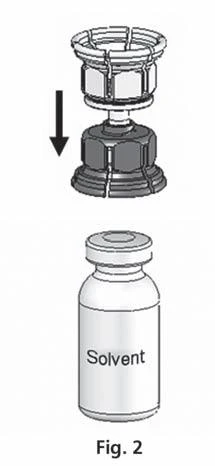
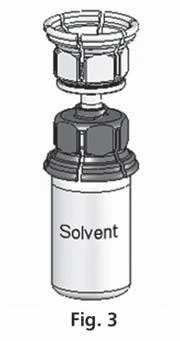
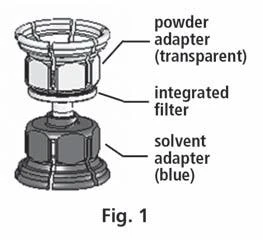
- The Mix2Vial™ system is shown in Fig. 1. Place the solvent vial on a flat surface and hold it firmly. Take the Mix2Vial™ and turn it. Place the blue part of the Mix2Vial™ onto the solvent vial and press firmly until it clicks into place (Fig. 2 + 3).
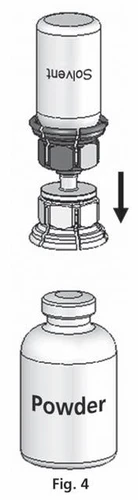
- Place the vial with powder on a flat surface and hold it firmly. Take the solvent vial with the attached Mix2Vial™ and turn it upside down. Place the transparent part of the device onto the top of the powder vial and press firmly until it clicks (Fig. 4). The solvent will automatically flow into the vial with powder.
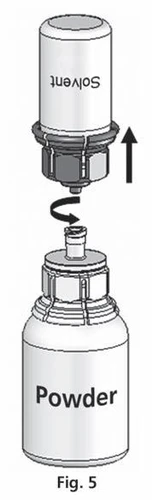
- With both vials connected, gently rotate the vial with powder until the product is completely dissolved. Dissolution takes less than 10 minutes at room temperature. Slight foaming may occur during preparation. Unscrew the Mix2Vial™ into two parts (Fig. 5). The foam will disappear.
Discard the empty solvent vial with the blue part of the Mix2Vial™.
Instructions for administering the injection:
As a precaution, check the pulse before and during the injection.
If a significant increase in pulse rate occurs, reduce the injection speed or temporarily interrupt administration.
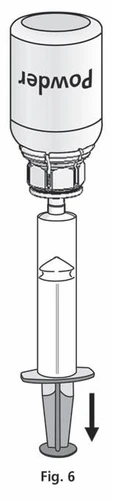
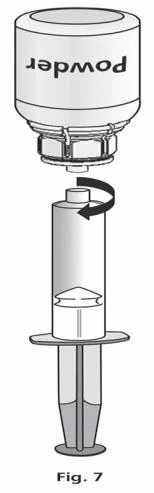
- Attach the syringe to the transparent part of the Mix2Vial™. Turn the vial upside down and draw the solution into the syringe (Fig. 6). The solution in the sy游戏副本 should be clear or slightly opalescent and glossy. After transferring the solution, firmly hold the plunger (keeping it directed downward) and remove the syringe from the Mix2Vial™ (Fig. 7). Discard the Mix2Vial™ and the empty vial.
- Clean the selected injection site with one of the provided alcohol swabs.
- Attach the provided injection needle to the syringe.
- Insert the needle into the selected vein. If a tourniquet was used to visualize the vein, loosen it before starting the injection of Pharmavate. Blood must not enter the syringe due to the risk of fibrin clot formation.
- Inject the solution slowly into the vein, no faster than 2–3 ml per minute.
When using more than one Pharmavate powder vial during a single administration, the same needle and syringe may be reused. The Mix2Vial™ set is intended for single use only.
Instructions for preparing the solution using the transfer set (1 double-ended needle and 1 filter needle):
- Do not use the product immediately after removing it from the refrigerator. Warm the powder and solvent in their closed vials to room temperature. Maintain this temperature during preparation. If a water bath is used for warming, ensure that water does not contact the rubber stoppers (non-latex) or the vial caps. The water bath temperature must not exceed +37°C.
- Remove the caps from the powder vial and the solvent vial (Fig. 1) and clean the rubber stoppers with one of the provided alcohol swabs (Fig. 2).
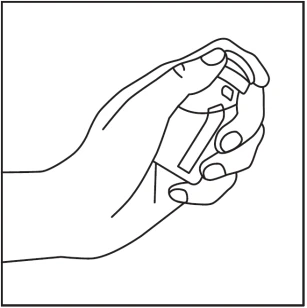
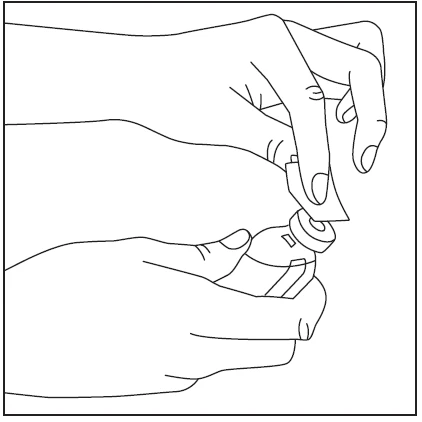
Fig.1 Fig.2
Fig.1 Fig.2
- Remove the protective cover from the short end of the double-ended needle (Fig. 3), taking care not to touch the exposed needle tip. Then pierce the center of the rubber stopper of the solvent vial vertically with the needle (Fig. 4). To completely withdraw the liquid from the solvent vial, insert the needle through the rubber stopper so that it penetrates fully and is visible inside the vial.
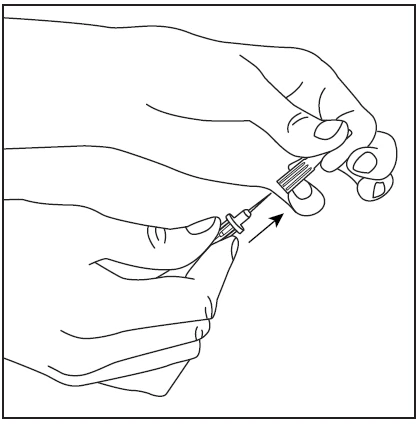
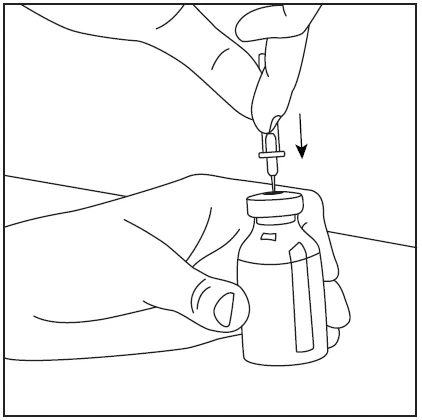
Fig. 4
Fig.3 Fig.4
- Remove the protective cover from the other, longer end of the double-ended needle, ensuring not to touch the exposed needle tip (Fig. 5). Hold the solvent vial with the inserted needle upside down above the powder vial and quickly pierce the center of the rubber stopper of the powder vial with the needle (Fig. 6). The vacuum inside the vial causes the solvent to flow into the powder vial.
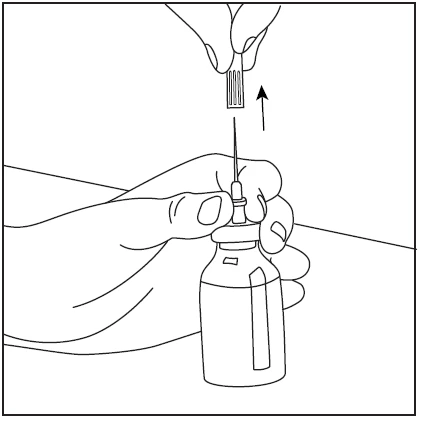
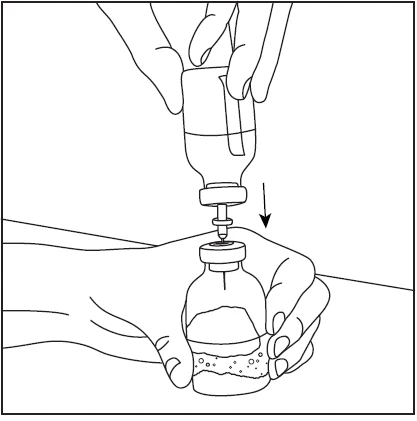
Fig.6
Fig.5 Fig.6
- Remove the double-ended needle with the empty solvent vial (Fig. 7), then slowly rotate the vial containing the powder and solvent until the product is completely dissolved. Pharmavate dissolves rapidly at room temperature into a clear solution (Fig. 8).
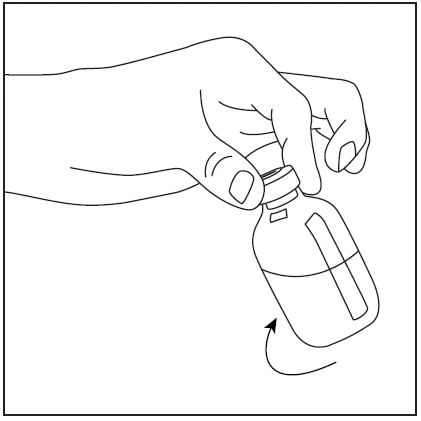
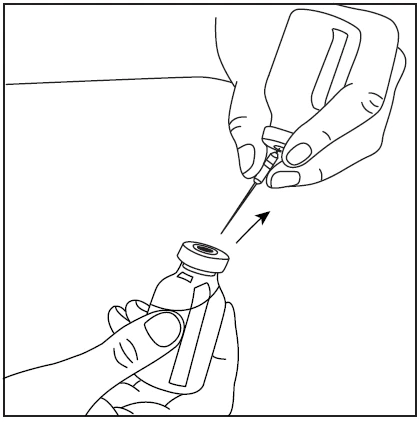
Fig.8
Fig.7 Fig.8
Instructions for administering the injection:
As a precaution, check the pulse before and during the injection.
If a significant increase in pulse rate occurs, reduce the injection speed or temporarily interrupt administration.
- After preparing the powder as described above, remove the protective cover from the filter needle and pierce the rubber stopper of the vial containing the prepared concentrate.
- Remove the cap from the filter needle and attach the syringe.
- Invert the vial with the attached syringe and draw the solution into the syringe.
- Clean the selected injection site with one of the provided alcohol swabs.
- Remove the filter needle from the syringe and attach the infusion needle to the syringe.
- Inject the solution into the vein at a rate not exceeding 2–3 ml per minute.
Any unused portions of the medicinal product or waste materials must be disposed of in accordance with local regulations.
Patients using more than one Pharmavate concentrate vial may use the same infusion needle and syringe, but the filter needle is intended for single use only.
Always use the filter needle when drawing the solution into the syringe.
Use of a higher than recommended dose of Pharmavate
Symptoms of overdose with human coagulation factor VIII have not been observed. However, exceeding the recommended dose is not advised.
Missed dose of Pharmavate
Do not administer a double dose to make up for a missed dose. Proceed immediately to the next dose and continue dosing as directed by the physician or pharmacist.
Contact your physician or pharmacist if you have any further questions regarding the use of this product.
4. Possible adverse reactions
Like all medicines, this product may cause adverse reactions, although not everyone experiences them.
Although rare (may affect up to 1 in 1,000 people), hypersensitivity or allergic reactions have been observed in patients treated with products containing factor VIII.
Contact your doctor immediately if any of the following symptoms occur:
vomiting, burning or stinging pain at the infusion site, chest tightness, chills, tachycardia, nausea, tingling sensation, redness, headache, urticaria, hypotension, rash, restlessness, swelling of the face, lips, mouth, tongue or throat, which may lead to difficulty in swallowing or breathing (angioedema), fatigue (lethargy), wheezing.
Very rarely (may affect up to 1 in 10,000 people), hypersensitivity may lead to a life-threatening allergic reaction called anaphylaxis, which may include shock and some or all of the symptoms described above. In such a case, seek immediate medical attention or call emergency services.
Other rare adverse reactions (may affect up to 1 in 1,000 people):
Fever
In previously untreated children receiving factor VIII-containing medicines, inhibitory antibodies (see section 2) may develop very commonly (more than 1 in 10 patients). However, in patients who have previously been treated with factor VIII (more than 150 days of treatment), the risk is uncommon (less than 1 in 100 patients). If this occurs, the patient's medication may cease to work effectively, and persistent bleeding may occur. If this happens, contact your doctor immediately.
Viral safety information, see section 2. (Special caution must be exercised when using Pharmavate.)
Reporting of adverse reactions
If any adverse reactions occur, including any not listed in this leaflet, inform your doctor or pharmacist.
Adverse reactions can be reported directly to the Department of Monitoring of Adverse Drug Reactions at the Office for Registration of Medicinal Products, Medical Devices and Biocidal Products
Al. Jerozolimskie 181C
PL - 02-222 Warsaw
Tel: +48 22 49 21 301
Fax: +48 22 49 21 309
Website: https://smz.ezdrowie.gov.pl
Adverse reactions may also be reported to the marketing authorization holder.
Reporting adverse reactions helps provide more information on the safety of this medicine.
5. How to store Pharmavate
Keep this medicine out of sight and reach of children.
Do not use this medicine after the expiry date stated on the label. The expiry date refers to the last day of the stated month.
Store below 25°C.
Do not freeze.
Store in the outer carton to protect from light.
The solution after reconstitution should be used immediately and only for a single administration.
Do not use this medicine if the solution appears cloudy or not completely dissolved.
Medicines must not be disposed of via wastewater or household waste. Ask your pharmacist how to dispose of medicines no longer required. Such measures help protect the environment.
6. Contents of the pack and other information
What Pharmavate contains
The active substance in this medicine is human coagulation factor VIII.
Volume and concentrations
| Pharmavate® vial size (factor VIII IU) | Solvent vial size (to be added to the Pharmavate® powder vial) (ml) | Nominal concentration of the solution after reconstitution (factor VIII IU/ml) |
| 250 IU | 5 | 50 |
| 500 IU | 10 | 50 |
| 1,000 IU | 10 | 100 |
Other ingredients are:
For the powder: sodium citrate, sodium chloride, calcium chloride, glycine
For the solvent: water for injections
What Pharmavate looks like and contents of the pack
Pharmavate is available as a powder and solvent for solution for injection.
White or pale yellow powder, or friable mass.
The solvent is a clear, colourless liquid.
3 available pack sizes differ in the content of coagulation factor VIII and solvent:
- 250 IU/vial: after reconstitution in 5 ml, strength is 50 IU/ml
- 500 IU/vial: after reconstitution in 10 ml, strength is 50 IU/ml
- 1000 IU/vial: after reconstitution in 10 ml, strength is 100 IU/ml
All pack sizes contain:
1 Mix2Vial transfer system, 1 single-use syringe, 1 injection needle,
and 2 alcohol-impregnated swabs
or
1 transfer set (1 double-ended needle and 1 filter needle), 1 single-use syringe,
1 injection needle and 2 alcohol-impregnated swabs.
Not all pack sizes may be marketed.
Marketing Authorisation Holder
Octapharma (IP) SPRL
Route de Lennik 451
1070 Anderlecht
Belgium
Manufacturer
Octapharma Pharmazeutika Produktionsges.m.b.H
Oberlaaer Str. 235
1100 Vienna
Austria
Octapharma S.A.S
72 Rue du Maréchal Foch
67380 Lingolsheim
France
Octapharma AB
112 75 Stockholm
Sweden