Pernazinum
Poland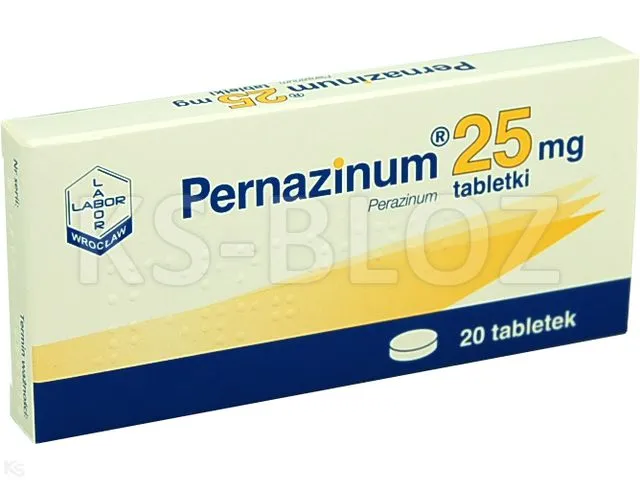
Table of Contents
Pernazinum
(Perazinum)
25 mg, tablets
100 mg, tablets
Please read the entire leaflet carefully before taking the medicine, as it contains
important information for the patient.
- Keep this leaflet for future reference.
- If you have any doubts, consult your doctor or pharmacist.
- This medicine has been prescribed for a specific individual. Do not share it with others. The medicine may harm another person, even if their symptoms are identical.
- If any adverse reactions occur, including those not listed in this leaflet, inform your doctor or pharmacist. See section 4.
Leaflet contents:
- What Pernazinum is and what it is used for
- Important information before using Pernazinum
- How to use Pernazinum
- Possible side effects
- How to store Pernazinum
- Contents of the pack and other information
1. What Pernazinum is and what it is used for
Pernazinum is an antipsychotic medicine used in the treatment of acute and chronic schizophrenia; acute psychotic disorders with delusions, anxiety, hallucinations, loss of personality awareness; catatonia (motor activity disorders), mania, and psychomotor agitation.
2. Important information before using Pernazinum
When not to use Pernazinum
Do not use Pernazinum if the patient has:
- hypersensitivity to perazine or any of the other ingredients of the medicine;
- severe bone marrow or blood cell damage;
- neuroleptic malignant syndrome;
- comatose states;
- pregnancy and breastfeeding;
- acute intoxication with drugs acting on the central nervous system, narcotics, or alcohol;
- prolactin-dependent tumours, due to increased prolactin secretion caused by perazine.
Warnings and precautions
Exercise particular caution when using Pernazinum in patients with the following conditions:
- leukopenia (low white blood cell count);
- epilepsy, glaucoma, prostate hyperplasia, liver insufficiency;
- advanced ischaemic heart disease, recent myocardial infarction;
- sudden drop in blood pressure, especially at the beginning of treatment;
- pyloric stenosis;
- orthostatic hypotension (sudden drop in arterial blood pressure upon changing to upright position or after prolonged standing), especially at the beginning of treatment;
- significant decrease in arterial blood pressure.
At the beginning of perazine treatment, a complete blood count is recommended.
If fever, infections, or nosebleeds occur, a haematological blood test should be performed immediately.
During long-term perazine treatment, blood tests should be performed every 6 months. In case of a significant decrease in leukocyte count (white blood cells) below 3,000 cells/mm³, as well as in case of changes in peripheral blood picture, the physician may decide to discontinue perazine treatment and switch to another medicine.
During perazine treatment, regular monitoring is required:
- blood glucose levels in diabetic patients;
- blood pressure and ECG examinations in patients with heart diseases or defects;
- and liver function tests at the beginning and after 6 months of treatment. In case of liver function disturbances, the physician will appropriately reduce the dosage.
During treatment with perazine, a life-threatening neuroleptic malignant syndrome may occur, characterised by fever and muscle rigidity. If this syndrome is suspected, the drug should be discontinued immediately and medical advice sought.
Photosensitivity reactions have been reported during perazine treatment. Exposure to intense sunlight should be avoided, and protective creams containing ultraviolet radiation filters should be used to reduce photosensitivity.
Perazine may cause cutaneous allergic reactions (hypersensitivity).
The medicine should be used with caution in patients with brain damage, cerebral vascular disorders, and depression (due to possible worsening of depressive symptoms).
In elderly patients, extrapyramidal symptoms (muscle rigidity, reduced facial expression, bradykinesia, motor restlessness, involuntary muscle contractions, and involuntary movements – see section 4. Possible side effects) occur more frequently, tardive dyskinesia (involuntary movements of limbs or various body parts) is more common, the sedative effect is stronger, and hypotension occurs more frequently.
Alcohol consumption is strictly prohibited during perazine treatment. Consult a physician even if the above warnings refer to conditions that occurred in the past.
Pernazinum and other medicines
Inform your doctor or pharmacist about all medicines currently taken or recently taken, as well as any medicines planned for use.
Concomitant use of perazine with other psychotropic drugs necessitates dose reduction.
Simultaneous administration of perazine with antihypertensive drugs may lead to excessive drop in blood pressure.
Using perazine with antiarrhythmic drugs increases the risk of cardiac rhythm disturbances.
Concomitant use of perazine with narcotic analgesics, non-steroidal anti-inflammatory drugs, and antipyretics enhances analgesic and sedative effects.
Concomitant administration of reserpine-containing preparations and perazine is not recommended.
Using perazine with lithium increases the risk of adverse effects.
Concomitant use of oral contraceptives with perazine increases the risk of extrapyramidal symptoms, phlebitis, and enhanced prolactin secretion.
The effect of bromocriptine is reduced, while the effect of metoclopramide is enhanced during concomitant use with perazine.
Concomitant use of anticonvulsants reduces the antipsychotic efficacy of perazine.
Administration of perazine together with carbamazepine increases the risk of adverse effects on the nervous system and blood cell damage.
Drugs blocking β-adrenergic receptors in combination with perazine increase the risk of arterial hypotension.
Concomitant administration of perazine with thiopental prolongs its duration of action.
In chronic smokers, the effect of perazine may be reduced.
Pernazinum, food, drink, and alcohol
The absorption of perazine from the gastrointestinal tract is reduced when milk, coffee, tea, or fruit juices are consumed simultaneously.
During treatment with Pernazinum, alcohol consumption is strictly prohibited. Concomitant use of alcohol and perazine mutually enhances the effects of both substances and causes a drop in blood pressure.
Pregnancy, breastfeeding, and effects on fertility
If the patient is pregnant, breastfeeding, suspects she may be pregnant, or is planning to conceive, she should consult a doctor or pharmacist before using this medicine.
Perazine crosses the placenta and reaches fetal blood; therefore, Pernazinum is contraindicated during pregnancy.
Perazine and its metabolites pass into breast milk; therefore, Pernazinum should not be used during breastfeeding.
Driving and operating machinery
Perazine may impair psycho-physical performance; therefore, it is prohibited to: drive motor vehicles, operate any mechanical equipment, or use tools.
Pernazinum contains lactose
This medicine should not be used in patients with rare hereditary problems of galactose intolerance, Lapp-type lactase deficiency, or glucose-galactose malabsorption syndrome.
3. How to use Pernazinum
This medicine should always be used as directed by a physician or pharmacist. In case of doubt,
consult a physician or pharmacist.
For adult patients during the initial treatment of acute psychoses with psychomotor agitation and
manic symptoms, the recommended dose is 50 mg to 150 mg of perazine per day. The maintenance
dose for hospitalized patients is 200 mg to 600 mg per day, given in divided doses. In justified cases,
the dose may be increased up to mg per day. The maintenance dose for patients not requiring
hospital treatment is 300 mg per day in divided doses.
In the treatment of chronic schizophrenia, doses of 75 mg to 600 mg of perazine per day are used,
divided into two or three doses. Patients not requiring hospitalization should start therapy with lower
doses, which should then be gradually increased until the desired effect is achieved. Sudden changes
in dosing are not recommended, as they increase the risk of adverse effects. The maximum
antipsychotic effect occurs after one to three weeks of treatment. After an appropriate dose has
been administered for a prolonged period, the physician will gradually reduce the dose to the lowest
effective dose.
In renal insufficiency, there is no need to adjust the dosage of the medicine.
In patients with impaired liver function, minimal therapeutic doses of perazine are recommended,
and in severe hepatic insufficiency, treatment should be discontinued.
Elderly patients should receive half the dose used for adults. Such dosing usually ensures the desired
therapeutic effect in older individuals.
In case of any doubts regarding the use of this medicine, consult a physician or pharmacist.
Taking more Pernazinum than recommended
Overdose of perazine may lead to the following symptoms: difficulty speaking, motor incoordination,
visual disturbances, muscle tremors, and confusion.
If more than the recommended dose has been taken, seek immediate advice from a physician or
pharmacist.
Missing a dose of Pernazinum
Take the missed dose as soon as possible, unless it is almost time for the next dose.
Do not take a double dose to make up for a missed dose.
Stopping Pernazinum treatment
Your physician will advise how long Pernazinum should be taken. Do not stop treatment prematurely,
as treatment of psychotic disorders is long-term.
The dose should be gradually reduced under medical supervision over several to several months.
The physician's decision to discontinue treatment should be based solely on clinical experience,
taking into account the patient's previous disease course and current condition.
4. Possible adverse reactions
Like all medicines, this medicine can cause adverse reactions, although not everyone will experience them.
The frequency of the possible adverse reactions listed below is defined as follows:
- very common: (occurs in more than 1 in 10 people);
- common: (occurs in 1 to 10 in 100 people);
- uncommon: (occurs in 1 to 10 in 1,000 people);
- rare: (occurs in 1 to 10 in 10,000 people);
- very rare: (occurs in fewer than 1 in 10,000 people);
- unknown: (frequency cannot be estimated from available data).
Blood and lymphatic system disorders
During perazine treatment, changes in peripheral blood count occur sporadically: decreased white blood cell count, increased eosinophil count, and decreased neutrophil count.
Very rare cases include decreased platelet count, anaemia, and agranulocytosis.
Cardiac disorders
The most common adverse effects include drop in blood pressure and cardiac arrhythmias. The drop in blood pressure occurs especially at the beginning of treatment, particularly when higher doses of perazine are used.
Very common: changes in ECG recording. These changes vary in severity and are proportional to the administered doses. They are transient in nature.
Nervous system disorders
During the first few days of perazine treatment, a reaction may occur characterized by paroxysmal head movements, neck stiffness, trismus (lockjaw), contractions of facial mimic muscles and tongue muscles. Less frequently, these movements may involve larger muscle groups. Occasionally, "associative attacks" and difficulty swallowing are observed. Patients treated with high doses of perazine over a long period may experience distressing motor restlessness, often accompanied by depression.
In patients treated with perazine for a long time (many months), uncoordinated and involuntary movements of the limbs have not been observed so far during treatment. However, there remains a possibility of their occurrence.
In isolated cases, treatment with neuroleptics may lead to the development of neuroleptic malignant syndrome, characterized by fever of 40°C and muscular rigidity (increased serum myoglobin and creatine kinase activity). To date, there have been no reports of neuroleptic malignant syndrome occurring after treatment with Pernazinum.
In the early phase of perazine treatment (most commonly on days 5–30 of treatment), increased skeletal muscle tension, movement retardation, and usually mild muscle tremors may occur.
Psychiatric disorders
Common: sedation.
Sleep disturbances, confusion, general restlessness, increased frequency of dreams or nocturnal nightmares, disorientation, and mental dullness have also been observed. Perazine treatment may lead to the development of depression, the symptoms of which usually appear after acute psychoses.
Eye disorders
Perazine may cause blurred vision and changes in intraocular pressure.
During long-term therapy with high doses of perazine, pigmentary changes in the eye may occur.
Respiratory, thoracic and mediastinal disorders
Long-term administration of perazine may lead to impaired respiratory function and nasal mucosal congestion.
Gastrointestinal disorders
The effect of perazine on the gastrointestinal tract results from the anticholinergic action of perazine.
When high doses are used, symptoms such as constipation, dryness of oral mucous membranes, and nausea have been observed. Cases of necrotizing enteritis and intrahepatic cholestasis have been reported in association with perazine use.
Renal and urinary disorders
Rare: urinary incontinence or urinary retention.
Reproductive system and breast disorders
During perazine therapy, sexual disturbances may occur: erectile dysfunction and decreased libido.
Skin and subcutaneous tissue disorders
Perazine treatment may sporadically cause allergic skin reactions. Increased skin reaction to sunlight exposure has occasionally been observed. If possible, patients should avoid exposure to sunlight during perazine treatment.
Excessive sweating occurs during perazine treatment.
Endocrine disorders
Another adverse effect during perazine therapy is galactorrhea. This symptom appears transiently in treated women and is dose-dependent.
Menstrual disturbances may also occur, and in men, gynaecomastia (enlargement of the breast in males).
Metabolism and nutrition disorders
Cases of increased body weight have been reported in patients taking perazine.
Hepatobiliary disorders
In studies involving 156 patients, asymptomatic elevation of at least one liver enzyme was observed in 43% of patients treated with perazine; however, none of these patients developed acute hepatitis.
Very rare: severe liver function impairment.
Rare: acute hepatitis.
Investigations
During treatment with medium and high doses of perazine, changes in glucose tolerance test results occur fairly frequently.
Immune system disorders
One case of systemic lupus erythematosus during perazine treatment has been reported.
Reporting of adverse reactions
If any adverse reactions occur, including any adverse reactions not listed in this leaflet, inform your doctor, pharmacist, or nurse. Adverse reactions can be reported directly to the Department of Monitoring Adverse Drug Reactions of the Office for Registration of Medicinal Products, Medical Devices and Biocidal Products:
Al. Jerozolimskie 181C, 02-222 Warsaw
tel.: 22 49-21-301, fax: 22 49-21-309
e-mail: [email protected]
Adverse reactions can also be reported to the marketing authorization holder.
Reporting adverse reactions helps provide more information on the safety of the medicine.
5. How to store Pernazinum
Store below 25°C.
Store in the original packaging.
Keep the medicine out of the sight and reach of children.
Do not use this medicine after the expiry date stated on the carton and blister. The expiry date refers to the last day of the stated month.
Medicines must not be disposed of via wastewater or household waste. Ask your pharmacist how to dispose of medicines no longer required. This will help protect the environment.
6. Contents of the package and other information
What Pernazinum contains
The active substance is perazine.
The other ingredients are: monohydrate lactose (Pernazinum 25 mg tablets contain 68.4 mg lactose per tablet, and Pernazinum 100 mg tablets contain 191.6 mg lactose), potato starch, gelatin, magnesium stearate, sodium starch glycolate.
What Pernazinum looks like and contents of the pack
Pernazinum 25 mg tablets: yellow, round tablet with a diameter of 8 mm
Pernazinum 100 mg tablets: yellow, round tablet with a diameter of 12 mm
The immediate packaging consists of an aluminium / PVC foil blister.
Unit pack of Pernazinum 25 mg tablets:
aluminium / PVC foil blister in a cardboard box
20 tablets (1 blister containing 20 tablets)
Unit pack of Pernazinum 25 mg tablets:
aluminium / PVC foil blister in a cardboard box
60 tablets (3 blisters containing 20 tablets each)
Hospital pack of Pernazinum 25 mg tablets:
aluminium / PVC foil blister in a cardboard box
200 tablets (10 blisters containing 20 tablets each)
Unit pack of Pernazinum 100 mg tablets:
aluminium / PVC foil blister in a cardboard box
30 tablets (1 blister containing 30 tablets)
Hospital pack of Pernazinum 100 mg tablets:
aluminium / PVC foil blister in a cardboard box
300 tablets (10 blisters containing 30 tablets each)
Marketing Authorisation Holder and Manufacturer
LABOR Przedsiębiorstwo Farmaceutyczno-Chemiczne Sp. z o.o.
ul. Długosza 49, 51-162 Wrocław
tel.: +48 71 325 30 85
fax: +48 71 326 14 57
e-mail: [email protected]