Paracetamol hasco
Poland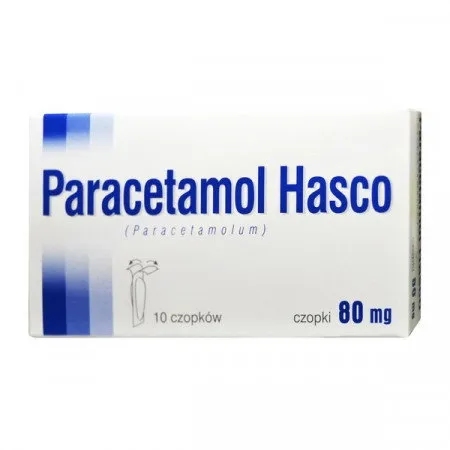
Table of Contents
Package leaflet: Information for the patient
PARACETAMOL HASCO, 80 mg, suppositories
PARACETAMOL HASCO, 125 mg, suppositories
PARACETAMOL HASCO, 250 mg, suppositories
PARACETAMOL HASCO, 500 mg, suppositories
Paracetamolum
Please read this leaflet carefully before using the medicine, as it contains
important information for the patient.
This medicine should always be used exactly as described in this patient leaflet or as directed by the
physician, pharmacist, or nurse.
- Keep this leaflet, as you may need to read it again.
- If you need advice or further information, consult your pharmacist.
- If the patient experiences any adverse reactions, including any not listed in this leaflet, inform the physician, pharmacist, or nurse. See section 4.
- If there is no improvement after 5 days in adults or 3 days in children (see "Warnings and precautions"), or if the patient feels worse, consult a physician.
Table of contents of the leaflet
- What Paracetamol Hasco is and what it is used for
- Important information before using Paracetamol Hasco
- How to use Paracetamol Hasco
- Possible side effects
- How to store Paracetamol Hasco
- Contents of the pack and other information
1. What Paracetamol Hasco is and what it is used for
Paracetamol Hasco is a medicine with analgesic and antipyretic properties. The duration of analgesic action is 4–6 hours. The antipyretic effect lasts 6–8 hours. Indications for use include various types of pain and febrile conditions.
2. Important information before using Paracetamol Hasco
When not to use Paracetamol Hasco:
- if the patient is allergic to paracetamol or any of the other ingredients of this medicine (listed in section 6),
- in case of severe liver failure or viral hepatitis,
- in case of alcoholic liver disease,
- in case of severe renal failure,
- in case of rectal bleeding.
Warnings and precautions
Before starting to use Paracetamol Hasco, discuss it with your doctor, pharmacist, or
nurse.
Do not use without medical advice:
- for pain relief for longer than 5 days in adults and 3 days in children,
- for sore throat for longer than 2 days,
- for recurrent or high fever for longer than 3 days.
Do not use doses higher than recommended.
1/4
Use of suppositories is not recommended in patients with diarrhoea.
Use with caution in patients with impaired liver or kidney function.
Particular risk of liver damage occurs in fasting patients. In patients with asthma,
allergic to salicylic acid, allergy to paracetamol may occur.
During treatment with Paracetamol Hasco, inform your doctor immediately if the
patient develops serious conditions, including severe kidney dysfunction or sepsis (when
bacteria and their toxins circulate in the blood, leading to organ damage), malnutrition,
chronic alcoholism, or if the patient is also taking flucloxacillin (an antibiotic). In these
cases, severe illness called metabolic acidosis (abnormality in blood and body fluids) has been reported in patients receiving paracetamol at regular doses over a prolonged period or when paracetamol was taken concomitantly with flucloxacillin. Symptoms of metabolic acidosis may include: severe breathing difficulties, including rapid deep breathing, drowsiness, nausea, vomiting.
Paracetamol Hasco and other medicines
Tell your doctor or pharmacist about all medicines the patient is currently taking or has recently taken, as well as any medicines the patient plans to take.
Concomitant use of paracetamol and drugs that increase hepatic metabolism, such as
certain sedatives or anticonvulsants (e.g. phenobarbital, phenytoin, carbamazepine), or
rifampicin, as well as concomitant alcohol consumption, may lead to liver damage.
Regular daily use of paracetamol may enhance the anticoagulant effect of warfarin or other coumarin derivatives, increasing the risk of bleeding.
Paracetamol increases plasma concentrations of acetylsalicylic acid and chloramphenicol.
Concomitant administration of paracetamol and non-steroidal anti-inflammatory drugs increases the risk of renal function impairment.
Inform your doctor or pharmacist if the patient is taking flucloxacillin (an antibiotic) due to the serious risk of blood and body fluid disturbances (called metabolic acidosis), which require urgent treatment (see section 2).
Paracetamol Hasco and alcohol
Do not consume alcoholic beverages during treatment with paracetamol. Do not use the medicine in patients with alcohol dependence.
Pregnancy and breastfeeding
If the patient is pregnant or breastfeeding, suspects she may be pregnant, or is planning to become pregnant, she should consult her doctor or pharmacist before using this medicine.
Paracetamol crosses the placenta and is excreted in breast milk. During pregnancy and breastfeeding, use only when necessary and when, in the opinion of the doctor, the benefit to the mother outweighs the potential risk to the fetus.
Driving and operating machinery
Paracetamol Hasco has no effect or has a negligible effect on the ability to drive and operate machinery.
3. How to use Paracetamol Hasco
This medicine should always be used exactly as described in this patient information leaflet, or as directed by a doctor, pharmacist, or nurse. If in doubt, consult a doctor, pharmacist, or nurse.
Paracetamol Hasco suppositories are for rectal use.
2/4
For adults, the single dose is 500 mg of paracetamol. The maximum daily dose of paracetamol for adults is 4.0 g for short-term treatment and 2.6 g for long-term treatment. Do not use for longer than 5 days without medical advice.
For children, the dose should be calculated according to body weight (typically 10 to 15 mg/kg body weight per dose) or according to the age-based table below.
| Child's age | Single dose of paracetamol |
| 3 months – 1 year | 80 mg |
| 2–3 years | 125 mg |
| 4–6 years | 125 mg to 250 mg |
| 7–8 years | 250 mg |
| 9–10 years | 250 mg to 500 mg |
| 11–12 years | 500 mg |
If necessary, the dose may be repeated every 4 hours, but no more frequently than 4 times a day.
In children, do not use the medicine for longer than 3 days without consulting a doctor.
Use of the medicine in children under 2 years of age should be recommended by a doctor.
Use of a higher than recommended dose of Paracetamol Hasco
If a higher than recommended dose of the medicine has been taken, consult a doctor or pharmacist immediately.
Severe poisoning may occur in adults after ingestion of 10-15 g of paracetamol. This leads to severe liver damage, which develops gradually and usually becomes apparent from the second day after administration of toxic doses. Treatment of poisoning within 24 hours after overdose consists of intravenous infusion of N-acetylcysteine in 200 ml of 5% glucose solution.
Missed dose of Paracetamol Hasco
Do not use a double dose to make up for a missed dose.
If you have any further doubts concerning the use of this medicine, consult your doctor or pharmacist.
4. Possible adverse reactions
Like all medicines, this medicine can cause adverse reactions, although not everyone will experience them.
At therapeutic doses, paracetamol is relatively low in toxicity.
Rarely (occurs in 1 to 10 patients out of 10,000): angioedema, anaphylactoid reactions (including: hypotension, bronchospasm, urticaria), laryngeal edema.
Very rarely (occurs in less than 1 patient out of 10,000): agranulocytosis, thrombocytopenia, anaemia, renal colic, renal failure, renal function disorders, pyuria, hypersensitivity, hepatitis.
Frequency unknown (cannot be estimated from available data): serious condition which may cause blood acidification (so-called metabolic acidosis) in patients with severe disease taking paracetamol (see section 2).
Reporting of adverse reactions
If any adverse reactions occur, including any adverse reactions not listed in this leaflet, inform a doctor, pharmacist, or nurse. Adverse reactions can be reported directly to the Department of Monitoring Adverse Drug Reactions at the Office for Registration of Medicinal Products, Medical Devices and Biocidal Products:
3/4
Al. Jerozolimskie 181C, 02-222 Warsaw
Tel.: +48 22 49 21 301, Fax: +48 22 49 21 309
Website: https://smz.ezdrowie.gov.pl
Adverse reactions can also be reported to the marketing authorization holder.
Reporting adverse reactions helps to provide more information on the safety of the medicine.
5. How to store Paracetamol Hasco
Keep the medicine out of the sight and reach of children.
Store below 25°C.
Keep in the outer packaging to protect from light.
Do not use this medicine after the expiry date stated on the container. The expiry date refers to the last day of the stated month.
Medicines must not be disposed of via wastewater or household waste. Ask your pharmacist how to dispose of medicines no longer required. Such measures help protect the environment.
6. Contents of the package and other information
What Paracetamol Hasco contains
- The active substance is paracetamol. Each suppository contains: 80 mg, 125 mg, 250 mg or 500 mg of paracetamol, respectively.
- The other ingredient (excipient) is: hard fat (Witepsol S58).
What Paracetamol Hasco looks like and contents of the pack
Paracetamol Hasco is in the form of milky-white, torpedo-shaped suppositories.
One pack contains 10 suppositories.
Marketing Authorisation Holder and Manufacturer
"PRZEDSIĘBIORSTWO PRODUKCJI FARMACEUTYCZNEJ HASCO-LEK" S.A.
51-131 Wrocław, ul. Żmigrodzka 242 E
Medicinal product information
tel.: (22) 742 00 22
e-mail: [email protected]
4/4