Paracetamol farmina
Poland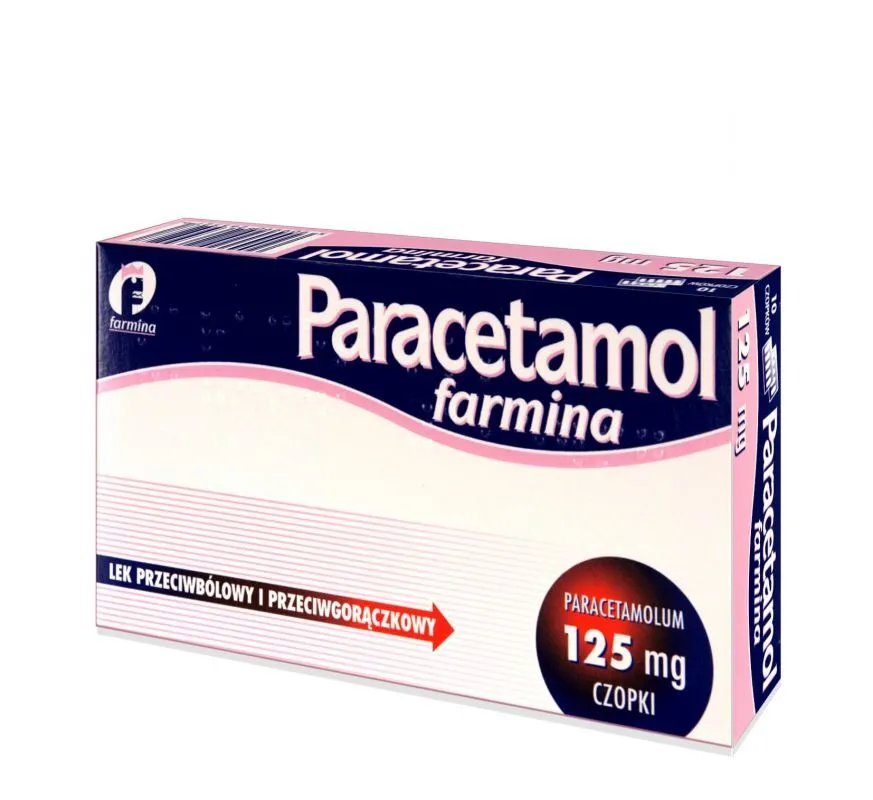
Table of Contents
- Package leaflet: Information for the user
- 1. What Paracetamol Farmina is and what it is used for
- 2. Important information before using Paracetamol Farmina
- 3. How to use Paracetamol Farmina
- 4. Possible adverse reactions
- 5. How to store Paracetamol Farmina
- 6. Contents of the pack and other information
Package leaflet: Information for the user
Paracetamol Farmina, 250 mg, suppositories
Paracetamol Farmina, 500 mg, suppositories
Paracetamolum
Read the entire leaflet carefully before using this medicine, because
it contains important information for the patient.
This medicine should always be used exactly as described in this patient leaflet or
as directed by a doctor or pharmacist.
Keep this leaflet so that you can read it again if necessary.
If you need advice or further information, please consult your pharmacist.
If you experience any adverse reactions, including any possible adverse reactions not
listed in this leaflet, inform your doctor or pharmacist. See section 4.
If there is no improvement or if the patient feels worse after 3 days, consult a doctor.
Table of contents
- What Paracetamol Farmina is and what it is used for
- Important information before using Paracetamol Farmina
- How to use Paracetamol Farmina
- Possible side effects
- How to store Paracetamol Farmina
- Contents of the pack and other information
1. What Paracetamol Farmina is and what it is used for
Paracetamol Farmina suppositories have analgesic and antipyretic effects.
The medicine is used to relieve pain of various origins (headache, toothache, muscle, joint and bone pain, painful menstruation, postoperative pain or pain after dental procedures), for symptomatic treatment of cold and flu, to reduce fever associated with various infections, and after vaccinations.
2. Important information before using Paracetamol Farmina
When not to use Paracetamol Farmina
Paracetamol Farmina must not be used if the patient has:
hypersensitivity (allergy) to paracetamol;
hypersensitivity (allergy) to any of the other ingredients of this medicine (listed in section 6);
severe renal and/or hepatic insufficiency;
alcoholic liver disease.
Warnings and precautions
Paracetamol Farmina should be used with caution in patients with impaired liver and/or kidney function, as well as in patients with glucose-6-phosphate dehydrogenase deficiency.
An increased risk of liver damage also exists in fasting patients and in those who regularly consume alcohol.
Less than 5% of patients allergic to acetylsalicylic acid derivatives may be allergic to paracetamol.
Paracetamol Farmina and other medicines
Inform your doctor or pharmacist about all medicines the patient is currently taking or has recently taken, including medicines obtained without a prescription, as well as any medicines the patient plans to use. In particular, inform about the use of the following medicines:
carbamazepine, phenobarbital, phenytoin (medicines used in epilepsy);
omeprazole (a medicine used in peptic ulcer disease);
rifampicin (an antibiotic);
zidovudine (an antiviral medicine);
medicines containing St. John's wort (Hypericum perforatum);
medicines containing ethanol (e.g. some traditional herbal remedies);
probenecid (a medicine used in gout);
warfarin (an anticoagulant medicine).
Warning: Do not use other medicines containing paracetamol simultaneously.
Pregnancy and breastfeeding
Consult a doctor before using this medicine.
Driving and operating machinery
This medicine does not affect the ability to drive or operate machinery.
3. How to use Paracetamol Farmina
Paracetamol Farmina 250 mg, suppositories:
Paracetamol Farmina 250 mg suppositories are intended for rectal administration.
The dosage should be calculated according to the child's body weight; the approximate age of the child is provided as a general guideline. The recommended single dose is 10 to 15 mg of paracetamol per kg of body weight. The maximum daily dose is 60 mg of paracetamol per kg of body weight.
From 16.6 kg to 25 kg (approximately 3 to 7 years of age) – 1 suppository 3 to 4 times daily.
Do not administer more frequently than every 4 hours.
Paracetamol Farmina 500 mg, suppositories:
Paracetamol Farmina 500 mg suppositories are intended for rectal administration.
Adults and children with body weight above 50 kg: 1 to 2 suppositories every 4 to 6 hours.
Do not exceed the maximum daily dose of 4 g per day, taking into account all medications containing paracetamol.
Use in children and adolescents:
The dosage should be calculated according to the child's body weight; the approximate age of the child is provided as a general guideline. The recommended single dose is 10 to 15 mg of paracetamol per kg of body weight. The maximum daily dose is 60 mg of paracetamol per kg of body weight.
From 33.3 kg to 50 kg (approximately 10 to 13 years of age) – 1 suppository 3 to 4 times daily.
Do not administer more frequently than every 4 hours.
If symptoms worsen or do not improve after 3 days, consult a doctor.
In case of doubt regarding the use of the medicine, consult a doctor or pharmacist.
Use of a higher than recommended dose of Paracetamol Farmina
If a higher than recommended dose is used, seek immediate medical advice. Overdose may cause symptoms such as nausea, vomiting, excessive sweating, drowsiness, and general weakness within a few or several hours. These symptoms may subside the following day, even though liver damage may have started to develop, manifesting as abdominal discomfort, recurrence of nausea, and jaundice.
Missed dose of Paracetamol Farmina
Do not use a double dose to make up for a missed dose.
4. Possible adverse reactions
Like all medicines, Paracetamol Farmina may cause adverse reactions, although not
everyone will experience them.
Adverse reactions occurring rarely (in 1 to 10 people out of 10,000):
skin and subcutaneous tissue disorders such as: itching, urticaria, rash, erythema,
angioedema.
Adverse reactions occurring very rarely (in less than 1 person out of 10,000):
blood and lymphatic system disorders such as: changes in blood morphology
(thrombocytopenia with symptoms of thrombocytopenic purpura);
hepatic and biliary disorders such as: impaired liver function;
renal and urinary disorders such as: impaired kidney function.
If any adverse reactions occur, the use of the medicine should be discontinued.
Adverse reactions can be reported to a healthcare professional,
the marketing authorization holder, or to the President of the Office for Medicinal Products, Medical Devices and Biocidal Products, Al. Jerozolimskie 181C, 02-222 Warsaw, tel.: +48 22 49 21 301, fax: +48 22 49 21 309, e-mail: [email protected]
5. How to store Paracetamol Farmina
Store below 25°C.
Keep out of the reach and sight of children.
Do not use after the expiry date stated on the packaging.
6. Contents of the pack and other information
What Paracetamol Farmina contains
The active substance is paracetamol.
The excipient is hard fat.
The medicine is also available in other strengths: 50 mg and 125 mg.
What Paracetamol Farmina looks like and contents of the pack
The medicine is in the form of suppositories, packed in blisters and contained in a cardboard box.
The pack contains 10 suppositories.
Marketing Authorisation Holder and Manufacturer
Farmina sp. z o.o.
ul. Lipska 44
30-721 Kraków
[Logo]