Novain
Poland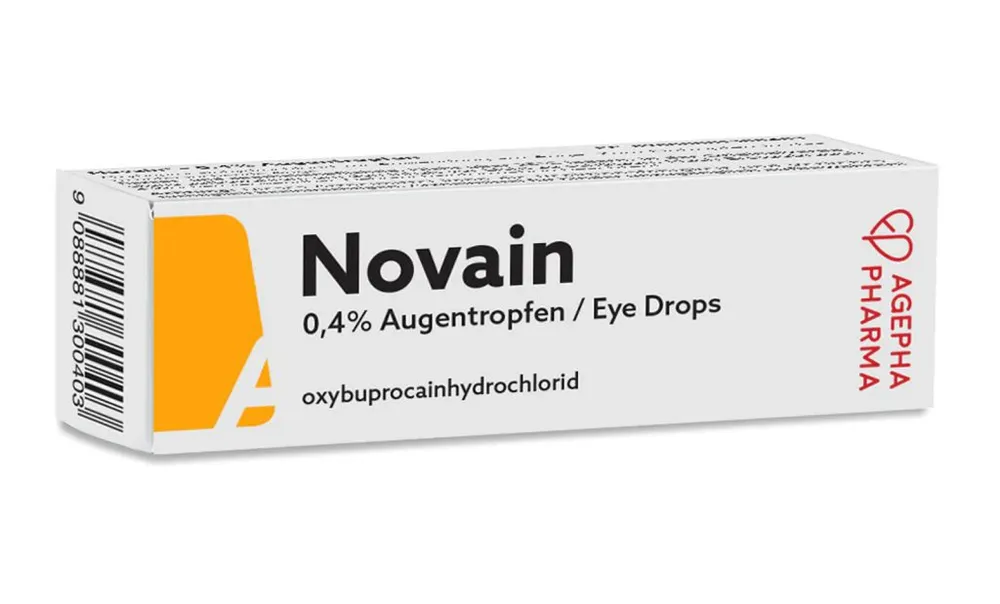
Table of Contents
Package leaflet: Information for the user
Novain, 4 mg/mL, eye drops, solution
oxybuprocaine hydrochloride
Please read all of this leaflet carefully before using this medicine, because it contains
important information for you.
- Keep this leaflet, as you may need to read it again.
- If you have any questions, ask your doctor, pharmacist, or nurse.
- This medicine has been prescribed for a specific individual. Do not pass it on to others. This medicine may harm other people, even if their symptoms are the same.
- If you experience any adverse reactions, including any not listed in this leaflet, inform your doctor, pharmacist, or nurse. See section 4.
Contents of the leaflet
- What Novain is and what it is used for
- What you need to know before using Novain
- How to use Novain
- Possible side effects
- How to store Novain
- Contents of the pack and other information
1. What Novain is and what it is used for
This medicine is a local anaesthetic intended for external use in adults.
It is used for local anaesthesia of the surface of the eye during short ophthalmic procedures.
2. Important information before using Novain
When not to use Novain
- Hypersensitivity (allergy) to oxybuprocaine or any of the excipients of Novain (listed in section 6);
- Hypersensitivity (allergy) to other local anaesthetics belonging to the same active substance group (para-aminobenzoic acid derivatives).
Warnings and precautions
Exercise special caution when using Novain
- If the patient wears contact lenses: the lenses should be removed before instillation and not reinserted until the anaesthetic effect has completely subsided (see also section 3. How to use Novain).
- In patients with allergies, heart disease, asthma, hyperthyroidism, liver disorders, and in elderly patients.
- In case of eye inflammation, as ocular redness significantly increases blood flow across the ocular surface.
Prolonged and repeated use
Novain is intended for short-term use only by a physician. Repeated,
uncontrolled use may lead to serious corneal damage. This also applies
to prolonged use of the medicine.
Children and adolescents
The safety and efficacy of Novain in children and adolescents have not been established.
Novain and other medicines
Inform your doctor or pharmacist about all medicines and eye drops currently used or recently used,
as well as any medicines and eye drops the patient plans to use, including those available without a prescription.
Sulfonamides (contained in certain antibiotics): The effectiveness of these antibiotics may be reduced.
Pregnancy and breastfeeding
If the patient is pregnant or breastfeeding, suspects she may be pregnant, or is planning to become pregnant,
she should consult a doctor. The doctor will advise whether Novain can be used.
Driving and operating machinery
This medicine may impair reaction ability, as well as the ability to drive vehicles.
Use of Novain may disturb vision and thus affect the ability to react in road traffic
and to operate machinery. Do not drive or operate tools or machinery until the effect of the medicine has worn off.
3. How to use Novain
The recommended dose is 1 drop into the eye before an examination or procedure; this dose may be repeated if necessary.
Method of administration
For ocular use. (Administer one drop into the examined eye.)
The doctor or ophthalmologist will instill the drop into the patient's eye. The patient may be asked to press on the inner corners of the eyelid for 1–2 minutes. This helps prevent the solution from draining into the nose and throat. This is particularly recommended for elderly patients and those in risk groups.
The eye will remain numb for approximately one hour, depending on the number of drops administered. The patient should avoid touching the eye until the anaesthetic effect has completely worn off.
If other eye drops are to be administered to the patient, wait at least 15 minutes before administering them.
In case of administration of a higher than recommended dose of Novain, overdose is very unlikely.
If the patient suddenly feels unwell after receiving the drops, they should inform the doctor or ophthalmologist or contact the nearest emergency department immediately.
Information for contact lens wearers
Contact lenses must be removed before instilling the eye drops and should not be reinserted until at least one hour after instillation—once the anaesthetic effect has completely subsided. Failure to follow this advice may lead to corneal damage.
In case of administration of a higher than recommended dose of Novain
Overdose: Systemic toxicity due to local anaesthetic, especially if administered orally, may cause the following symptoms: muscle twitching, convulsions, hypotension, fainting, cardiac arrhythmias, cardiac arrest due to conduction disturbances, and respiratory paralysis.
In such cases, immediate medical consultation is required.
Instructions for healthcare professionals
Information regarding overdose is provided at the end of the package leaflet.
If you have any questions concerning the use of this medicine, consult your doctor or pharmacist.
4. Possible adverse reactions
Like any medicine, this medicine can cause adverse reactions, although not everyone will experience them.
You should contact a doctor immediately if the patient develops any of the following symptoms of a serious allergic/anaphylactic reaction: swelling, rash, itching, urticaria, breathing difficulties, chills, hot flushes, headache, general malaise, nausea, restlessness, rapid heartbeat, or low blood pressure (occurring with unknown frequency).
Other possible adverse reactions:
Common (may affect up to 1 in 10 people):
The most common adverse reaction is local irritation. Other common adverse reactions include transient burning sensation after instillation and corneal damage with repeated use.
Rare (may affect up to 1 in 1,000 people):
Tremor, blurred vision, slow heartbeat, low blood pressure, dizziness.
Frequency unknown (cannot be estimated from available data):
Eye allergy, allergic conjunctivitis. Symptoms of eye allergy and allergic conjunctivitis may include itching, redness and swelling of the eyelids, eye redness, eye irritation, watery eyes, burning or stinging sensation in the eyes, flaky or crusty deposits along the eyelash margins resembling dandruff, and light sensitivity.
Reporting of adverse reactions
If any adverse reactions occur, including any not listed in this leaflet, inform a doctor or pharmacist. Adverse reactions can be reported directly to the Department of Monitoring Adverse Drug Reactions at the Office for Registration of Medicinal Products, Medical Devices and Biocidal Products
Al. Jerozolimskie 181C
02-222 Warsaw
Phone: +48 22 49 21 301
Fax: +48 22 49 21 309
https://smz.ezdrowie.gov.pl
Adverse reactions may also be reported to the marketing authorization holder.
Reporting adverse reactions helps to provide more information on the safety of the medicine.
5. How to store Novain
This medicine does not require any special storage conditions.
Keep the medicine in a place out of sight and reach of children.
Do not use this medicine after the expiry date stated on the carton and on the label of the bottle following
EXP. The expiry date refers to the last day of the stated month.
Shelf-life after first opening the bottle: 28 days.
Medicines must not be disposed of via wastewater or household waste. Ask your pharmacist how to dispose of medicines no longer required. This will help protect the environment.
6. Contents of the package and other information
What Novain contains
- The active substance is oxybuprocaine hydrochloride. Each mL contains 4 mg of oxybuprocaine hydrochloride.
- Other ingredients: boric acid, chlorhexidine diacetate, hydrochloric acid 1N (for pH adjustment), water for injections.
What Novain looks like and contents of the pack
Novain, 4 mg/mL, eye drops, solution, is a clear, colourless solution intended for use in adults. Each carton contains one bottle made of LDPE with a capacity of 10 mL.
Marketing Authorisation Holder and Manufacturer
AGEPHA Pharma s.r.o.,
Diaľničná cesta 5,
Senec 903 01,
Slovakia
Tel: +421 226 226 032
Fax: +421 245528069
Email: [email protected]
This medicinal product is authorised in the Member States of the European Economic Area under the following names:
| Member State | Trade name |
| Austria | Novain 4 mg/ml Augentropfen, Lösung |
| Denmark | Oxybuprocainhydrochlorid “Agepha” 4 mg/ml øjendråber, opløsning |
| Estonia | Novain 4 mg/ml silmatilgad, lahus |
| Finland | Obupro 4 mg/ml silmätipat, liuos |
| Ireland | Oxybuprocaine Agepha 4 mg/ml eye drops, solution |
| Latvia | Oxybuprocaine hydrochloride Agepha 4 mg/ml acu pilieni, šķīdums |
| Iceland | Novain 4 mg/ml augndropar, lausn |
| Croatia | Ophtesia 4 mg/ml kapi za oko, otopina |
| Lithuania | Novain 4 mg/ml akių lašai (tirpalas) |
| Netherlands | Obupro 4 mg/ml oogdruppels, oplossing |
| Norway | Obupro 4 mg/ml øyedråper, løsning |
| Poland | Novain 4 mg/mL, eye drops, solution |
| Portugal | Novain 4 mg/ml colírio, solução |
| Sweden | Novain 4 mg/ml ögondroppar, lösning |
| Spain | Oxibuprocaina hidrocloruro Agepha 4 mg/ml eye drops in solution |
| Hungary | Oxybuprocaine hydrochloride AGEPHA 4 mg/ml oldatos szemcsepp |
Information intended exclusively for medical professionals:
Management in case of poisoning
Immediately initiate respiratory and circulatory control (intubation and mechanical ventilation), circulatory stimulation, and infusions (without adrenaline). In case of circulatory arrest, perform external cardiac massage and apply electrostimulation. In case of seizures, administer ultrashort-acting barbiturates or diazepam (do not administer long-acting barbiturates due to the risk of respiratory depression).