Nidazid
Poland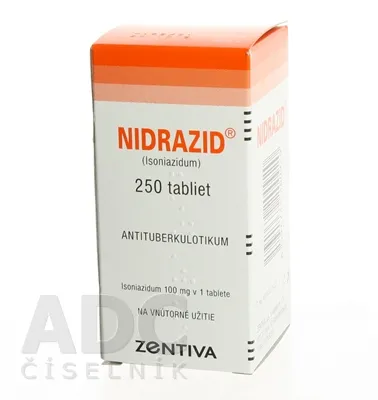
Table of Contents
Patient Information Leaflet
Nidrazid, 100 mg, tablets
Isoniazidum
Please read all of this leaflet carefully before taking this medicine, because it contains
important information for you.
- Keep this leaflet so that you can read it again if necessary.
- If you have any further questions, please ask your doctor or pharmacist.
- This medicine has been prescribed for a specific individual. Do not pass it on to others. It may harm someone else, even if their symptoms are the same.
- If you experience any adverse effects, including any not listed in this leaflet, tell your doctor or pharmacist. See section 4.
Table of contents
- What Nidrazid is and what it is used for
- Important information before taking Nidrazid
- How to take Nidrazid
- Possible side effects
- How to store Nidrazid
- Contents of the pack and other information
1. What Nidrazid is and what it is used for
Isoniazid (the active substance in Nidrazid) acts against tubercle bacilli.
Nidrazid is indicated for the treatment of all pulmonary and extrapulmonary forms of tuberculosis, as well as for the prevention of pulmonary tuberculosis.
During tuberculosis treatment, Nidrazid must be used simultaneously with other antituberculosis drugs to prevent the development of bacterial resistance to this drug (loss of drug effectiveness).
For preventive purposes, Nidrazid is usually used as a single agent.
The medicine is indicated for use in adults and children over 3 years of age who are able to swallow the tablet (if swallowing is difficult, the tablet may be crushed).
2. Important information before using Nidrazid
When not to use Nidrazid
- if the patient is allergic to isoniazid or any of the other ingredients of this medicine (listed in section 6);
- if the patient has severe liver failure or drug-induced liver failure;
- if the patient has previously experienced the following after taking Nidrazid: severe skin rash, skin peeling, blisters, or oral ulcers.
Warnings and precautions
Before starting treatment with Nidrazid, consult your doctor if the patient has any of the following conditions:
- epilepsy;
- psychosis;
- tendency to bleed;
- neuritis;
- liver function disorders (currently present or in the past); the doctor may discontinue the drug or adjust the dosage;
- kidney function disorders; the doctor may adjust the dosage; in patients with severe kidney impairment, treatment should be closely monitored;
- AIDS;
- diabetes.
Special caution is required in patients:
- of advanced age;
- who consume alcoholic beverages daily;
- receiving intravenous medications;
- who are malnourished;
- who require high doses of Nidrazid; vitamin B deficiency may then occur, increasing the frequency of certain adverse effects. If neuritis develops, the doctor will recommend increasing the dose of vitamin B.
- During treatment (even several months after starting therapy), severe hepatitis may develop, sometimes leading to death. Hepatitis occurs more frequently in patients over 35 years of age, and they should be monitored for prodromal symptoms of hepatitis such as fatigue, weakness, malaise, anorexia, nausea, or vomiting. If these symptoms occur, the drug should be discontinued immediately;
- Before starting treatment with Nidrazid, the doctor will order liver function tests and blood tests for every adult patient.
- During treatment, the patient should remain under medical supervision and attend follow-up visits at least once a month.
- In patients over 35 years of age, liver function tests should be performed regularly, at least once a month.
- If abnormal test results are detected, the patient will be re-evaluated and the doctor may recommend repeating laboratory tests as necessary.
- In patients without prior history of liver disease, liver function tests should be performed if symptoms such as fever, vomiting, jaundice, or other signs indicating worsening health occur. If any of these symptoms occur during treatment with Nidrazid, the doctor should be informed immediately.
- In patients with liver function disorders, treatment should be administered only if necessary, with particular caution and under strict medical supervision; the doctor will order liver function tests before starting treatment and then every two to four weeks throughout the treatment period.
- The drug should be discontinued if symptoms indicating liver failure occur during treatment. The doctor will consider alternative tuberculosis treatment. When liver test results return to normal, the doctor may consider re-introducing Nidrazid, with daily laboratory monitoring (tracking liver function parameters).
- Nidrazid should be used cautiously in black women and/or those of Latino origin.
- Routine liver function tests are not necessary in children (except in children identified as being at risk of hepatotoxicity).
- Cases of Stevens-Johnson syndrome (SJS), toxic epidermal necrolysis (TEN), drug reaction with eosinophilia and systemic symptoms (DRESS), and acute generalized exanthematous pustulosis (AGEP) have been reported during treatment with Nidrazid. If any of the symptoms listed in section 4 occur, treatment with Nidrazid must be stopped immediately and medical help should be sought without delay.
Nidrazid and other medicines
Inform the doctor about all medicines currently used or recently used, as well as any medicines the patient plans to take.
If the doctor recommends starting any other medicine, inform them that the patient is taking Nidrazid. Do not use any over-the-counter medicines without consulting a doctor while taking Nidrazid.
Isoniazid may affect the action of certain medicines, and some medicines may affect the action of Nidrazid. If the patient is taking any of the following medicines, inform the doctor before starting Nidrazid, as dosage adjustment may be necessary:
- oral anticoagulants;
- anticonvulsants (phenytoin, carbamazepine, valproic acid, ethosuximide, primidone, barbiturates);
- benzodiazepines (medicines used to treat psychiatric disorders);
- stavudine, zalcitabine (medicines used in the treatment of HIV infection);
- rifampicin (antibiotic);
- cycloserine (antibiotic);
- disulfiram (medicine used in the treatment of alcoholism);
- ketoconazole, itraconazole (antifungal medicines);
- alfentanil (medicine used for anesthesia before surgery);
- antacids (used for hyperacidity) containing aluminium – these reduce the absorption of isoniazid; therefore, it is recommended to take Nidrazid one hour before taking antacids;
- p-aminosalicylic acid (an antituberculosis medicine).
Nidrazid, food, drink, and alcohol
Patients taking isoniazid should avoid foods and drinks containing tyramine (such as cheese, red wine) and histamine (such as bonito, tuna, other tropical fish).
Alcoholic beverages should not be consumed during treatment with Nidrazid.
Pregnancy and breastfeeding
If the patient is pregnant or breastfeeding, suspects she may be pregnant, or is planning to have a child, she should consult a doctor or pharmacist before using this medicine.
The decision on using the medicine during pregnancy or breastfeeding will be made by the doctor.
Isoniazid passes into breast milk, although its concentration in milk is low. Women should not breastfeed while taking isoniazid unless, in the doctor's opinion, the potential benefit to the mother outweighs the risk to the infant.
Driving and operating machinery
When used at recommended doses, Nidrazid does not affect concentration. However, in cases of overdose, psychomotor performance may be reduced due to adverse effects such as headache or dizziness, psychiatric disturbances, or psychosis.
Nidrazid contains sodium
The medicine contains less than 1 mmol of sodium (23 mg) per tablet, meaning the medicine is considered "sodium-free".
3. How to use Nidrazid
This medicine should always be used as directed by the physician. In case of doubt, consult your
doctor or pharmacist.
Treatment of tuberculosis should be initiated and supervised by experienced specialists in the
diagnosis and treatment of tuberculosis, according to current standards.
The dose of the medicine will be determined by the doctor. Always follow the doctor's instructions, as various dosing regimens may be used.
Treatment is long-term.
Adults
- Daily administration: the usual therapeutic dose is 5 mg/kg body weight per day; do not exceed 3 tablets (300 mg) per day.
- Administration twice weekly: single dose is 15 mg/kg body weight, not exceeding 9 tablets (900 mg).
- Prevention of pulmonary tuberculosis: 3 tablets (300 mg) per day should be taken.
Children over 3 years of age
The doctor will determine the dose according to the child's body weight.
- Daily administration: the usual dose in children is 5 to 10 mg/kg body weight per day, with a maximum of 3 tablets (300 mg) per day.
- Administration twice weekly: single dose is 15 mg/kg body weight, not exceeding 9 tablets (900 mg).
- Prevention of pulmonary tuberculosis: 5 to 10 mg/kg body weight per day should be taken, not exceeding 3 tablets (300 mg) per day.
Prevention of neuropathy
To prevent the adverse effect of neuropathy, vitamin B(_6) (pyridoxine) should be taken daily at a dose of 10 mg. If neuritis occurs, the dose of vitamin B(_6) should be increased to 50 mg per day.
Patients with renal impairment
The doctor may decide to use a lower dose of Nidrazid.
Method of administration
It is recommended to take Nidrazid once daily on an empty stomach, at least 30 minutes before a meal or 2 hours after a meal.
Use of a higher than recommended dose of Nidrazid
In case of overdose or accidental ingestion by a child, contact a doctor immediately.
Symptoms of isoniazid overdose include: nausea, vomiting, dizziness, slurred speech and blurred vision, ataxia, visual hallucinations (including seeing bright colors and strange patterns), skin rash; in more severe cases, respiratory failure, central nervous system (CNS) depression progressing rapidly from stupor to deep coma, and severe, treatment-resistant seizures may occur. Laboratory findings include metabolic acidosis, presence of ketone bodies (ketonuria), and hyperglycemia.
Missed dose of Nidrazid
Do not take a double dose to make up for a missed dose.
Take the missed dose as soon as possible. If the next dose is due soon, skip the missed dose and continue with the regular dosing schedule.
Stopping treatment with Nidrazid
Do not stop taking Nidrazid without consulting your doctor, even if the patient feels better.
If you have any further questions about the use of this medicine, consult your doctor or pharmacist.
4. Possible adverse reactions
Like all medicines, this medicine can cause adverse reactions, although not everyone will experience them.
If symptoms of liver dysfunction occur, such as fatigue, loss of appetite, nausea,
vomiting, itching, or yellowing of the skin or whites of the eyes, discontinue the medicine and consult a doctor
immediately.
If any of the following adverse reactions occur, contact your doctor as soon as possible.
- Inflammation of the pancreas causing severe abdominal and back pain (pancreatitis), frequency unknown.
- Serious, widespread skin damage (detachment of the outer layer of skin and mucous membranes) – toxic epidermal necrolysis (Lyell's syndrome, toxic epidermal necrolysis TEN), may occur in 1 in 1000 people.
- Drug reaction causing rash, fever, internal organ inflammation, hematological abnormalities, and systemic illness (DRESS syndrome, drug rash with eosinophilia and systemic symptoms), may occur in 1 in 1000 people.
- Severe illness characterized by blister formation on the skin, in the mouth, around the eyes, and on the genital organs (Stevens-Johnson syndrome, frequency unknown).
- Acute generalized pustular eruption (AGEP, frequency unknown).
- Yellowing of the skin or whites of the eyes, dark urine, pale stools, fatigue, weakness, malaise, loss of appetite, nausea, or vomiting due to liver disease (hepatitis), may occur in 1 in 100 people.
The following adverse reactions may occur during treatment with Nidrazid, listed according to their frequency of occurrence.
Very common (may occur in more than 1 in 10 people): increased liver enzyme activity.
Common (may occur in not more than 1 in 10 people): vitamin B deficiency, psychiatric disorders (irritability, anxiety), psychosis (mania, catatonia, paranoia), headache, dizziness, tingling or itching sensations (peripheral neuropathy), nausea, vomiting, indigestion.
Uncommon (may occur in not more than 1 in 100 people): jaundice, hepatitis (usually occurring 4-8 weeks or even several months after starting treatment), fatigue, weakness, fever.
Rare (may occur in not more than 1 in 1000 people): anorexia, pellagra (niacin deficiency, i.e. vitamin B deficiency), muscle cramps, optic neuritis (e.g. blurred vision), skin allergic reactions, urticaria, pruritus, skin rash, exanthema, erythema, cutaneous manifestations of pellagra, toxic epidermal necrolysis (Lyell's syndrome), DRESS syndrome (systemic symptoms of eosinophilia), disturbances in urination.
Very rare (may occur in fewer than 1 in 10,000 people): blood count abnormalities (reduced red blood cell count, reduced platelet count, changes in white blood cell count), lymph node enlargement, immune system disorders (lupus-like syndrome), gynaecomastia (breast enlargement in men and women), increased blood bilirubin or glucose levels, metabolic acidosis.
Frequency unknown (frequency cannot be estimated from available data): red, scaly, widespread rash with subcutaneous nodules and blisters, accompanied by fever. Symptoms usually appear at the beginning of treatment (acute generalized pustular eruption), anaphylactic reactions, increased blood glucose levels, metabolic acid游戏副本
5. How to store Nidrazid
Keep the medicine out of sight and reach of children.
Store below 25°C, in the original packaging to protect from light and moisture.
Do not use this medicine after the expiry date stated on the packaging.
The expiry date refers to the last day of the specified month.
Medicines must not be disposed of via wastewater or household waste. Ask your pharmacist how to dispose of medicines no longer in use. This will help protect the environment.
6. Contents of the pack and other information
What Nidrazid contains
The active substance is isoniazid. Each Nidrazid tablet contains 100 mg of isoniazid.
The other components are: maize starch, sodium stearyl fumarate, sodium carboxymethyl starch,
gelatin, talc.
What Nidrazid looks like and contents of the pack
Flat tablets, 7 mm in diameter, white or slightly yellowish, with a score line on one side.
The packaging contains 250 tablets in glass bottles.
Marketing Authorisation Holder and Manufacturer
Zentiva k.s., U Kabelovny 130, Dolni Mecholupy, 102 37 Prague, Czech Republic.
For further information about this medicine, please contact the local representative of the Marketing Authorisation Holder in Poland:
Zentiva Polska Sp. z o.o.
ul. Bonifraterska 17
00-203 Warsaw
tel. +48 22 375 92 00