Melodyn
Poland
Table of Contents
Package leaflet: Information for the user
Melodyn, 35 micrograms/hour, transdermal system
Melodyn, 52.5 micrograms/hour, transdermal system
Melodyn, 70 micrograms/hour, transdermal system
(Buprenorphinum)
Please read all of this leaflet carefully before using this medicine, because it contains
important information for you.
- Keep this leaflet. You may need to read it again.
- If you have any further questions, ask your doctor or pharmacist.
- This medicine has been prescribed for you only. Do not pass it on to others. It may harm them, even if their symptoms are the same as yours.
- If you get any side effects, including any not listed in this leaflet, tell your doctor or pharmacist.
Contents of the leaflet
- What Melodyn is and what it is used for
- What you need to know before using Melodyn
- How to use Melodyn
- Possible side effects
- How to store Melodyn
- Contents of the pack and other information
1. What Melodyn is and what it is used for
Melodyn is an analgesic (pain-relieving) medicine used to relieve moderate to severe pain in cancer-related diseases and severe pain in other conditions that does not respond to non-steroidal painkillers. Melodyn works through the skin. After applying the patch to the skin, the active substance buprenorphine passes through the skin into the bloodstream.
Buprenorphine belongs to the group of opioids (strong painkillers), which reduce pain by acting on the central nervous system (on specific nerve cells in the spinal cord and brain). The effect of the patches lasts up to three days. Melodyn is not recommended for the treatment of acute (short-term) pain.
2. What you need to know before using Melodyn
Do not use Melodyn:
- if you are allergic to buprenorphine, soy, peanuts, or any of the other ingredients of this medicine (listed in section 6);
- if you are dependent on strong painkillers (opioids);
- if you have a disease causing significant breathing difficulties;
- if you are taking monoamine oxidase inhibitors (MAO inhibitors – some medicines used to treat depression) or have taken them within the last two weeks (see section “Melodyn and other medicines”);
- if you have myasthenia gravis (muscle weakness);
- if you have delirium tremens (confusion and tremors caused by sudden alcohol withdrawal in individuals with chronic alcohol abuse, or occurring during episodes of excessive alcohol intake);
- if you are pregnant.
Melodyn should not be used to treat withdrawal symptoms in individuals dependent on drugs.
Warnings and precautions
Talk to your doctor or pharmacist before using Melodyn if:
- you have recently consumed large amounts of alcohol;
- you have seizures or convulsions;
- you experience episodes of impaired consciousness (such as dizziness or fainting) of unknown cause;
- you are in shock (symptoms of shock may include cold sweats);
- you have increased intracranial pressure (e.g. after head surgery or due to brain disease) and artificial ventilation is not possible;
- you have breathing difficulties or are taking other medicines that may cause respiratory depression or weakening of respiratory function (see section “Melodyn and other medicines”);
- you have liver function disorders;
- you have a tendency to misuse medicines or drugs;
- you have depression or other conditions treated with antidepressant medicines. Taking these medicines together with Melodyn may lead to serotonin syndrome, a potentially life-threatening condition (see section “Melodyn and other medicines”).
Please also pay attention to the following warnings:
Fever and the use of external heat sources may increase the amount of buprenorphine released into the bloodstream. External heat sources may also cause improper adhesion of the patch to the skin. Therefore, do not use external heat sources (e.g. sauna, infrared lamp, electric blanket, hot water bottle). Consult your doctor if you develop a fever.
Tolerance, dependence and abuse
This medicine contains buprenorphine, which is an opioid. Repeated use of opioids may lead to reduced effectiveness of the medicine (known as tolerance). Repeated use of Melodyn may also lead to dependence, misuse, and abuse, which may result in life-threatening overdose. The risk of these adverse effects may increase with higher doses and longer duration of use.
Dependence or abuse may cause the patient to lose control over the amount and frequency of medicine intake.
The risk of dependence or abuse varies between individuals. The risk of dependence on Melodyn may be higher if:
- you or someone in your family has ever misused or been dependent on alcohol, prescription medicines, or illegal substances ("addiction");
- you are a smoker;
- you have ever had mood problems (depression, anxiety, or personality disorders) or have been treated by a psychiatrist for other mental illnesses.
If any of the following symptoms occur while taking Melodyn, this may indicate dependence:
- need to take the medicine longer than prescribed by the doctor;
- need to take higher than the recommended dose;
- need to continue taking the medicine even though it does not help relieve pain;
- use of the medicine for reasons other than recommended, e.g. "to calm down" or "to fall asleep more easily";
- repeated unsuccessful attempts to stop or control medicine use;
- feeling unwell after stopping the medicine, with improvement of well-being upon resuming use ("withdrawal effects").
If any of these symptoms occur, talk to your doctor to discuss the best treatment approach for you, including when and how to stop taking the medicine safely (see section 3, “Stopping treatment with Melodyn”).
Athletes should be aware that this medicine may lead to a positive result in anti-doping tests.
Sleep-related breathing disorders
Melodyn contains an active substance belonging to the group of opioids. Opioids may cause breathing disorders during sleep, such as central sleep apnoea (shallow breathing or breathing pauses during sleep) and nocturnal hypoxia (reduced oxygen levels in the blood).
The risk of central sleep apnoea depends on the opioid dose. Your doctor may consider reducing the total opioid dose if central sleep apnoea occurs.
Children and adolescents
Do not use Melodyn in individuals under 18 years of age, as there is insufficient experience with the use of this medicine in this age group.
Melodyn and other medicines
Tell your doctor or pharmacist about all medicines you are currently taking, have recently taken, or plan to take.
Some medicines may worsen the side effects of Melodyn and sometimes cause very serious reactions. Do not take other medicines during treatment with Melodyn without first consulting your doctor, especially:
- Antidepressants such as moclobemide, tranylcypromine, citalopram, escitalopram, fluoxetine, fluvoxamine, paroxetine, sertraline, duloxetine, venlafaxine, amitriptyline, doxepin, or trimipramine. These medicines may interact with Melodyn and cause symptoms such as involuntary rhythmic muscle contractions, including eye movement muscles, agitation, hallucinations, fever, excessive sweating, tremor, increased reflexes, increased muscle tone, body temperature above 38°C. If you experience such symptoms, contact your doctor.
- Do not use Melodyn simultaneously with monoamine oxidase inhibitors (MAO inhibitors – some medicines used to treat depression) or if you have taken such medicines within the last two weeks.
- Melodyn may cause drowsiness, nausea, or fainting and may lead to slowed or weakened breathing. These side effects may be intensified when taken together with other medicines causing similar side effects. Such medicines include strong painkillers (opioids), certain sleeping medicines, anaesthetics, and medicines used to treat certain mental illnesses, such as sedatives, antidepressants, and neuroleptics.
- Concurrent use of Melodyn and sedatives such as benzodiazepines or related medicines increases the risk of drowsiness, breathing difficulties (respiratory depression), coma, and may be life-threatening. Therefore, concurrent use of these medicines should only be considered if no other treatment options are possible. However, if your doctor prescribes Melodyn together with a sedative, the dose and duration of concurrent use should be limited. Inform your doctor about all sedatives you are taking and strictly follow the doctor's instructions. It may be helpful to inform friends or relatives about the above-mentioned symptoms. If such symptoms occur, contact your doctor.
- Concurrent use of Melodyn with certain medicines may enhance the effect of the transdermal system. These include some anticancer and antifungal medicines (e.g. containing erythromycin or ketoconazole), and medicines used to treat HIV infection (e.g. containing ritonavir).
- Concurrent use of Melodyn with certain medicines may weaken the effect of the transdermal system. These include, for example, dexamethasone; medicines used to treat epilepsy (e.g. containing carbamazepine or phenytoin); medicines used to treat tuberculosis (e.g. rifampicin).
- Gabapentin or pregabalin used to treat epilepsy or nerve-related pain (neuropathic pain).
- Medicines used to treat depression.
- Medicines used for allergies, motion sickness, or nausea (antihistamines or antiemetics).
- Medicines used to treat mental disorders (antipsychotics or neuroleptics).
- Muscle relaxants.
- Medicines used to treat Parkinson's disease.
Using Melodyn with food, drink and alcohol
Do not consume alcohol while using Melodyn. Alcohol may worsen some side effects and cause worsening of your condition.
Drinking grapefruit juice may enhance the effect of Melodyn.
Pregnancy, breastfeeding and fertility
If you are pregnant, breastfeeding, think you may be pregnant, or plan to have a baby, consult your doctor or pharmacist before using this medicine.
There is insufficient data on the use of Melodyn during pregnancy.
Therefore, do not use Melodyn during pregnancy.
Buprenorphine, the active substance in this medicine, inhibits milk production and passes into breast milk. Therefore, do not use Melodyn during breastfeeding.
Driving and using machines
Melodyn may cause dizziness, drowsiness, blurred or double vision, which may affect your reactions to such an extent that you may not react appropriately or quickly enough in unexpected or sudden situations. This is particularly relevant:
- at the beginning of treatment;
- when changing the dose;
- when switching from another painkiller to Melodyn;
- when taking other medicines acting on the central nervous system;
- when consuming alcohol.
In such cases, do not drive or operate machinery while using Melodyn. This also applies to the period after stopping Melodyn. Do not drive or operate machinery for at least 24 hours after removing the patch.
If you have any doubts or questions, consult your doctor or pharmacist.
Melodyn contains soy oil. If you are allergic to peanuts or soy, do not use this medicine.
3. How to use Melodyn
Always use Melodyn exactly as prescribed by your doctor. If in doubt, consult your doctor or pharmacist.
Before starting treatment and regularly during treatment, your doctor will discuss with you what to expect from using Melodyn, when and how long to use it, when to contact the doctor, and when to stop the medicine (see also: Stopping treatment with Melodyn).
Melodyn is available in three strengths: Melodyn 35 micrograms/hour, transdermal system; Melodyn 52.5 micrograms/hour, transdermal system; Melodyn 70 micrograms/hour, transdermal system.
Your doctor will decide which strength is appropriate for you. If necessary, your doctor may change the strength during treatment.
Usual dose:
Adults
Unless otherwise prescribed by your doctor, apply one Melodyn patch as described below and change it no later than after 3 days. To remember when to change the patch, write the date on the outer packaging. If your doctor prescribes additional painkillers, follow the instructions carefully. Otherwise, you will not get the full benefit from using Melodyn.
Use in children and adolescents
Do not use Melodyn in individuals under 18 years of age due to insufficient data on use in this age group.
Elderly patients
No dose adjustment is necessary in elderly patients.
Patients with renal impairment and dialysis patients
No dose adjustment is necessary in patients with kidney disorders or in dialysis patients.
Patients with hepatic impairment
In patients with liver function disorders, the strength and duration of action of Melodyn may be altered. Your doctor will monitor such patients more closely.
Instructions for opening child-resistant pouches.
- Cut along the arrows marked on the sides of the pouch.
- Tear open at the cut areas along the sealed edge.
- Open the pouch and remove the patch.
How to apply the patch
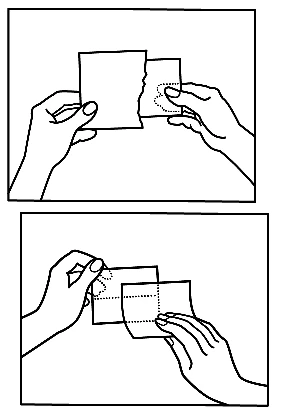
- Open the pouch immediately before applying the patch. Each patch is individually sealed in a pouch.
- First, gently peel off the loosely attached thin protective liner.
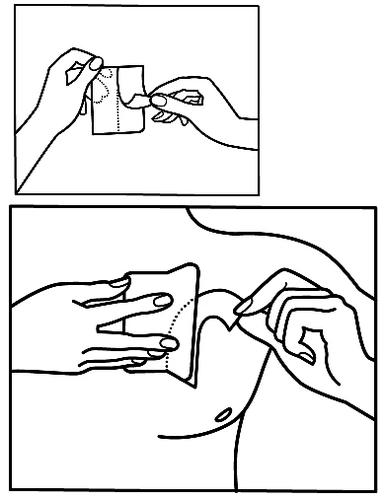
- Then remove the foil backing from half of the patch, avoiding contact with the adhesive surface.
- After applying half of the patch, remove the foil backing from the other half.
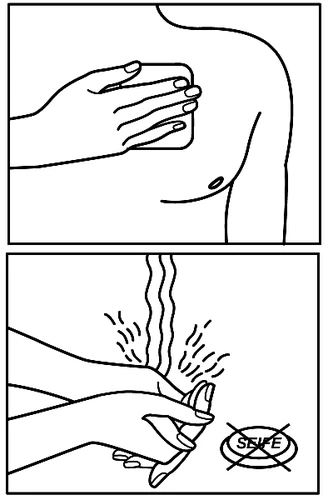
- After application, press the patch firmly onto the skin with the palm of your hand for about 30–60 seconds. Make sure the patch adheres well to the skin, especially at the edges.
- Wash your hands after applying the patch. Do not use cleaning agents.
After applying the patch
The patch may remain on the skin for up to 3 days. If the patch has been applied correctly, there is little risk of it detaching. With a properly applied patch, you may take a shower, bathe, or swim. Do not expose the patch to heat (e.g. sauna, infrared lamp, electric blanket, hot water bottle).
If the patch detaches unexpectedly before the scheduled change, do not reapply it. Immediately apply a new patch (see “Changing the patch”).
Changing the patch
- Remove the old patch from the skin.
- Fold it in half with the adhesive sides facing inward.
- Dispose of the used patch carefully so it is not visible and inaccessible to children.
- Apply a new patch to a different area of skin (following the instructions above). Do not apply a new patch to the same skin site until one week has passed.
Duration of treatment
Your doctor will inform you how long to use Melodyn. Do not stop using Melodyn on your own, as this may cause pain to return and worsen your condition (see also section “Stopping treatment with Melodyn”).
If you feel that the effect of Melodyn is too strong or too weak, consult your doctor or pharmacist.
Using more than the recommended dose of Melodyn
If more than the recommended dose of Melodyn is used, symptoms of buprenorphine overdose may occur. Overdose may intensify the adverse effects of buprenorphine, such as drowsiness, nausea, and vomiting. The patient may have pinpoint (sharply constricted) pupils, respiratory depression or weakening of respiratory function, and circulatory collapse.
If you realize you have used more patches than necessary, remove the extra patch immediately and contact your doctor or pharmacist without delay.
Missing a dose of Melodyn
If you forget to apply a patch, do so as soon as you remember. If the patch change is delayed too long, pain may return. In such a case, contact your doctor.
Do not apply two patches to make up for a missed dose.
Stopping treatment with Melodyn
Suddenly stopping or ending treatment with Melodyn may lead to recurrence of pain symptoms.
If you wish to stop using Melodyn due to unpleasant side effects, consult your doctor first. Your doctor will advise you on how to discontinue treatment and whether other medicines are needed.
In some patients, withdrawal symptoms may occur after stopping long-term use of strong painkillers. The risk of withdrawal symptoms after stopping Melodyn is very low. However, if after stopping treatment you experience agitation, anxiety, restlessness, chills, hyperactivity, difficulty sleeping, or gastrointestinal disturbances, consult your doctor.
If you have any further questions about using this medicine, consult your doctor or pharmacist.
4. Possible adverse reactions
Like all medicines, this medicinal product may cause adverse reactions, although not everyone experiences them.
Adverse reactions have been classified as follows:
| Very common: More than 1 in 10 people | Common: More than 1 in 100 people and less than 1 in 10 people |
| Uncommon: More than 1 in 1,000 people and less than 1 in 100 people | Rare: More than 1 in 10,000 people and less than 1 in 1,000 people |
| Very rare: Less than 1 in 10,000 people | Frequency not known: cannot be estimated based on available data |
The following adverse reactions have been reported:
Immune system disorders
Very rare: severe skin reactions (see below)
Metabolism and nutrition disorders
Rare: loss of appetite
Psychiatric disorders
Uncommon: confusion, sleep disturbances, psychomotor agitation
Rare: hallucinations, anxiety and nightmares, decreased libido
Very rare: dependence, mood changes
Nervous system disorders
Common: dizziness, headache
Uncommon: various degrees of sedation, ranging from fatigue to a feeling of heaviness in the head
Rare: difficulty concentrating, speech disturbances, mental clouding, balance disorders, abnormal skin sensations (tingling, pricking, burning of the skin)
Very rare: muscle twitching, taste disturbances
Eye disorders
Rare: visual disturbances, blurred vision, eyelid swelling
Very rare: miosis (constriction of the pupils)
Ear disorders
Very rare: ear pain
Cardiac and vascular disorders
Uncommon: circulatory disturbances (such as low blood pressure or, rarely, circulatory collapse)
Rare: hot flushes
Thoracic and pulmonary disorders
Common: shortness of breath
Rare: breathing difficulties (respiratory depression)
Very rare: abnormally rapid breathing, hiccups
Gastrointestinal disorders
Very common: nausea
Common: vomiting, constipation
Uncommon: dry mouth
Rare: heartburn
Very rare: vomiting reflex
Skin disorders (usually at the application site)
Very common: redness, itching
Common: skin changes (rash, usually after repeated use), sweating
Uncommon: rash
Rare: urticaria
Very rare: pustules, small blisters
Frequency not known: contact dermatitis (skin rash with inflammation, which may include a burning sensation), skin discoloration
Urinary system disorders
Uncommon: difficulty urinating, urinary retention (reduced volume of urine passed)
Reproductive system disorders
Rare: erectile dysfunction
General disorders
Common: swelling (e.g. of legs), fatigue
Uncommon: fatigue
Rare: withdrawal symptoms (see below), reactions at the application site
Very rare: chest pain
If any of the adverse reactions listed above occur, inform your doctor as soon as possible.
In some cases, delayed allergic reactions with visible signs of inflammation may occur. In such cases, discontinue use of the medicinal product Melodyn after prior consultation with a doctor.
If the patient develops swelling of the hands, feet, ankles, face, lips, mouth, or throat swelling causing difficulty in swallowing or breathing, urticaria, fainting, yellowing of the skin and eyes (so-called jaundice), the patch should be removed immediately and medical help should be sought urgently from a doctor or the nearest hospital emergency department. These may be symptoms of a very rare, serious allergic reaction.
In some patients, withdrawal symptoms may occur after discontinuation of long-term treatment with strong analgesics. The risk of such symptoms occurring after discontinuation of Melodyn is low. However, if symptoms such as restlessness, anxiety, nervousness, tremor, hyperactivity, difficulty falling asleep, or gastrointestinal disturbances occur, inform your doctor.
If any of the adverse reactions worsen or if any adverse reactions not listed in this leaflet occur, inform your doctor or pharmacist.
Reporting of adverse reactions
If any adverse reactions occur, including any adverse reactions not listed in this leaflet, inform your doctor or pharmacist. Adverse reactions can be reported directly to:
Department of Monitoring Adverse Reactions of Medicinal Products
Office for Registration of Medicinal Products, Medical Devices and Biocidal Products
Al. Jerozolimskie 181C
02-222 Warsaw
Phone: +48 22 49 21 301
Fax: +48 22 49 21 309
Website: https://smz.ezdrowie.gov.pl
Adverse reactions may also be reported to the marketing authorization holder.
Reporting adverse reactions helps to provide more information on the safety of the medicine.
5. How to store Melodyn
The medicine should be stored in a place out of sight and reach of children.
Do not use this medicine after the expiry date (EXP) stated on the cardboard box and
blister pack. The expiry date refers to the last day of the specified month.
Store below 25°C.
Do not freeze.
This medicine should be stored in a secure place, inaccessible to other people. The medicine may cause serious harm,
or even death, in individuals who take it accidentally or intentionally, if it has not been prescribed for them.
Medicines must not be disposed of via wastewater or household waste. Ask your pharmacist how to dispose of medicines you no longer use.
This will help protect the environment.
6. Contents of the pack and other information
What Melodyn contains
The active substance is buprenorphine.
Melodyn 35 micrograms/hour, transdermal system: each transdermal system contains 20 mg of buprenorphine and releases 35 micrograms of buprenorphine per hour. The surface area of the patch containing the active substance is 25 cm².
Melodyn 52.5 micrograms/hour, transdermal system: each transdermal system contains 30 mg of buprenorphine and releases 52.5 micrograms of buprenorphine per hour. The surface area of the patch containing the active substance is 37.5 cm².
Melodyn 70 micrograms/hour, transdermal system: each transdermal system contains 40 mg of buprenorphine and releases 70 micrograms of buprenorphine per hour. The surface area of the patch containing the active substance is 50 cm².
The other ingredients are:
Adhesive layer
Styrene-butadiene-styrene (SBS) and styrene-butadiene block copolymers, rosin, antioxidants (2,4-bis(1,1-dimethylethyl) phosphonate (3:1), tris(2,4-di-tert-butylphenyl) phosphite), aloe vera leaf oil extract (also contains refined soybean oil and alpha-tocopherol acetate).
Outer layer
Polyethylene/polyester/aluminium, blue ink.
Protective liner (to be removed)
Siliconised polyester.
What Melodyn looks like and contents of the pack
Skin patches in beige colour, rectangular in shape with rounded edges, printed with "Buprenorphin 35 µg/h".
Skin patches in beige colour, rectangular in shape with rounded edges, printed with "Buprenorphin 52.5 µg/h".
Skin patches in beige colour, rectangular in shape with rounded edges, printed with "Buprenorphin 70 µg/h".
Each transdermal system is individually packed in a sealed sachet.
Melodyn is available in packs containing 4, 5, 8, 10, 16 or 24 (6x4) patches, each packed in a sachet, in a cardboard box.
Not all pack sizes may be marketed.
Available patch strengths are:
Melodyn 35 micrograms/hour
Melodyn 52.5 micrograms/hour
Melodyn 70 micrograms/hour
Marketing Authorisation Holder and Manufacturer
G.L. Pharma GmbH
Schlossplatz 1
8502 Lannach
Austria
For more detailed information about this medicine, please contact the representative of the Marketing Authorisation Holder:
G.L. PHARMA POLAND Sp. z o.o.
ul. Sienna 75
00-833 Warsaw, Poland
Tel: 022/636 52 23; 636 53 02
[email protected]
This medicinal product is authorised for marketing in the European Economic Area under the following names:
Germany
Buvera 35 Microgramm/Stunde Transdermales Pflaster
Buvera 52.5 Microgramm/Stunde Transdermales Pflaster
Buvera 70 Microgramm/Stunde Transdermales Pflaster
Czech Republic
Buprenorphine Teva 35 µg/h transdermální náplast
Buprenorphine Teva 52.5 µg/h transdermální náplast
Buprenorphine Teva 70 µg/h transdermální náplast
Poland
Melodyn 35 micrograms/hour, transdermal system
Melodyn 52.5 micrograms/hour, transdermal system
Melodyn 70 micrograms/hour, transdermal system
Portugal
Buprenorfina Actavis 35 microgramas/h sistema transdermico
Buprenorfina Actavis 52.5 microgramas/h sistema transdermico
Buprenorfina Actavis 70 microgramas/h sistema transdermico