Majamil pph
Poland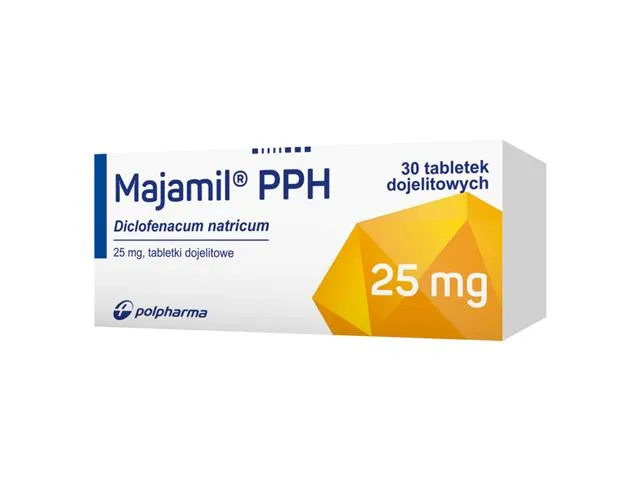
Table of Contents
Package leaflet: Information for the patient
Majamil PPH, 25 mg, enteric-coated tablets
Majamil PPH, 50 mg, enteric-coated tablets
Diclofenacum natricum
Please read this leaflet carefully before using the medicine, as it contains
important information for the patient.
- Keep this leaflet, as you may need to read it again.
- If you have any questions, please consult your doctor or pharmacist.
- This medicine has been prescribed for a specific individual. Do not give it to others. This medicine may harm others, even if their symptoms are the same.
- If you experience any adverse reactions, including any not listed in this leaflet, inform your doctor or pharmacist. See section 4.
Table of contents of the leaflet:
- What Majamil PPH is and what it is used for
- Important information before taking Majamil PPH
- How to take Majamil PPH
- Possible side effects
- How to store Majamil PPH
- Contents of the pack and other information
1. What Majamil PPH is and what it is used for
Sodium diclofenac (the active substance in Majamil PPH) belongs to a group of medicines called non-steroidal anti-inflammatory drugs (NSAIDs). Diclofenac has anti-inflammatory, analgesic and antipyretic properties.
Majamil PPH is used in the treatment of:
- rheumatoid arthritis;
- osteoarthritis, including back pain caused by spinal joint inflammation;
- painful shoulder stiffness caused by inflammation around the shoulder joint;
- pain associated with inflammation and swelling following surgical or dental procedures;
- acute attacks of gout;
- severe menstrual pain;
- conditions associated with fever, for a short period in combination with an anti-infective agent.
2. Information before using Majamil PPH
When not to use Majamil PPH:
- if the patient is allergic to sodium diclofenac or any of the other ingredients of this medicine (listed in section 6); if the patient suspects they may be allergic to sodium diclofenac, acetylsalicylic acid, ibuprofen, or any other medicine in the NSAID group, or to any of the other components of Majamil PPH (listed at the end of this leaflet). Symptoms of hypersensitivity include swelling of the face and lips (angioedema), difficulty breathing, chest pain, nasal discharge, rash, or any other allergic-type reactions.
- if there has been gastrointestinal bleeding or perforation in the past due to use of painkillers (NSAIDs) (blood in stool or black stools);
- if there is active or a history of peptic ulcer disease;
- if there has been bleeding from blood vessels in the brain;
- if there is a blood disorder;
- if there are certain disorders of bone marrow function;
- if there is severe liver, heart, or kidney dysfunction;
- if the patient has heart disease and/or cerebrovascular disease, e.g. after a heart attack, stroke, mini-stroke (transient ischaemic attack), or arterial embolism in the heart or brain, or after a procedure to unblock or bypass blocked blood vessels;
- if the patient has or has had circulatory disorders (peripheral vascular disease);
- during the last three months of pregnancy.
Warnings and precautions
Before starting to use Majamil PPH, discuss it with your doctor or pharmacist.
When to exercise particular caution when using Majamil PPH:
- if the patient has intestinal disease (e.g. ulcerative colitis, Crohn's disease);
- if there is reduced liver or kidney function;
- if there are blood clotting disorders or abnormal blood test results;
- if allergic reactions occur, such as wheezing, shortness of breath, fainting, swelling of the face, feet, or legs;
- if certain heart conditions or high blood pressure are present. Taking medicines such as diclofenac may be associated with a small increased risk of heart attack (myocardial infarction) or stroke. This risk increases with long-term use of high doses. Do not use higher doses or longer treatment duration than recommended.
- If the patient has heart problems, has had a stroke, or suspects they may be at risk of these conditions (e.g. high blood pressure, diabetes, high cholesterol, smoking), discuss the treatment approach with a doctor or pharmacist.
- if gastrointestinal disturbances occur. Treatment with diclofenac should be discontinued and the patient should consult a doctor.
- if the patient is elderly. The risk of adverse effects increases with age.
- if there has been a history of gastrointestinal diseases (e.g. gastrointestinal ulcer complicated by bleeding or perforation). The risk of adverse effects on the gastrointestinal tract increases if gastrointestinal disease occurred in the past.
- if a rash or other symptoms of hypersensitivity occur. Diclofenac use should be stopped and the patient should contact a doctor.
- if the patient is taking diuretics or selective cyclooxygenase-2 (COX-2) inhibitors such as celecoxib.
Consult a doctor even if one of the above warnings applies to the patient currently or in the past.
If long-term treatment is necessary, the doctor may recommend regular check-ups, even if the patient does not have any of the conditions listed above.
Before taking Majamil PPH, inform the doctor:
- if the patient smokes;
- if the patient has diabetes;
- if the patient has angina pectoris, blood clots, hypertension, high cholesterol, or high triglyceride levels;
- if the patient has recently undergone or is scheduled for stomach or gastrointestinal surgery, as Majamil PPH may sometimes impair wound healing in the intestines after surgery.
The occurrence of adverse effects can be minimized by using the lowest effective dose for the shortest duration necessary.
Majamil PPH and other medicines
Tell your doctor or pharmacist about all medicines currently or recently used, as well as any medicines you plan to take, especially:
- certain non-steroidal anti-inflammatory drugs (NSAIDs), such as acetylsalicylic acid or ibuprofen; increased risk of adverse effects;
- lithium, digoxin, methotrexate, and cyclosporine; increased risk of adverse effects;
- antidiabetic medicines (except insulin); their effect may be reduced;
- diuretics; potassium levels in blood should be monitored;
- certain anticoagulant medicines; anticoagulant effect and risk of gastrointestinal bleeding may increase;
- certain corticosteroid anti-inflammatory medicines; gastrointestinal symptoms may worsen;
- certain antibiotics used to treat infections (quinolones);
- certain medicines used to treat depression (selective serotonin reuptake inhibitors); risk of gastrointestinal bleeding increases;
- phenytoin (used in epilepsy);
- colestipol or cholestyramine (cholesterol-lowering medicines);
- sulfinpyrazone (used in the treatment of gout);
- voriconazole (used to treat fungal infections).
Pregnancy, breastfeeding, and fertility
If the patient is pregnant or breastfeeding, suspects she may be pregnant, or is planning to have a child, she should consult a doctor or pharmacist before using this medicine.
Do not take Majamil PPH if the patient is in the last three months of pregnancy, as it may harm the unborn child or cause problems during delivery. Majamil PPH may cause kidney and heart problems in the unborn child. It may increase the tendency to bleeding in both the mother and the child and may delay or prolong labour.
During the first six months of pregnancy, do not use Majamil PPH unless the doctor considers its use absolutely necessary. If treatment is required during this period or when trying to conceive, use the lowest possible dose for the shortest possible time. Majamil PPH taken for longer than a few days starting from week 20 of pregnancy may lead to impaired kidney function in the unborn child, which may result in low levels of amniotic fluid surrounding the baby (oligohydramnios) or narrowing of a blood vessel (ductus arteriosus) in the baby's heart. This may lead to low levels of amniotic fluid (oligohydramnios). If treatment for longer than a few days is required, the doctor may recommend additional monitoring.
Diclofenac passes into breast milk in small amounts. Therefore, diclofenac should not be used during breastfeeding to avoid adverse effects in the infant.
Driving and operating machinery
Wait and see how the patient reacts to diclofenac before driving or operating machinery. Diclofenac may cause dizziness, drowsiness, or visual disturbances. If these adverse effects occur, do not drive, operate machinery, or perform any other activities requiring concentration.
Majamil PPH contains lactose and sodium
Majamil PPH 25 mg enteric-coated tablets: Each tablet contains 50 mg of monohydrate lactose.
Majamil PPH 50 mg enteric-coated tablets: Each tablet contains 65 mg of monohydrate lactose.
If the patient has previously been diagnosed with intolerance to certain sugars, they should consult a doctor before taking this medicine.
Majamil PPH contains less than 1 mmol of sodium (23 mg) per tablet, meaning the medicine is considered "sodium-free".
3. How to use Majamil PPH
This medicine should always be used according to the instructions given by your doctor or pharmacist. If you have any doubts,
you should consult your doctor or pharmacist.
Usual doses
This medicine should always be used according to the instructions given by your doctor. If you have any doubts,
you should consult your doctor or pharmacist.
Do not exceed the maximum daily dose of 150 mg.
Your doctor may recommend taking diclofenac tablets during the day and using diclofenac suppositories at night.
Adults
For rheumatoid arthritis, the usual recommended starting dose is typically 150 mg per day; the maintenance dose ranges from 75 mg to 100 mg daily.
For osteoarthritis, the initial recommended dose is usually between 100 mg and 150 mg per day, depending on the severity of pain; the usual maintenance dose is 75 mg to 100 mg per day.
For painful shoulder stiffness, the initial recommended dose is 150 mg per day. The dose should then be reduced according to symptom severity.
For painful inflammatory conditions and swelling following surgical procedures, the usual starting dose is 150 mg per day. The dose should then be reduced depending on symptom severity.
For painful menstruation, the initial dose is 50 mg to 100 mg per day. The initial dose should be taken at the onset of the first symptoms. If necessary, a maximum dose of 50 mg three times a day may be taken for several days. If the maximum daily dose is insufficient over 2–3 menstrual cycles, the maximum daily dose may be increased to 200 mg during subsequent menstrual cycles.
Elderly patients
Elderly patients are more sensitive to the effects of diclofenac. They should take the lowest effective dose possible.
Children
Diclofenac should not be used in children under 1 year of age. In children over 1 year of age, the recommended dose is 0.5 mg to 2 mg per kilogram of body weight per day, divided into 2 to 3 doses, depending on the severity of the disease.
In the treatment of juvenile rheumatoid arthritis, the dose may be increased up to 3 mg per kilogram of body weight, divided into smaller doses throughout the day.
Only 25 mg tablets are suitable for use in children.
50 mg tablets should not be used in children.
How to use the medicine
Tablets should be swallowed whole with water (do not crush or chew them), preferably before meals.
The daily dose should be divided into 2–3 doses.
Duration of treatment
The duration of treatment may range from several days to several weeks, or even longer. Your doctor will determine the treatment duration. It is very important to follow this recommendation. If a patient wishes to discontinue treatment earlier, they should consult their doctor.
Taking more than the recommended dose of Majamil PPH
If you take more than the recommended dose, contact your doctor or pharmacist immediately. Try to recall how many tablets were taken and the dose ingested. Follow your doctor's instructions exactly.
Missed dose of Majamil PPH
If you miss a dose, take the next dose as soon as possible, unless more than half of the time between usual doses has passed. In that case, do not take the missed dose and take the next dose at the scheduled time. Do not take a double dose to make up for a missed dose.
If you have any further doubts about the use of this medicine, consult your doctor or pharmacist.
4. Possible adverse effects
Like all medicines, this medicine can cause adverse effects, although not everyone will experience them.
Some adverse effects may be serious.
You must stop taking Majamil PPH and contact your doctor immediately if
you notice any of the following:
- Mild abdominal cramps and tenderness occurring soon after starting Majamil PPH, followed by rectal bleeding or bloody diarrhoea, usually within 24 hours of the onset of abdominal pain (frequency unknown – cannot be estimated from available data).
If any of the following symptoms occur, stop taking Majamil PPH immediately and
contact your doctor immediately:
- Abdominal pain, indigestion, and epigastric pain;
- Vomiting blood, black stools, or blood in the urine;
- Skin reactions such as rash and itching;
- Wheezing and shortness of breath;
- Chest pain, which may be a sign of a potentially serious allergic reaction called Kounis syndrome (frequency unknown – cannot be estimated from available data);
- Yellowing of the skin or eyes;
- Persistent sore throat and high fever;
- Swelling of the face, feet, or legs;
- Severe headache;
- Chest pain during coughing.
The following adverse effects may occur:
Common (affecting more than 1 in 100 and less than 1 in 10 patients)
- Headache and dizziness;
- Stomach discomfort and other gastrointestinal disturbances such as nausea, vomiting, dyspepsia, diarrhoea, bloating, loss of appetite;
- Increased liver enzymes in blood;
- Skin rash.
Uncommon (affecting more than 1 in 10,000 and less than 1 in 1,000 patients)
- Hypersensitivity reactions such as: asthma, pale and clammy skin, restlessness, vasculitis, hypotension, shock;
- Drowsiness;
- Asthma, including shortness of breath;
- Gastritis, vomiting blood, blood in stool, bloody diarrhoea, lower abdominal pain;
- Hepatitis with or without jaundice, liver function abnormalities;
- Urticaria;
- Fluid retention (oedema).
Rare (affecting less than 1 in 10,000 patients)
- Blood disorders associated with increased susceptibility to infections (leucopenia);
- Increased tendency to bruising and bleeding (thrombocytopenia), high fever, severe sore throat (agranulocytosis), and anaemia;
- Disorientation, depression, insomnia, nightmares, irritability, psychotic reactions;
- Sensory disturbances, including tingling, itching or burning sensations without apparent cause, memory problems, seizures, restlessness, tremor, taste disturbances, and certain types of meningitis;
- Visual disturbances, blurred vision, double vision;
- Hearing disturbances, tinnitus;
- Palpitations, chest pain, heart failure;
- Pneumonitis;
- High blood pressure, vasculitis;
- (Ulcerative) colitis and Crohn's disease, constipation, stomatitis, glossitis, oesophageal injury, pancreatitis associated with severe epigastric pain radiating to the back and accompanied by nausea and vomiting;
- Fulminant hepatitis, hepatic necrosis, liver failure;
- Skin reactions with blister formation, including Stevens-Johnson syndrome and toxic epidermal necrolysis (life-threatening skin diseases causing rash, skin peeling, and mucosal ulceration);
- Skin rash with intense itching and formation of halos, blisters, eruptions, skin rash with red (moist) irregular patches, hair loss, photosensitivity (to sunlight), purpura (allergic), erythema, pruritus;
- Blood in urine, protein in urine, nephritis associated with blood in urine, fever and flank pain, reduced kidney function.
Taking medicines such as diclofenac is associated with a small increased risk of arterial thrombosis (e.g. heart attack or stroke).
Reporting of adverse effects
If any adverse effects occur, including any not listed in this leaflet, inform your doctor or pharmacist. Adverse effects can be reported directly to the Department of Monitoring Adverse Drug Reactions, Office for Registration of Medicinal Products, Medical Devices and Biocidal Products
Al. Jerozolimskie 181C
02-222 Warsaw
Tel.: +48 22 49 21 301
Fax: +48 22 49 21 309
Website: https://smz.ezdrowie.gov.pl
Adverse effects can also be reported to the responsible entity.
Reporting adverse effects helps to provide more information on the safety of this medicine.
5. How to store Majamil PPH
Store below 25°C. Store in the original packaging.
Keep the medicine out of sight and reach of children.
Do not use the medicine after the expiry date stated on the packaging following the EXP. The expiry date refers to the last day of the stated month.
The marking on the packaging following the abbreviation EXP indicates the expiry date, and following the abbreviation Lot/LOT indicates the batch number.
Medicines must not be disposed of via wastewater or household waste. Ask your pharmacist how to dispose of medicines no longer required. This will help protect the environment.
6. Contents of the pack and other information
What Majamil PPH contains
- The active substance is sodium diclofenac. Each 25 mg enteric-coated tablet contains: 25 mg of sodium diclofenac. Each 50 mg enteric-coated tablet contains: 50 mg of sodium diclofenac.
- Other ingredients are: tablet core: corn starch, monohydrate lactose, sodium carboxymethyl starch (Type A), pregelatinized corn starch, microcrystalline cellulose, magnesium stearate; tablet coating: talc, macrogol 6000, copolymer of methacrylic acid and ethyl acrylate, 30% dispersion, silicone emulsion (dimethicone, polysorbate 80, sorbic acid, purified water), titanium dioxide (E 171), yellow iron oxide (E 172), red iron oxide (E 172) (50 mg tablets only).
What Majamil PPH looks like and contents of the pack
Majamil PPH 25 mg enteric-coated tablets are yellow coated tablets engraved with "D25".
Majamil PPH 50 mg enteric-coated tablets are brown coated tablets engraved with "D50".
The cardboard box contains 30 tablets.
Marketing Authorisation Holder and Manufacturer
Marketing Authorisation Holder
Zakłady Farmaceutyczne POLPHARMA S.A.
ul. Pelplińska 19, 83-200 Starogard Gdański
tel. + 48 22 364 61 01
Manufacturer
Zakłady Farmaceutyczne POLPHARMA S.A.
ul. Pelplińska 19, 83-200 Starogard Gdański
Dragenopharm Apotheker Püschl GmbH
Göllstrasse 1
84529 Tittmoning
Germany