Loperamide apteo med
Poland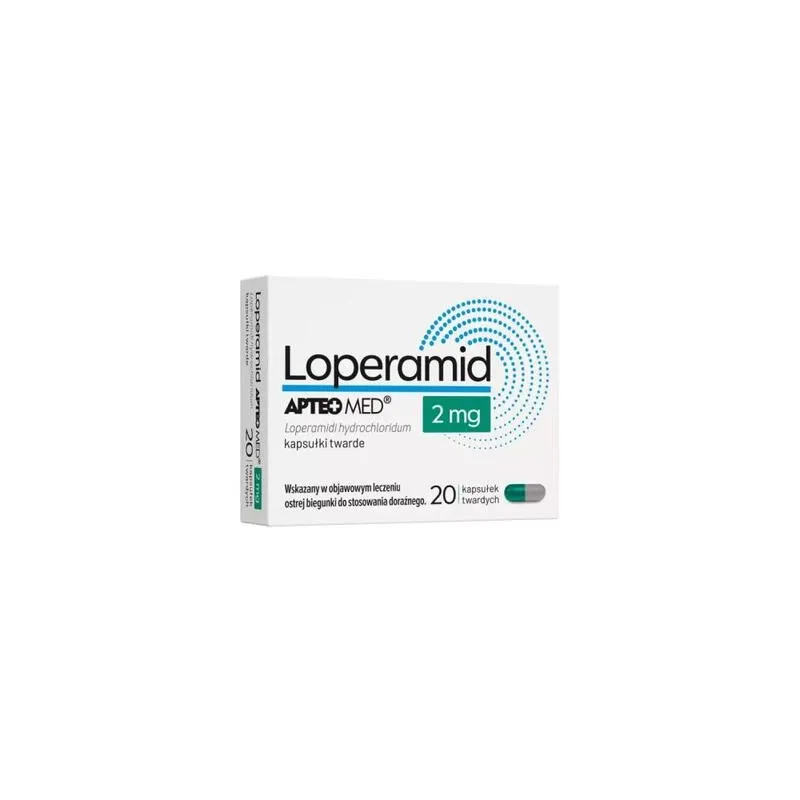
Table of Contents
- Package leaflet: Information for the patient
- 1. What Loperamid APTEO MED is and what it is used for
- 2. Important information before using Loperamid APTEO MED
- 3. How to use Loperamid APTEO MED
- 4. Possible adverse reactions
- 5. How to store Loperamid APTEO MED
- 6. Contents of the pack and other information
Package leaflet: Information for the patient
Loperamid APTEO MED, 2 mg, hard capsules
Loperamidi hydrochloridum
Please read the entire leaflet carefully before taking the medicine, as it contains
important information for the patient.
This medicine should always be used exactly as described in the patient leaflet or as directed by a
physician or pharmacist.
- Keep this leaflet, so that you can read it again if necessary.
- If you need advice or further information, please consult your pharmacist.
- If you experience any adverse reactions, including any possible side effects not listed in this leaflet, inform your doctor or pharmacist. See section 4.
- If there is no improvement after 2 days, or if you feel worse, consult your doctor.
Leaflet contents:
- What Loperamid APTEO MED is and what it is used for
- Important information before taking Loperamid APTEO MED
- How to take Loperamid APTEO MED
- Possible side effects
- How to store Loperamid APTEO MED
- Contents of the pack and other information
1. What Loperamid APTEO MED is and what it is used for
The active substance in Loperamid APTEO MED is loperamide hydrochloride, an antidiarrhoeal agent. The medicine prolongs the intestinal transit time, reduces the loss of water and electrolytes, and decreases the immediate need for defecation.
Loperamid APTEO MED is indicated:
- for symptomatic treatment of acute and chronic diarrhoea in adults, children and adolescents aged 6 years and above;
- for symptomatic treatment of acute episodes of diarrhoea associated with irritable bowel syndrome in adults aged 18 years and above, following initial diagnosis by a physician.
If there is no improvement after 2 days, or if you feel worse, consult your doctor.
2. Important information before using Loperamid APTEO MED
When not to use Loperamid APTEO MED:
- if the patient is allergic to loperamide hydrochloride or any of the other ingredients of the medicine (listed in section 6),
- in children under 6 years of age,
- in patients diagnosed with irritable bowel syndrome (IBS) under 18 years of age,
- in patients with acute dysentery characterized by blood in the stool and high fever,
- in patients with an acute flare-up of ulcerative colitis,
- in patients with bacterial infection of the small intestine and colon caused by pathogenic bacteria of the genus Salmonella, Shigella, and Campylobacter,
- in patients with pseudomembranous colitis associated with the use of broad-spectrum antibiotics,
- if the patient should avoid slowing intestinal peristalsis. In such cases, there is a risk of severe complications, including bowel obstruction, abdominal distension, and toxic megacolon. Treatment with Loperamid APTEO MED must be immediately discontinued if constipation, abdominal distension, or intestinal obstruction occurs.
Warnings and precautions
Before starting treatment with Loperamid APTEO MED, consult your doctor or pharmacist.
Treatment of diarrhoea with Loperamid APTEO MED is symptomatic only.
Whenever the cause of diarrhoea can be identified and it is appropriate (or indicated), the doctor will recommend suitable treatment.
In patients with diarrhoea, particularly in adolescents, elderly individuals, and debilitated patients, dehydration and excessive loss of electrolytes may occur. Therefore, during diarrhoea, increased fluid intake is recommended to compensate for these losses.
If symptoms do not resolve within 48 hours of starting treatment in acute diarrhoea, discontinue Loperamid APTEO MED and consult a doctor.
Patients with AIDS who are using Loperamid APTEO MED for diarrhoea should immediately stop taking the medicine and contact their doctor if early signs of abdominal distension occur. Cases of toxic megacolon have been reported in patients with AIDS and infectious colitis caused by both viruses and bacteria during loperamide treatment.
Loperamid APTEO MED should be used with caution in patients with impaired liver function due to reduced metabolism related to the first-pass effect in the liver. In these patients, relative overdose may occur, leading to toxic effects on the central nervous system.
This medicine should not be used for purposes other than those indicated (see section 1) or in doses higher than recommended (see section 3). Severe cardiac disorders (including rapid or irregular heartbeat) have been reported in patients taking excessive doses of loperamide (the active substance in Loperamid APTEO MED).
Patients diagnosed by a doctor with irritable bowel syndrome (IBS) should discuss treatment with a doctor or pharmacist before taking the medicine, especially if:
- the patient is 40 years of age or older, or if some time has passed since the last episode of IBS symptoms, or if the current symptoms differ from previous ones,
- the patient has recently experienced gastrointestinal bleeding,
- the patient suffers from severe constipation,
- the patient has nausea or vomiting,
- the patient has loss of appetite or weight loss,
- the patient has difficulty or pain during urination,
- the patient has fever,
- the patient has recently travelled abroad.
Children and adolescents
Loperamid APTEO MED should not be used in children under 6 years of age or in patients diagnosed with irritable bowel syndrome under 18 years of age.
Loperamid APTEO MED and other medicines
Inform your doctor or pharmacist about all medicines you are currently taking or have recently taken, as well as any medicines you plan to take.
It is particularly important to inform your doctor or pharmacist if you are taking:
- ritonavir (a medicine used in the treatment of HIV infection),
- quinidine (a medicine used to treat abnormal heart rhythm or malaria),
- oral desmopressin (a medicine used to treat excessive urination),
- itraconazole or ketoconazole (medicines used to treat fungal infections),
- gemfibrozil (a medicine used to treat high cholesterol levels).
Taking Loperamid APTEO MED with food, drink, and alcohol
See section 3.
Pregnancy, breastfeeding, and fertility
If the patient is pregnant or breastfeeding, suspects she may be pregnant, or is planning to have a child, she should consult her doctor or pharmacist before using this medicine.
Small amounts of loperamide may pass into breast milk; therefore, use during breastfeeding is not recommended.
Pregnant or breastfeeding women should consult their doctor to determine appropriate treatment.
The effect of the medicine on fertility has not been studied.
Driving and operating machinery
During treatment of diarrhoea with loperamide, reduced alertness, fatigue, dizziness, or drowsiness may occur. Therefore, caution should be exercised when driving or operating machinery.
Loperamid APTEO MED contains lactose
If the patient has previously been diagnosed with intolerance to certain sugars, the patient should consult a doctor before taking this medicine.
3. How to use Loperamid APTEO MED
Loperamid APTEO MED should be taken exactly as described in the patient leaflet or as advised by your doctor. If in doubt, consult your doctor or pharmacist.
Loperamid APTEO MED should be taken orally, with liquid.
Dosage
Diarrhoea may resolve after a single dose. In such case, further use of the medicine should be discontinued. During diarrhoea, it is important to drink more fluids than usual. This is particularly important for adolescents, elderly individuals, and weakened patients.
Acute and chronic diarrhoea:
Adults, children and adolescents above 6 years of age
Acute diarrhoea: initial dose is 2 capsules (4 mg) for adults and 1 capsule (2 mg) for children, followed by 1 capsule (2 mg) after each loose bowel movement.
Chronic diarrhoea: initial dose is 2 capsules (4 mg) per day for adults and 1 capsule (2 mg) per day for children. This initial dose should be adjusted until 1 to 2 normal stools per day are achieved, usually by using a maintenance dose ranging from 1 to 6 capsules (2 mg to 12 mg) per day.
Maximum daily dose in acute and chronic diarrhoea: 8 capsules (16 mg) per day for adults and children; in children, the dose must be adjusted according to body weight (3 capsules/20 kg body weight). Do not exceed the maximum recommended daily dose.
If symptoms worsen or do not improve within 48 hours of starting treatment with Loperamid APTEO MED, discontinue use and consult your doctor.
Symptomatic treatment of acute episodes of diarrhoea associated with irritable bowel syndrome:
Adults, individuals aged 18 years and older
Initial dose: 2 capsules (4 mg), followed by 1 capsule (2 mg) after each loose stool or as directed by your doctor. The maximum daily dose should not exceed 6 capsules (12 mg).
In recurrent episodes of diarrhoea associated with irritable bowel syndrome, Loperamid APTEO MED may be used for up to 2 weeks, but if any episode of diarrhoea lasts longer than 48 hours, medical advice should be sought.
Children
Loperamid APTEO MED must not be used in children under 6 years of age, nor in patients under 18 years of age with irritable bowel syndrome.
Use of Loperamid APTEO MED in elderly patients
Dosage adjustment is not required in elderly patients.
Use of Loperamid APTEO MED in patients with renal impairment
Dosage adjustment is not required in patients with impaired kidney function.
Use of Loperamid APTEO MED in patients with hepatic impairment
In patients with impaired liver function, the medicine should be used under medical supervision, as caution is required and careful monitoring for signs of central nervous system toxicity is necessary.
Overdose of Loperamid APTEO MED
If you take more than the recommended dose, seek immediate medical advice from a doctor or go to the nearest hospital.
Symptoms of overdose may include:
rapid heartbeat, irregular heartbeat, changes in heart rhythm (these may have severe, life-threatening consequences), muscle stiffness, uncoordinated movements, drowsiness, pinpoint pupils, difficulty urinating, shallow breathing, slowed breathing. Children may react more strongly to large doses of Loperamid APTEO MED than adults. If a child takes too high a dose or develops any of the symptoms listed above, contact a doctor immediately.
Missed dose of Loperamid APTEO MED
If you miss a dose, take it after the next loose bowel movement. Do not take a double dose to make up for a missed dose.
4. Possible adverse reactions
Like all medicines, this medicine can cause adverse reactions, although not everyone will experience them.
Stop taking the medicine and contact a doctor immediately if any of the following adverse reactions occur.
These require immediate treatment.
Rare (may affect 1 in 1,000 people):
- hypersensitivity reactions, anaphylactic reaction (including anaphylactic shock), anaphylactoid reaction, angioedema,
- blistering rash, peeling of large sheets of the outer layer of skin (including Stevens-Johnson syndrome, toxic epidermal necrolysis [Lyell's syndrome], erythema multiforme), itching, urticaria,
- loss of consciousness, stupor or reduced level of consciousness, increased muscle tone, movement coordination disorders.
If any of the following adverse reactions occur, stop taking the medicine and contact a doctor
immediately.
Uncommon (may affect less than 1 in 100 people):
- rash,
- abdominal pain, discomfort in the abdominal cavity, indigestion, epigastric pain.
Rare (may affect 1 in 1,000 people):
- urinary retention,
- severe constipation,
- abdominal distension,
- miosis (pupillary constriction).
Frequency not known (cannot be estimated from available data): epigastric pain, abdominal pain radiating to the back, abdominal tenderness, fever, tachycardia, nausea, vomiting, which may be symptoms of inflammation of the pancreas (acute pancreatitis).
Other adverse reactions that may occur during treatment with this medicine:
Common (may affect less than 1 in 10 people):
- constipation, nausea, bloating with flatulence,
- headache.
Uncommon (may affect less than 1 in 100 people):
- dizziness, drowsiness,
- vomiting, indigestion,
- dry mouth.
Rare (may affect 1 in 1,000 people):
- fatigue.
Reporting of adverse reactions
If any adverse reactions occur, including any adverse reactions not listed in this leaflet, inform a doctor or pharmacist. Adverse reactions can be reported directly to the Department of Monitoring of Adverse Drug Reactions at the Office for Registration of Medicinal Products, Medical Devices and Biocidal Products:
Al. Jerozolimskie 181C, 02-222 Warsaw.
Tel.: +48 22 49 21 301
Fax: +48 22 49 21 309
Website: https://smz.ezdrowie.gov.pl
Adverse reactions can also be reported to the marketing authorization holder.
Reporting adverse reactions helps to provide more information on the safety of the medicine.
5. How to store Loperamid APTEO MED
Do not store above 25°C.
Keep the medicine in a place out of sight and reach of children.
Do not use this medicine after the expiry date stated on the packaging. The expiry date refers to the last day of the stated month.
Medicines must not be disposed of via sewage systems or household waste. Ask your pharmacist how to dispose of medicines no longer in use. This will help protect the environment.
6. Contents of the pack and other information
What Loperamid APTEO MED contains
The active substance is loperamide hydrochloride. Each tablet contains 2 mg of loperamide hydrochloride.
The other ingredients are:
Corn starch (dried), lactose (DCL 21), polysorbate 80, talc, colloidal anhydrous silica, magnesium stearate.
Capsule shell: body: gelatin, purified water, sodium lauryl sulfate, erythrosine (E 127), iron oxide black (E 172), titanium dioxide (E 171); cap: gelatin, purified water, sodium lauryl sulfate, iron oxide yellow (E 172), indigotine (E 132), titanium dioxide (E 171); printing ink: shellac, iron oxide black (E 172), potassium hydroxide.
What Loperamid APTEO MED looks like and contents of the pack
Hard gelatin capsule, grey-green in colour, size "4", printed with "24" on the body and "C" on the cap, filled with white or almost white powder.
Pack sizes:
8, 10 or 20 capsules in PVC/Aluminum blisters, packed in a cardboard box.
Marketing Authorisation Holder:
Synoptis Pharma Sp. z o.o.
Krakowiaków 65
02-255 Warsaw
Tel. 607 696 231
e-mail: [email protected]
Manufacturer/Importer:
Synoptis Industrial Sp. z o.o.
Rabowicka 15
62-020 Swarzędz