Lakcid forte
Poland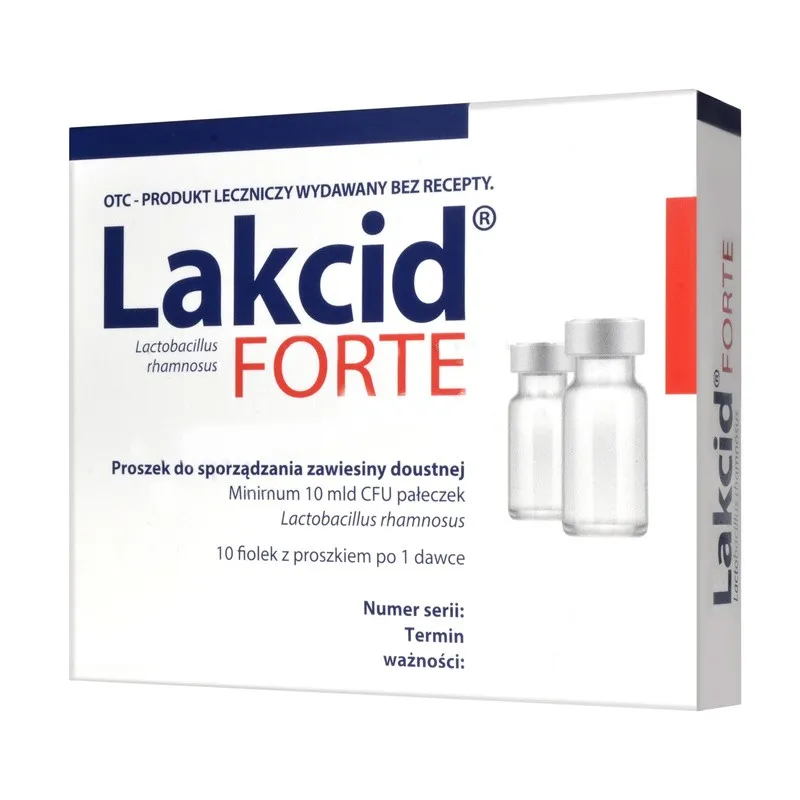
Table of Contents
Package leaflet: information for the user
Lakcid forte, powder for oral suspension
Lactobacillus rhamnosus
Minimum 10 billion CFU of Lactobacillus rhamnosus rods
Please read all of this leaflet carefully before taking this medicine, because it contains
important information for you.
This medicine should always be used exactly as described in this patient leaflet or as directed by
your doctor or pharmacist.
- Keep this leaflet so that you can read it again if necessary.
- If you need advice or further information, please contact your pharmacist.
- If you experience any adverse reactions, including any not listed in this leaflet, inform your doctor or pharmacist. See section 4.
- If there is no improvement or if you feel worse, consult your doctor.
Leaflet contents
- What Lakcid forte is and what it is used for
- Important information before taking Lakcid forte
- How to take Lakcid forte
- Possible side effects
- How to store Lakcid forte
- Contents of the pack and other information
1. What Lakcid forte is and what it is used for
Lakcid forte is a powder for preparing an oral suspension. It contains strains of Lactobacillus rhamnosus bacteria, which, like other lactic acid bacteria, colonize the intestinal mucosa and normalize the composition of gastrointestinal flora, particularly after its depletion due to antibiotic therapy. Research findings have confirmed that these strains survive in gastric juice and are resistant to bile salts, enabling their adaptation and viability in the gastrointestinal tract.
By competing for substrates and colonization sites on the intestinal mucosa, and by producing lactic acid through anaerobic sugar breakdown, they create unfavorable conditions for the growth of most pathogenic microorganisms.
These strains possess natural resistance to a broad spectrum of antibiotics used clinically.
Lakcid forte is intended for use:
- in post-antibiotic intestinal inflammation, particularly as supportive treatment in pseudomembranous colitis; primarily in recurrent pseudomembranous colitis,
- in prevention of travelers' diarrhea,
- as supportive treatment during and after antibiotic therapy.
2. Important information before using Lakcid forte
When not to use Lakcid forte
- if the patient is allergic to the active substances or to any of the other ingredients of this medicine (listed in section 6), including cow's milk protein.
Warnings and precautions
Before starting treatment with Lakcid, consult your doctor.
This medicine is intended for oral use only. Do not inject.
There is a risk of developing bacteremia (sepsis). Single cases of infective endocarditis caused by Lactobacillus rhamnosus infection have been reported in critically ill patients.
Treatment with medicinal products containing Lactobacillus rhamnosus may exceptionally lead to septic infections in high-risk patient groups, primarily in premature infants and full-term newborns with congenital malformations or impaired organ function.
Lakcid forte with food and drink
The medicine can be taken independently of meal times.
Pregnancy and breastfeeding
Lakcid forte may be used during pregnancy and breastfeeding.
Driving and operating machinery
Lakcid forte has no influence on the ability to drive or operate machinery.
Lakcid forte contains sucrose and lactose
If the patient has previously been diagnosed with intolerance to certain sugars, the patient should consult their doctor before taking this medicine.
3. How to use Lakcid forte
This medicine should always be taken exactly as described in the patient leaflet or as directed by a doctor or pharmacist. If in doubt, consult your doctor or pharmacist.
Oral administration.
Recommended dose
Unless otherwise advised by a doctor, the recommended dose is 2 times daily, 1 dose (contents of 1 vial or 1 sachet).
Immediately before use, remove the cap from the vial and take out the rubber stopper. Add a small amount of boiled and cooled to room temperature water or milk to the vial, mix well. Pour the contents of the vial onto a teaspoon.
Immediately before use, tear open the sachet at the cut line. Dissolve the contents of the sachet in approximately \⅛ of a glass of boiled and cooled to room temperature water or milk, mix well. The resulting suspension may range in colour from light to dark beige and may be heterogeneous with visible particles.
Use of a higher than recommended dose of Lakcid forte
No cases of overdose have been reported.
4. Possible adverse reactions
Like all medicinal products, this medicine can cause adverse reactions, although not everybody will experience them.
The following adverse reactions may occur:
Frequency unknown (frequency cannot be estimated from the available data):
- bacteraemia (sepsis), infective endocarditis – in severely ill patients and patients at increased risk (see section Warnings and precautions).
Reporting of adverse reactions
If any adverse reactions occur, including any not listed in this leaflet, inform your doctor, pharmacist, or nurse. Adverse reactions can be reported directly to the Department of Monitoring Adverse Drug Reactions of the Office for Registration of Medicinal Products, Medical Devices and Biocidal Products
Al. Jerozolimskie 181C
02-222 Warsaw
Phone: +48 22 49 21 301
Fax: +48 22 49 21 309
Website: https://smz.ezdrowie.gov.pl
Adverse reactions can also be reported to the marketing authorization holder.
Reporting adverse reactions helps provide more information on the safety of this medicine.
5. How to store Lakcid forte
Keep the medicine out of sight and reach of children.
Store in a refrigerator (2°C - 8°C).
During its valid shelf-life, the medicine may be stored for up to 1 month at a temperature of 15°C - 25°C.
Do not use this medicine after the expiry date stated on the packaging. The expiry date refers to the last day of the stated month.
Medicines must not be disposed of via the sewage system or household waste. Ask your pharmacist how to dispose of medicines no longer required. Such measures help protect the environment.
6. Contents of the packaging and other information
What Lakcid forte contains
- The active substance in the medicine is Lactobacillus rhamnosus bacteria. Each vial or sachet of powder contains: a minimum of 10 billion CFU of Lactobacillus rhamnosus bacteria: strain Lactobacillus rhamnosus Pen - 40%, strain Lactobacillus rhamnosus E/N - 40%, strain Lactobacillus rhamnosus Oxy - 20%. The bacteria are resistant to: amoxicillin, ampicillin, azlocillin, cefepime, cefotaxime, cefradine, ceftazidime, cefuroxime, doxycycline, erythromycin, gentamicin, imipenem, clindamycin, cloxacillin, colistin, cotrimoxazole, nalidixic acid, meropenem, metronidazole, neomycin, netilmicin, penicillin, piperacillin, streptomycin, teicoplanin, tobramycin, vancomycin.
CFU – Colony Forming Unit.
- The other ingredients are: skimmed milk and sucrose.
What Lakcid forte looks like and contents of the packaging
What Lakcid forte looks like
The powder in the vial is a free-flowing or crystalline-needle-like dry mass, ranging in colour from light to dark beige.
The powder in the sachet consists of loose, finely divided particles, ranging in colour from light to dark beige.
After reconstitution, the resulting suspension may be uneven in appearance, with visible sediment, and ranges in colour from light to dark beige.
Packaging
5 vials with powder, 1 dose each
10 vials with powder, 1 dose each
5 sachets with powder, 1 dose each
10 sachets with powder, 1 dose each
Not all pack sizes may be marketed.
Marketing Authorisation Holder
Zakłady Farmaceutyczne POLPHARMA S.A.
ul. Pelplińska 19, 83-200 Starogard Gdański
tel. + 48 22 364 61 01
Manufacturer
„BIOMED-LUBLIN” Wytwórnia Surowic i Szczepionek Spółka Akcyjna
ul. Uniwersytecka 10, 20-029 Lublin