Kornam
Poland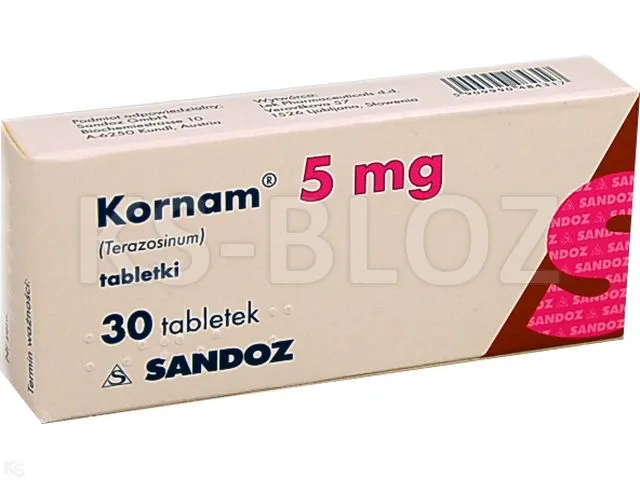
Table of Contents
Package leaflet: Information for the patient
Kornam, 2 mg, tablets
Kornam, 5 mg, tablets
Terazosinum
Please read this leaflet carefully before using the medicine, as it contains important information for the patient.
- Keep this leaflet so that you can read it again if necessary.
- If you have any doubts, please consult your doctor or pharmacist.
- This medicine has been prescribed for a specific individual. Do not pass it on to others. The medicine may harm another person, even if their symptoms are the same.
- If the patient experiences any adverse reactions, including any not listed in this leaflet, inform your doctor or pharmacist. See section 4.
Table of contents of the leaflet
- What Kornam is and what it is used for
- Important information before taking Kornam
- How to take Kornam
- Possible side effects
- How to store Kornam
- Contents of the pack and other information
1. What Kornam is and what it is used for
Kornam belongs to a group of medicines called alpha-adrenergic receptor antagonists (or alpha-adrenolytic agents).
Kornam reduces the tone of blood vessel walls (veins and arteries) and causes their dilation, thereby facilitating blood flow through these vessels. The medicine also relaxes the muscles of the prostate gland and bladder neck, making urination easier.
Kornam is used in the treatment of arterial hypertension, in the treatment of benign prostatic hyperplasia (enlarged prostate gland), and in the symptomatic treatment of urinary voiding disorders due to urethral obstruction caused by benign prostatic hyperplasia.
2. Important information before using Kornam
When not to use Kornam
- if the patient is allergic to terazosin or any of the other ingredients of this medicine (listed in section 6),
- if the patient has known hypersensitivity to other alpha-blocking agents,
- in patients with a history of fainting during urination.
Warnings and precautions
Before starting to take Kornam, please discuss this with your doctor or pharmacist.
Kornam may significantly lower blood pressure, cause a drop in blood pressure upon changing position from lying or sitting to standing (orthostatic hypotension), and fainting. The risk of these effects occurs after taking the first dose or first few doses, after increasing the dose, after an interruption of treatment lasting 2 or more days followed by resumption of therapy, and also in elderly patients (≥65 years of age), as well as when an additional antihypertensive or diuretic medicine is added to the treatment.
If the patient resumes taking Kornam after a several-day break, the doctor will recommend starting with the initial dose.
Marked lowering of arterial blood pressure may occur in patients, especially after the first dose ("first-dose effect") or after dose increase, particularly in the standing position or during postural changes. Symptoms such as weakness, dizziness, and, very rarely, loss of consciousness may then occur, sometimes triggered by supraventricular tachycardia.
These symptoms may also be expected when resuming treatment after a break of two or more days. They usually last only a short time and typically resolve with continued treatment.
Sudden changes in body position or prolonged standing should be avoided, especially after dose increase or resumption of treatment after a break. This particularly applies to elderly patients. Avoid stressful situations that may trigger fainting; sit or lie down immediately if any symptoms of low blood pressure occur, even though they may not always be related to body position. Be cautious when getting up from sitting or lying positions. If dizziness or palpitations occur, contact your doctor immediately, who may consider adjusting the dose.
This medicine should not be used in case of bladder overdistension, urinary retention, or advanced renal failure.
Due to the risk of excessive lowering of blood pressure, caution is required when terazosin (the active substance in Kornam) is used concomitantly with thiazide diuretics or other antihypertensive medicines. If such medicines are introduced during terazosin treatment, the doctor may recommend reducing or discontinuing the dose of terazosin. The new dose must be increased gradually. If terazosin is used in combination with other antihypertensive medicines, the doctor may recommend reducing their doses before starting terazosin treatment and adjusting them once the terazosin dose has been stabilised.
Terazosin may cause prolonged (lasting more than 4 hours) or painful erection (priapism). If this occurs, seek immediate medical advice, as otherwise there is a risk of permanent erectile dysfunction.
Before starting treatment for symptoms of benign prostatic hyperplasia, the doctor will perform appropriate examinations to exclude other causes of urinary flow disturbances or urinary tract symptoms. Patients with benign prostatic hyperplasia who also have upper urinary tract flow disturbances, chronic urinary tract infections, or kidney stones should not use Kornam.
The doctor will monitor treatment particularly carefully in patients with pulmonary oedema caused by heart valve stenosis or heart failure.
Particular caution is required when using Kornam together with medicines such as sildenafil, tadalafil, or vardenafil, due to the risk of symptoms of arterial hypotension. Please consult your doctor about this.
Inform your doctor if the patient has ever fainted after urinating, as Kornam should not be used in such patients.
If the patient is scheduled for cataract surgery, inform the ophthalmologist performing the procedure about current or past use of Kornam.
Terazosin may affect the results of certain blood laboratory tests.
Caution is required when using medicines that may influence hepatic metabolism (e.g. phosphodiesterase-5 inhibitors such as sildenafil, tadalafil, and vardenafil [medicines used to treat erectile dysfunction], calcium channel blockers, angiotensin-converting enzyme (ACE) inhibitors [medicines used to treat high blood pressure or certain heart conditions], and cimetidine [a medicine that reduces gastric acid secretion]).
If the patient is due to undergo urine testing for diagnosis of a chromaffin tumour (pheochromocytoma), they must inform the doctor about taking Kornam.
Children
Kornam is not used in children.
Kornam with other medicines
Tell your doctor about all medicines the patient is currently taking or has recently taken, as well as any medicines the patient plans to take.
Before taking any additional medicine, including over-the-counter medicines, vitamins, and herbal supplements, consult your doctor. Kornam and other concomitantly used medicines may interact and affect each other's action.
This particularly applies to the following medicines:
- other medicines that lower blood pressure (e.g. clonidine, moxonidine);
- diuretics;
- other alpha-blocking agents (e.g. doxazosin, prazosin);
- nitrates (e.g. nitroglycerin);
- medicines used to treat bronchial asthma;
- medicines used to treat heart diseases (e.g. beta-blockers, calcium channel blockers, angiotensin-converting enzyme [ACE] inhibitors);
- sympathomimetic medicines (e.g. dopamine, ephedrine, adrenaline, metaraminol, methoxamine);
- medicines used to treat eye diseases;
- medicines used to relieve symptoms of nasal mucosal inflammation (e.g. phenylephrine);
- medicines used to treat erectile dysfunction (e.g. sildenafil, tadalafil, and vardenafil).
Kornam with food, drink, and alcohol
Tablets should be swallowed with a sufficient amount of liquid (e.g. a glass of water).
During treatment with Kornam, consumption of alcoholic beverages should be avoided.
Pregnancy and breastfeeding
If the patient is pregnant or breastfeeding, suspects she may be pregnant, or is planning to become pregnant, she should consult her doctor before using this medicine.
This medicine may be used during pregnancy and breastfeeding only if the doctor considers it necessary. The medicine should not be used shortly before delivery.
Driving and operating machinery
Kornam has a major influence on the ability to drive and operate machinery.
Especially at the beginning of treatment, dizziness, drowsiness, and/or fainting may occur. Patients should not drive or operate machinery within 12 hours after taking the first dose of the medicine, after increasing the dose, or after resuming treatment with Kornam following a break.
Kornam contains monohydrate lactose. If the patient has previously been diagnosed with intolerance to certain sugars, the patient should consult their doctor before taking this medicine.
3. How to use Kornam
This medicine should always be used exactly as prescribed by your doctor. If in doubt, consult
your doctor or pharmacist.
Your doctor will prescribe the appropriate dose and determine how often you should take the medicine.
The dose may be adjusted several times until the optimal dose is established. Do not change the dose
or stop treatment without consulting your doctor. Unless otherwise decided by your doctor, the medicine
should be taken at bedtime.
The tablets should be swallowed with an adequate amount of liquid (e.g. a glass of water).
Arterial hypertension
The usual initial dose is 1 mg (half a 2 mg tablet) at bedtime, and this dose should not be exceeded.
Your doctor will then gradually increase the dose, if necessary, until blood pressure is normalized.
The usual maintenance dose ranges from 2 mg to 10 mg daily, taken at bedtime. The maximum daily
dose is 20 mg (40 mg in exceptional cases).
Benign prostatic hyperplasia
The initial dose is 1 mg daily (half a 2 mg tablet) at bedtime. The dose should be gradually increased
until clinical improvement is achieved, according to your doctor's instructions. The usual daily dose
is 10 mg of terazosin. Treatment effects may be observed after 2 weeks of starting therapy. Best results
are usually achieved after 4 to 6 weeks of treatment with a daily dose of 10 mg of terazosin. The usual
maintenance dose ranges from 5 mg to 10 mg taken at bedtime. The maximum daily dose is 20 mg.
Elderly patients
Dose adjustment is not necessary.
Patients with renal impairment
Patients who excrete reduced amounts of urine or do not excrete urine at all, as well as patients with
severe renal insufficiency, should not use this medicine. If in doubt, consult your doctor.
Patients with hepatic impairment
Patients with severe hepatic dysfunction should not use this medicine. If you are unsure whether this
applies to you, consult your doctor.
Taking more Kornam than prescribed
If you take more Kornam than recommended, consult your doctor immediately, as this may cause
excessive lowering of blood pressure.
Missing a dose of Kornam
If you forget to take your dose of Kornam at the usual time, take it as soon as possible and continue
taking the medicine according to your regular schedule. Do not take a double dose to make up for
the missed dose.
Stopping Kornam
Always consult your doctor before deciding to stop taking Kornam. Even if you feel well, do not
discontinue treatment without medical advice. After an interruption of several days in terazosin
treatment, therapy should be resumed with the initial dose of 1 mg.
If you have any further questions about the use of this medicine, consult your doctor or pharmacist.
4. Possible adverse reactions
Like all medicines, this medicine can cause adverse reactions, although not everyone will experience them.
Kornam may cause fainting. After taking the first dose, a marked drop in blood pressure may occur, causing dizziness and, in severe cases, fainting.
Very common adverse reactions (may affect more than 1 in 10 people):
- headache
- dizziness
- feeling weak
Common adverse reactions (may affect less than 1 in 10 people):
- sinusitis
- nervousness
- drowsiness
- anxiety
- tingling sensation
- blurred vision, double vision
- palpitations, increased heart rate
- drop in blood pressure when changing from lying down to sitting or standing, causing dizziness
- shortness of breath
- nausea
- limb pain, back pain
- erectile dysfunction
- limb swelling
- feeling tired
- mucosal oedema
Uncommon adverse reactions (may affect less than 1 in 100 people):
- decreased libido
- depression
- fainting
- oedema
Rare adverse reactions (may affect less than 1 in 1000 people):
- weight gain
Frequency not known (cannot be estimated from available data):
- bronchitis, flu-like symptoms, nasal and throat mucosal inflammation
- urinary tract infection
- reduced platelet count (thrombocytopenia)
- severe allergic reactions (anaphylactic reactions)
- gout
- insomnia
- conjunctivitis
- lazy eye (amblyopia)
- tinnitus
- heart rhythm disorders, atrial fibrillation
- vasodilation
- cough, nosebleed
- abdominal pain, constipation, diarrhoea, dry mouth, dyspepsia, bloating, vomiting
- increased frequency of urination, urinary incontinence
- excessive sweating
- itching
- rash
- joint pain, arthritis, joint disease (arthropathy), muscle pain, neck pain, shoulder pain
- increased frequency of urination, urinary incontinence
- prolonged and/or painful erection (priapism)
- chest pain
- facial swelling
- increased body temperature
- decreased albumin concentration, decreased haematocrit value, decreased blood pigment (haemoglobin) concentration, decreased total protein concentration
- decreased white blood cell (leukocyte) count
- nasal congestion
A variant of the "small pupil syndrome" known as intraoperative floppy iris syndrome (IFIS) has been reported with alpha-adrenolytic agents during cataract surgery.
Reporting of adverse reactions
If any adverse reactions occur, including any not listed in this leaflet, inform your doctor, pharmacist or nurse. Adverse reactions can be reported directly to the Department of Monitoring Adverse Drug Reactions at the Office for Registration of Medicinal Products, Medical Devices and Biocidal Products:
Al. Jerozolimskie 181C
02-222 Warsaw
Phone: +48 22 49 21 301
Fax: +48 22 49 21 309
Website: https://smz.ezdrowie.gov.pl
Adverse reactions can also be reported to the marketing authorisation holder.
Reporting adverse reactions helps provide more information on the safety of this medicine.
5. How to store Kornam
Keep this medicine out of sight and reach of children.
Store below 25°C.
Store in the original packaging.
Do not use this medicine after the expiry date stated on the packaging after EXP.
The expiry date refers to the last day of the stated month.
Medicines must not be disposed of via wastewater or household waste. Ask your pharmacist how to dispose of medicines no longer required. This will help protect the environment.
6. Contents of the pack and other information
What Kornam contains
The active substance in Kornam is terazosin.
Tablets 2 mg
One tablet contains 2 mg of terazosin in the form of terazosin hydrochloride dihydrate.
The other ingredients are: monohydrate lactose, microcrystalline cellulose, corn starch, talc,
anhydrous colloidal silicon dioxide, magnesium stearate, quinoline yellow.
Tablets 5 mg
One tablet contains 5 mg of terazosin in the form of terazosin hydrochloride dihydrate.
The other ingredients are: monohydrate lactose, microcrystalline cellulose, corn starch, talc,
anhydrous colloidal silicon dioxide, magnesium stearate, yellow iron oxide.
What Kornam looks like and contents of the pack
Tablets 2 mg
Yellow, round, flat tablets with bevelled edges and a dividing groove on one side.
Tablets 5 mg
Yellow-orange, round, flat tablets with bevelled edges and a dividing groove on one side.
Blister packs made of aluminium/PVC foil in cardboard boxes contain 30 tablets.
Marketing Authorisation Holder and Manufacturer
Marketing Authorisation Holder
Sandoz GmbH
Biochemiestrasse 10
A-6250 Kundl, Austria
Manufacturer
Lek Pharmaceuticals d.d.
Verovškova 57
1526 Ljubljana, Slovenia
For further information, please contact:
Sandoz Polska Sp. z o.o.
ul. Domaniewska 50 C
02-672 Warsaw, Poland
tel. 22 209 70 00