Hirudoid
Poland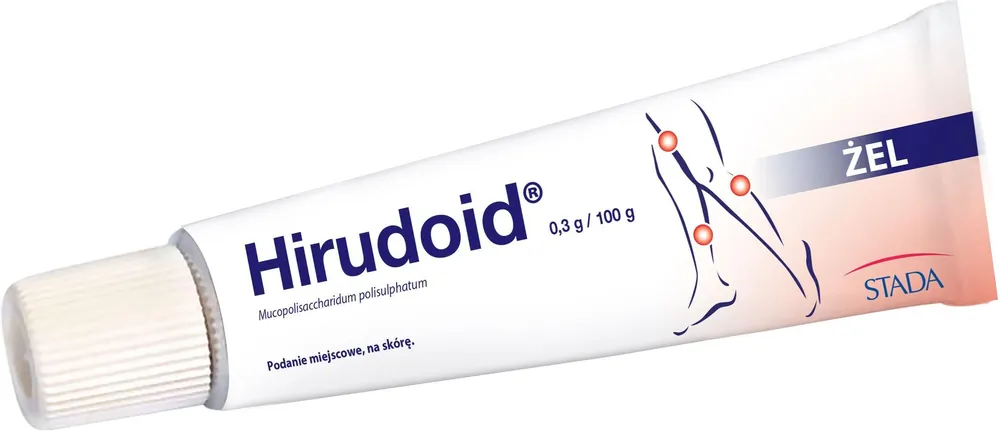
Table of Contents
Package leaflet: Information for the user
Warning! Keep this leaflet! Information on the immediate packaging in a foreign language.
Hirudoid (Hirudoid Gel)
0.3 g/100 g, gel
Mucopolysaccharide polysulphate
Hirudoid and Hirudoid Gel are different trade names for the same medicine.
Please read this leaflet carefully before using the medicine, as it contains
important information for the patient.
- This medicine should always be used exactly as described in the patient leaflet or as directed by a doctor or pharmacist.
- Keep this leaflet so that you can read it again if necessary.
- If you need advice or further information, please consult your pharmacist.
- If you experience any adverse reactions, including any possible adverse reactions not listed in this leaflet, inform your doctor or pharmacist. See section 4.
Table of contents of the leaflet:
- What Hirudoid is and what it is used for
- Important information before using Hirudoid
- How to use Hirudoid
- Possible side effects
- How to store Hirudoid
- Contents of the pack and other information
1. What Hirudoid is and what it is used for
Mucopolysaccharide polysulphate belongs to a group of medicines used topically in cases of:
- blunt injuries with or without bruising,
- superficial thrombophlebitis that cannot be treated with compression bandages.
Hirudoid gel may also be used in phonophoresis and iontophoresis. In iontophoresis, the gel is applied under the cathode.
2. Important information before using Hirudoid
When not to use Hirudoid
Do not use this medicine if the patient is allergic to polysulphated mucopolysaccharide or any of the other
ingredients of this medicine (listed in section 6).
Hirudoid gel contains isopropyl alcohol and therefore contact with open wounds, mucous membranes, and eyes should be avoided.
Warnings and precautions
Before starting to use Hirudoid, discuss it with a doctor or pharmacist.
Hirudoid and other medicines
Inform the doctor or pharmacist about all medicines the patient is currently taking or has recently taken, as well as any medicines the patient plans to take.
No interactions with other medicines have been reported.
Pregnancy, breastfeeding and fertility
If the patient is pregnant, breastfeeding, suspects she may be pregnant, or is planning to have a baby, she should consult a doctor or pharmacist before using this medicine.
This medicine may be used during pregnancy and breastfeeding.
Driving and operating machinery
Hirudoid has no influence on the ability to drive motor vehicles or operate mechanical equipment.
Hirudoid contains 5 mg of propylene glycol per 1 g of gel
Propylene glycol may cause skin irritation.
3. How to use Hirudoid
This medicine should always be used as directed by a physician or pharmacist. If in doubt,
consult a physician or pharmacist.
Hirudoid gel is a medicine for topical application to the skin.
Recommended dose
Hirudoid should be applied 2 to 3 times daily to affected areas, or more frequently if necessary.
Depending on the size of the area being treated, application of 3 to 5 cm of gel is usually sufficient.
Hirudoid gel should be gently massaged into the affected areas. Do not apply the medicine under a dressing.
In cases of blunt injuries, treatment usually lasts up to 10 days; in cases of superficial phlebitis,
treatment lasts from 1 to 2 weeks. Hirudoid may also be used in phonophoresis and iontophoresis.
During iontophoresis, the gel is applied under the cathode.
Use of a higher than recommended dose of Hirudoid
Due to the route of administration, overdose with Hirudoid is unlikely.
If symptoms of overdose occur, consult a physician.
Following accidental ingestion of Hirudoid, no overdose symptoms related to the active substance
are expected.
However, due to the presence of isopropyl alcohol, accidental ingestion of a large amount of
Hirudoid may cause alcohol poisoning, especially in children.
In case of alcohol poisoning, appropriate symptomatic treatment should be initiated immediately.
Missed dose of Hirudoid
Do not use a double dose to make up for a missed dose.
If you have any further doubts regarding the use of this medicine, consult your
physician or pharmacist.
4. Possible adverse effects
Like all medicines, this medicine can cause adverse effects, although not everyone will experience them.
Frequency less than 1 in 10,000 patients – very rare.
Very rarely, local hypersensitivity reactions such as skin redness may occur, which usually resolve quickly after discontinuation of the medicine.
Hirudoid gel contains propylene glycol, which may cause skin irritation.
Reporting of adverse effects
If any adverse effects occur, including any adverse effects not listed in this leaflet, inform your doctor, pharmacist or nurse. Adverse effects can be reported directly to the Department of Monitoring Adverse Drug Reactions of the Office for Registration of Medicinal Products, Medical Devices and Biocidal Products, Al. Jerozolimskie 181C, 02-222 Warsaw, phone: +48 22 49 21 301, fax: +48 22 49 21 309, website: https://smz.ezdrowie.gov.pl.
Reporting adverse effects allows further information on the safety of the medicine to be collected.
5. How to store Hirudoid
Keep the medicine out of sight and reach of children.
Store below 25°C.
Do not use this medicine after the expiry date stated on the packaging. The expiry date refers to the last day of the month stated.
Usable period after first opening of the tube – 1 year.
Medicines should not be disposed of via wastewater or household waste. Ask your pharmacist how to dispose of medicines no longer required. This will help protect the environment.
6. Contents of the pack and other information
What Hirudoid contains
The active substance is mucopolysaccharide polysulphate 0.3 g/100 g, equivalent to 25,000 IU*
(* International Units determined based on activated partial thromboplastin time (APTT) assay).
The other ingredients are: sodium hydroxide, propylene glycol, carbomers, isopropyl alcohol,
purified water.
What Hirudoid looks like and contents of the pack
Aluminium tube with a screw cap, packed in a cardboard box. Pack sizes: 40 g or 100 g.
For further information, please contact the marketing authorisation holder or the parallel importer.
Marketing authorisation holder in Austria, the country of export:
Stada Arzneimittel GmbH
Muthgasse 36/2
A-1190 Vienna
Austria
Manufacturer:
Mobilat Produktions GmbH, Luitpoldstrasse 1, 85276 Pfaffenhofen, Germany
Stada Arzneimittel AG, Stadastrasse 2-18, 61118 Bad Vilbel, Germany
Parallel importer:
InPharm Sp. z o.o.
ul. Strumykowa 28/11
03-138 Warsaw
Poland
Repackaged in:
InPharm Sp. z o.o. Services sp. k.
ul. Chełmżyńska 249
04-458 Warsaw
Poland
Marketing authorisation number in Austria, the country of export: 14.830
Parallel import authorisation number: 498/13