Gardimax medica lemon
Poland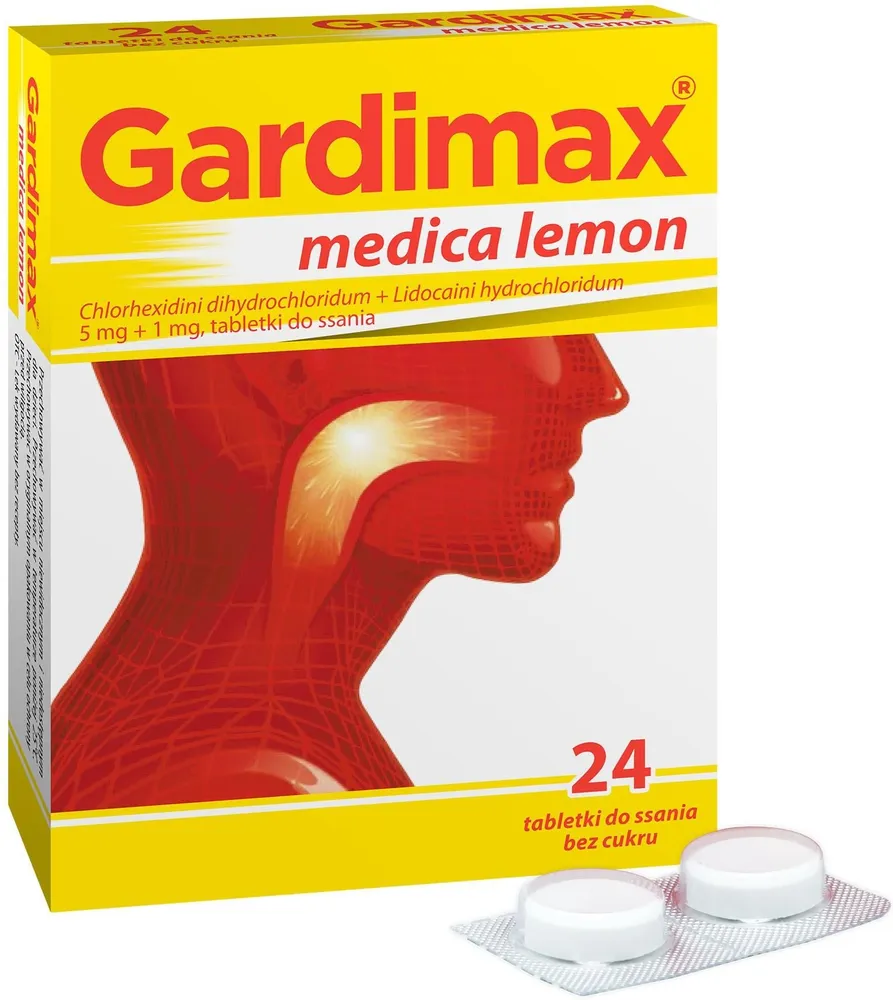
Table of Contents
- Package leaflet: Information for the patient
- 1. What Gardimax medica lemon is and what it is used for
- 2. Important information before taking Gardimax medica lemon
- 3. How to use Gardimax medica lemon
- 4. Possible adverse reactions
- 5. How to store Gardimax medica lemon
- 6. Contents of the pack and other information
Package leaflet: Information for the patient
Gardimax medica lemon, 5 mg + 1 mg, lozenges
Chlorhexidini dihydrochloridum + Lidocaini hydrochloridum
Read the entire leaflet carefully before using the medicine, as it contains
important information for the patient.
This medicine should always be used exactly as described in this patient leaflet or as directed by a
physician or pharmacist.
- Keep this leaflet for future reference.
- If advice or further information is needed, consult a pharmacist.
- If any adverse reactions occur, including any not listed in this leaflet, inform a doctor or pharmacist. See section 4.
- If there is no improvement after 3 to 4 days, or if the patient feels worse, consult a doctor.
Table of contents:
- What Gardimax medica lemon is and what it is used for
- Important information before taking Gardimax medica lemon
- How to use Gardimax medica lemon
- Possible side effects
- How to store Gardimax medica lemon
- Contents of the pack and other information
1. What Gardimax medica lemon is and what it is used for
Gardimax medica lemon contains the active substances: lidocaine hydrochloride, which has a local
anaesthetic effect, and chlorhexidine dihydrochloride, which has antibacterial properties.
Gardimax medica lemon is indicated for symptomatic use to relieve pain associated with
inflammation or irritation in inflammatory conditions of the mouth and throat.
If there is no improvement after 3 to 4 days, or if the patient feels worse, medical advice should be sought.
2. Important information before taking Gardimax medica lemon
When not to take Gardimax medica lemon
- if the patient is allergic to the active substances (chlorhexidine dihydrochloride or lidocaine hydrochloride), or to other locally acting anaesthetic drugs of the amide group, or to any of the other ingredients of this medicine (listed in section 6);
- in children under 6 years of age.
Patients should consult a doctor if any of the above contraindications apply to them, or have applied in the past.
Warnings and precautions
Before starting treatment with Gardimax medica lemon, discuss it with your doctor or pharmacist.
-
Do not use Gardimax medica lemon for prolonged periods. Do not suck one tablet immediately after another.
-
Avoid use in individuals particularly prone to allergies.
-
If an excessive dose is taken (more than 20 tablets per day), there is a risk of excessive loss of sensitivity in the laryngeal area, leading to reduced control of the swallowing reflex and increased risk of choking.
-
Consult a doctor if any of the above warnings apply to the patient, or have applied in the past.
-
Since toothpastes may contain anionic surfactants such as sodium lauryl sulphate, which may interact with the active ingredient chlorhexidine, it is recommended to leave at least a 30-minute interval between using toothpaste and applying this medicine.
Children and adolescents
Do not use in children under 6 years of age.
Gardimax medica lemon and other medicines
Inform your doctor or pharmacist about all medicines currently taken or recently taken, as well as any medicines planned for future use.
- Do not use this medicine simultaneously with other antiseptic medicines.
- Do not use this medicine simultaneously with drugs used for mild forms of Alzheimer's disease (cholinesterase inhibitors).
- Lidocaine hydrochloride may increase methemoglobin levels in blood in patients concurrently receiving other drugs affecting its formation, e.g. sulfonamides. Cimetidine, beta-blockers, norepinephrine, and inhalational anaesthetics inhibit lidocaine metabolism, leading to increased serum drug concentrations.
- Barbiturates, rifampicin, and phenytoin accelerate lidocaine metabolism. Lidocaine enhances the effect of neuromuscular blocking agents.
Gardimax medica lemon with food and drink
Avoid eating or drinking immediately after using the medicine. Due to reduced sensitivity to heat, there is an increased risk of thermal burns to the oral cavity and throat from consuming excessively hot drinks or food.
Pregnancy and breastfeeding
If the patient is pregnant, breastfeeding, suspects she may be pregnant, or is planning to have a child, she should consult her doctor before using this medicine.
During pregnancy and breastfeeding, use only when clearly necessary and only after consultation with a doctor.
Driving and operating machinery
No effects of Gardimax medica lemon on the ability to drive or operate machinery have been observed.
Gardimax medica lemon contains sorbitol and aspartame
Gardimax medica lemon contains 1208.95 mg of sorbitol (E 420) in each tablet. Sorbitol is a source of fructose. If intolerance to certain sugars has previously been diagnosed in the patient (or their child), or if hereditary fructose intolerance—a rare genetic disorder in which the body cannot break down fructose—has been diagnosed, the patient should consult a doctor before taking the medicine or giving it to a child. Sorbitol may cause gastrointestinal discomfort and may have a mild laxative effect.
Gardimax medica lemon contains 5.5 mg of aspartame (E 951) in each tablet.
Aspartame is a source of phenylalanine. It may be harmful to patients with phenylketonuria, a rare genetic disorder in which phenylalanine accumulates in the body due to improper excretion.
3. How to use Gardimax medica lemon
This medicine should always be used exactly as described in this patient leaflet or as directed by a
physician or pharmacist. If in doubt, consult a physician or pharmacist.
This medicine is intended for short-term symptomatic use: 3 to 4 days. If there is no improvement after
this period, or if new symptoms and/or general symptoms such as fever occur during treatment,
the patient should contact a physician.
Recommended dose
Adults: 6 to 10 lozenges per day; allow each lozenge to dissolve slowly in the mouth.
Children aged 6 years and older: half the adult dose (3 to 5 lozenges per day).
Method of administration
For application to the oral mucosa.
Allow the lozenge to dissolve slowly in the mouth. Do not take one lozenge immediately after another (see section 2, “Gardimax medica lemon with food and drink”).
Overdose of Gardimax medica lemon
In case of overdose, contact a physician immediately. Symptoms of overdose include: anxiety, yawning, nervousness, tinnitus, nystagmus, muscle tremors, convulsions, depression, respiratory failure, decreased myocardial tension, peripheral vasodilation, hypotension, bradycardia (abnormally slow heartbeat), cardiac arrhythmia, and cardiac arrest.
Missed dose of Gardimax medica lemon
Do not take a double dose to make up for a missed dose.
Discontinuation of Gardimax medica lemon
No special instructions.
If you have any further questions about the use of this medicine, consult your physician or pharmacist.
4. Possible adverse reactions
Like all medicines, this medicine can cause adverse reactions, although not everyone will experience them.
Discontinue use of the medicine and immediately contact a doctor or go to
the emergency department of the nearest hospital if a severe allergic reaction occurs.
Symptoms of a severe allergic reaction may include fainting, weakness, difficulty swallowing or
breathing, swelling of the lips, face, throat or tongue or other parts of the body, itching, rash.
The following may occur:
Rare (in 1 to 10 patients per 10,000)
allergic reactions affecting the skin and mucous membranes (rashes, inflammation of the oral mucosa,
sloughing of the oral mucosa, and salivary gland swelling), severe allergic reactions.
Frequency unknown (cannot be estimated from available data)
taste disturbances, burning sensation on the tongue; with prolonged use, brown discolorations may appear on the tongue and teeth (these discolorations can be removed).
Reporting of adverse reactions
If any adverse reactions occur, including any adverse reactions not listed in this leaflet, inform your doctor or pharmacist. Adverse reactions can be reported directly to the Department of Monitoring Adverse Drug Reactions of the Office for Registration of Medicinal Products, Medical Devices and Biocidal Products
Al. Jerozolimskie 181C
02-222 Warsaw
Phone: +48 22 49 21 301
Fax: +48 22 49 21 309
Website: https://smz.ezdrowie.gov.pl
Adverse reactions can also be reported to the marketing authorization holder.
Reporting adverse reactions helps to provide more information on the safety of this medicine.
5. How to store Gardimax medica lemon
Keep this medicine out of sight and reach of children.
Store below 25°C.
Keep in the original packaging to protect from moisture.
Do not use this medicine after the expiry date stated on the carton after: Expiry date (EXP) and on the blister after: EXP. The expiry date refers to the last day of the stated month.
Medicines must not be disposed of via wastewater or household waste. Ask your pharmacist how to dispose of medicines no longer required. These measures help protect the environment.
6. Contents of the pack and other information
What Gardimax medica lemon contains
The active substances are: chlorhexidine dihydrochloride 5 mg and lidocaine hydrochloride 1 mg.
The other ingredients are: sorbitol (E 420), magnesium stearate, aspartame (E 951), lemon flavour 501050 AP0551, potassium acesulfame (E 950).
What Gardimax medica lemon looks like and contents of the pack
White or almost white, round, lemon-flavoured tablets.
Unit-dose blisters (aluminium/PVC/PCTFE or aluminium/PVC/PE/PVDC) in a cardboard box. The pack contains 12, 24 or 36 tablets.
Not all pack sizes may be marketed.
Marketing Authorisation Holder
TACTICA Pharmaceuticals Sp. z o.o.
ul. Królowej Jadwigi 148a/1a
30-212 Kraków
tel.: +48 889 388 538
{Logo of the Marketing Authorisation Holder}
Manufacturer
Laboratoria Qualiphar N.V./S.A Rijksweg 9
B-2880 Bornem Belgium