Erdomed
Poland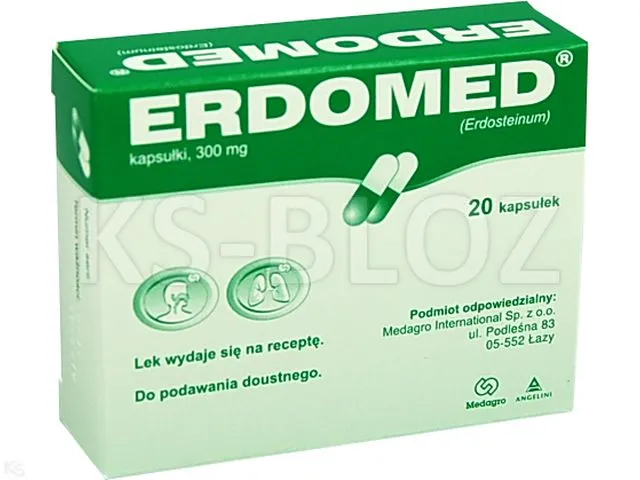
Table of Contents
Patient Information Leaflet
Warning!
Keep this leaflet. The packaging information in a foreign language.
Erdomed
300 mg, hard capsules
Erdosteine
Please read the entire leaflet before taking this medicine, as it contains important information for the patient.
- Keep this leaflet so that you can read it again if necessary.
- Consult your doctor or pharmacist if you have any further questions.
- This medicine has been prescribed for a specific individual. Do not pass it on to others.
- This medicine may harm another person, even if their symptoms are the same.
- If any of the side effects worsen, or if any side effects occur that are not listed in this leaflet, inform your doctor, pharmacist, or nurse. See section 4.
Table of contents:
- What Erdomed is and what it is used for
- What you need to know before taking Erdomed
- How to take Erdomed
- Possible side effects
- How to store Erdomed
- Contents of the pack and other information
1. What Erdomed is and what it is used for
Erdomed contains the active substance erdosteine, which belongs to a group of medicines called mucolytics—agents that reduce the viscosity of bronchial secretions and facilitate expectoration.
Erdomed is indicated for secretolytic treatment in acute and chronic diseases of the upper respiratory tract, bronchi, and lungs associated with abnormal mucus secretion and impaired mucus transport. It is also used for prophylactic treatment of seasonal exacerbations of chronic bronchitis.
2. Important information before taking Erdomed
When not to use Erdomed:
- if the patient is allergic (hypersensitive) to the active substance, to any of the excipients, or to substances containing free SH groups
- if the patient has impaired liver function
- if the patient has renal failure
- if the patient has homocystinuria (especially in patients on a methionine-free diet)
- in children under 12 years of age.
Warnings and precautions
If typical symptoms of hypersensitivity occur (rash, urticaria), treatment must be discontinued immediately.
Use with caution in patients with weakened cough reflex or impaired ciliary clearance (due to the risk of accumulation of large amounts of mucus).
The risk of adverse reactions can be minimized by using the lowest effective doses for the shortest possible duration. If no improvement occurs, the physician will consider discontinuing treatment.
Dose adjustment is not required in adults with chronic obstructive pulmonary disease (COPD).
Children
Erdomed must not be administered to children under 12 years of age.
Taking Erdomed with food and drink
Food and drink do not affect the absorption of the medicinal product.
Use of Erdomed in patients with renal impairment
In patients with severe renal failure, metabolites of erdosteine formed in the liver may accumulate.
Use of Erdomed in elderly patients
No dosage adjustment is necessary in patients over 65 years of age.
Other medicines and Erdomed
No interactions have been observed with other drugs used in the treatment of respiratory tract infections and chronic obstructive pulmonary disease, such as: theophylline, bronchodilators (corticosteroids), erythromycin, amoxicillin, or co-trimoxazole.
After administration of erdosteine, increased concentrations of amoxicillin in the respiratory tract have been demonstrated.
Concomitant treatment with drugs that suppress the cough reflex (antitussives) may lead to accumulation of large amounts of bronchial secretion, which may worsen the patient's condition, e.g. due to deterioration of respiratory function.
To avoid complications, antitussive and secretolytic (mucus-increasing) drugs should not be routinely combined, especially before going to sleep.
Pregnancy, breastfeeding and fertility
Consult a physician before taking this medicine. The decision on using the medicine should be made by a physician.
Driving and operating machinery
Erdomed has no influence on the ability to drive or operate machinery.
Erdomed contains the following excipients:
povidone, microcrystalline cellulose, magnesium stearate, gelatin, titanium dioxide (E 171), yellow iron oxide (E 172), indigotine (E 132).
3. How to use Erdomed
This medicine should always be taken exactly as directed by your doctor. If you are unsure, consult
your doctor or pharmacist.
The recommended dose for adults is:
1 capsule of 300 mg twice daily.
Do not take this medicine before going to sleep.
Taking more Erdomed than recommended
No cases of overdose have been reported.
If you take more than the recommended dose, contact your doctor immediately.
Missing a dose of Erdomed
Take the missed dose as soon as possible, then continue with your regular dosing schedule. If it is almost time for your next dose, take only one dose as prescribed and continue your regular dosing schedule.
Do not take a double dose to make up for a missed dose.
If you have any further questions about the use of this medicine, consult your doctor or pharmacist.
4. Possible adverse reactions
Like all medicines, Erdomed may cause adverse reactions, although not everybody experiences them.
- Common (in 1 to 10 out of 100 patients): stomach discomfort, nausea, headache;
- Uncommon (in 1 to 10 out of 1,000 patients): heartburn;
- Rare (in 1 to 10 out of 10,000 patients): loss of taste sensation or taste disturbances, constipation, dry mouth, dizziness, general malaise, diarrhoea, allergic reactions: rash, urticaria, fever.
Other adverse reactions may occur in some individuals during treatment with Erdomed.
Reporting of adverse reactions
If any adverse effects occur, including any not listed in this leaflet, inform your doctor, pharmacist or nurse. Adverse reactions can be reported directly to the Department of Monitoring Adverse Drug Reactions at the Office for Registration of Medicinal Products, Medical Devices and Biocidal Products
Al. Jerozolimskie 181C, 02-222 Warsaw, tel.: + 48 22 49 21 301, fax: + 48 22 49 21 309
Website: https://smz.ezdrowie.gov.pl
Reporting adverse reactions helps to provide more information on the safety of this medicine.
5. How to store Erdomed
Keep the medicine out of the sight and reach of children.
Store below 25°C.
Do not use Erdomed after the expiry date stated on the packaging.
Medicines must not be disposed of via wastewater or household waste. Ask your pharmacist how to dispose of medicines no longer required. Such measures help protect the environment.
6. Contents of the package and other information
What Erdomed contains
The active substance is erdosteine. One hard capsule contains 300 mg of erdosteine.
Other components of the medicine are: povidone, microcrystalline cellulose, magnesium stearate, gelatin, titanium dioxide (E 171), yellow iron oxide (E 172), indigo carmine (E 132).
What Erdomed looks like and contents of the pack
The pack contains 10 or 20 or 60 capsules in Al/PVC/PVDC blisters in a cardboard box.
For more detailed information, please contact the marketing authorisation holder or the parallel importer.
Marketing authorisation holder in the Czech Republic, country of export:
Angelini Pharma Česká republika s.r.o.
Palachovo náměstí 799/5, 625 00 Brno, Czech Republic
Manufacturer:
Aziende Chimiche Riunite Angelini Francesco ACRAF SPA
Via Vecchia del Pinocchio, 22
60131 Ancona
Italy
Astrea Fontaine S.A.S.
Rue des Prés Potets
21121 Fontaine-les-Dijon
France
Parallel importer:
Delfarma Sp. z o.o.
ul. Św. Teresy od Dzieciątka Jezus 111
91-222 Łódź
Poland
Repackaged in:
Delfarma Sp. z o.o.
ul. Św. Teresy od Dzieciątka Jezus 111
91-222 Łódź
Poland
Marketing authorisation number in the Czech Republic, country of export: 52/045/96-C
Parallel import licence number: 275/25