Enterol
Poland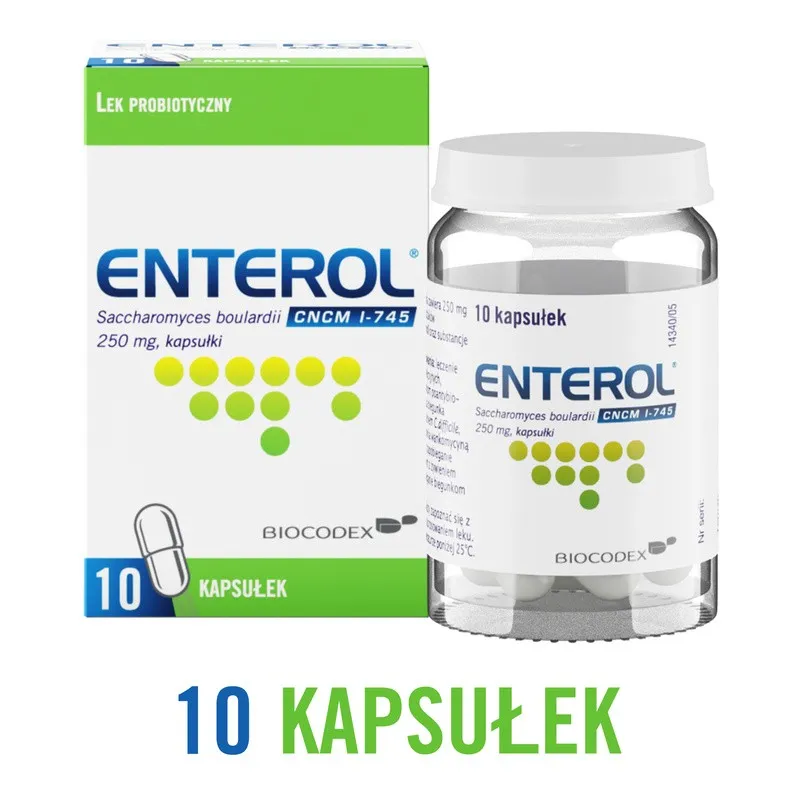
Table of Contents
Package leaflet: Information for the patient
Warning! Keep this leaflet! Information on the immediate packaging is in a foreign language.
Enterol, 250 mg, hard capsules
Saccharomyces boulardii CNCM I-745
Please read this leaflet carefully before taking the medicine, as it contains
important information for the patient.
This medicine should always be taken exactly as described in this patient leaflet or as directed by a
physician or pharmacist.
- Keep this leaflet for future reference.
- If advice or additional information is needed, please consult a pharmacist.
- If the patient experiences any adverse reactions, including any not listed in this leaflet, inform a physician or pharmacist. See section 4.
- If there is no improvement after 2 days, or if the patient feels worse, consult a physician.
Table of contents of the leaflet:
- What Enterol is and what it is used for
- Important information before taking Enterol
- How to take Enterol
- Possible side effects
- How to store Enterol
- Contents of the package and other information
1. What Enterol is and what it is used for
Enterol is an oral anti-diarrheal medicine. Its active ingredient consists of lyophilized yeast
Saccharomyces boulardii, classified as probiotics—live microorganisms that provide health benefits to the host organism.
The intestinal bacterial flora consists of billions of microorganisms. Maintaining microbial balance in the gut is essential for important gastrointestinal functions such as digestion, protection against infections, and strengthening natural immunity.
However, the balance of bacterial flora is delicate and can be disrupted by many factors: gastrointestinal infections, both viral and bacterial, use of certain medications including antibiotics, and changes in dietary habits. This may lead to various digestive problems resulting in diarrhea.
Enterol is a medicine that acts on the intestinal flora, a so-called "natural flora substitute," which helps restore balance during temporary disturbances.
Enterol is used for:
- treatment of acute infectious diarrhea
- prevention of antibiotic-associated diarrhea
- recurrent diarrhea caused by Clostridium difficile infection, as an adjunct to treatment with vancomycin or metronidazole
- prevention of diarrhea associated with enteral nutrition
- prevention of travelers' diarrhea
- supportive treatment of diarrhea occurring in irritable bowel syndrome (IBS).
If there is no improvement after 2 days, or if the patient feels worse, consult a physician.
2. Important information before using Enterol
When not to use Enterol:
- if the patient is allergic to the active substance or to any of the other ingredients of this medicine (listed in section 6)
- if the patient has a central venous catheter in place (see section Warnings and precautions)
- patients with significantly reduced immunity or those hospitalized due to severe diseases or disorders (weakening) of the immune system
Warnings and precautions
Before starting treatment with Enterol, discuss this with your doctor or pharmacist.
It is not recommended to open the capsules near patients with a central venous catheter,
to prevent unwanted fungal colonization of the catheter, especially transmission via
contaminated hands. There have been reports of very rare cases of fungaemia (fungal penetration into the bloodstream) accompanied by fever and positive blood culture, even in patients not treated with Saccharomyces boulardii. In all reported cases, fungaemia resolved after antifungal treatment or, when necessary, after removal of the central venous catheter.
As an adjunct to treatment, it is recommended to:
- ensure adequate hydration (rehydration) by drinking large amounts of salty or sweet beverages to compensate for fluid loss caused by diarrhoea (the average daily water requirement for an adult is 2 litres)
- maintain an appropriate diet, avoiding certain foods such as: fruits, green vegetables, spicy dishes, frozen food, and cold beverages; grilled meat and rice are recommended; milk and dairy products should be limited.
Seek immediate medical advice if:
- there is no improvement after 2 days of treatment
- fever or vomiting occur
- blood or mucus appears in the stool
- increased thirst or dry mouth occur: these are symptoms of developing dehydration, meaning significant fluid loss due to diarrhoea. Contact a doctor who will decide whether oral or intravenous rehydration is necessary.
Enterol with other medicines
Inform your doctor or pharmacist about all medicines currently or recently taken, as well as any medicines planned for future use.
Do not take Enterol simultaneously with oral antifungal medicines (medicines used to treat fungal infections).
Enterol with food, drink and alcohol
Enterol contains live cells. Therefore, it should not be mixed with very hot (over 50°C) or very cold liquids, food, or alcohol, as this could destroy the yeast cells.
Pregnancy and breastfeeding
If the patient is pregnant or breastfeeding, suspects she may be pregnant, or is planning to become pregnant, she should consult her doctor or pharmacist before using this medicine.
Due to lack of data, use of Enterol during pregnancy is not recommended.
Saccharomyces boulardii is not excreted into breast milk. Due to lack of data, the benefit-risk balance should be carefully considered before using Enterol during breastfeeding.
Driving and operating machinery
Enterol does not affect the ability to drive or operate machinery.
Enterol contains monohydrate lactose
If the patient has previously been diagnosed with intolerance to certain sugars, the patient should consult a doctor before taking this medicine.
3. How to take Enterol
This medicine should always be taken exactly as described in this patient information leaflet, or as directed by a doctor or pharmacist. If in doubt, consult a doctor or pharmacist.
Recommended dosage in adults and children:
- Infectious acute diarrhoea: 1 to 2 capsules per day for up to 1 week
- Antibiotic-associated diarrhoea: 1 to 2 capsules per day during and after antibiotic treatment
- Diarrhoea caused by C. difficile infection: 4 capsules per day for up to 4 weeks
- Diarrhoea associated with enteral nutrition: 1 to 2 capsules per day
- Travellers' diarrhoea: 1 to 4 capsules per day for up to 1 week
- As supportive treatment in diarrhoea-predominant irritable bowel syndrome (IBS): 1 capsule 1 to 2 times per day. Treatment of diarrhoea should be continued for several days after symptoms have resolved.
Method of administration
For oral use. Swallow the capsule with a glass of water.
The capsule may be opened and its contents mixed with a small amount of sweetened drink, food, or added to a bottle of infant feed.
In children under 6 years of age, administration of capsules is not recommended due to the risk of choking; it is recommended to open the capsule and mix the contents with a drink or food.
If you forget to take Enterol
Do not take a double dose to make up for a missed dose.
If you have any further questions about the use of this medicine, consult your doctor or pharmacist.
4. Possible adverse reactions
Like all medicines, this medicine can cause adverse reactions, although not everyone will experience them.
Rare (occurring no more frequently than in 1 in 1,000): several cases of bloating have been reported.
Very rare (occurring less frequently than in 1 in 10,000 people): local rash, allergic reactions,
urticaria, pruritus, anaphylactic reactions, facial swelling, angioedema, generalized skin rash (exanthema),
yeast invasion into the bloodstream (fungemia).
Frequency not known (frequency cannot be estimated from available data): constipation,
severe blood infection (sepsis).
Reporting of adverse reactions
If any adverse symptoms occur, including any adverse symptoms not listed in this leaflet, inform your doctor or pharmacist. Adverse reactions can be reported directly to the Department of Monitoring Adverse Drug Reactions at the Office for Registration of Medicinal Products, Medical Devices and Biocidal Products, Al. Jerozolimskie 181C, 02-222 Warsaw, phone: +48 22 4921301, fax: +48 22 4921309, website: https://smz.ezdrowie.gov.pl.
Reporting adverse reactions helps to provide more information on the safety of the medicine.
5. How to store Enterol
Keep this medicine out of sight and reach of children.
Do not use this medicine after the expiry date stated on the packaging. The expiry date refers to the last day of the stated month.
Do not store above 25 °C. Store in the original packaging to protect from moisture.
Medicines must not be disposed of via wastewater or household waste. Ask your pharmacist how to dispose of medicines no longer in use. This will help protect the environment.
6. Contents of the packaging and other information
What the medicinal product Enterol contains
- The active substance is lyophilized Saccharomyces boulardii CNCM I-745; one hard capsule contains 250 mg of the yeast.
- Other ingredients: monohydrate lactose, magnesium stearate; components of the gelatin capsule shell: gelatin, titanium dioxide (E 171).
What Enterol looks like and contents of the pack
White hard capsules containing a light brown powder with a characteristic odour.
Glass bottle in a cardboard box containing 20 or 30 hard capsules.
For further information, please contact the Marketing Authorisation Holder or the Parallel Importer.
Marketing Authorisation Holder in Latvia, country of export:
BIOCODEX
22 rue des Aqueducs
94250 Gentilly
France
Manufacturer:
BIOCODEX
1 avenue Blaise Pascal
60000 Beauvais
France
Parallel Importer:
InPharm Sp. z o.o.
ul. Strumykowa 28/11
03-138 Warsaw
Poland
Repackaged in:
InPharm Sp. z o.o. Services sp. k.
ul. Chełmżyńska 249
04-458 Warsaw
Poland
Marketing Authorisation number in Latvia, country of export: 97-0022
Parallel Import Authorisation number: 357/25