Dulcobis
Poland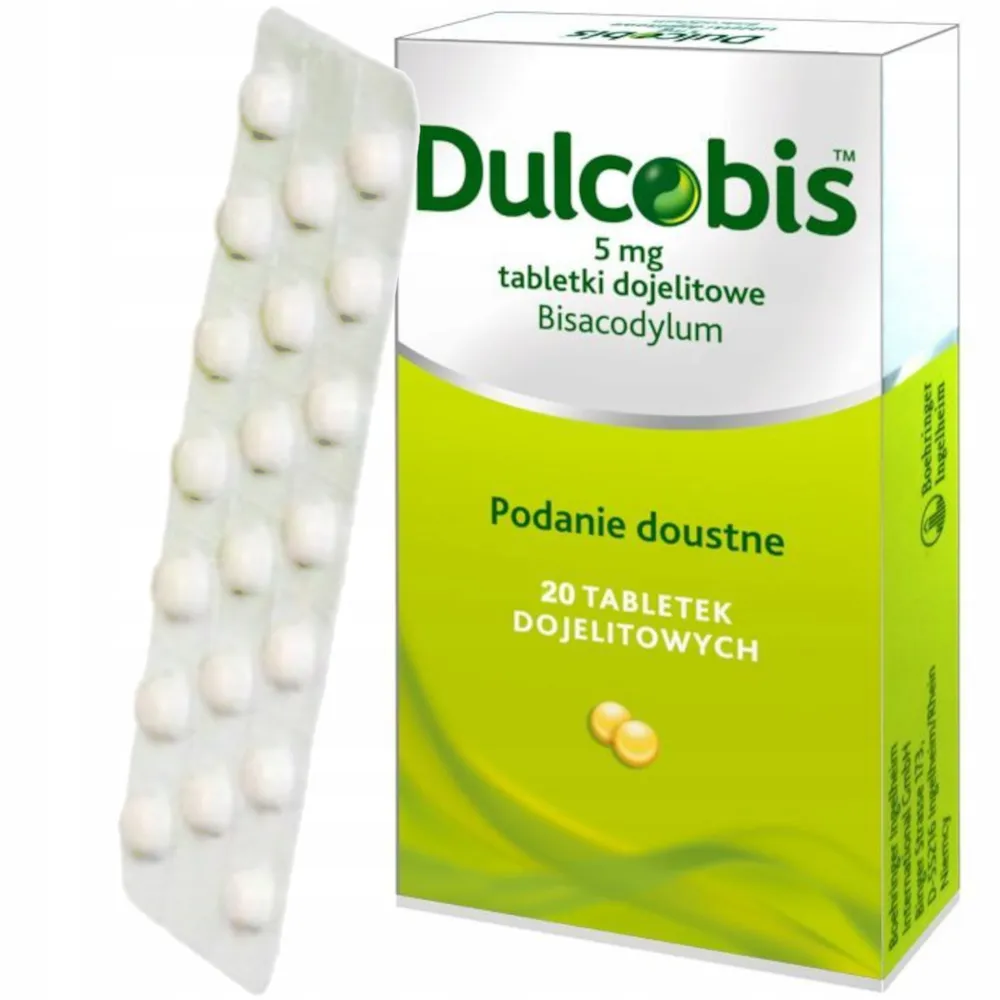
Table of Contents
Patient Information Leaflet
Warning! Keep this leaflet! Information on the immediate packaging is in a foreign language.
Dulcobis (Dulcolax), 5 mg, enteric-coated tablets
Bisacodyl
Dulcobis and Dulcolax are different trade names for the same medicine.
Please read the entire leaflet carefully as it contains important information for the patient.
This medicine should always be used exactly as described in this patient leaflet or as directed by a physician or pharmacist.
- Keep this leaflet for future reference.
- If you need advice or further information, consult your pharmacist.
- If you experience any adverse reactions, including any possible side effects not listed in this leaflet, inform your doctor or pharmacist. See section 4.
- If there is no improvement after 5 days, or if you feel worse, contact your doctor.
Table of contents:
- What Dulcobis is and what it is used for
- Important information before taking Dulcobis
- How to take Dulcobis
- Possible side effects
- How to store Dulcobis
- Contents of the pack and other information
1. What Dulcobis is and what it is used for
Dulcobis is a locally acting laxative that stimulates bowel evacuation and softens stool.
Dulcobis is indicated for short-term, symptomatic treatment of constipation:
- in patients suffering from constipation,
- to prepare for medical examinations, before and after surgery, and in conditions requiring facilitation of defecation.
2. Important information before using Dulcobis
When not to use Dulcobis:
- if the patient is allergic (hypersensitive) to bisacodyl or any of the other ingredients of Dulcobis (listed in section 6),
- if the patient has intestinal obstruction,
- if the patient has acute abdominal conditions, including appendicitis or acute inflammatory bowel diseases,
- if the patient has lost a significant amount of fluid,
- if the patient experiences severe abdominal pain associated with nausea and vomiting – this may indicate more serious conditions,
- if the patient has a hereditary intolerance to certain sugars (see also: "Dulcobis contains lactose and sucrose"),
- in children under 4 years of age
Warnings and precautions
- if the patient feels the need to use laxatives daily or for prolonged periods, the patient should consult a doctor to investigate the cause of constipation,
because prolonged and excessive use may lead to disturbances in fluid and electrolyte balance and to low blood potassium levels (hypokalaemia),
- if the patient experiences increased thirst or reduced urine output, which may be signs of dehydration and may be dangerous for elderly patients or patients with kidney disease, the patient should stop taking Dulcobis and contact a doctor.
Patients may also observe the presence of blood in the stool, but usually this symptom is mild and resolves spontaneously.
Dizziness and/or fainting have been observed in patients taking Dulcobis. These symptoms may be related to constipation (straining during defecation, abdominal pain), and not necessarily to the administration of Dulcobis itself.
Children should not take laxatives without medical advice.
Laxatives, including Dulcobis, do not contribute to weight loss.
Dulcobis with other medicines
Inform your doctor or pharmacist about all medicines the patient is currently taking or has recently taken, as well as any medicines the patient intends to take.
Concomitant use of diuretics or steroids may increase the risk of electrolyte imbalance when excessive doses of Dulcobis are taken. Electrolyte imbalance may increase sensitivity to cardiac glycosides (medicines used to treat heart failure and cardiac arrhythmias; an example is digoxin).
Concomitant use of Dulcobis with other laxatives may intensify gastrointestinal adverse effects.
Dulcobis tablets have a special coating and to prevent premature dissolution, the medicine should not be taken with medicinal products that reduce acidity in the upper gastrointestinal tract, such as antacids or proton pump inhibitors.
Taking Dulcobis with food and drink
Dulcobis tablets have a special coating and to prevent premature dissolution, the medicine should not be taken with food products that reduce acidity in the upper gastrointestinal tract, such as milk.
Pregnancy and breastfeeding
If the patient is pregnant, breastfeeding, suspects she may be pregnant, or is planning to have a child, she should consult a doctor before using this medicine.
Dulcobis may be used during pregnancy only after consultation with a doctor.
Dulcobis may be used during breastfeeding.
Driving and operating machinery
Studies on the effect of Dulcobis on the ability to drive vehicles and operate machinery have not been conducted.
It should be remembered that abdominal cramps associated with constipation may lead to dizziness and/or fainting. If abdominal cramps occur, potentially hazardous activities such as driving vehicles and operating machinery should be avoided.
Dulcobis contains lactose and sucrose
The medicine contains 33.2 mg lactose and 23.4 mg sucrose per enteric-coated tablet.
If a sugar intolerance has previously been diagnosed in the patient, the patient should consult a doctor before taking the medicine.
3. How to use Dulcobis
This medicine should always be used exactly as described in this patient leaflet or as directed by your doctor or pharmacist. If in doubt, consult your doctor or pharmacist.
This medicine is intended for short-term use only. The duration of using Dulcobis without consulting a doctor should not exceed 5 days.
Unless otherwise advised by your doctor, the following dosage is recommended:
Short-term treatment of constipation:
Adults (aged 18 years and above): 1–2 enteric-coated tablets (5–10 mg) orally, once daily, at bedtime.
Adolescents and children over 10 years of age:
1–2 enteric-coated tablets (5–10 mg) orally, once daily, at bedtime.
It is recommended to start treatment with the lowest dose. The dose may be adjusted up to the maximum recommended dose to achieve regular bowel movements.
Do not exceed the maximum daily dose.
Children aged 4 to 10 years:
1 enteric-coated tablet (5 mg) orally, once daily, at bedtime.
Do not exceed the maximum daily dose.
Children aged 10 years and younger with chronic or persistent constipation should be treated only under medical supervision.
Method of administration:
Enteric-coated tablets should be taken orally in the evening to ensure bowel movement in the morning. The tablets must be swallowed whole with a large amount of water (do not take with milk – see section “Use of Dulcobis with food and drink”). Do not chew the tablets.
Preparation for diagnostic tests and surgical procedures:
During preparation for diagnostic tests or prior to surgical procedures, Dulcobis should be used under the supervision of medical personnel.
Adults (aged 18 years and above):
To achieve complete bowel evacuation, adults should take 2–4 enteric-coated tablets (10–20 mg) orally in the evening before the examination, as directed by the doctor, followed by a fast-acting laxative (e.g. suppository) on the morning of the examination.
Children over 4 years of age:
One enteric-coated tablet (5 mg) in the evening, followed by administration of a fast-acting laxative (e.g. suppository) the next morning.
Use of a higher than recommended dose of Dulcobis
If more Dulcobis has been taken than recommended, consult your doctor or pharmacist immediately.
Symptoms
After taking large doses, rare bowel movements, intestinal cramps, abdominal pain, and loss of fluids, potassium, and other electrolytes may occur.
Chronic overdose of Dulcobis may lead to chronic diarrhea, abdominal pain, various disorders caused by increased aldosterone secretion, which regulates blood sodium and potassium levels (secondary hyperaldosteronism), low blood potassium levels, and kidney stones. Chronic abuse of laxatives has also been associated with renal tubular damage (a type of kidney injury), metabolic alkalosis (a condition in which the body contains more bases than acids), and muscle weakness due to low potassium levels in the blood.
Missed dose of Dulcobis
Do not take a double dose to make up for a missed dose of Dulcobis.
If a dose is missed, take it as soon as you remember.
Discontinuation of Dulcobis
Dulcobis should only be taken when necessary. Its use without prior consultation with a doctor should be discontinued once symptoms have resolved, but no later than after 5 days.
If you have any further questions about the use of this medicine, consult your doctor or pharmacist.
4. Possible adverse reactions
Like all medicines, Dulcobis may cause adverse reactions, although not everybody experiences them.
The following adverse reactions have been observed during the use of Dulcobis:
Common (occur in not more than 1 in 10 patients, but more than 1 in 100 patients):
abdominal cramps, abdominal pain, diarrhoea, nausea
Uncommon (occur in not more than 1 in 100 patients, but more than 1 in 1,000 patients):
abdominal discomfort, vomiting, blood in stool, discomfort around the anus, dizziness
Rare (occur in fewer than 1 in 1,000 patients, but more than 1 in 10,000 patients):
hypersensitivity reactions, fainting, dehydration, angioedema, rapidly progressing, life-threatening anaphylactic reactions, colitis including ischaemic colitis of the large intestine
Dizziness and fainting may be related to constipation (straining at stool, abdominal pain) and not necessarily to the use of bisacodyl.
If allergic reactions occur, including hives, facial swelling, swelling of the lips, tongue and/or throat, which may cause difficulty in breathing or swallowing, treatment with Dulcobis must be discontinued and you must immediately contact a doctor or the Emergency Department of the nearest hospital.
Reporting of adverse reactions
If any adverse reactions occur, including any adverse reactions not listed in this leaflet, inform your doctor or pharmacist. Adverse reactions can be reported directly to the Department of Monitoring of Adverse Drug Reactions of the Office for Registration of Medicinal Products, Medical Devices and Biocidal Products, Al. Jerozolimskie 181C, 02-222 Warsaw, tel.: +48 22 49 21 301, fax: +48 22 49 21 309, website: https://smz.ezdrowie.gov.pl.
Reporting adverse reactions helps to provide more information on the safety of the medicine.
5. How to store Dulcobis
Keep the medicine out of the sight and reach of children.
Do not store above 25°C. Store the blister pack in the outer packaging.
Do not use the medicine after the expiry date stated on the packaging. The expiry date refers to the last day of the stated month.
Medicines must not be disposed of via wastewater or household waste. Ask your pharmacist how to dispose of medicines no longer in use. This will help protect the environment.
6. Contents of the package and other information
What Dulcobis contains
- The active substance is bisacodyl. One enteric-coated tablet contains 5 mg of bisacodyl.
- Other ingredients: monohydrate lactose, corn starch, modified starch (corn, oxidized), glycerol 85%, magnesium stearate, coating: magnesium stearate, sucrose, talc, arabic gum, titanium dioxide (E 171), copolymer of methacrylic acid and methyl methacrylate (1:1), copolymer of methacrylic acid and methyl methacrylate (1:2), castor oil, macrogol 6000, yellow iron oxide (E 172), white wax, carnauba wax, shellac.
What Dulcobis looks like and contents of the pack
Dulcobis is an enteric-coated tablet.
Packaging: PVC/PVDC/Al or PVC/Al blisters in a cardboard carton.
Pack contents: 20, 40 or 60 enteric-coated tablets.
For more detailed information, please contact the responsible entity or the parallel importer.
Responsible entity in Ireland, country of export:
Opella Healthcare France SAS, T/A Sanofi
82 Avenue Raspail
94250 Gentilly
France
Manufacturer:
Delpharm Reims S.A.S., 10 Rue Colonel Charbonneaux, 51100 Reims, France
Parallel importer:
InPharm Sp. z o.o.
ul. Strumykowa 28/11
03-138 Warsaw
Repackaged in:
InPharm Sp. z o.o. Services sp. k.
ul. Chełmżyńska 249
04-458 Warsaw
Irish licence number, country of export: PA23180/018/003
Parallel import licence number: 108/23