Diclofenac perrigo
Poland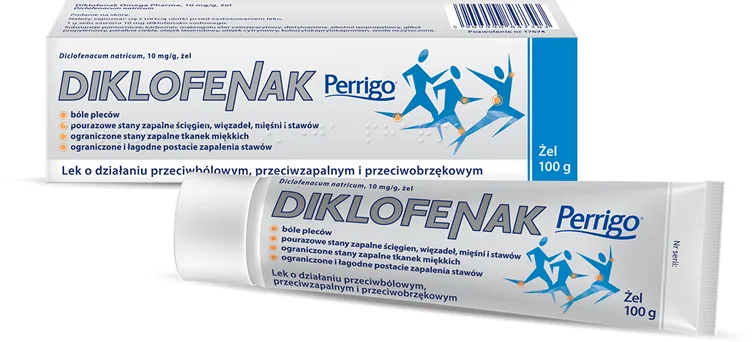
Table of Contents
Patient Information Leaflet
Diklofenak Perrigo, 10 mg/g, gel
Diclofenacum natricum
Please read this leaflet carefully before using the medicine, as it contains
important information for the patient.
This medicine should always be used exactly as described in this patient leaflet or as directed by
your doctor, pharmacist, or nurse.
- Keep this leaflet for future reference.
- If you need advice or further information, please consult your pharmacist.
- If you experience any adverse reactions, including any possible side effects not listed in this leaflet, inform your doctor, pharmacist, or nurse. See section 4.
- If there is no improvement after 7 days, or if your condition worsens, consult your doctor.
Table of Contents
- What Diklofenak Perrigo is and what it is used for
- Important information before using Diklofenak Perrigo
- How to use Diklofenak Perrigo
- Possible side effects
- How to store Diklofenak Perrigo
- Contents of the pack and other information
1. What Diklofenak Perrigo is and what it is used for
Diklofenak Perrigo has analgesic, anti-inflammatory, and anti-edematous properties. The active substance, diclofenac, belongs to the group of non-steroidal anti-inflammatory drugs (NSAIDs). Due to its water-alcohol base, Diklofenak Perrigo also has a soothing and cooling effect.
The medicine is applied topically to the skin:
- in inflammatory conditions of tendons, ligaments, muscles, and joints following injury (e.g. sprains, strains, or contusions),
- in back pain,
- in localized inflammatory conditions of soft tissues (such as tendonitis or tennis elbow),
- in localized and mild forms of joint inflammation.
This medicine is intended for use in adults and adolescents.
2. Important information before using Diklofenak Perrigo
When not to use Diklofenak Perrigo
- if the patient has a known allergy (hypersensitivity) to diclofenac, propylene glycol, or any of the other ingredients of Diklofenak Perrigo;
- if the patient has previously experienced asthma attacks (shortness of breath), urticaria, or rhinitis after taking acetylsalicylic acid or other non-steroidal anti-inflammatory drugs (e.g. ibuprofen);
- in children under 12 years of age;
- during the last three months of pregnancy.
Warnings and precautions
Before starting to use Diklofenak Perrigo, discuss this with your doctor,
pharmacist, or nurse.
When to exercise particular caution when using Diklofenak Perrigo
- when applying the gel to large areas of skin or during prolonged use, as systemic adverse effects may occur;
- the gel should only be applied to intact skin;
- avoid contact with eyes and mucous membranes (e.g. mouth);
- after applying the gel, standard bandages or wraps commonly used for sprains may be applied, but without occlusive (airtight) layers.
Diklofenak Perrigo and other medicines
Tell your doctor about all medicines you are currently taking or have recently taken, including
those available without a prescription.
After applying the gel to the skin, only a small amount of the drug is absorbed into the bloodstream, so
the likelihood of interactions with other medicines is low.
Pregnancy, breastfeeding, and fertility
If the patient is pregnant or breastfeeding, suspects she may be pregnant, or is planning to have a child, she should consult her doctor or pharmacist before using this medicine.
Do not use Diklofenak Perrigo during the last three months of pregnancy. During the first six
months of pregnancy, Diklofenak Perrigo should not be used unless necessary and recommended
by a doctor. If use is necessary, the lowest possible dose for the shortest possible time should be administered.
Adverse effects on the unborn child have been reported after oral forms of diclofenac-containing medicines (e.g. tablets). It is unknown whether the same risk applies to Diklofenak Perrigo when applied topically.
Use of Diklofenak Perrigo is not recommended during breastfeeding.
If use during breastfeeding is necessary, do not apply the gel to the skin of the breast, large skin areas, or for prolonged periods.
Driving and operating machinery
Use of Diklofenak Perrigo does not affect the ability to drive or operate machinery.
Important information about some ingredients of Diklofenak Perrigo
The medicine contains 50 mg of propylene glycol in 1 gram of gel. Propylene glycol may cause skin irritation.
3. How to use Diklofenak Perrigo
The gel is for topical application to the skin.
Diklofenak Perrigo is intended for topical use only.
Do not swallow the medicine.
To open the tube, unscrew the cap and break the aluminium seal covering the tube opening.
Adults and adolescents over 12 years of age
Diklofenak Perrigo should be applied topically to the skin, 3 to 4 times daily, gently massaging it into the affected areas of the body. The amount of gel used should be adjusted according to the size of the affected area: 2 g to 4 g (an amount the size of a cherry up to the size of a walnut) is sufficient to treat an area of approximately 400 cm² to 800 cm².
After applying the medicine, the tube should be tightly closed, hands should be dried with a paper towel, and then washed, unless the hands themselves are the treated area.
If an excessive amount of gel is accidentally applied, the excess should be wiped off with a paper towel.
Used paper towels should be disposed of in a household waste container to prevent unused medicine from entering the aquatic environment.
Allow the gel to dry on the skin for several minutes before applying a bandage.
Do not use the medicine for longer than 14 days in cases of strains and soft tissue inflammation, or for longer than 21 days in cases of pain associated with joint inflammation, unless otherwise advised by a doctor. If symptoms do not improve within 7 days of using the gel, or if symptoms worsen, consult a doctor.
Use of a higher than recommended dose of Diklofenak Perrigo
Do not increase the recommended dose of Diklofenak Perrigo without consulting a doctor.
Overdose is unlikely due to the low systemic absorption of topically applied diclofenac.
If the medicine is accidentally swallowed and adverse symptoms occur, seek medical advice immediately.
Missed dose of Diklofenak Perrigo
Do not apply a double dose to make up for a missed dose.
If you have any further questions about the use of this medicine, consult your doctor, pharmacist, or nurse.
4. Possible adverse effects
Like all medicines, this medicine can cause adverse effects, although not everyone will
experience them.
Adverse effects include mild and transient skin symptoms at the site of application.
In very rare cases, allergic reactions may occur.
If any of the symptoms listed below, which may indicate an allergic reaction, occur,
discontinue use of the medicine immediately and contact your doctor.
Adverse effects are classified according to their frequency of occurrence, using the
following terms:
- common (may affect 1 to 10 people in 100);
- rare (may affect 1 to 10 people in 10,000);
- very rare (may affect fewer than 1 person in 10,000);
Common: rash, dermatitis, erythema, skin inflammation (including contact dermatitis),
itching
Rare: bullous dermatitis
Very rare: nodular rash, hypersensitivity, swelling, asthma, photosensitivity reaction (symptoms of photosensitivity include sunburn with itching,
swelling and blistering)
Reporting of adverse effects
If any adverse effects occur, including any adverse effects not listed in this leaflet, inform your doctor, pharmacist or nurse.
Adverse effects can be reported directly to the Department of Monitoring of Adverse Drug Reactions of the Office for Registration of Medicinal Products, Medical Devices and Biocidal Products
Al. Jerozolimskie 181C,
02-222 Warsaw,
tel.: +48 22 49 21 301,
fax: +48 22 49 21 309,
Website: https://smz.ezdrowie.gov.pl
Adverse effects can also be reported to the marketing authorization holder.
By reporting adverse effects, additional information on the use of the medicine can be
collected.
5. How to store Diklofenak Perrigo
Keep this medicine out of the sight and reach of children.
No special storage instructions are required.
Do not use Diklofenak Perrigo after the expiry date stated on the tube and
the cardboard box.
Medicines must not be disposed of via wastewater or household waste. Ask your pharmacist what to do with medicines no longer required. Such measures will help protect the environment.
6. Contents of the pack and other information
What Diklofenac Perrigo contains
- The active substance is sodium diclofenac. 1 g of gel contains 10 mg of sodium diclofenac.
- The other ingredients are carbomer, cetostearyl macrogol ether, diethanolamine, isopropyl alcohol, propylene glycol, liquid paraffin, lavender oil, lemon oil, cocoyl caprylocaprate, purified water.
What Diklofenac Perrigo looks like and contents of the pack
Tubes containing 40 g, 50 g, 75 g or 100 g of gel, placed together with the patient leaflet in a cardboard box.
Marketing Authorisation Holder and Manufacturer
Marketing Authorisation Holder
Perrigo Poland Sp. z o.o. [+logo of the marketing authorisation holder]
ul. Domaniewska 48
02-672 Warsaw
Tel.: +48 (22) 852 55 51
Manufacturer
Laboratorium Galenowe Olsztyn Sp. z o.o.
ul. Spółdzielcza 25A
11-001 Dywity