Devikap
Poland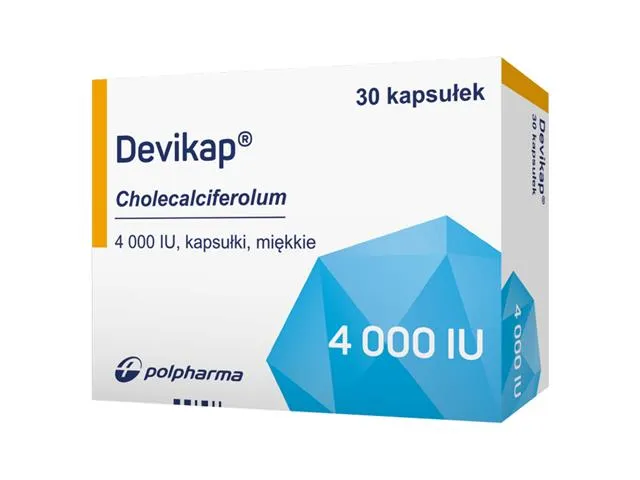
Table of Contents
Patient Information Leaflet
Devikap, 2 000 IU, soft capsules
Devikap, 4 000 IU, soft capsules
Devikap, 10 000 IU, soft capsules
Cholecalciferolum
Please read this leaflet carefully before taking this medicine, as it contains important information for you.
- Keep this leaflet, as you may need to read it again.
- If you have any further questions, please consult your doctor or pharmacist.
- This medicine has been prescribed for a specific individual. Do not share it with others. This medicine may harm other people, even if their symptoms appear identical.
- If you experience any adverse reactions, including those not listed in this leaflet, inform your doctor or pharmacist. See section 4.
Table of Contents
- What Devikap is and what it is used for
- Important information before taking Devikap
- How to take Devikap
- Possible side effects
- How to store Devikap
- Contents of the pack and other information
1. What Devikap is and what it is used for
Devikap contains cholecalciferol as the active substance, which is identical to the vitamin D produced in the human body.
Devikap is used:
- for the prevention of vitamin D deficiency and conditions resulting from vitamin D deficiency in patients at high risk;
- for the treatment of vitamin D deficiency and conditions resulting from vitamin D deficiency.
Vitamin D deficiency may occur in individuals living at high latitudes (> 35°), or in those whose diet or lifestyle does not provide sufficient vitamin D (e.g. people who spend most of their time indoors, night workers), or when vitamin D requirements are increased (e.g. pregnant women, individuals with overweight or obesity).
2. Important information before using Devikap
When not to use Devikap:
- if the patient is allergic to cholecalciferol or any of the other ingredients of this medicine (listed in section 6);
- if the patient has elevated calcium levels in the blood (hypercalcemia) or in the urine (hypercalciuria);
- if the patient has severe kidney failure, kidney stones (nephrolithiasis), or a tendency to develop kidney stones;
- if the patient has elevated vitamin D levels in the blood (hypervitaminosis D);
- in children under 11 years of age.
Warnings and precautions
Before starting treatment with Devikap, discuss the following with your doctor or pharmacist:
- if the patient is taking certain medicines used for heart conditions (e.g. cardiac glycosides such as digoxin);
- if the patient has sarcoidosis (an immune system disorder that may increase vitamin D levels in the body);
- if the patient is taking other medicines and/or dietary supplements containing vitamin D and calcium, or consuming foods fortified with vitamin D;
- if the patient is likely to be exposed to large amounts of sunlight during treatment with Devikap;
- if the patient is taking additional calcium supplements. During treatment with Devikap, the doctor will monitor calcium levels in the blood to ensure they are not too high;
- if the patient has damaged or diseased kidneys. In such cases, the doctor may recommend monitoring calcium levels in blood and urine and may check kidney function by measuring creatinine levels in the blood;
- if treatment with vitamin D is long-term, as the doctor should regularly monitor calcium levels in blood and urine and assess kidney function by measuring creatinine levels in the blood.
Children and adolescents
Devikap may be administered only to children above 11 years of age.
Devikap with other medicines
Tell your doctor or pharmacist about all medicines the patient is currently taking or has recently taken, as well as any medicines the patient plans to take.
This is particularly important if the patient is taking:
- medicines affecting the heart or kidneys, such as cardiac glycosides (e.g. digoxin) or thiazide diuretics (e.g. hydrochlorothiazide). When used concomitantly with vitamin D, these medicines may cause a significant increase in calcium levels in blood and urine;
- medicines containing vitamin D, calcitriol, or other vitamin D metabolites or analogs, as well as foods rich in vitamin D;
- actinomycin (a medicine used in the treatment of certain cancers) and imidazole antifungal agents (e.g. clotrimazole and ketoconazole, used to treat fungal infections), as they may affect vitamin D metabolism;
- the following medicines, as they may affect the action or absorption of vitamin D:
- anticonvulsants (antiepileptic drugs), barbiturates (sedatives, anticonvulsants);
- glucocorticosteroids (steroid hormones such as hydrocortisone or prednisolone). These may reduce the effectiveness of vitamin D;
- cholesterol-lowering medicines (such as cholestyramine or colestipol);
- certain medicines used to treat obesity that reduce fat absorption (e.g. orlistat);
- certain laxatives (such as liquid paraffin);
- antacids containing magnesium or aluminium (used for heartburn or indigestion);
- medicines used in the treatment of tuberculosis (e.g. rifampicin, isoniazid).
Devikap with food and drink
This medicine should be taken with a main meal to facilitate vitamin D absorption.
Pregnancy and breastfeeding
If the patient is pregnant or breastfeeding, suspects she may be pregnant, or is planning to have a baby, she should consult her doctor or pharmacist before using this medicine.
Pregnancy
Devikap should be taken during pregnancy only if prescribed by a doctor.
During pregnancy, women should follow their doctor's advice, as their requirements may vary depending on the degree of deficiency and response to treatment.
If additional vitamin D supplementation is needed, it should not be taken without medical supervision, as excessively high vitamin D levels may harm the unborn child.
Vitamin D overdose should be avoided during pregnancy, as prolonged hypercalcemia (elevated calcium levels in blood) may lead to delayed physical and mental development, as well as congenital heart defects and eye abnormalities in the child.
Breastfeeding
Devikap should be taken during breastfeeding only if prescribed by a doctor.
Vitamin D and its metabolites pass into breast milk.
No overdose has been observed in breastfed infants. Breastfeeding women should not take high doses of vitamin D to supplement their child.
Driving and operating machinery
Devikap is unlikely to affect the ability to drive or operate machinery.
3. How to use Devikap
This medicine should always be taken as directed by a doctor or pharmacist. If in
doubt, consult a doctor or pharmacist.
The dosing regimen and treatment approach should take into account the individual patient's clinical condition.
BMI (Body Mass Index) is a coefficient used to determine whether body weight in relation to height is appropriate. A normal BMI is above 18.5 and less than 25 (kg/m² body surface area).
An individual is considered overweight if their BMI is between 25 and 29.9 (kg/m² body surface area), and obese if BMI is 30 (kg/m² body surface area) or higher.
- Prophylaxis of vitamin D deficiency and conditions related to vitamin D deficiency in high-risk patients
Adults, including elderly individuals
2,000 IU daily, as directed by a physician.
Obese adults (BMI ≥ 30 kg/m²)
The usual recommended dose is 4,000 IU daily, depending on the degree of obesity and the patient's response to treatment.
If necessary, measurement of 25(OH)D concentration should be performed three to four months after starting treatment to confirm that the target 25(OH)D concentration has been achieved.
Obese adolescents and obese children over 11 years of age (BMI > 90th percentile for age)
2,000 IU daily, as directed by a physician.
If necessary, measurement of 25(OH)D concentration should be performed three to four months after starting treatment to confirm that the target 25(OH)D concentration has been achieved.
- Treatment of vitamin D deficiency and conditions related to vitamin D deficiency
Adults
2,000 IU to 4,000 IU daily, as directed by a physician. In certain populations (including obese adults), a higher dose may be required.
In adult patients with laboratory-confirmed vitamin D deficiency, the recommended dose is 10,000 IU daily for 1 to 3 months, followed by 2,000 IU daily or 10,000 IU weekly, depending on age and body weight, under medical supervision.
The physician will recheck 25(OH)D concentration three to four months after starting treatment to confirm that the target 25(OH)D concentration has been achieved.
Obese patients
Obese adults (BMI ≥ 30 kg/m²) may require higher doses.
Underweight patients
Adults who are underweight (BMI < 18.5 kg/m²) may require lower doses.
Children and adolescents
Adolescents and children over 11 years of age
2,000 IU to 4,000 IU daily, as directed by a physician. Some patients (including obese adolescents and children) may require higher doses.
Treatment of vitamin D deficiency and conditions related to vitamin D deficiency should continue for three months or until 25(OH)D concentration reaches ≥30–50 ng/mL. After this, a maintenance dose—i.e., the prophylactic dose recommended for the general population—should be used, adjusted according to age and body weight.
Obese adolescents and obese children over 11 years of age (BMI > 90th percentile for age)
Obese adolescents and obese children over 11 years of age (BMI > 90th percentile for age) may require higher vitamin D doses than those recommended for adolescents and children with normal body weight, depending on the degree of obesity.
Underweight adolescents and underweight children over 11 years of age (BMI < 5th percentile for age)
Underweight adolescents and underweight children over 11 years of age (BMI < 5th percentile for age) may require lower doses than those recommended for adolescents and children with normal body weight.
Do not use other medicines, dietary supplements, or foods containing vitamin D (cholecalciferol), calcitriol, or other vitamin D metabolites and analogs without medical supervision.
Method of administration
Capsules should be swallowed whole with water, preferably during a main meal.
Use of a higher than recommended dose of Devikap
If a patient accidentally takes one extra capsule, symptoms of overdose are unlikely.
In case of overdose, inform a doctor or pharmacist or contact the nearest hospital emergency department for further advice. If possible, bring the packaging and this leaflet to show the doctor.
Missed dose of Devikap
If a patient forgets to take the medicine, it should be taken as soon as possible. The next dose should be taken at the usual time. However, if it is almost time for the next dose, the missed dose should not be taken; only the next scheduled dose should be taken at the usual time.
Do not take a double dose to make up for a missed dose.
If there are any further doubts about the use of this medicine, consult a doctor or pharmacist.
4. Possible adverse reactions
Like any medicine, this medicine can cause adverse reactions, although not everyone will experience them.
Some adverse reactions may be serious and may require immediate medical attention.
You should immediately consult a doctor if symptoms of angioedema occur, such as:
- swelling of the face, tongue or throat (larynx)
- difficulty swallowing
- urticaria and breathing difficulties
Other adverse reactions associated with the use of Devikap include:
Not very common (occur in less than 1 in 100 patients)
- increased calcium levels in blood (hypercalcaemia)
- increased calcium levels in urine (hypercalciuria)
Rare (occur in less than 1 in 1,000 patients)
- rash
- itching
- urticaria
Frequency unknown (cannot be estimated from available data)
- constipation
- gas (bloating)
- nausea
- abdominal pain
- diarrhoea
Reporting of adverse reactions
If any adverse symptoms occur, including any adverse symptoms not listed in this leaflet, inform your doctor or pharmacist. Adverse reactions can be reported directly to the Department of Monitoring Adverse Drug Reactions of the Office for Registration of Medicinal Products, Medical Devices and Biocidal Products:
Al. Jerozolimskie 181C
02-222 Warsaw
Phone: +48 22 49 21 301
Fax: +48 22 49 21 309
Website: https://smz.ezdrowie.gov.pl
Adverse reactions can also be reported to the marketing authorisation holder.
Reporting adverse reactions helps to provide more information on the safety of the medicine.
5. How to store Devikap
Keep this medicine out of sight and reach of children.
Do not store above 30°C. Store in the original packaging to protect from light.
Do not use this medicine after the expiry date stated on the carton and blister pack following EXP.
The expiry date refers to the last day of the stated month.
The marking on the packaging following the abbreviation EXP indicates the expiry date, and following the abbreviation Lot/LOT indicates the batch number.
Medicines must not be disposed of via wastewater or household waste. Ask your pharmacist how to dispose of medicines no longer required. These measures will help protect the environment.
6. Contents of the pack and other information
What the medicine Devikap contains
- The active substance is cholecalciferol.
- Each capsule contains: Devikap 2 000 IU – 50 micrograms of cholecalciferol equivalent to 2 000 IU of vitamin D; Devikap 4 000 IU – 100 micrograms of cholecalciferol equivalent to 4 000 IU of vitamin D; Devikap 10 000 IU – 250 micrograms of cholecalciferol equivalent to 10 000 IU of vitamin D.
- Other ingredients are: capsule contents: purified crocus oil (type I); capsule shell composition: gelatin, glycerol, purified water, medium-chain triglycerides.
What Devikap looks like and contents of the pack
Devikap 2 000 IU: the medicine is in the form of light yellow, oval soft capsules (shorter diameter approx. 6 mm) with a central seam, filled with a light yellow oily liquid.
Devikap 4 000 IU: the medicine is in the form of light yellow, oval soft capsules (shorter diameter approx. 7 mm) with a central seam, filled with a light yellow oily liquid.
Devikap 10 000 IU: the medicine is in the form of light yellow, oval soft capsules (shorter diameter approx. 9 mm) with a central seam, filled with a light yellow oily liquid.
Devikap 2 000 IU and Devikap 4 000 IU: packs contain 30, 60 or 90 capsules in blisters.
Devikap 10 000 IU: packs contain 30 or 60 capsules in blisters.
Not all pack sizes may be marketed.
Marketing Authorisation Holder
Zakłady Farmaceutyczne POLPHARMA S.A.
ul. Pelplińska 19, 83-200 Starogard Gdański
tel. +48 22 364 61 01
Manufacturer
Zakłady Farmaceutyczne POLPHARMA S.A.
Medana Branch in Sieradz
ul. Władysława Łokietka 10, 98-200 Sieradz