Darifenacin aristo
Poland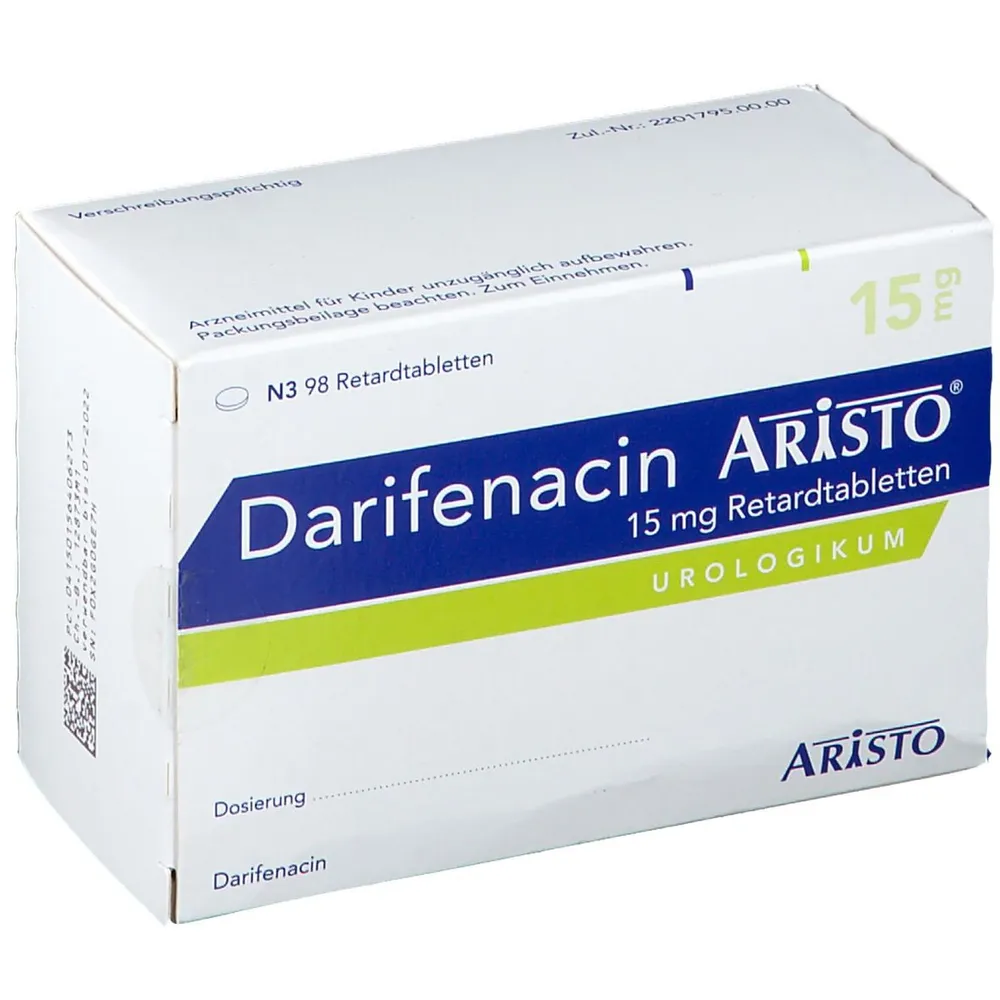
Table of Contents
Darifenacin Aristo, 7.5 mg, prolonged-release tablets
Darifenacin Aristo, 15 mg, prolonged-release tablets
Darifenacinum
Please read the entire leaflet carefully before taking this medicine, as it contains
important information for the patient.
- Keep this leaflet for future reference.
- If you have any questions, please consult your doctor or pharmacist.
- This medicine has been prescribed for a specific individual. Do not share it with others. This medicine may harm others, even if their symptoms are the same.
- If you experience any adverse reactions, including any not listed in this leaflet, inform your doctor or pharmacist. See section 4.
Table of contents
- What Darifenacin Aristo is and what it is used for
- Important information before taking Darifenacin Aristo
- How to take Darifenacin Aristo
- Possible side effects
- How to store Darifenacin Aristo
- Contents of the pack and other information
1. What Darifenacin Aristo is and what it is used for
How Darifenacin Aristo works
Darifenacin Aristo reduces the overactivity of the urinary bladder. This allows for longer intervals between visits to the toilet and increases the bladder capacity for urine storage.
When Darifenacin Aristo is used
Darifenacin Aristo belongs to a group of medicines that relax the muscles of the urinary bladder. It is used in adults for the symptomatic treatment of overactive bladder conditions, such as:
urgent need to go to the toilet, frequent urination, and/or when the patient is unable to reach the toilet in time and experiences involuntary loss of urine (urge incontinence).
2. Important information before using Darifenacin Aristo
When not to take Darifenacin Aristo:
- if the patient is allergic to darifenacin or any of the other ingredients of this medicine (listed in section 6).
- if the patient has urinary retention (inability to empty the bladder).
- if the patient has gastric content retention (difficulties in emptying the stomach).
- if the patient has uncontrolled narrow-angle glaucoma (elevated pressure in the eyeballs which is not adequately treated).
- if the patient has myasthenia (a disease characterized by unusual fatigue and weakness of certain muscles).
- if the patient has severe ulcerative colitis or toxic megacolon (acute dilation of the colon caused by infection or inflammation).
- if the patient has severe liver function impairment.
- if the patient is taking medicines which strongly reduce the activity of certain liver enzymes,
such as cyclosporine (a medicine used in transplantation to prevent organ rejection or in other conditions, e.g. rheumatoid arthritis or atopic dermatitis), verapamil (a medicine reducing blood pressure, regulating heart rhythm and used in the treatment of angina pectoris), antifungal medicines (e.g. ketoconazole and itraconazole) and certain antiviral medicines (e.g. ritonavir) – see section "Darifenacin Aristo with other medicines".
Warnings and precautions
Before starting treatment with Darifenacin Aristo, discuss with your doctor:
- if the patient has autonomic neuropathy (nerve damage affecting communication between the brain and internal organs, muscles, skin and blood vessels, regulating vital functions such as heart rhythm, blood pressure and intestinal function) – your doctor will have previously informed the patient if such diagnosis exists.
- if the patient has a condition in which one or more abdominal organs have moved upward into the chest through an opening in the diaphragm, causing heartburn and frequent belching.
- if the patient has difficulty urinating or passes urine with a weak stream.
- if the patient has severe constipation (2 or fewer than 2 bowel movements per week).
- if the patient has gastrointestinal motility disorders.
- if the patient has gastrointestinal obstruction (any condition impairing the passage of intestinal or gastric contents, such as pyloric stenosis, narrowing of the lower part of the stomach) – your doctor should have previously informed the patient about its presence.
- if the patient is taking medicines which may cause or worsen esophageal inflammation, such as oral bisphosphonates (a group of medicines protecting against bone mass loss, used in the treatment of osteoporosis).
- if the patient is being treated for narrow-angle glaucoma.
- if the patient has liver function impairment.
- if the patient has urinary tract infection or other kidney function disorders.
- if the patient has overactive bladder muscle leading to involuntary urination (a condition called overactive bladder) – your doctor will inform the patient whether they suffer from this condition.
- if the patient has heart diseases.
If the patient has any of these conditions, they must inform their doctor before taking Darifenacin Aristo.
During treatment with Darifenacin Aristo, immediately inform your doctor and discontinue use of Darifenacin Aristo if swelling of the face, lips, tongue and (or) throat occurs (symptoms of angioedema).
Children and adolescents
Darifenacin Aristo is not recommended for use in children and adolescents (under 18 years of age).
Darifenacin Aristo with other medicines
Tell your doctor or pharmacist about all medicines you are currently taking or have recently taken, including those obtained without a prescription. This is particularly important if the patient is taking any of the following medicines, as the doctor may need to adjust the dose of Darifenacin Aristo and (or) other medicines:
- certain antibiotics (e.g. erythromycin, clarithromycin, telithromycin and rifampicin),
- antifungal medicines (e.g. ketoconazole and itraconazole – see section "When not to take Darifenacin Aristo", fluconazole, terbinafine),
- medicines used to reduce immune system activity, for example after organ transplantation (e.g. cyclosporine – see section "When not to take Darifenacin Aristo"),
- antiviral medicines (e.g. ritonavir – see section "When not to take Darifenacin Aristo"),
- antipsychotic medicines (e.g. thioridazine),
- certain antidepressants (e.g. imipramine and paroxetine), certain anticonvulsants (e.g. carbamazepine, barbiturates),
- certain medicines used in the treatment of heart diseases (e.g. verapamil – see section "When not to take Darifenacin Aristo", flecainide, digoxin and quinidine),
- certain medicines used in the treatment of stomach disorders (e.g. cimetidine),
- other antimuscarinic medicines (e.g. tolterodine, oxybutynin and flavoxate).
You should also inform your doctor if you are taking medicines containing St. John's wort.
Darifenacin Aristo with food and drink
Eating does not affect the action of Darifenacin Aristo. Grapefruit juice may interact with Darifenacin Aristo. Inform your doctor if you regularly consume grapefruit juice.
Pregnancy and breastfeeding
If the patient is pregnant or breastfeeding, suspects she may be pregnant, or is planning to become pregnant, she should consult her doctor before using this medicine.
Darifenacin Aristo is not recommended during pregnancy.
Caution should be exercised when taking Darifenacin Aristo during breastfeeding.
Driving and operating machinery
Darifenacin Aristo may cause symptoms such as dizziness, blurred vision, insomnia or drowsiness. If any of these symptoms occur during treatment with Darifenacin Aristo, consult your doctor about adjusting the dose or considering an alternative treatment. If these symptoms occur, do not drive or operate machinery. For darifenacin, these effects occurred not very commonly (see section 4).
3. How to use Darifenacin Aristo
Darifenacin Aristo must always be taken exactly as prescribed by your doctor. If in doubt, consult your doctor or pharmacist. If you feel that the effect of Darifenacin Aristo is too strong or too weak, consult your doctor or pharmacist.
How much Darifenacin Aristo to take
The recommended initial dose of Darifenacin Aristo, including in patients aged over 65 years, is 7.5 mg once daily.
Depending on the response to treatment, your doctor may increase the dose of Darifenacin Aristo to 15 mg once daily, two weeks after starting treatment.
These doses may be used in patients with mild hepatic impairment or renal impairment.
Darifenacin Aristo tablets should be taken once daily with liquid, preferably at the same time each day.
The tablet may be taken with or without food. Swallow the tablet whole. Do not chew, divide, or crush the tablet.
Taking more Darifenacin Aristo than recommended
If you take more tablets than recommended or if someone else accidentally takes the medicine, seek immediate medical advice from your doctor or go to the nearest hospital.
If seeking medical advice, it is important to have this leaflet and any remaining tablets from the pack available to show the doctor. Individuals who have taken an overdose may experience dry mouth, constipation, headache, dyspepsia, and dryness of the nasal mucosa. Overdose with Darifenacin Aristo may lead to severe symptoms requiring urgent hospital treatment.
If you miss a dose of Darifenacin Aristo
If you forget to take your dose of Darifenacin Aristo at your usual time, take it as soon as possible, provided it is not almost time for your next dose. Do not take a double dose to make up for a missed dose.
Stopping Darifenacin Aristo treatment
Your doctor will inform you how long your treatment with Darifenacin Aristo should last. Do not stop treatment prematurely because you do not notice an immediate effect. The bladder requires some time to adapt to the treatment. You should complete the course of treatment prescribed by your doctor. If the treatment does not produce noticeable results, discuss this with your doctor.
If you have any further questions about the use of this medicine, consult your doctor or pharmacist.
4. Possible adverse reactions
Like all medicines, this medicine can cause adverse reactions, although not everyone experiences them.
Adverse reactions to Darifenacin Aristo are usually mild and transient.
Some adverse reactions may be severe
Frequency unknown (frequency cannot be estimated from available data)
Severe allergic reactions including: swelling, mainly of the face and neck (angioedema).
Other adverse reactions
Very common (may affect more than 1 in 10 people)
Dry mouth, constipation.
Common (may affect up to 1 in 10 people)
Headache, abdominal pain, indigestion, nausea, dry eyes, dryness of the nasal mucosa.
Uncommon (may affect up to 1 in 100 people)
Feeling of fatigue, accidental injury, facial swelling, high blood pressure, diarrhoea,
bloating with gas passage, oral mucosal ulceration, increased liver enzyme activity (indicating abnormal liver function), oedema including swelling of hands, ankles or feet, dizziness, insomnia, somnolence, cognitive disturbances, nasal congestion (rhinitis), cough, dyspnoea, dry skin, pruritus, rash, sweating, visual disturbances including blurred vision, taste disturbances, kidney disorders or urinary tract infections, impotence, vaginal discharge and itching, bladder pain, inability to empty the bladder.
Frequency unknown (frequency cannot be estimated from available data)
Depressed mood and (or) mood changes, hallucinations.
Reporting of adverse reactions
If any adverse reactions occur, including any not listed in this leaflet, inform your doctor, pharmacist, or nurse. Adverse reactions can be reported directly to the Department of Monitoring Adverse Reactions of Medicinal Products at the Office for Registration of Medicinal Products, Medical Devices and Biocidal Products:
Al. Jerozolimskie 181C, 02-222 Warsaw, tel.: 22 49-21-301, fax: 22 49-21-309.
Website: https://smz.ezdrowie.gov.pl
Adverse reactions can also be reported to the marketing authorisation holder.
Reporting adverse reactions helps provide more information on the safety of this medicine.
5. How to store Darifenacin Aristo
- Keep the medicine out of the sight and reach of children.
- Do not use this medicine after the expiry date stated on the carton and blister pack. The expiry date refers to the last day of the specified month.
- No special precautions for storage of the medicinal product.
- Do not use if you notice any signs of damage or deterioration of the packaging.
- Medicines must not be disposed of via wastewater or household waste. Ask your pharmacist how to dispose of medicines no longer in use. This will help protect the environment.
6. Contents of the pack and other information
What Darifenacin Aristo contains
Darifenacin Aristo 7.5 mg prolonged-release tablets
- The active substance is darifenacin. Each prolonged-release tablet contains 7.5 mg of darifenacin (as darifenacin hydrobromide).
- Other components of the medicine are: Tablet core: calcium hydrogen phosphate, hypromellose 2208, magnesium stearate Coating: hypromellose 2910, titanium dioxide, macrogol 4000, talc.
Darifenacin Aristo 15 mg prolonged-release tablets
- The active substance is darifenacin. Each prolonged-release tablet contains 15 mg of darifenacin (as darifenacin hydrobromide).
- Other components of the medicine are: Tablet core: calcium hydrogen phosphate, hypromellose 2208, magnesium stearate Coating: hypromellose 2910, titanium dioxide, macrogol 6000, talc, yellow iron oxide (E 172), red iron oxide (E 172).
What Darifenacin Aristo looks like and contents of the pack
Darifenacin Aristo 7.5 mg prolonged-release tablets are white to almost white, round, biconvex coated tablets with an embossing "7.5" on one side and a diameter of 8 mm.
Darifenacin Aristo 15 mg prolonged-release tablets are light apricot-coloured, round, biconvex coated tablets with a diameter of 8 mm.
The tablets are available in blister packs containing 14, 28, 49 or 98 prolonged-release tablets in a cardboard carton.
Not all pack sizes may be marketed.
Marketing Authorisation Holder and Manufacturer
Marketing Authorisation Holder
Aristo Pharma Sp. z o.o.
ul. Baletowa 30
02-867 Warsaw
tel. +48 22 855 40 93
Manufacturer
Aristo Pharma GmbH
Wallenroder Straße 8–10
13435 Berlin
Germany
This medicine is authorised for marketing in the European Economic Area countries under the following names:
Czech Republic Darifenacin Aristo
Spain Darifenacina Aristo, 7.5 mg, 15 mg, Comprimidos de liberación prolongada
Netherlands Darifenacine Aristo, 7.5 mg, 15 mg, tabletten met verlengde afgifte
Germany Darifenacin Aristo, 7.5 mg, 15 mg, Retardtabletten
Poland Darifenacin Aristo
Portugal Darifenacina Aristo, 7.5 mg, 15 mg, Comprimido de libertação prolongada
United Kingdom Darifenacin Aristo, 7.5 mg, 15 mg, Prolonged-released tablets
Italy Darifenacina Aristo, 7.5 mg, 15 mg, compresse a rilascio prolungato