Dalfaz sr 5
Poland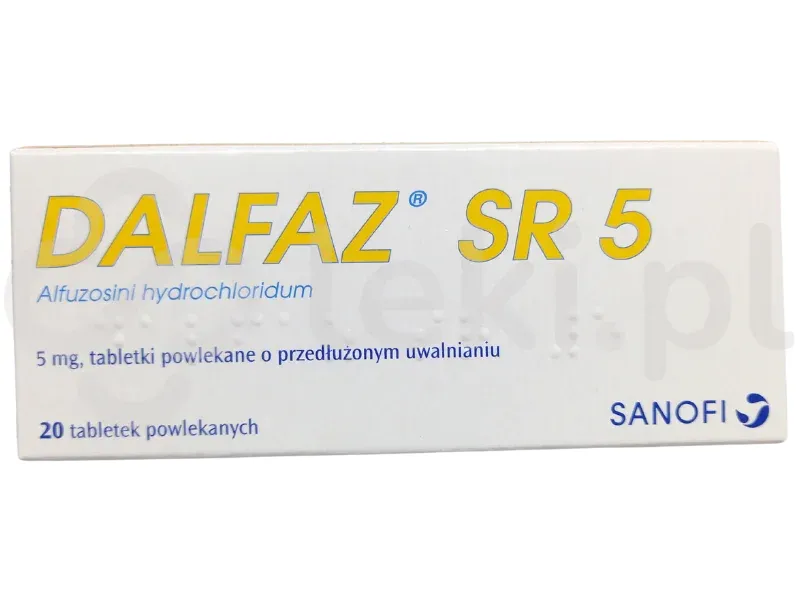
Table of Contents
Package leaflet: Information for the user
DALFAZ SR 5, 5 mg, prolonged-release coated tablets
Alfuzosini hydrochloridum
Please read all of this leaflet carefully before taking this medicine, because it contains
important information for the patient.
- Keep this leaflet, as you may need to read it again.
- If you have any further questions, please ask your doctor or pharmacist.
- This medicine has been prescribed for a specific individual. Do not pass it on to others. It may harm other people, even if their symptoms are the same.
- If you experience any adverse effects, including any not listed in this leaflet, tell your doctor or pharmacist. See section 4.
Contents of the leaflet:
- What Dalfaz SR 5 is and what it is used for
- Important information before taking Dalfaz SR 5
- How to take Dalfaz SR 5
- Possible side effects
- How to store Dalfaz SR 5
- Contents of the pack and other information
1. What Dalfaz SR 5 is and what it is used for
Dalfaz SR 5 is available as prolonged-release coated tablets and contains the active substance alfuzosin. Alfuzosin is a quinazoline derivative, active after oral administration. Alfuzosin reduces lower urinary tract symptoms such as bladder fullness and difficulty in urination.
Dalfaz SR 5 is used:
- For the treatment of functional disorders caused by benign prostatic hyperplasia, when surgical treatment has been deferred.
2. Important information before using Dalfaz SR 5
Do not use Dalfaz SR 5:
- if the patient is allergic to alfuzosin or any of the other ingredients of this medicine (listed in section 6),
- when taking other α1-adrenergic receptor blockers (see section "Concomitant use of other medicines" below),
- when taking ritonavir alone or in combination with ombitasvir/paritaprevir, lopinavir, or nirmatrelvir (see section "Concomitant use of other medicines" below),
- in cases of severe hepatic impairment.
Exercise particular caution when using Dalfaz SR 5 in the following cases:
- in patients who have previously experienced a marked drop in blood pressure as a reaction to α-adrenergic receptor blockers;
- in patients with symptomatic orthostatic hypotension;
- in patients receiving antihypertensive medicines or nitrates;
- in elderly patients due to increased risk of decreased blood pressure.
In some patients receiving antihypertensive medicines, asymptomatic or symptomatic orthostatic drops in blood pressure (dizziness, weakness, sweating) may occur several hours after administration of the medicine. In such cases, the patient should lie down and remain in this position until symptoms completely subside. These symptoms are usually transient, occur at the beginning of treatment, and do not always require discontinuation of the medicine. Regular blood pressure monitoring is recommended.
Post-marketing studies have reported cases of marked decrease in arterial blood pressure in patients with existing risk factors (e.g., concomitant heart disease and/or concomitant use of antihypertensive medicines). The risk of hypotension and associated adverse reactions may be higher in elderly patients.
In patients with ischaemic heart disease, treatment for ischaemic heart disease should be continued concomitantly. If symptoms of coronary heart disease worsen, alfuzosin should be discontinued.
There is a risk of cerebral ischaemia in patients with concomitant cerebrovascular disorders due to hypotension that may occur after administration of alfuzosin.
As with other α-adrenergic receptor blockers, caution should be exercised when administering alfuzosin to patients with acute heart failure.
Patients with cardiac conduction disorders (congenital QTc prolongation, history of QTc prolongation, or those taking medicines known to prolong the QTc interval) should be carefully evaluated by a physician before starting treatment and remain under medical supervision during alfuzosin therapy.
Alfuzosin may cause priapism (a prolonged, painful erection unrelated to sexual activity). Since this condition may lead to permanent impotence if not properly treated, the physician should inform the patient about the potential consequences of this condition.
In some patients treated with α-adrenergic receptor blockers, either currently or in the past, intraoperative floppy iris syndrome (IFIS) – a type of small pupil syndrome – has been observed during cataract surgery.
Although the risk of IFIS with alfuzosin is very low, ophthalmologists should be informed prior to planned cataract surgery that the patient is or has been treated with α-adrenergic receptor blockers, as IFIS may increase the risk of surgical complications.
Ophthalmologists should be prepared to modify their surgical technique if necessary.
Use of Dalfaz SR 5 with food and drink:
Food does not affect gastrointestinal absorption of the medicine.
Dalfaz SR 5 may be taken with or without food.
Pregnancy:
This medicine is not intended for use in women.
Breast-feeding:
Not applicable.
Driving and using machines:
At the beginning of treatment, symptoms such as dizziness (including vestibular dizziness) and weakness may occur. This should be taken into account when driving or operating machinery.
Important information about some of the ingredients of Dalfaz SR 5:
Dalfaz SR 5 contains hydrogenated castor oil as an excipient. Hydrogenated castor oil may cause gastrointestinal discomfort and diarrhoea.
Concomitant use of other medicines:
Inform your doctor about all medicines you are currently taking, including those available without a prescription.
Studies in healthy volunteers have shown no interaction between alfuzosin and the following medicines:
- warfarin, digoxin, hydrochlorothiazide, and atenolol.
Concomitant use of Dalfaz SR 5 is contraindicated with:
- other α-adrenergic receptor blockers due to the risk of orthostatic hypotension;
- ritonavir alone or in combination with lopinavir (commonly used in HIV treatment), or ritonavir in combination with ombitasvir/paritaprevir (commonly used in the treatment of chronic hepatitis C virus infection), or ritonavir in combination with nirmatrelvir (commonly used in the treatment of mild to moderate COVID-19).
Your doctor may consider concomitant use with:
- antihypertensive medicines (see section 2: "Exercise particular caution when using Dalfaz SR 5");
- anaesthetics used for general anaesthesia: administration of these agents in patients treated with alfuzosin may cause a significant drop in blood pressure. The medicine should be discontinued 24 hours before a scheduled surgical procedure under general anaesthesia;
- nitrates (see section 2: "Exercise particular caution when using Dalfaz SR 5");
- antifungal medicines (such as itraconazole);
- antibacterial medicines (such as clarithromycin, telithromycin);
- medicines used in the treatment of depression (such as nefazodone);
- ketoconazole tablets (a medicine used in Cushing's syndrome – when the body produces excessive cortisol).
3. How to use Dalfaz SR 5
Take this medicine exactly as prescribed by your doctor. If in doubt, consult your doctor again.
The first tablet, starting treatment, should be taken in the evening before going to sleep. Tablets must be swallowed whole (do not chew).
Adults:
1 tablet of Dalfaz SR 5 twice daily (in the morning and evening).
Patients over 65 years of age:
For elderly patients and patients treated for arterial hypertension, the initial dose is 1 tablet of Dalfaz SR 5 in the evening. Then, depending on the clinical response, the doctor may increase the dose to 2 tablets per day (1 tablet in the morning and 1 tablet in the evening).
Patients with renal impairment:
For patients with renal insufficiency, treatment starts with 1 tablet of Dalfaz SR 5 at night, and depending on the clinical response, the doctor may increase the dose to 1 tablet twice daily.
Patients with hepatic impairment:
For patients with mild to moderate hepatic insufficiency, Dalfaz 2.5 mg should be used.
Children and adolescents:
The efficacy of alfuzosin has not been demonstrated in children and adolescents aged 2 to 16 years.
The use of alfuzosin in children and adolescents is not recommended.
If you feel that the effect of Dalfaz SR 5 is too strong or too weak, consult your doctor.
In case of taking more Dalfaz SR 5 than prescribed:
If you have taken more than the recommended dose, seek immediate medical advice from your doctor or pharmacist.
In cases of overdose, the doctor may decide to transfer the patient to hospital. If hypotension occurs, the doctor will monitor cardiovascular function and, if necessary, administer vasoconstrictor drugs.
Alfuzosin is highly protein-bound and difficult to remove from the body by dialysis. The doctor may perform gastric lavage and administer activated charcoal.
If you miss a dose of Dalfaz SR 5:
If you miss a dose, take it as soon as possible, unless it is almost time for the next dose. Do not take a double dose or two doses within a short interval of time.
If in doubt, consult your doctor.
4. Possible adverse effects
Like all medicinal products, Dalfaz SR 5 may cause adverse effects.
Adverse effects are listed according to the following frequency classification:
very common (occurring in at least 1 in 10 people), common (occurring in less than 1 in 10 but more than
1 in 100 people), uncommon (occurring in less than 1 in 100 but more than 1 in 1,000 people),
rare (occurring in less than 1 in 1,000 but more than 1 in 10,000 people), very rare (occurring in less than
1 in 10,000 people), frequency not known (cannot be estimated from available data).
The following adverse effects may occur:
Common:
- dizziness, vertigo, headache,
- nausea, abdominal pain, diarrhoea, dry mouth,
- fatigue, malaise,
- orthostatic hypotension (see section 2: Special warnings and precautions for use).
Uncommon:
- fainting, somnolence,
- visual disturbances,
- tachycardia (increased heart rate), palpitations,
- rhinitis,
- vomiting,
- rash, pruritus,
- oedema, chest pain,
- hot flushes.
Very rare:
- angina pectoris in patients with pre-existing coronary artery disease (see section 2: Special warnings and precautions for use),
- urticaria, angioedema.
Frequency not known:
- cerebral ischaemia in patients with concomitant cerebral circulatory disorders,
- intraoperative floppy iris syndrome (IFIS) (see section 2: Special warnings and precautions for use),
- atrial fibrillation,
- liver cell damage, cholestatic liver disease,
- priapism (prolonged, painful penile erection),
- neutropenia,
- thrombocytopenia (reduced platelet count leading to increased risk of bleeding and bruising).
Reporting of adverse reactions
If any adverse effects occur, including any not listed in this leaflet, inform your doctor or pharmacist. Adverse reactions can be reported directly to the Department of Monitoring Adverse Drug Reactions, Office for Registration of Medicinal Products, Medical Devices and Biocidal Products, Al. Jerozolimskie 181C, 02-222 Warsaw, tel.: +48 22 49 21 301, fax: +48 22 49 21 309,
Website: https://smz.ezdrowie.gov.pl
Adverse reactions can also be reported to the Marketing Authorisation Holder or its representative in Poland.
Reporting adverse reactions helps provide more information on the safety of the medicine.
5. How to store Dalfaz SR 5
Storage – no special requirements.
Keep the medicine out of the reach and sight of children.
Do not use the medicine after the expiry date stated on the packaging.
6. Contents of the pack and other information
What Dalfaz SR 5 contains
One prolonged-release coated tablet contains the following active substance:
5 mg of alfuzosin hydrochloride
and the following excipients:
microcrystalline cellulose, calcium hydrogen phosphate dihydrate, hydrogenated castor oil,
povidone, magnesium stearate.
Film-coat composition: hypromellose, titanium dioxide (E 171), propylene glycol,
iron oxide red, iron oxide yellow.
What the medicine looks like and contents of the pack
The pack contains 20, 56 or 60 prolonged-release coated tablets.
Marketing Authorisation Holder and Manufacturer
Marketing Authorisation Holder:
Sanofi Winthrop Industrie
82, Avenue Raspail
94250 Gentilly
France
Manufacturer:
Sanofi Winthrop Industrie
30-36 avenue Gustave Eiffel
37100 Tours
France
For further information, please contact the local representative of the Marketing Authorisation Holder:
Sanofi Sp. z o.o.
ul. Marcina Kasprzaka 6
01-211 Warsaw