Dacepton
Poland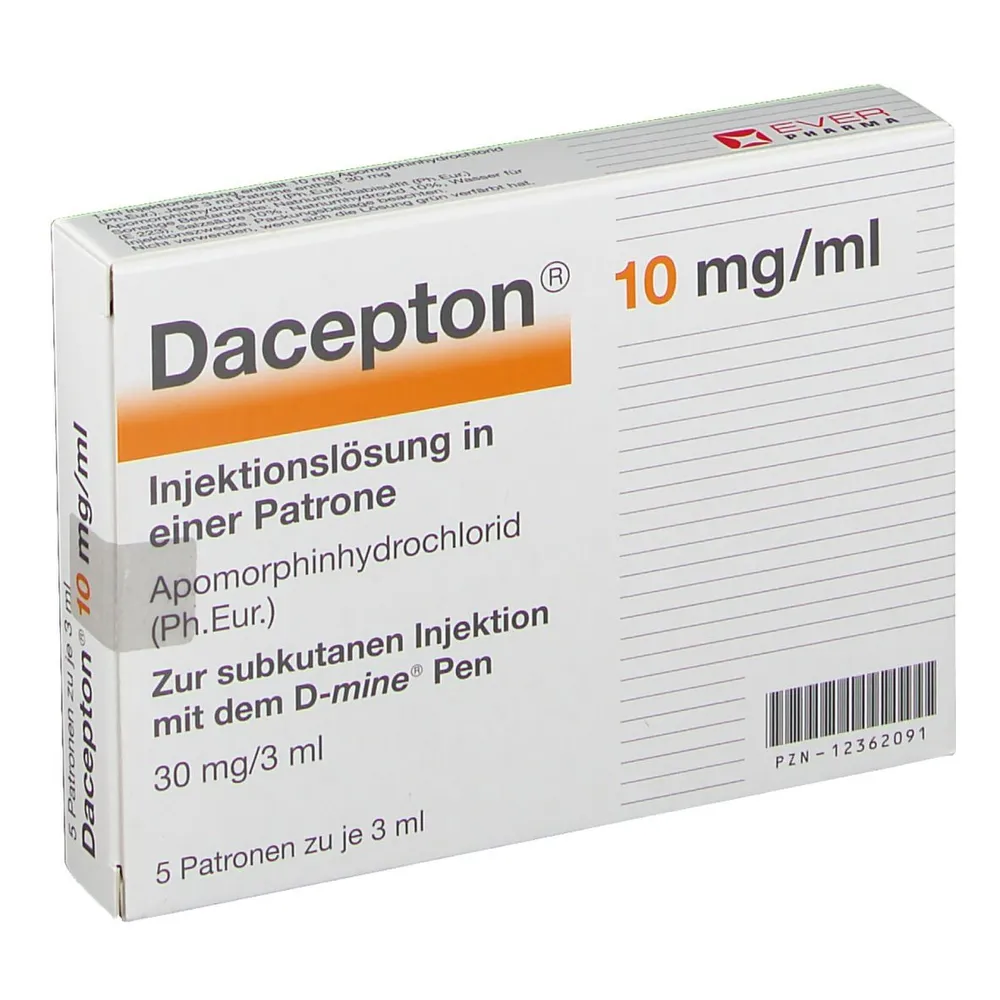
Table of Contents
Patient Information Leaflet
Dacepton, 5 mg/ml, infusion solution
Apomorphini hydrochloridum hemihydricum
Please read this leaflet carefully before using the medicine, as it contains
important information for the patient.
- Keep this leaflet for future reference.
- If you have any questions, please consult your doctor or pharmacist.
- This medicine has been prescribed for a specific individual. Do not pass it on to others. The medicine may harm someone else, even if their symptoms are the same.
- If you experience any adverse reactions, including those not listed in this leaflet, inform your doctor or pharmacist. See section 4.
The full name of this medicine is Dacepton, 5 mg/ml, infusion solution – the name Dacepton will be used throughout this leaflet.
Table of contents
- What Dacepton is and what it is used for
- Important information before using Dacepton
- How to use Dacepton
- Possible side effects
- How to store Dacepton
- Contents of the pack and other information
1. What Dacepton is and what it is used for
Apomorphine hydrochloride belongs to a group of medicines known as dopamine agonists. Dacepton is used in the treatment of Parkinson's disease. Apomorphine helps reduce the duration of the "off" state, i.e. immobility, in patients who have previously been treated for Parkinson's disease with levodopa (another medicine used in Parkinson's disease) and/or other dopamine agonists.
Your treating physician or nurse will help you recognize the symptoms indicating the need to use the medicine.
2. Important information before using Dacepton
When not to use Dacepton
- if the patient is under 18 years of age;
- if the patient has breathing difficulties or suffers from asthma;
- if the patient has dementia or Alzheimer's disease;
- if the patient has confusion, hallucinations, delusions or other similar disorders;
- if the patient has liver disorders;
- if the patient has severe dyskinesias (involuntary movements) or severe dystonia (inability to perform movements) despite treatment with levodopa;
- if the patient is allergic to apomorphine or any of the other ingredients of this medicine (listed in section 6);
- if it is known that the patient or a family member has abnormalities in the ECG (long QT syndrome). The doctor should be informed;
- if the patient is taking ondansetron (a medicine used to treat nausea and vomiting).
Warnings and precautions
Before using Dacepton, the doctor will perform an ECG (electrocardiogram) and ask the patient
about any other medicines currently being taken. The ECG will be repeated on the first day of
treatment and then at any time during treatment if the doctor considers it necessary. The doctor will
ask questions about the patient's medical conditions, especially heart-related diseases. Some questions
and tests may be repeated at each visit. If the patient experiences symptoms related to the heart, such
as palpitations, fainting, or feeling like they are about to faint, they should immediately inform the doctor.
The doctor should also be informed immediately if the patient develops diarrhoea or starts taking any new
medication. Before starting treatment with Dacepton, discuss the following with the doctor, pharmacist,
or nurse:
- if the patient has kidney disorders;
- if the patient has lung disorders;
- if the patient has heart disorders;
- if the patient has low blood pressure or feels weak and dizzy upon standing;
- if the patient is taking medicines for high blood pressure;
- if the patient has nausea or vomiting;
- if psychiatric disturbances occur after starting treatment with Dacepton;
- if the patient is elderly or frail;
- if the patient drives or operates machinery, as apomorphine may cause drowsiness and sudden episodes of overwhelming drowsiness (the patient should not drive or operate machinery if Dacepton causes drowsiness);
- the doctor will regularly monitor the patient if Dacepton is used concomitantly with levodopa (another medicine used in the treatment of Parkinson's disease).
The patient, a family member or caregiver should inform the doctor if they notice that the patient
experiences urges or a desire to behave in an unusual way and is unable to resist the impulse, urge, or
temptation to carry out certain actions that may be harmful to themselves or others. These behaviours are
known as impulse control disorders and may include compulsive gambling, binge eating or spending,
excessively high sex drive, or increased sexual thoughts and feelings. The doctor may adjust the dose
or discontinue the medicine.
Some patients may develop symptoms resembling addiction, leading to a desire to take high doses of
Dacepton and other medicines used in the treatment of Parkinson's disease.
If any of the above situations occur, the patient should inform their doctor or nurse.
Dacepton and other medicines
Tell the doctor or pharmacist about all medicines the patient is currently taking, has recently taken,
or plans to take, including over-the-counter medicines.
Consult the doctor or pharmacist before using the medicine:
If the patient is taking medicines known to affect heart function. These include medicines used for
heart rhythm disorders (e.g. quinidine and amiodarone), depression (including tricyclic antidepressants
such as amitriptyline and imipramine), bacterial infections (macrolide antibiotics such as erythromycin,
azithromycin and clarithromycin), and domperidone.
If the patient is taking ondansetron (a medicine used to treat nausea and vomiting), as this may lead to
severe drop in blood pressure and loss of consciousness.
When the patient uses Dacepton together with other medicines, it may alter the effect of those medicines.
This is particularly important with:
- medicines such as clozapine, used to treat certain psychiatric disorders;
- medicines that lower blood pressure;
- other medicines used in Parkinson's disease.
The doctor will inform the patient if a dose adjustment of apomorphine or other medicines is required.
If the patient is taking levodopa (another medicine used in Parkinson's disease) as well as apomorphine,
the doctor should regularly monitor blood test results.
Food and drink
Food and drink do not affect the action of Dacepton.
Pregnancy and breastfeeding
If the patient is pregnant, breastfeeding, suspects she may be pregnant, or is planning to have a child,
she should consult her doctor or pharmacist before using this medicine.
Dacepton should not be used during pregnancy unless absolutely necessary.
It is not known whether Dacepton passes into human breast milk. If the patient is breastfeeding or
intends to breastfeed, she should talk to her doctor. The doctor will advise whether breastfeeding
should continue or be interrupted, and whether to continue or discontinue taking the medicine.
Driving and using machines
Dacepton may cause drowsiness and a strong need to sleep. The patient should not drive or operate
machinery if Dacepton affects them in this way.
Dacepton contains sodium metabisulphite
Dacepton contains sodium metabisulphite, which in rare cases may cause allergic reactions with
symptoms such as skin rash or itching, breathing difficulties, eyelid, facial or lip swelling, or swelling or
redness of the tongue. If such adverse effects occur, the patient should go immediately to the nearest
hospital emergency department.
Dacepton contains 3.4 mg of sodium per 1 ml. This should be taken into account in patients who are
monitoring sodium intake in their diet.
3. How to use Dacepton
This medicine should always be used exactly as prescribed by the doctor. In case of any doubts, consult your doctor, nurse, or pharmacist.
Before using Dacepton, your doctor will ensure that you tolerate this medicine and the antiemetic medicine that must be taken simultaneously.
When not to use Dacepton
- The solution has turned green.
- The solution is cloudy or solid particles are visible.
Where to inject Dacepton
Dacepton must be injected under the skin (subcutaneously), as demonstrated to you by your doctor or nurse.
Do not inject Dacepton into a vein.
Dosage of the medicine
The amount of Dacepton to be administered and the required duration of treatment per day depend on individual patient needs. Your doctor will discuss this with you and inform you of the appropriate dosage.
The optimal dose for the patient will be determined during a visit at a specialist clinic.
- The usual dose for continuous infusion ranges from 1 mg to 4 mg of apomorphine hydrochloride per hour.
- The dose is usually administered while awake and infusion is paused before going to sleep.
- The daily dose of apomorphine hydrochloride that the patient should receive must not exceed 100 mg.
- Your doctor will decide the best dose for you.
- The infusion site should be changed every 12 hours.
There is no need to dilute Dacepton before administration. Moreover, it must not be mixed with other medicines.
Dacepton is intended for continuous infusion using a minipump or syringe pump. It should not be used for repeated injections. Your doctor will decide which minipump and/or syringe pump to use and will adjust the dosage according to your individual needs.
If you have any further questions about the use of this medicine, consult your doctor or nurse.
Accidental overdose of Dacepton
- Contact your doctor or the nearest hospital emergency department immediately.
- It is important to use the correct dose of Dacepton and not exceed the dose prescribed by your doctor. Overdosing may cause slow heartbeat, increased nausea, excessive drowsiness, and/or breathing difficulties. Low blood pressure may also lead to fainting or dizziness, especially when standing up. Lying down with legs elevated may help.
Missed dose of Dacepton
Take the next dose at the usual time. Do not administer a double dose to make up for a missed dose.
Stopping Dacepton treatment
Do not stop using Dacepton without first consulting your doctor.
If you have any further questions about the use of this medicine, consult your doctor, nurse, or pharmacist.
4. Possible side effects
Like all medicines, this medicine can cause side effects, although not everybody gets them.
You should contact a doctor if the patient feels worse after using the medicine or experiences any of the following symptoms:
Very common side effects (occur in more than 1 in 10 patients):
- Subcutaneous nodules at the injection site, which are painful, bothersome, and may be red and itchy. To avoid these nodules, it is recommended to change the injection site each time the needle is inserted.
- Hallucinations (seeing, hearing or feeling things that are not real)
Common side effects (occur in 1 to 10 in 100 patients):
- Nausea or vomiting, particularly at the beginning of apomorphine treatment. Domperidone should be taken for at least 2 days before starting treatment with Dacepton to prevent nausea or vomiting.
- If the patient is taking domperidone and still experiences nausea, or is not taking domperidone and experiences nausea, a doctor or nurse should be informed as soon as possible.
- Feeling of fatigue or excessive drowsiness
- Confusion or hallucinations
- Yawning
- Dizziness or lightheadedness when standing up
Uncommon side effects (occur in 1 to 10 in 1,000 patients):
- Worsening of involuntary movements or increased tremor during "on" periods
- Haemolytic anaemia, abnormal breakdown of red blood cells in blood vessels or other parts of the body. This is an uncommon side effect that may occur in patients also taking levodopa.
- Sudden sleep attacks
- Rash
- Difficulty breathing
- Ulceration at the injection site
- Decrease in red blood cell count, resulting in pale-yellowish skin discoloration and possible weakness or shortness of breath
- Decrease in platelet count, leading to increased risk of bleeding or bruising
Rare side effects (occur in 1 to 10 in 10,000 patients):
- Allergic reaction such as difficulty breathing or breathlessness, swelling of the eyelids, face or lips, swelling or redness of the tongue
- Eosinophilia – abnormally high number of white blood cells in the blood or other body tissues
Side effects occurring in an unknown number of users:
- Swelling of the legs, feet or fingers
- Fainting
- Headache
- Inability to resist an impulse, urge or temptation to perform an action that may be harmful to the patient or others, which may include:
- inability to stop gambling despite serious personal or family consequences;
- changes in sexual interests and behaviours significant to the patient or others, such as increased libido;
- uncontrolled excessive shopping or spending;
- binge eating (consuming large amounts of food in a short time) or compulsive eating (eating more food than usual and more than needed to satisfy hunger).
- Aggression, agitation.
You should tell your doctor if the patient experiences any of these behaviours. The doctor will advise
on how to manage or reduce the symptoms.
Reporting of side effects
If any side effects occur, including any side effects not listed in this leaflet, you should inform your doctor, pharmacist or nurse. Side effects can be reported directly to the Department of Monitoring Adverse Drug Reactions at the Office for Registration of Medicinal Products, Medical Devices and Biocidal Products
Al. Jerozolimskie 181C
02-222 Warsaw
Phone: +48 22 49 21 301
Fax: +48 22 49 21 309
Website: https://smz.ezdrowie.gov.pl
Side effects can also be reported to the marketing authorisation holder.
Reporting side effects helps provide more information on the safety of this medicine.
5. How to store Dacepton
Keep this medicine out of sight and reach of children.
Store the vials in the outer packaging to protect from light.
Do not store in the refrigerator or freeze.
Chemical and physical stability after opening and filling the syringes included in the infusion kits has been confirmed for up to 7 days at 25°C.
From a microbiological point of view, the product should be used immediately, unless reconstitution or dilution was carried out under controlled and validated aseptic conditions. If the solution is not used immediately, the responsibility for the duration and conditions of storage of the prepared solution prior to use lies with the user.
Do not use this medicine after the expiry date stated on the cardboard box and label after "EXP". The expiry date refers to the last day of the indicated month.
Do not use the medicine if the solution has changed colour to green. The medicine may only be used if the solution is clear, colourless to slightly yellow, and contains no solid particles.
Used syringes and needles must be disposed of in a sharps container or another suitable container. When the sharps container is full, return it to a doctor or pharmacist for safe disposal.
Medicines should not be disposed of via wastewater or household waste. Ask your pharmacist how to dispose of medicines no longer required. This will help protect the environment.
6. Contents of the package and other information
What Dacepton contains
The active substance is apomorphine hydrochloride monohydrate. Each millilitre of Dacepton contains 5 mg of apomorphine hydrochloride monohydrate.
Dacepton is available in 20 ml vials containing 100 mg of apomorphine hydrochloride monohydrate.
The other ingredients are:
- Sodium metabisulfite
- Sodium chloride
- Hydrochloric acid 1M
- Water for injections
Information on Dacepton relating to sodium metabisulfite and sodium chloride is given in section 2.
What Dacepton looks like and contents of the pack
Dacepton is a clear, colourless to yellowish infusion solution.
The 20 ml infusion solution is supplied in clear type I glass vials with a bromobutyl rubber stopper and an aluminium flip-off cap. The carton contains 1, 5 or 30 vials.
Bulk pack sizes: 5 x 1; 10 x 1; 30 x 1; 2 x 5 and 6 x 5.
Not all pack sizes may be marketed.
Marketing Authorisation Holder
EVER Neuro Pharma GmbH
Oberburgau 3
4866 Unterach am Attersee
Austria
Manufacturer
- EVER Neuro Pharma GmbH, Oberburgau 3, 4866 Unterach am Attersee, Austria
- EVER Pharma Jena GmbH, Otto-Schott-Str. 15, Jena 07745, Germany
- EVER Pharma Jena GmbH, Brüsseler Str. 18, Jena 07747, Germany
This medicinal product is authorised for marketing in the European Economic Area and in the United Kingdom (Northern Ireland) under the following names:
Austria: Dacepton 5mg/ml Infusionslösung
Belgium: Dacepton 5 mg/ml oplossing voor infusie
Bulgaria: Dacepton 5 mg/ml Инфузионен разтвор
Czech Republic: Dacepton 5 mg/ml Infuzní roztok
Denmark: Dacepton 5 mg/ml infusionsvæske, opløsning
Estonia: Dacepton 5 mg/ml
Greece: Dopaceptin 5 mg/ml Διάλυμα για έγχυση
Netherlands: Dacepton 5 mg/ml oplossing voor infusie
Finland: Dacepton 5 mg/ml infuusioneste, liuos
France: Dopaceptin 5 mg/ml Solution pour perfusion
Germany: Dacepton 5 mg/ml Infusionslösung
Norway: Dacepton
Spain: Dacepton 5 mg/ml Solución para perfusión
Ireland: Dacepton 5 mg/ml solution for infusion
Lithuania: Dacepton 5 mg/ml Infuzinis tirpalas
Latvia: Dacepton 5 mg/ml šķīdums infūzijām
Poland: Dacepton
Portugal: Dacepton
Romania: Dacepton 5 mg/ml Soluţie perfuzabilă
Slovakia: Dacepton 10mg/ml Infúzny roztok
Slovenia: Dacepton 5 mg/ml raztopina za infundiranje
Sweden: Dacepton 5 mg/ml infusionsvätska, lösning
Hungary: Dacepton 5 mg/ml Oldatos infúzió
United Kingdom (Northern Ireland): Dacepton 5 mg/ml solution for infusion