Cyxodil
Poland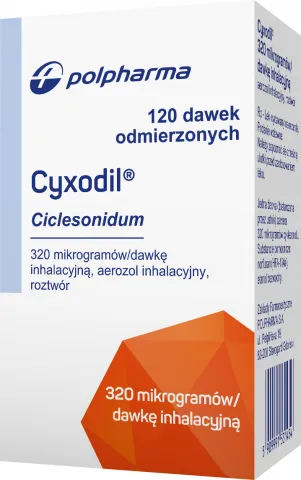
Table of Contents
Package leaflet: Information for the user
Cyxodil, 80 micrograms/inhalation dose, inhalation aerosol, solution
Cyxodil, 160 micrograms/inhalation dose, inhalation aerosol, solution
Cyxodil, 320 micrograms/inhalation dose, inhalation aerosol, solution
Ciclesonide
Please read carefully the entire leaflet before using the medicine, as it contains
important information for the patient.
- Keep this leaflet, so that you can read it again if necessary.
- If you have any questions, please consult your doctor, pharmacist, or nurse.
- This medicine has been prescribed for a specific individual. Do not pass it on to others. The medicine may harm another person, even if their symptoms are the same.
- If you experience any adverse effects, including any not listed in this leaflet, inform your doctor, pharmacist, or nurse. See section 4.
Table of contents:
- What Cyxodil is and what it is used for
- Important information before using Cyxodil
- How to use Cyxodil
- Possible side effects
- How to store Cyxodil
- Contents of the pack and other information
1. What Cyxodil is and what it is used for
What Cyxodil is:
Cyxodil contains ciclesonide as the active substance. Cyxodil is a clear, colourless inhalation aerosol intended for inhalation through the mouth into the lungs. It is a preventive medicine (a corticosteroid) which must be used daily and whose effect occurs only after inhalation into the lungs.
What Cyxodil is used for:
Cyxodil is used for the treatment of chronic asthma in adults and adolescents (aged 12 years and older).
How Cyxodil works:
Cyxodil helps to make breathing easier by reducing the severity of asthma symptoms and decreasing the likelihood of asthma attacks.
The effect of the medicine increases over time; therefore, it should be taken daily, even if you feel well.
This medicine is not suitable for use during an acute attack of breathlessness. To rapidly relieve
such an attack, only a reliever inhaler medicine should be used.
2. Important information before using Cyxodil
When not to use Cyxodil:
- if the patient is allergic to cyclenonide or to any of the other ingredients of this medicine (listed in section 6).
Warnings and precautions
Before starting treatment with Cyxodil, discuss this with your doctor or pharmacist.
Before starting treatment with this medicine, inform your doctor if:
- the patient has ever been treated or is currently being treated for tuberculosis, fungal, viral or bacterial infections.
If in doubt, contact your doctor. It is important to ensure that the medicine
Cyxodil is suitable for the individual patient.
Contact your doctor immediately if, during treatment with
Cyxodil, the patient:
- experiences difficulty breathing and worsening symptoms such as cough, shortness of breath, wheezing, chest tightness, increased adventitious lung sounds (coarse crackles), or other symptoms of airway constriction. Use a reliever inhaler as directed, which usually results in rapid improvement.
- symptoms cause awakening from sleep;
- there is no improvement after using the reliever inhaler. The doctor will determine further treatment.
Special patient groups
In patients with severe asthma, there is a risk of acute asthma attacks. In this group
of patients, the doctor will regularly perform thorough assessments of asthma control, including
lung function tests.
Patients who are already taking oral corticosteroids:
Cyxodil may be used to replace tablets or to reduce the number of tablets required. Follow your doctor's instructions exactly.
- The switch will begin approximately one week after starting inhaled Cyxodil.
- The number of tablets taken will be gradually reduced over a period of time.
- During this time, the patient may occasionally feel generally unwell.
- Despite this, it is important to continue inhaled treatment with Cyxodil and the gradual reduction of tablet dosage.
- If severe symptoms such as nausea, vomiting, diarrhoea or high fever occur, contact your doctor.
- Switching from tablet to inhaled treatment may occasionally unmask mild allergic reactions, such as rhinitis or rash (itchy red skin).
- After switching from tablets to inhaled treatment, the patient may remain at risk of adrenal suppression for some time due to previously taken oral corticosteroids. Symptoms of adrenal suppression (e.g. dizziness, fainting, nausea, loss of appetite, mood changes, hair loss, reduced stress tolerance, weakness, headache, memory disturbances, allergies, increased appetite and changes in blood glucose levels) may also persist for some time.
- It may be necessary to consult a specialist to determine the degree of adrenal suppression.
- The doctor will also regularly monitor adrenal function.
- In stressful situations, such as during surgery or worsening asthma attacks, additional oral corticosteroids may be required. For this reason, the patient should carry a steroid warning card indicating this.
Patients with liver or kidney disease
Dosage adjustment of cyclenonide is not necessary in patients with liver or kidney disease.
If the patient has severe liver disease, the doctor will perform a more detailed assessment regarding
possible adverse effects due to impaired steroid production.
Children
This medicine is not recommended for use in children under 12 years of age, due to lack of information on its effects in this age group.
Cyxodil with other medicines
Inform your doctor or pharmacist about all medicines the patient is currently taking or has recently taken, as well as any medicines the patient plans to take, including over-the-counter medicines.
Before taking Cyxodil, inform your doctor if the patient is currently being treated for any fungal or viral infection with a medicine containing:
- ketoconazole,
- itraconazole,
- cobicistat,
- ritonavir,
- nelfinavir. These medicines may enhance the effect of Cyxodil, so the possibility of adverse reactions cannot be completely ruled out.
Cyxodil with food and drink
No interaction has been observed between Cyxodil and food or drink.
Pregnancy, breastfeeding and fertility
If the patient is pregnant or breastfeeding, suspects she may be pregnant, or is planning to have a child, she should consult her doctor or pharmacist before using this medicine.
- Since there is insufficient information on the effects of Cyxodil in pregnant women, the doctor will discuss the risks and benefits of using Cyxodil with the patient.
- Cyclenonide (the active substance in Cyxodil) may be used during pregnancy only if the potential benefit to the mother outweighs the possible risk to the developing fetus. If the doctor decides that the patient may continue using Cyxodil, the lowest possible dose of cyclenonide necessary to maintain asthma control will be used.
- Adrenal function will be carefully monitored in children whose mothers received corticosteroids during pregnancy.
- If the patient intends to use Cyxodil while breastfeeding, she should discuss this with her doctor.
- It is not known whether inhaled cyclenonide passes into human milk.
- Prescribing Cyxodil to breastfeeding women will only be considered if the expected benefit to the mother outweighs the possible risk to the infant.
Driving and using machines
Cyxodil and its excipients have no effect or have a negligible effect on the ability to drive or operate machinery.
Cyxodil contains ethanol
This medicine contains 4.7 mg of alcohol (ethanol) per inhalation dose. The amount of alcohol in each dose is equivalent to less than 1 ml of beer or 1 ml of wine. The small amount of alcohol in this medicine will not cause noticeable effects.
3. How to use Cyxodil
This medicine should always be used as directed by the doctor or pharmacist. If in doubt,
consult the doctor or pharmacist.
- If the patient has started using this medicine instead of oral corticosteroids or together with oral corticosteroids, see section 2, "Patients who are already using oral corticosteroids".
What dose of Cyxodil should be used every day?
The doctor will inform the patient of the dose to be used every day. This will depend on the individual needs of the patient.
- The recommended dose of Cyxodil is 160 micrograms once daily, which provides asthma symptom control in most patients.
- In some patients, a reduced dose of 80 micrograms once daily may be sufficient to maintain adequate asthma control.
- In patients with severe asthma exacerbation, a temporary increase in the dose of Cyxodil may be necessary. The dose may be increased up to 640 micrograms per day, administered as 320 micrograms twice daily; however, there are no data confirming additional therapeutic benefit after 3 months of using higher doses.
If necessary, the doctor may also prescribe oral corticosteroids and (or) antibiotics
in case of infection.
- The doctor will adjust the dose to the lowest level necessary to control the patient's asthma.
- Improvement in symptoms (wheezing, chest tightness, and cough) should be noticeable within 24 hours.
When to use Cyxodil?
In most cases, either in the morning or evening – one or two doses per day. Follow the doctor's instructions strictly. It is important to use Cyxodil regularly every day, even if the patient feels better.
If the patient finds that they need to use their reliever inhaler more than 2–3 times a week, they should contact their doctor, who will reassess the treatment.
How to use Cyxodil?
It is important that the doctor, nurse, or pharmacist first demonstrate the correct way to use the Cyxodil inhaler. Proper technique ensures that the correct amount of medicine reaches the lungs. The instructions in this leaflet should be used as a reminder.
To ensure the patient is using the Cyxodil inhaler correctly, it may be helpful to perform the first few inhalations in front of a mirror. Make sure the medicine does not escape from the top or sides of the mouth.
A new inhaler or an inhaler that has not been used for a week or longer must be primed before use. Remove the mouthpiece cover and press the three times on the pressurized canister inside the inhaler to release three doses, directing the spray into the air away from the user.
Shaking the Cyxodil inhaler before use is not necessary. The medicine is a uniform solution, which ensures delivery of the correct dose with each inhalation.
The patient may sit or stand while inhaling.
Follow the instructions below carefully, using the illustrations provided.
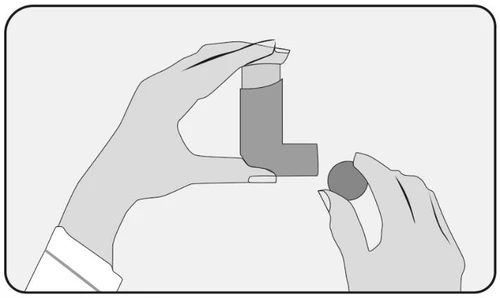
- Remove the mouthpiece cover and check the mouthpiece inside and outside to ensure it is clean and dry.
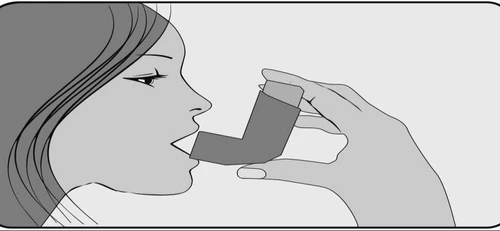
- Hold the inhaler with the base pointing upwards (the base of the pressurized canister at the top), placing the index finger on the base of the canister and the thumb under the mouthpiece.
- Breathe out as long as comfortably possible. Do not exhale into the inhaler.
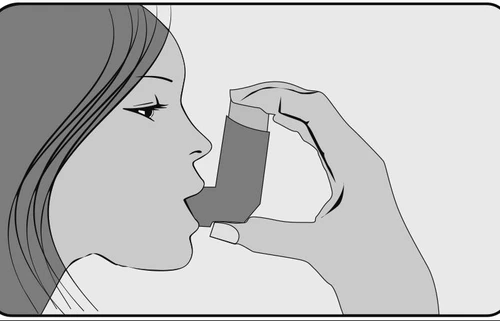
- Place the mouthpiece in the mouth and close the lips firmly around it.
- Just as the inhalation through the mouth begins, press the top of the inhaler with the index finger to release the dose, while simultaneously taking a slow and deep breath in. Be careful not to let the medicine escape through the top, bottom, or sides of the mouth.
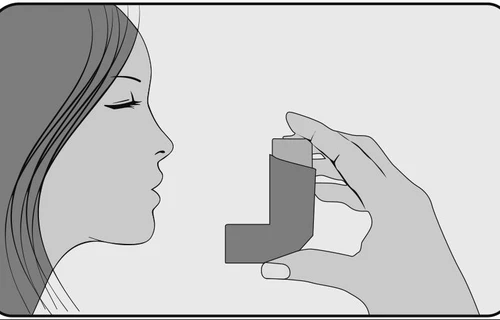
- Hold the breath, remove the inhaler from the mouth, and remove the index finger from the top of the inhaler. Continue holding the breath for about ten seconds or as long as possible. Then breathe out slowly through the mouth. Avoid blowing into the inhaler.
It is important not to rush the steps described in points 3 to 6.
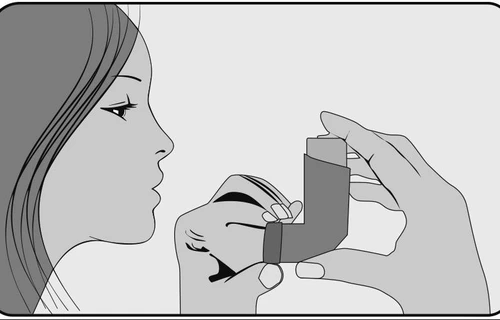
- If a second dose is prescribed, wait about half a minute and repeat steps 3 to 6.
- After use, always replace the mouthpiece cover to prevent dust from entering. Press the cover firmly and snap it into place.
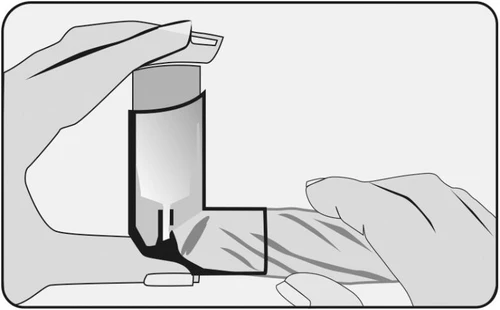
For hygiene reasons, clean the inner and outer surfaces of the mouthpiece weekly with a dry cloth.
- Remove the mouthpiece cover without removing the inhaler from the plastic housing;
- Wipe the front part of the small opening through which the medicine is released, using a dry folded cloth;
- Do not use water or other liquids.
Proper technique ensures that the correct dose of Cyxodil reaches the patient's lungs with each use of the inhaler. The doctor will regularly check the patient's inhalation technique to ensure optimal treatment effect.
When the pressurized canister is completely empty, the spray will no longer be audible or perceptible.
If the patient experiences wheezing or chest tightness after using Cyxodil:
- Do not take additional doses.
- Use a reliever inhaler to ease breathing.
- Contact the doctor immediately.
If the patient has difficulty using the inhaler, the doctor may recommend using a spacer. The spacer compatible with the Cyxodil inhaler is called AeroChamber Plus Flow-Vu.
When using the AeroChamber Plus Flow-Vu device, follow the instructions provided with it.
The doctor or pharmacist can provide advice on using this device.
Using more than the recommended dose of Cyxodil
It is important that the dose used is in accordance with the doctor's instructions. Do not increase or decrease the dose without consulting the doctor.
If an excessive dose of Cyxodil is taken, no specific treatment is required, but the doctor should be informed. If high doses are used for a prolonged period, reduced adrenal function cannot be excluded, and monitoring of adrenal function may be necessary.
Missing a dose of Cyxodil
If the patient forgets to use Cyxodil, they should take the next dose at the scheduled time. Do not take a double dose to make up for a missed dose.
Stopping treatment with Cyxodil
Do not stop using the Cyxodil inhaler, even if the patient feels better.
If treatment with this medicine is stopped, inform the doctor immediately.
If there are any further doubts about using this medicine, consult the doctor or pharmacist.
4. Possible adverse reactions
Like all medicines, this medicine can cause adverse reactions, although not everyone will experience them.
Treatment should be discontinued and immediate medical advice sought if the patient experiences any of the following severe adverse reactions:
- severe allergic reactions such as swelling of the lips, tongue, and throat (occurring in no more than 1 in 1,000 people),
- allergic reactions: skin rash, redness, itching, or skin eruptions in the form of hives and urticaria (occurring in no more than 1 in 100 people),
- cough or wheezing worsening shortly after inhalation (occurring in no more than 1 in 100 people).
Other adverse reactions observed during treatment with Cyxodil are usually mild.
In most cases, patients may continue treatment. The possible adverse reactions include:
Uncommon adverse reactions (occurring in no more than 1 in 100 people):
- hoarseness
- burning, inflammation, or irritation of the mouth or throat
- oral thrush (fungal infection of the mouth)
- headache
- unpleasant taste in the mouth
- dryness of the mouth or throat
- nausea or vomiting
Rare adverse reactions (occurring in no more than 1 in 1,000 people):
- sensation of rapid heartbeat (palpitations)
- discomfort or abdominal pain
- high blood pressure
Adverse reactions with unknown frequency, but which may also occur:
- sleep disorders, depression, feelings of worry, anxiety, restlessness, increased excitability, or irritability. These reactions are more likely to occur in children.
- blurred vision and eye disorders causing visual disturbances (central serous chorioretinopathy).
Cyxodil may affect the normal production of corticosteroids in the patient's body.
This has usually been observed in patients receiving high doses over a long period. This effect may include:
- slowed growth in adolescents
- thinning of the bones
- possible clouding of the eye lens (cataract), causing blurred vision
- loss of vision caused by abnormally high pressure within the eye (glaucoma)
- moon-shaped face, increased mass of the upper body, and thinning of arms and legs (cushingoid syndrome or Cushing's syndrome). The doctor will regularly monitor the growth of adolescents receiving long-term treatment. If growth has slowed, the doctor will adjust the dose, if possible, to the lowest effective dose that maintains adequate asthma control.
Oral corticosteroids may cause more adverse reactions than inhaled corticosteroids such as Cyxodil.
In patients who have taken steroid tablets before or during treatment with Cyxodil, there may be an ongoing risk of adverse reactions related to tablet steroid use for some time. Regular medical check-ups will ensure that the dose of Cyxodil taken by the patient is appropriate. Regular monitoring will also allow early detection of any adverse reactions and reduce the likelihood of their worsening.
Please remember:
If any of the adverse symptoms worsen or if any adverse reactions not listed in this leaflet occur, inform your doctor or pharmacist.
Reporting of adverse reactions
If any adverse reactions occur, including any not listed in this leaflet, tell your doctor, pharmacist, or nurse.
Adverse reactions can be reported directly to the Department of Monitoring of Adverse Drug Reactions at the Office for Registration of Medicinal Products, Medical Devices and Biocidal Products:
Al. Jerozolimskie 181C
02-222 Warsaw
Phone: +48 22 49 21 301
Fax: +48 22 49 21 309
Website: https://smz.ezdrowie.gov.pl
Adverse reactions can also be reported to the marketing authorization holder.
Reporting adverse reactions helps to provide more information on the safety of the medicine.
5. How to store the medicine Cyxodil
Keep the medicine out of the sight and reach of children.
Do not use the medicine after the expiry date stated on the carton and label after EXP. The expiry date refers to the last day of the stated month.
The marking on the packaging after the abbreviation EXP indicates the expiry date, and after the abbreviation Lot indicates the batch number.
Pressurised container. Do not expose to temperatures above 50°C.
Do not pierce, damage, or burn the container, even if it appears to be empty.
As with most pressurised inhalation medicines, the effectiveness of this medicine may be reduced if the container is cold. However, Cyxodil delivers the same dose within the temperature range from minus 10°C to plus 40°C.
If the inhaler is very cold, remove it from the plastic container and warm it in your hands for several minutes before use. Never use anything else to heat it.
Medicines must not be disposed of via wastewater or household waste. Ask your pharmacist how to dispose of medicines no longer required. This will help protect the environment.
6. Contents of the package and other information
What Cyxodil contains:
- The active substance is ciclesonide. Each actuation of the inhaler delivers a dose (delivered via the mouthpiece) containing 80, 160, or 320 micrograms of ciclesonide.
- The other ingredients are: anhydrous ethanol and norflurane (HFA-134a). This medicine contains fluorinated greenhouse gases. Each inhaler contains 8.8 g of HFA-134a, equivalent to 0.013 tonnes of CO₂-equivalent (global warming potential GWP = 1430).
What Cyxodil looks like and contents of the pack
Cyxodil is a clear, colourless solution contained in an aluminium pressurised canister that delivers a precisely metered dose of ciclesonide as an aerosol via the mouthpiece.
The canister is placed in a plastic holder comprising a mouthpiece with a protective cap in green (Cyxodil 80 micrograms), violet (Cyxodil 160 micrograms), or red (Cyxodil 320 micrograms).
Pack sizes:
1 inhaler containing 120 metered inhalation doses.
Marketing Authorisation Holder and Manufacturer
Marketing Authorisation Holder
Zakłady Farmaceutyczne POLPHARMA S.A.
ul. Pelplińska 19, 83-200 Starogard Gdański
tel. +48 22 364 61 01
Manufacturer
Genetic S.p.A.
Contrada Canfora
84084 Fisciano (SA)
Italy
This medicinal product is authorised in the European Economic Area countries under the following names:
Poland: Cyxodil
Czech Republic: Ciclesonide Polpharma