Cefepime kabi
Poland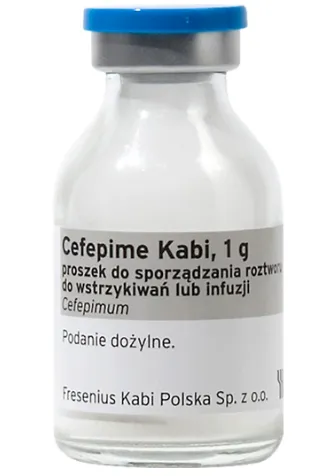
Table of Contents
- Package leaflet: Information for the user
- 1. What Cefepime Kabi is and what it is used for
- 2. Important information before using Cefepime Kabi
- 3. How to use Cefepime Kabi
- 4. Possible adverse reactions
- 5. How to store Cefepime Kabi
- 6. Contents of the pack and other information
- Information intended exclusively for healthcare professionals:
Package leaflet: Information for the user
Cefepime Kabi, 1 g, powder for solution for injection or infusion
Cefepime Kabi, 2 g, powder for solution for injection or infusion
Cefepimum
Please read carefully all the information in this leaflet before using this medicine, as it contains
important information for the patient.
Keep this leaflet, so that you can read it again if necessary.
If you have any further questions, please consult your doctor.
If you experience any adverse reactions, including any not listed in this leaflet, inform your doctor. See section 4.
Table of contents
- What Cefepime Kabi is and what it is used for
- Important information before using Cefepime Kabi
- How to use Cefepime Kabi
- Possible side effects
- How to store Cefepime Kabi
- Contents of the pack and other information
1. What Cefepime Kabi is and what it is used for
Cefepime Kabi is an antibiotic used to treat infections in various parts of the body caused by bacteria. It belongs to a group of antibiotics called "fourth-generation cephalosporins".
Cefepime acts only against certain types of bacteria. This means it is suitable for treating only certain types of infections.
Cefepime Kabi is used to treat various infections:
In adult patients and children aged over 12 years:
- Complicated (severe) urinary tract and kidney infections (urinary tract infections);
- Lung infections (pneumonia);
- Complicated (severe) intra-abdominal infections;
- Peritonitis (inflammation of the peritoneum) associated with dialysis in patients undergoing continuous ambulatory peritoneal dialysis;
In children aged 2 months to 12 years with body weight ≤40 kg:
- Complicated (severe) urinary tract and kidney infections (urinary tract infections);
- Lung infections (pneumonia).
Cefepime may be used in adult patients and children over 2 months of age for the treatment of bacterial bloodstream infections (bacteraemia) that are or may be associated with the infections listed above.
Cefepime may be used in adult patients and children over 2 months of age who have neutropenia (patients with reduced immunity) and fever, when a bacterial infection is suspected as the cause.
2. Important information before using Cefepime Kabi
When not to use Cefepime Kabi
- If the patient is allergic (hypersensitive) to:
- cefepime or to any of the other ingredients of this medicine (listed in section 6);
- any other antibiotic belonging to the cephalosporin group.
- If the patient has ever experienced a severe allergic reaction to any other antibiotic belonging to the group called beta-lactams (such as penicillins, so-called monobactams and carbapenems).
If in doubt, consult a doctor.
Warnings and precautions
Before starting treatment with Cefepime Kabi, consult a doctor:
- if the patient has ever had an allergic reaction to cefepime or any other antibiotic from the beta-lactam group, or to any other medicine; if an allergic reaction occurs during treatment with cefepime, contact a doctor immediately, as the reaction may be severe and the doctor will immediately discontinue the medicine;
- if the patient has ever been diagnosed with asthma or has a tendency towards allergies;
- if the patient has kidney function disorders; dose adjustment of Cefepime Kabi may be necessary;
- if the patient develops severe and persistent diarrhoea during treatment; this may be a sign of inflammation of the bowel and prompt medical attention may be required;
- if the patient suspects a new infection has developed during treatment with Cefepime Kabi; this may be an infection caused by microorganisms resistant to cefepime, and discontinuation of the medicine may be necessary;
- if the doctor orders blood or urine tests, inform the doctor that the patient is taking Cefepime Kabi, as this medicine may affect the results of certain tests.
Cefepime Kabi and other medicines
Tell the doctor about all medicines the patient is currently taking or has recently taken,
and also about any medicines the patient plans to take. This is important because some medicines should not
be used together with cefepime.
In particular, inform the doctor if the patient is taking:
- any other antibiotics, especially aminoglycosides (such as gentamicin) or "drying" medicines (diuretics, such as furosemide); in such cases, kidney function should be monitored;
- medicines used to prevent blood clots (anticoagulants, coumarin derivatives such as warfarin); their effect may be enhanced;
- certain types of antibiotics (bacteriostatic antibiotics), as they may interfere with the action of cefepime.
Pregnancy and breastfeeding
If the patient is pregnant or suspects she may be pregnant, she should inform the doctor.
There is no data available on the use of cefepime in pregnant women. The use of cefepime during pregnancy is not recommended.
Small amounts of the medicine may pass into human milk. Cefepime may be used during
breastfeeding; however, the infant should be carefully monitored for any adverse effects.
If the patient is pregnant or breastfeeding, suspects she may be pregnant, or is planning to have a
child, she should consult a doctor before using this medicine.
Driving and operating machinery
During treatment, headache or seizures, dizziness, confusion or altered consciousness may occur.
If such symptoms occur, the patient should not drive or operate machinery.
3. How to use Cefepime Kabi
Cefepime Kabi is usually administered by a doctor or nurse. It is given:
- by slow injection into a vein (intravenous injection) or
- by infusion (drip) into a vein (intravenous infusion). The dose depends on the type and severity of the infection, as well as the patient's age, body weight, and kidney function. Your doctor will explain this to you.
Cefepime Kabi is usually given 2–3 times a day.
Typical recommended dosing:
- in adult patients and adolescents (over 12 years of age): 4 to 6 g per day;
- in infants and children (from 2 months to 12 years of age): 100 to 150 mg/kg body weight/day;
- duration of treatment is usually 7 to 10 days;
- maximum dose in children over 2 months of age and adult patients is 6 g per day.
Use of a higher than recommended dose of Cefepime Kabi
If the patient thinks they have received too high a dose of the medicine, they should inform the doctor immediately.
Missed dose of Cefepime Kabi
If the patient thinks they have missed a dose, they should inform the doctor.
Stopping treatment with Cefepime Kabi
This medicine should be used for the entire prescribed duration, even if the patient feels better after the first few doses. If treatment is stopped too early, the infection may not be completely cured.
If you have any further questions about the use of this medicine, consult your doctor.
4. Possible adverse reactions
Like all medicines, this medicine can cause adverse reactions, although not everyone will experience them.
If any of the following adverse reactions occur, immediate action is required. If any of the following adverse reactions occur, stop using the medicine and immediately contact a doctor.
- Inflammation of the large intestine called pseudomembranous colitis (or post-antibiotic colitis), causing severe, prolonged, watery diarrhoea with abdominal cramps and fever (occurs in fewer than 1 in 100 patients).
- Severe allergic reaction (called anaphylaxis) with sudden wheezing or shortness of breath, swelling of the face or body, rash, fainting (loss of consciousness) (occurs in fewer than 1 in 1,000 patients).
- Mild or moderate skin rash with erosions and blister formation (erythema multiforme) (frequency cannot be determined from available data).
- Sudden onset of severe rash and swelling with blistering or peeling of the skin associated with high fever and joint pain (Stevens-Johnson syndrome) (frequency cannot be determined from available data).
The following adverse reactions have also been observed during treatment with Cefepime Kabi.
Very common adverse reactions (occurring in more than 1 in 10 patients):
- False positive result in antibody tests causing death (breakdown) of red blood cells.
Common adverse reactions (occurring in fewer than 1 in 10 patients):
- Allergic reactions such as skin rash;
- Diarrhoea;
- Pain, swelling and irritation at the injection or infusion site (phlebitis) and thrombophlebitis;
- Changes in blood cell counts, including low red blood cell count (anaemia) and changes in certain types of white blood cells;
- Changes in laboratory test results indicating liver function abnormalities.
Uncommon adverse reactions (occurring in fewer than 1 in 100 patients):
- Vaginitis;
- Itching of the skin, urticaria;
- Headache, fever;
- Nausea and vomiting;
- Oral candidiasis (thrush);
- Increased values in certain blood tests (urea and creatinine), indicating kidney function;
- Changes in blood cell counts (changes in certain types of white blood cells and platelets);
- Inflammation at the infusion site.
Rare adverse reactions (occurring in fewer than 1 in 1,000 patients):
- Sensory disturbances (paraesthesia), confusion, dizziness, seizures, appetite disturbances;
- Breathing difficulties;
- Candidiasis;
- Abdominal pain, constipation;
- Vasodilation;
- Chills.
Frequency not known (cannot be determined from available data):
- Life-threatening allergic reactions (anaphylactic shock);
- Changes in blood cell counts, marked decrease in red blood cells (anaemia) or white blood cells (agranulocytosis);
- Brain function disorders, including altered consciousness (stupor, coma), confusion, hallucinations, muscle movements (myoclonic jerks);
- Kidney function disorders (renal failure, toxic nephropathy);
- Gastrointestinal disorders;
- Bleeding from damaged blood vessels (haemorrhage);
- False positive results in urine glucose tests.
Reporting of adverse reactions
If any adverse reactions occur, including any not listed in this leaflet, inform a doctor, pharmacist or nurse. Adverse reactions can be reported directly to the Department of Monitoring Adverse Drug Reactions of the Office for Registration of Medicinal Products, Medical Devices and Biocidal Products
Al. Jerozolimskie 181C
02-222 Warsaw
Phone: +48 22 49 21 301
Fax: +48 22 49 21 309
Email: [email protected].
Adverse reactions can also be reported to the marketing authorisation holder.
Reporting adverse reactions helps provide more information on the safety of this medicine.
5. How to store Cefepime Kabi
Keep the medicine out of the sight and reach of children.
Do not use this medicine after the expiry date stated on the packaging after EXP.
The expiry date refers to the last day of the stated month.
Do not store above 25°C.
Keep the vials in the cardboard box to protect from light.
The Cefepime Kabi solution should be administered immediately after preparation. Do not administer Cefepime Kabi if the solution is cloudy or has changed colour; the solution should be completely clear, colourless to amber-yellow. Any unused solution should be discarded.
Medicines must not be disposed of via wastewater or household waste. Ask your pharmacist how to dispose of medicines no longer required. This will help protect the environment.
6. Contents of the pack and other information
What Cefepime Kabi contains
- The active substance is cefepime in the form of cefepime hydrochloride monohydrate.
Cefepime Kabi, 1 g
Each vial contains 1 g of cefepime as cefepime hydrochloride monohydrate (1189.2 mg).
Cefepime Kabi, 2 g
Each vial contains 2 g of cefepime as cefepime hydrochloride monohydrate (2378.5 mg).
- The other ingredient is L-arginine.
What Cefepime Kabi looks like and contents of the pack
Cefepime Kabi, powder for solution for injection or infusion, is usually reconstituted
with water for injections or other suitable fluids to obtain a clear solution for intravenous injection or intravenous infusion (intravenous drip).
The prepared cefepime solution may be further mixed by the physician with other appropriate infusion fluids.
Pack contents: 1 vial, 10 vials or 50 vials.
Marketing Authorisation Holder and Manufacturer
Marketing Authorisation Holder
Fresenius Kabi Polska Sp. z o.o.
Al. Jerozolimskie 134
02-305 Warsaw
Poland
Manufacturer
Labesfal-Laboratórios Almiro S.A. (Fresenius Kabi Group)
Lagedo
3465-157 Santiago de Besteiros
Portugal
For further information, contact the representative of the Marketing Authorisation Holder:
Fresenius Kabi Polska Sp. z o.o.
Al. Jerozolimskie 134
02-305 Warsaw
Poland
Tel.: +48 22 345 67 89
This medicinal product is authorised in the European Economic Area countries under the following names:
Belgium Cefepim Fresenius Kabi 1 g, powder for solution for injection or infusion
Cefepim Fresenius Kabi 2 g, powder for solution for injection or infusion
Bulgaria Cefepime Kabi 1 g powder for solution for injection or infusion
Cyprus Cefepime Kabi 1 g, κόνις για διάλυμα προς ένεση ή έγχυση
Cefepime Kabi 2 g, κόνις για διάλυμα προς ένεση ή έγχυση
Greece Cefepime Kabi 1 g, κόνις για διάλυμα προς ένεση ή έγχυση
Cefepime Kabi 2 g, κόνις για διάλυμα προς ένεση ή έγχυση
Netherlands Cefepim Fresenius Kabi 1 g, poeder voor oplossing voor injectie of infusie
Cefepim Fresenius Kabi 2 g, poeder voor oplossing voor injectie of infusie
Spain Cefepima Kabi 1 g, polvo para solución inyectable o para perfusión EFG
Cefepima Kabi 2 g, polvo para solución inyectable o para perfusión EFG
Poland Cefepime Kabi
Portugal Cefepima Kabi
Romania CEFEPIME KABI 1 g, pulbere pentru soluţie injectabilă sau perfuzabilă
Slovenia Cefepim Kabi 1 g prašek za raztopino za injiciranje ali infundiranje
Cefepim Kabi 2 g prašek za raztopino za injiciranje ali infundiranje
Information intended exclusively for healthcare professionals:
Before administration, it is recommended to check whether the parenteral solution contains any visible solid particles.
During storage, the solution may change colour (from colourless to amber-yellow), which does not affect the efficacy of the medicinal product.
Storage conditions
Before opening the vial
Do not store above 25°C.
Keep vials in the cardboard box to protect from light.
After reconstitution/dilution
Cefepime solution should be used immediately after reconstitution.
The prepared solution is chemically and physically stable for 2 hours at 25°C.
From a microbiological standpoint, the medicinal product should be used immediately. If not used immediately, the user is responsible for the duration and conditions of storage prior to use. Storage should not exceed 24 hours at 2ºC–8ºC, unless reconstitution has taken place under controlled and validated aseptic conditions.
Compatibility
Cefepime is compatible with the following solvents and solutions: 0.9% sodium chloride solution (with or without 5% glucose solution), 10% glucose solution, Ringer's solution (with or without 5% glucose solution), sodium lactate M/6.
Instructions for reconstitution, dilution and administration
For direct intravenous injection, Cefepime Kabi should be reconstituted with Water for Injections, 5% Glucose Solution for Injection, or 0.9% Sodium Chloride Solution, using the volumes specified in the table below "Preparation of cefepime solutions".
The prepared solution should be administered by direct intravenous injection over 3 to 5 minutes or added to an infusion set when the patient is receiving a compatible infusion fluid.
For intravenous infusion, prepare a 1 g or 2 g cefepime solution in the same manner as for direct intravenous injection, and add the appropriate volume of the resulting solution to a container containing a compatible infusion fluid. The intravenous infusion time should be 30 minutes.
Preparation of cefepime solutions
| Dose and route of administration | Volume of added solvent (ml) | Approximate volume in vial (ml) | Approximate concentration of cefepime (mg/ml) | |
|---|---|---|---|---|
| iv. | ||||
| vial 1 g | 10 | 11.4 | 90 | |
| vial 2 g | 10 | 12.8 | 160 | |
| Removal | ||||
Any unused remnants of the medicinal product or waste materials should be disposed of in accordance with local regulations.