Bupropion accord
Poland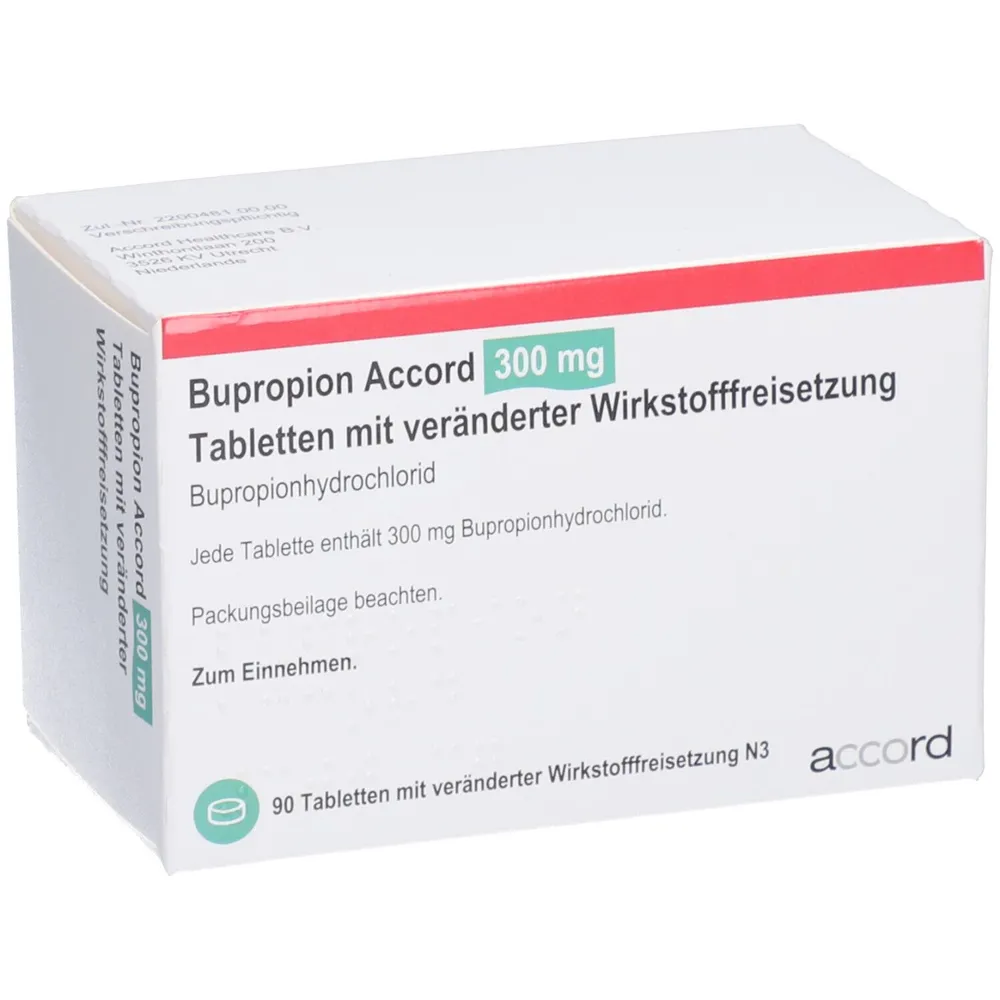
Table of Contents
Package leaflet: Information for the patient
Bupropion Accord, 300 mg, modified-release tablets
Bupropion hydrochloride
Please read all of this leaflet carefully before taking this medicine because it contains
important information for you.
- Keep this leaflet. You may need to read it again.
- If you have any further questions, ask your doctor or pharmacist.
- This medicine has been prescribed for you only. Do not pass it on to others. It may harm them, even if their symptoms are the same as yours.
- If you experience any side effects, including any not listed in this leaflet, tell your doctor or pharmacist. See section 4.
Contents of the leaflet:
- What Bupropion Accord is and what it is used for
- What you need to know before you take Bupropion Accord
- How to take Bupropion Accord
- Possible side effects
- How to store Bupropion Accord
- Contents of the pack and other information
1. What Bupropion Accord is and what it is used for
Bupropion Accord is a prescription medicine used to treat depression. It works on chemical substances in the brain called noradrenaline and dopamine, which are involved in depression.
2. Important information before using Bupropion Accord
When not to use Bupropion Accord:
- if the patient is allergic to bupropion or to any of the other ingredients of this medicine (listed in section 6);
- if the patient is taking any other medicines containing bupropion;
- if the patient suffers from epilepsy or has had seizures;
- if the patient has or has previously had eating disorders (e.g. bulimia or mental anorexia - anorexia nervosa);
- if the patient has a brain tumour;
- if the patient is an alcohol abuser who has recently stopped drinking alcohol or intends to do so;
- if the patient has severe liver disease;
- if the patient has recently stopped taking sedative medicines or intends to stop them during treatment with Bupropion Accord;
- if the patient is taking or has taken within the last two weeks antidepressant medicines known as monoamine oxidase inhibitors (MAO inhibitors).
If any of the above situations apply to the patient, contact the doctor immediately,
do not take Bupropion Accord.
Warnings and precautions
Before starting treatment with Bupropion Accord, discuss this with your doctor or pharmacist.
Brugada syndrome
- if the patient has a condition called Brugada syndrome (a rare inherited condition affecting heart rhythm) or if there has been cardiac arrest or sudden death in the patient’s family.
Children and adolescents
Bupropion Accord is not recommended for use in children under 18 years of age.
In children under 18 years of age treated with antidepressant medicines, there is an increased risk
of suicidal thoughts and behaviours.
Adults
Inform your doctor before starting treatment with Bupropion Accord:
- if the patient regularly drinks large amounts of alcohol,
- if the patient has diabetes and is using insulin or oral antidiabetic medicines,
- if the patient has previously had a serious head injury or head trauma.
Bupropion Accord may cause seizures in approximately 1 in 1000 patients. The occurrence of this
adverse effect is more likely in patients from the groups listed above. If seizures occur during
treatment, discontinue use of Bupropion Accord.
Do not take more of this medicine and contact your doctor.
- If the patient has bipolar disorder (extreme mood swings), because Bupropion Accord may trigger an episode of this disorder.
- If the patient is taking other medicines used to treat depression, concomitant use of these medicines with Bupropion Accord may lead to serotonin syndrome, a potentially life-threatening condition (see "Bupropion Accord with other medicines" in this section).
- If the patient has liver or kidney disease, because adverse effects may be more likely.
If any of the above situations apply to the patient, contact the doctor again before starting
treatment with Bupropion Accord. The doctor may decide that treatment should be conducted under
close supervision or recommend alternative treatment.
Suicidal thoughts and worsening of depression symptoms
Patients with depression may sometimes experience thoughts of self-harm or suicide. These
behaviours may worsen when the patient starts taking antidepressant medicines, as it takes time
before these medicines start to work, usually about two weeks, but sometimes longer.
Such thoughts may be more common:
- if the patient previously had suicidal thoughts or thoughts of self-harm.
- if the patient is a young adult. Clinical trials have shown an increased risk of suicidal behaviour in adults (under 25 years of age) with psychiatric disorders who were treated with antidepressant medicines.
If thoughts of self-harm or suicide occur at any time, contact the doctor immediately or go to
hospital.
It may be helpful to inform a relative or friend that the patient has depression and ask them to read
this leaflet. The patient may ask them to inform him or her if they think the patient's depression is
worsening or if changes in behaviour become concerning.
Bupropion Accord with other medicines
If the patient is currently taking or has taken within the last fourteen days other antidepressant
medicines known as monoamine oxidase inhibitors (MAO inhibitors), contact the doctor immediately
without taking Bupropion Accord (see also: When not to take Bupropion Accord, section 2).
Tell your doctor or pharmacist about all medicines currently or recently taken,
including those the patient plans to take, as well as herbal remedies or vitamins, even those
purchased without a prescription. The doctor may adjust the dose of Bupropion Accord, recommend
changing the dosing regimen, or discontinuing other medicines.
Some medicines must not be taken together with Bupropion Accord. Some of them may increase
the risk of seizures or convulsions. Other medicines may increase the risk of other adverse effects.
Examples of such medicines are listed below, but this is not a complete list.
Seizures may occur more frequently than usual:
- if the patient is taking other antidepressants or medicines used to treat psychiatric disorders,
- if the patient is taking theophylline, a medicine for asthma or lung disease,
- if the patient is taking tramadol, a strong painkiller,
- if the patient has recently taken or is currently taking sedative medicines or intends to stop taking them during treatment with Bupropion Accord (see also When not to take Bupropion Accord, section 2),
- if the patient is taking antimalarial medicines (such as mefloquine or chloroquine),
- if the patient is taking stimulant medicines or other medicines controlling body weight or appetite,
- if the patient is taking steroids (orally or by injection),
- if the patient is taking antibiotics known as quinolones,
- if the patient is taking certain types of antihistamines that may cause drowsiness,
- if the patient is taking antidiabetic medicines.
If any of the above situations apply to the patient, contact the doctor immediately before starting
treatment with Bupropion Accord. The doctor will assess the risks and benefits of using Bupropion
Accord.
The likelihood of other adverse effects may increase:
- if the patient is taking other antidepressants (such as amitriptyline, fluoxetine, paroxetine, citalopram, escitalopram, venlafaxine, dosulepin, desipramine or imipramine) or medicines for other psychiatric disorders (such as clozapine, risperidone, thioridazine or olanzapine). Bupropion Accord may interact with medicines used to treat depression and the patient may experience changes in mental state (e.g. agitation, hallucinations, coma), and other symptoms such as body temperature above 38°C, rapid heartbeat, unstable blood pressure, increased reflexes, muscle rigidity, lack of coordination, and/or gastrointestinal disturbances (e.g. nausea, vomiting, diarrhoea).
- if the patient is taking medicines used to treat Parkinson's disease (levodopa, amantadine, orphenadrine),
- if the patient is taking medicines that affect the metabolism of Bupropion Accord (carbamazepine, phenytoin, valproic acid),
- if the patient is taking certain medicines used to treat malignant tumours (such as cyclophosphamide, ifosfamide),
- if the patient is taking ticlopidine or clopidogrel, mainly used to prevent stroke,
- if the patient is taking β-blockers (such as metoprolol),
- if the patient is taking certain medicines for irregular heart rhythm (propafenone and flecainide),
- if the patient is using nicotine patches as an aid to stop smoking.
If any of the above situations apply to the patient, contact the doctor immediately before starting
treatment with Bupropion Accord.
Bupropion Accord may be less effective:
- If the patient is taking ritonavir or efavirenz, medicines used to treat HIV infections.
If this applies to the patient, inform the doctor.
The doctor will assess the effectiveness of Bupropion Accord in the patient. It may be necessary to
increase the dose or change the method of treating depression. Do not increase the dose of Bupropion
Accord without the doctor's recommendation, as this may increase the risk of adverse effects,
including seizures.
Bupropion Accord may reduce the effectiveness of certain medicines
- If the patient is taking tamoxifen, used to treat breast cancer.
If this applies to the patient, tell the doctor. It may be necessary to change the method of treating
depression.
- If the patient is taking digoxin for heart problems.
If this applies to the patient, tell the doctor. The doctor may consider adjusting the dose of digoxin.
Bupropion Accord and alcohol
Alcohol may affect the action of Bupropion Accord and taking them together may, although rarely,
cause nervousness or change the mental state. Some patients become more sensitive to alcohol while
taking Bupropion Accord. The doctor may recommend abstaining from alcohol (beer, wine, spirits) or
significantly reducing alcohol consumption during treatment with Bupropion Accord.
If the patient currently drinks large amounts of alcohol, do not suddenly stop drinking, as this may
trigger a seizure.
Talk to the doctor about alcohol consumption before starting treatment with Bupropion Accord.
Effect on urine tests
Bupropion Accord may affect laboratory test results for the presence of other drugs. If the patient
is undergoing such a test, inform the doctor or nurse that he or she is taking Bupropion Accord.
Pregnancy and breastfeeding
Do not take Bupropion Accord during pregnancy, if there is suspicion of pregnancy, or if planning
pregnancy, unless otherwise advised by a doctor. Consult a doctor or pharmacist before taking any
medicine during pregnancy. Some, but not all, studies indicate an increased risk of congenital
malformations, particularly heart defects, in children whose mothers took Bupropion Accord. It is
unknown whether this was caused by taking this medicine.
The ingredients of Bupropion Accord may pass into breast milk. Consult a doctor or pharmacist
before using Bupropion Accord.
Driving and using machines
If Bupropion Accord causes dizziness or a feeling of emptiness in the head, do not drive or operate
machinery.
3. How to use Bupropion Accord
This medicine should always be taken exactly as directed by your doctor or pharmacist. Your doctor will determine the dose individually for you. If in doubt, consult your doctor or pharmacist.
Improvement in the patient's condition may take some time. The full effect of the medicine may not become apparent until several weeks or months have passed. Even when the patient starts to feel better, the doctor may recommend continuing treatment with Bupropion Accord to prevent recurrence of depression.
What dose should be taken
Only Bupropion Accord 300 mg tablets are available. To achieve a dose of 150 mg, another bupropion-containing medicine available on the market should be used.
The usual recommended dose for adults is one 150 mg tablet once daily.
Your doctor may increase the dose to 300 mg once daily if there is no improvement after several weeks of treatment.
The dose of Bupropion Accord should be taken in the morning. Do not take Bupropion Accord more frequently than once daily.
The tablet is coated with a special layer that slowly releases the active substance into the gastrointestinal tract. You may notice something in your stool that looks like a whole tablet. This is the empty coating, which has been eliminated from the body.
Bupropion Accord tablets must be swallowed whole. Do not chew, crush, or divide them – doing so may lead to overdose due to too rapid release of the medicine into the body. This may increase the risk of adverse effects, including seizures.
For some patients, a dose of 150 mg once daily may be sufficient throughout treatment. Your doctor may recommend this dose if you have liver or kidney disease.
How long to continue treatment
Only your doctor, together with you, can decide how long treatment with Bupropion Accord should continue. It may take weeks or even months before any improvement is observed. You should regularly discuss your depressive symptoms with your doctor to determine the appropriate duration of treatment. Even if you start to feel better, your doctor may recommend continuing Bupropion Accord to prevent depression from returning.
Taking more Bupropion Accord than prescribed
Taking too many tablets may cause seizures or a seizure attack. Do not delay. Contact your doctor or go to the nearest hospital emergency department immediately.
If you miss a dose of Bupropion Accord
If you miss a dose, wait until the next scheduled time to take the next dose. Do not take a double dose to make up for the missed dose.
Stopping Bupropion Accord treatment
Do not stop taking Bupropion Accord or reduce the dose without first discussing it with your doctor.
If you have any further questions about the use of this medicine, consult your doctor or pharmacist.
4. Possible adverse effects
Like all medicines, this medicine can cause adverse effects, although not everyone will experience them.
Serious adverse effects
Seizures or epileptic fits
Seizures (epileptic fits or convulsions) may occur in approximately 1 in 1,000 patients taking Bupropion Accord. The likelihood is higher in patients taking doses exceeding the recommended dose, taking certain other medicines, or belonging to a group at increased risk of seizures. If in doubt, consult your doctor.
If a seizure occurs, contact your doctor immediately. Do not take the medicine again.
Allergic reactions
Some patients may experience allergic reactions to Bupropion Accord. These include:
- skin redness or rash (such as maculopapular rash), blisters, or itchy lumps (urticaria) on the skin; some rashes may require hospitalization, especially if mouth pain or eye pain also occur,
- unusual wheezing or difficulty breathing,
- swelling of the eyelids, lips, or tongue,
- muscle or joint pain,
- collapse or brief loss of consciousness.
If any symptoms of an allergic reaction occur, contact your doctor immediately. Do not take the medicine again.
Allergic reactions may be prolonged. If your doctor has prescribed medication to relieve allergic symptoms, complete the full course of treatment.
Drug-induced lupus erythematosus or worsening of lupus symptoms
Frequency unknown – cannot be estimated from available data.
Lupus is an autoimmune disorder affecting the skin and other organs. If lupus flares, skin rash, or skin lesions (particularly on areas of skin exposed to sunlight) occur while taking Bupropion Accord, contact your doctor immediately, as discontinuation of treatment may be necessary.
Acute generalized exanthematous pustulosis
Frequency unknown – frequency cannot be estimated from available data in patients taking Bupropion Accord. Symptoms of acute generalized exanthematous pustulosis include
skin rash with pustules/blisters filled with pus.
If a skin rash with pustules/blisters filled with pus occurs, contact your doctor immediately, as discontinuation of treatment may be necessary.
Other adverse effects
Very common adverse effects: may affect more than 1 in 10 patients.
- difficulty sleeping; ensure Bupropion Accord is taken in the morning,
- headache,
- dry mouth,
- nausea, vomiting.
Common adverse effects: may affect up to 1 in 10 patients.
- fever, dizziness, itching, sweating, skin rash (sometimes due to allergic reaction),
- chills, tremors, weakness, fatigue, chest pain,
- feeling of anxiety or agitation,
- abdominal pain or other gastrointestinal disturbances (constipation), altered taste sensation, loss of appetite (anorexia),
- increased blood pressure, sometimes marked, facial flushing,
- ringing in the ears, visual disturbances.
Uncommon adverse effects: may affect up to 1 in 100 patients.
- feeling of depression (see also section 2: Warnings and precautions),
- feeling of disorientation,
- difficulty concentrating,
- increased heart rate,
- weight loss.
Rare adverse effects: may affect up to 1 in 1,000 patients.
- seizures.
Very rare adverse effects: may affect up to 1 in 10,000 patients.
- palpitations, fainting,
- muscle twitching, muscle stiffness, uncontrolled movements, problems with walking or coordination,
- feeling of restlessness, irritability, hostility, aggression, strange dreams, tingling or numbness, memory loss,
- yellowing of the skin or whites of the eyes (jaundice), which may be due to increased liver enzyme activity, hepatitis,
- severe allergic reactions; rash accompanied by muscle and joint pain,
- changes in blood sugar levels,
- urinating more or less frequently than usual,
- urinary incontinence (involuntary urination, uncontrolled leakage of urine),
- severe skin reactions, which may involve the mouth and other body parts and may be life-threatening,
- worsening of psoriasis (red, thickened skin patches),
- unusual hair loss or thinning (alopecia),
- feeling of unreality or detachment (depersonalization), seeing or hearing things that are not there (hallucinations), experiencing or believing in unreal things (delusions), excessive suspiciousness (paranoia).
Frequency unknown:
Other adverse effects have occurred in an unknown, although small, number of patients:
- thoughts of self-harm or suicide during treatment with Bupropion Accord or shortly after stopping it (see section 2 "Important information before taking Bupropion Accord"). If such thoughts occur, contact your doctor or go to hospital immediately.
- loss of touch with reality and impaired thinking or judgment (psychosis); other symptoms may include hallucinations and (or) delusions.
- feeling of sudden and intense fear (panic attack)
- stuttering
- reduced number of red blood cells (anaemia), reduced number of white blood cells (leukopenia), and reduced number of platelets (thrombocytopenia).
- low sodium levels in the blood (hyponatremia).
- changes in mental state (e.g. agitation, hallucinations, coma), and other symptoms such as body temperature above 38°C, rapid heartbeat, unstable blood pressure, increased reflexes, muscle rigidity, lack of coordination, and (or) gastrointestinal disturbances (e.g. nausea, vomiting, diarrhoea) while taking Bupropion Accord together with medicines used to treat depression (such as paroxetine, citalopram, escitalopram, fluoxetine, and venlafaxine).
Reporting of adverse effects
If any adverse effects occur, including any not listed in this leaflet, inform your doctor or pharmacist. Adverse effects can be reported directly to the Department of Monitoring Adverse Drug Reactions at the Office for Registration of Medicinal Products, Medical Devices and Biocidal Products
Al. Jerozolimskie 181C
02-222 Warsaw
Phone: +48 22 49 21 301
Fax: +48 22 49 21 309
Website: https://smz.ezdrowie.gov.pl
Adverse effects can also be reported to the marketing authorization holder.
Reporting adverse effects helps provide more information on the safety of this medicine.
5. How to store Bupropion Accord
Keep this medicine out of the sight and reach of children.
Do not use this medicine after the expiry date stated on the blister pack and carton after: EXP.
The expiry date refers to the last day of the stated month.
No special storage conditions are required for this medicine.
Medicines should not be disposed of via wastewater or household waste. Ask your pharmacist how to dispose of medicines you no longer use. This will help protect the environment.
6. Contents of the pack and other information
What Bupropion Accord contains
The active substance is bupropion hydrochloride.
Each tablet contains 300 mg of bupropion hydrochloride.
The other ingredients are:
Tablet core: povidone K90, cysteine hydrochloride monohydrate, colloidal silicon dioxide anhydrous, glycerol dibehenate, magnesium stearate
Coating: ethylcellulose 100 mPas, povidone K90, macrogol 1450, methacrylic acid and ethyl acrylate copolymer (1:1), dispersion 30% (containing sodium lauryl sulfate and polysorbate 80), colloidal silicon dioxide hydrated, triethyl citrate.
Ink: shellac, iron oxide black (E 172), propylene glycol.
What Bupropion Accord looks like and contents of the pack
Bupropion Accord is cream-white to light yellow, round tablets, printed with "GS2" on one side and smooth on the other.
The diameter of the tablet is approximately 9.3 mm.
The medicine is packed in blisters made of OPA/Aluminum/PVC/Aluminium.
Pack sizes: 7, 30, 60, 90 tablets.
Or unit-dose blisters OPA/Aluminum/PVC/Aluminium.
Pack size: 30 x 1 tablet.
Not all pack sizes may be marketed.
Marketing Authorisation Holder:
Accord Healthcare Polska Sp. z o.o.
Taśmowa Street 7
02-677 Warsaw
Tel: +48 22 577 28 00
Manufacturer/Importer:
Accord Healthcare Limited
Sage House, 319 Pinner Road
North Harrow, Middlesex, HA1 4HF
United Kingdom
Laboratori Fundació Dau
C/C, 12-14 Pol. Industrial Zona Franca
08040 Barcelona
Spain
Accord Healthcare Polska Sp. z o.o.
Lutomierska Street 50
95-200 Pabianice
Poland
Accord Healthcare Single Member S.A.
64th Km National Road Athens, Lamia, 32009, Greece
This medicinal product is authorised in the European Economic Area countries under the following names:
| Member State | Name of the medicinal product |
| Austria | Bupropion Accord 300 mg prolonged-release tablets |
| Italy | Bupropione Accord |
| Netherlands | Bupropion Hcl Accord 300 mg tablets with prolonged release |
| Germany | Bupropion Accord 300 mg prolonged-release tablets |
| Finland | Bupropion Accord 300 mg prolonged-release tablet |
| Norway | Paritdam |
| Poland | Bupropion Accord |
| Sweden | Bupropion Accord |
| Slovenia | Bupropion Accord 300 mg tablets with prolonged release |