Bisoprolol vitabalans
Poland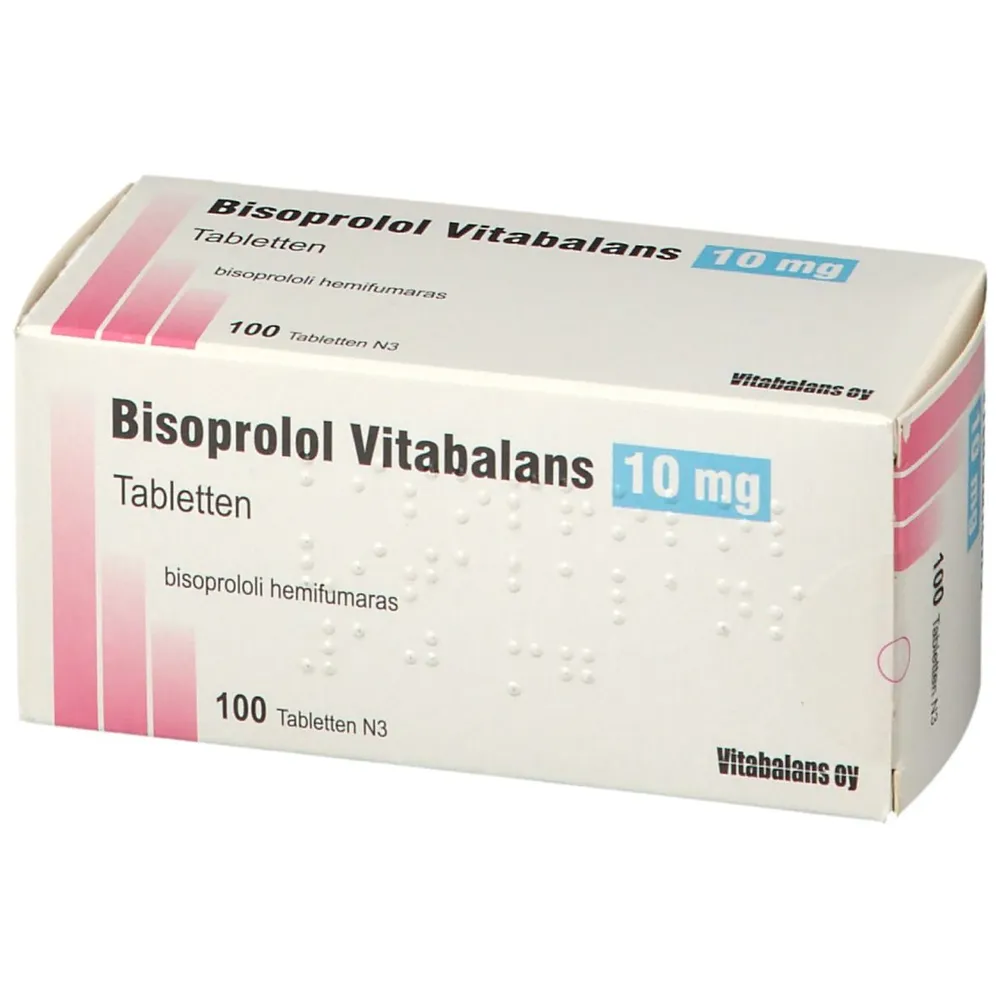
Table of Contents
Bisoprolol Vitabalans 5 mg tablets
Bisoprolol Vitabalans 10 mg tablets
bisoprolol hemifumarate
Please read the entire leaflet before taking this medicine.
- Keep this leaflet, as you may need to read it again.
- Consult your doctor or pharmacist if you need advice or further information.
- This medicine has been prescribed for a specific individual and must not be given to others, as it may harm them even if their symptoms are similar.
- If any of the side effects worsen or if any side effects not listed in this leaflet occur, inform your doctor or pharmacist.
Contents of the leaflet:
- What Bisoprolol Vitabalans is and what it is used for
- Important information before taking Bisoprolol Vitabalans
- How to take Bisoprolol Vitabalans
- Possible side effects
- How to store Bisoprolol Vitabalans
- Other information
1. WHAT BISOPROLOL VITABALANS IS AND WHAT IT IS USED FOR
Bisoprolol Vitabalans contains bisoprolol, an active substance that selectively blocks beta-adrenergic receptors in the heart. Bisoprolol Vitabalans is used to treat high blood pressure and chest pain caused by insufficient oxygen supply to the heart muscle (angina pectoris).
2. IMPORTANT INFORMATION BEFORE TAKING BISOPROLOL VITABALANS
When not to take Bisoprolol Vitabalans
- if you are allergic (hypersensitive) to the active substance (bisoprolol) or to any of the excipients (see section 6 of the leaflet),
- if you have untreated heart failure (causing breathlessness or worsening swelling),
- if you have very low blood pressure (systolic pressure, i.e. the "upper" number, below 100 mmHg), which may cause dizziness or fainting,
- if you have a very slow heart rate (less than 45 to 50 beats per minute),
- if you have conduction disorders in the heart (such as sick sinus syndrome or atrioventricular block), unless a pacemaker has been implanted,
- if you have severe asthma or chronic obstructive pulmonary disease (COPD),
- if you have severe circulatory disorders in the limbs, such as intermittent claudication (pain or cramps in the legs during exercise or walking due to poor blood circulation) or Raynaud's syndrome (pallor, blueness, and redness of fingers or toes accompanied by pain),
- if you have metabolic acidosis (e.g. in diabetic patients when blood glucose levels are too high),
- if you have untreated adrenal gland disorder called phaeochromocytoma, or
- if you are taking medications containing floctafene (a non-steroidal anti-inflammatory drug (NSAID) used to treat pain) or sultopride (a medicine used in the treatment of psychiatric disorders such as psychosis).
When to exercise special caution with Bisoprolol Vitabalans
- if you have heart failure (inability of the heart to pump enough blood to meet the body's needs),
- if you have mild (first-degree) atrioventricular heart block,
- if you have chest pain caused by coronary artery spasm (Prinzmetal's angina or vasospastic angina),
- if you have asthma or chronic obstructive pulmonary disease (COPD) (if bronchodilator medicines are used, a higher dose may be required),
- if you have diabetes (Bisoprolol Vitabalans may mask symptoms, and adjustment of antidiabetic medication may be necessary),
- if you have hyperthyroidism (Bisoprolol Vitabalans may mask symptoms),
- if you are undergoing desensitization therapy, e.g. for insect stings (allergic reactions may be more severe and higher doses of medication may be needed to control them),
- if you are scheduled for radiological examination using iodinated contrast agents,
- if you have psoriasis (Bisoprolol Vitabalans may worsen symptoms),
- if you are fasting, or
- if you are scheduled for anti-doping testing (Bisoprolol Vitabalans may cause a positive test result).
If you are scheduled for surgery under general, spinal, or epidural anaesthesia, inform the anaesthesiologist that you are taking Bisoprolol Vitabalans.
Consult your doctor before taking Bisoprolol Vitabalans if you have any of the conditions or situations listed above.
If treatment with Bisoprolol Vitabalans needs to be discontinued, it should be done gradually.
Do not stop treatment or change the dose of Bisoprolol Vitabalans without consulting your doctor.
Taking Bisoprolol Vitabalans with other medicines
Inform your doctor about all medicines you are currently taking, including those obtained without a prescription, herbal preparations, or natural products.
In particular, inform your doctor if you are taking any of the following medicines:
- floctafene (a painkiller) or sultopride (an antipsychotic) – Bisoprolol Vitabalans must not be used in combination with these medicines,
- calcium channel blockers used for hypertension and heart conditions, such as bepridil, diltiazem, verapamil, amlodipine, felodipine, nifedipine, or lercanidipine,
- clonidine, methyldopa, moxonidine, guanfacine, or rilmenidine (used for hypertension),
- antiarrhythmic drugs (such as amiodarone, disopyramide, or quinidine),
- digoxin or other so-called digitalis glycosides (used in the treatment of heart failure),
- other antihypertensive medicines or nitrates used to treat chest pain – increased blood pressure-lowering effect,
- other beta-blockers (even eye drops containing, for example, timolol or betaxolol),
- medicines used to treat diabetes (insulin and oral antidiabetic agents),
- ergotamine derivatives (used to treat migraine or low blood pressure),
- so-called acetylcholinesterase inhibitors such as donepezil, galantamine, rivastigmine, or tacrine (used to treat dementia), pyridostigmine or neostigmine (used to treat myasthenia gravis), physostigmine (used to treat elevated intraocular pressure, glaucoma),
- so-called MAO inhibitors such as moclobemide or phenelzine (used to treat depression),
- so-called tricyclic antidepressants (used to treat depression), phenothiazine derivatives (used to treat psychosis), or barbiturates (used to treat epilepsy) – these medicines may also lower blood pressure,
- amifostine (a protective agent used during chemotherapy or radiotherapy),
- baclofen (a muscle relaxant),
- mefloquine (an antimalarial agent),
- oral corticosteroids (cortisone in tablet form), or
- anti-inflammatory and pain-relieving medicines (so-called non-steroidal anti-inflammatory drugs – NSAIDs) used to treat pain and inflammation, such as acetylsalicylic acid, ibuprofen, or ketoprofen, when taken regularly and long-term – low daily doses of acetylsalicylic acid with antithrombotic effect (e.g. 50 or 100 mg) may be safely used with Bisoprolol Vitabalans.
Pregnancy and breastfeeding
Before taking any medicine, consult your doctor or pharmacist. Bisoprolol Vitabalans may affect the unborn child. For this reason, do not take Bisoprolol Vitabalans during pregnancy unless clearly necessary. Consult your doctor before using this medicine during pregnancy.
It is not known whether Bisoprolol Vitabalans passes into breast milk. Therefore, breastfeeding is not recommended during treatment with Bisoprolol Vitabalans. Always consult your doctor.
Driving and operating machinery
Your ability to drive or operate machinery may be impaired. Bisoprolol Vitabalans may cause side effects related to low blood pressure, such as dizziness or fatigue (see section 4 of the leaflet). Side effects are more likely at the beginning of treatment, after increasing the dose, or when alcohol is consumed simultaneously. If you experience any side effects, do not drive or perform other activities requiring alertness.
3. HOW TO USE THE MEDICINE BISOPROLOL VITABALANS
The doctor will determine the dosage individually for each patient. The medicine Bisoprolol Vitabalans should always be used exactly as prescribed by the doctor. If in doubt, contact your doctor or pharmacist again.
The tablets should be swallowed with an adequate amount of liquid (e.g. one glass of water) during breakfast.
Do not chew the tablets. The tablet may be divided into equal doses.
The usual initial dose for adults is 5 mg once daily. Your doctor may increase the dose to 10 mg once daily if necessary. In exceptional cases, the daily dose may be increased up to 20 mg. In patients with mild arterial hypertension, the doctor may start treatment with half a 5 mg tablet (2.5 mg).
In patients with severe renal or hepatic impairment, the maximum daily dose is 10 mg of bisoprolol.
Due to insufficient experience with the use of Bisoprolol Vitabalans in children and adolescents under 18 years of age, its use is not recommended in this age group.
Use of a higher than recommended dose of Bisoprolol Vitabalans
In case of overdose or poisoning, seek immediate medical attention by contacting a doctor or going to an emergency department at a hospital.
Activated charcoal should be administered to reduce absorption of bisoprolol.
If you have any doubts regarding the use of the medicine, consult your doctor or pharmacist.
Missed dose of Bisoprolol Vitabalans
Take the next tablet at the usual time. Do not take a double or higher dose to make up for a missed dose.
Stopping treatment with Bisoprolol Vitabalans
Abrupt discontinuation of Bisoprolol Vitabalans may lead to a dangerous worsening of symptoms. This is particularly relevant for patients with angina pectoris.
Therefore, treatment with Bisoprolol Vitabalans should not be stopped suddenly. The dose should be tapered gradually. If you wish to discontinue treatment, consult your doctor.
If you have any doubts regarding the use of the medicine, consult your doctor or pharmacist.
4. POSSIBLE ADVERSE REACTIONS
Like all medicines, Bisoprolol Vitabalans may cause adverse reactions, although not everyone experiences them.
The following adverse reactions have been reported:
Common (may occur in less than 1 in 10, but more than 1 in 100 patients):
- fatigue, dizziness, and headaches (especially at the beginning of treatment; these are usually mild and subside within 1–2 weeks),
- cold sensation or numbness in the extremities, worsening of Raynaud's syndrome (pallor, cyanosis, and redness of fingers or toes accompanied by pain), or worsening of intermittent claudication (pain or cramps in the legs during exercise or walking),
- nausea, vomiting, abdominal pain, diarrhoea, or constipation.
Uncommon (may occur in less than 1 in 100, but more than 1 in 1,000 patients):
- depression or sleep disturbances,
- too slow heart rate, disturbances in cardiac conduction, or worsening of heart failure (shortness of breath and increasing limb oedema),
- dizziness or fainting upon standing (orthostatic hypotension),
- bronchospasm (difficulty breathing) in patients with asthma or chronic obstructive pulmonary disease,
- muscle weakness, muscle cramps, or joint pain,
- asthenia (weakness, loss of strength).
Rare (may occur in less than 1 in 1,000, but more than 1 in 10,000 patients):
- allergic rhinitis,
- lupus-like syndrome (appearance of antinuclear antibodies in blood, fever, muscle or joint pain, vasculitis, and skin changes),
- nightmares or hallucinations,
- fainting,
- reduced tear secretion, which may cause dryness of the conjunctiva (contact lens wearers should take this into account),
- hearing disturbances,
- increased blood triglyceride levels or decreased blood glucose levels,
- increased activity of liver enzymes (AlAT, AspAT) in blood,
- hepatitis (usually causing upper abdominal pain),
- allergic skin reactions (itching, redness, rash),
- disturbances of potency (impotence).
Very rare (may occur in less than 1 in 10,000 patients):
- conjunctivitis (redness and irritation of the eyes),
- induction or exacerbation of psoriasis,
- alopecia (hair loss).
Reporting of adverse reactions
If any adverse symptoms occur, including any not listed in this leaflet, inform your doctor, pharmacist, or nurse. Adverse reactions can be reported directly to:
Department of Monitoring of Adverse Drug Reactions
Office for Registration of Medicinal Products, Medical Devices and Biocidal Products
Al. Jerozolimskie 181C
PL-02 222 Warsaw
Tel.: +48 22 49 21 301
Fax: +48 22 49 21 309
Website: https://smz.ezdrowie.gov.pl
Reporting adverse reactions helps to provide more information on the safety of the medicine.
5. HOW TO STORE BISOPROLOL VITABALANS
Do not store above 30 °C.
Keep out of the reach and sight of children.
Do not use Bisoprolol Vitabalans after the expiry date stated on the packaging.
The expiry date refers to the last day of the stated month.
Medicines should not be disposed of via wastewater or household waste. Ask your pharmacist
how to dispose of medicines no longer required. This will help protect the environment.
6. OTHER INFORMATION
What Bisoprolol Vitabalans contains
The active substance is bisoprolol hemifumarate.
Bisoprolol Vitabalans 5 mg: Each tablet contains 5 mg of bisoprolol hemifumarate, equivalent to 4.2 mg of bisoprolol.
Bisoprolol Vitabalans 10 mg: Each tablet contains 10 mg of bisoprolol hemifumarate, equivalent to 8.5 mg of bisoprolol.
The other ingredients are: microcrystalline cellulose, calcium hydrogen phosphate dihydrate, magnesium stearate.
Bisoprolol Vitabalans 10 mg also contains iron oxide yellow (E172).
What Bisoprolol Vitabalans looks like and contents of the pack
Bisoprolol Vitabalans 5 mg: white, round, convex tablets with a score line. Diameter is 8 mm.
Bisoprolol Vitabalans 10 mg: beige, mottled, round, convex tablets with a score line. Diameter is 8 mm.
The tablet can be divided into equal doses.
Pack sizes: 10, 20, 28, 30, 50, 56, 60, 90 and 100 tablets (PVC/PVDC/Aluminium blister or PVC/Aluminium blister in a cardboard box).
Not all pack sizes may be marketed.
Marketing Authorisation Holder and Manufacturer
Vitabalans Oy
Varastokatu 8
13500 Hämeenlinna
Finland
Tel.: +358 (3) 615600
Fax: +358 (3) 6183130
This medicinal product is authorised in the European Economic Area countries under the following names:
Bisoprolol Vitabalans (CZ, DE, DK, EE, FI, HU, LT, LV, NO, PL, SE, SK)