Bisoprolol
Poland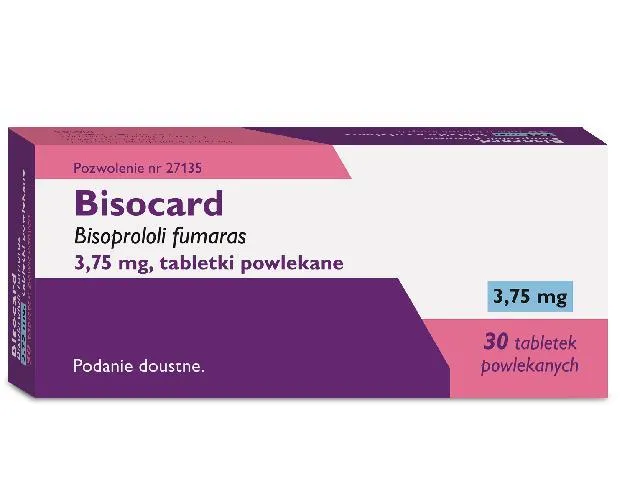
Table of Contents
PACKAGE LEAFLET: INFORMATION FOR THE PATIENT
Warning! Keep this leaflet – information on the immediate packaging is in a foreign language!
Bisocard,
5 mg, film-coated tablets
Bisoprolol fumarate
Please read this leaflet carefully before using the medicine, as it contains
important information for the patient.
- Keep this leaflet so that you can read it again if necessary.
- If you have any doubts, consult your doctor or pharmacist.
- This medicine has been prescribed for a specific individual. Do not pass it on to others. This medicine may harm another person, even if their symptoms appear identical.
- If any adverse reactions occur in the patient, including any adverse reactions not listed in this leaflet, inform your doctor or pharmacist immediately. See section 4.
Table of contents of the leaflet
- What Bisocard is and what it is used for
- Important information before taking Bisocard
- How to take Bisocard
- Possible side effects
- How to store Bisocard
- Contents of the pack and other information
1. What Bisocard is and what it is used for
Bisocard is a medicine that selectively blocks beta-adrenergic receptors (present, among others, in the heart and blood vessels). It has beneficial effects, particularly in patients with heart failure and symptomatic systolic dysfunction, by protecting the heart from excessive activity.
Bisocard is used in the treatment of:
- arterial hypertension;
- angina pectoris (chest pain due to insufficient oxygen supply to the heart);
- stable, moderate to severe chronic heart failure with impaired left ventricular systolic function (ejection fraction ≤ 35% as assessed by echocardiography), in combination with ACE inhibitors (angiotensin-converting enzyme inhibitors), diuretics, and, if necessary, digitalis glycosides.
2. Important information before using Bisocard
When not to use Bisocard:
- if the patient is allergic to bisoprolol fumarate or any of the other ingredients of this medicine (listed in section 6);
- if the patient has been diagnosed with cardiogenic shock – a severe heart condition characterized by rapid, weak pulse, low blood pressure, cold and clammy skin, weakness, and fainting;
- if the patient has severe bronchial asthma or severe chronic obstructive pulmonary disease (COPD);
- if the patient has a slow heart rate (less than 60 beats per minute) – in case of doubt, consult a doctor;
- if the patient has very low blood pressure;
- if the patient has severe circulatory disorders in the limbs (which may cause tingling, paleness, or blueness of fingers and toes);
- if the patient has heart rhythm disorders – slow or irregular heartbeat;
- if the patient has developed acute heart failure or existing heart failure has worsened, requiring intravenous administration of drugs that increase the force of heart contractions;
- if the patient is concurrently using floctafénine (a non-steroidal anti-inflammatory drug) or sultopride (a medicine used to treat psychiatric disorders);
- if the patient has metabolic acidosis (a condition in which blood pH is too low);
- if the patient has been diagnosed with a pheochromocytoma (a chromaffin tumour of the adrenal medulla) that is untreated.
Warnings and precautions
Before starting treatment with Bisocard, consult a doctor:
- if the patient has mild bronchial asthma or chronic obstructive pulmonary disease – bronchodilators should be used concomitantly, and their dose may need to be increased;
- if the patient has diabetes – Bisocard may mask symptoms of hypoglycaemia (low blood glucose levels);
- if the patient is on a strict diet;
- if the patient has first-degree atrioventricular block (a heart conduction disorder);
- if the patient has Prinzmetal's angina (chest pain caused by spasm of the coronary arteries supplying blood to the heart muscle);
- if the patient has mild circulatory disorders in the limbs;
- if the patient has thyroid dysfunction (bisoprolol may mask some symptoms of hyperthyroidism, such as rapid heartbeat);
- if the patient has a chromaffin tumour (pheochromocytoma) – prior to prescribing Bisocard, the doctor must initiate appropriate treatment;
- if the patient has (or has had in the past) psoriasis (a recurrent disease characterized by reddish-brown patches and skin scaling);
- if the patient has ever experienced allergic reactions – Bisocard may increase sensitivity to substances causing allergic reactions (allergens) and may intensify allergic reactions;
- if the patient is scheduled for allergen immunotherapy (treatment aimed at reducing allergy, e.g. to bee or wasp stings);
- if the patient is scheduled for surgery – Bisocard may alter the body's response to administered drugs.
Treatment of heart failure with Bisocard requires regular medical monitoring. This is absolutely essential, particularly at the beginning of treatment, during dose escalation, and when discontinuing treatment.
Consult a doctor if any of the warnings described above apply to the patient or applied in the past.
Children and adolescents
Due to lack of experience with the use of bisoprolol in children and adolescents, its use is not recommended in this age group.
Bisocard and other medicines
Inform your doctor or pharmacist about all medicines currently or recently taken, as well as any medicines the patient plans to take.
The doctor will not prescribe Bisocard if the patient is taking the following medicines:
- floctafénine (a non-steroidal anti-inflammatory drug) or sultopride (a medicine used to treat psychiatric disorders).
Do not take the following medicines together with Bisocard without specific medical advice:
- certain medicines used to treat heart rhythm disorders (class I antiarrhythmics such as quinidine, disopyramide, lidocaine, phenytoin, flecainide, propafenone);
- certain medicines used to treat high blood pressure, angina, or heart rhythm disorders (calcium antagonists such as verapamil and diltiazem);
- certain medicines used to treat high blood pressure, such as clonidine, methyldopa, moxonidine, rilmenidine. However, do not stop taking these medicines without consulting your doctor.
Before taking any of the following medicines together with Bisocard, talk to your doctor – the doctor may recommend more frequent monitoring of the patient's condition:
-
certain medicines used to treat high blood pressure or angina (calcium antagonists of the dihydropyridine group, such as felodipine and amlodipine);
-
certain medicines used to treat heart rhythm disorders (class III antiarrhythmics such as amiodarone);
-
locally applied beta-blockers (such as eye drops containing timolol, used in glaucoma treatment);
-
certain medicines used to treat, for example, Alzheimer's disease or glaucoma (parasympathomimetics such as donepezil or pilocarpine), or medicines used to treat acute heart conditions (sympathomimetics such as isoprenaline and dobutamine);
-
antidiabetic medicines, including insulin;
-
anaesthetics (e.g. during surgery);
-
digitalis glycosides used in the treatment of heart failure;
-
non-steroidal anti-inflammatory drugs (NSAIDs), used to treat inflammatory conditions and to relieve pain (e.g. ibuprofen and diclofenac);
-
all medicines that may lower blood pressure, either as a desired or adverse effect, such as antihypertensives, certain antidepressants (tricyclic antidepressants such as imipramine or amitriptyline), certain antiepileptic drugs or those used during general anaesthesia (barbiturates, e.g. phenobarbital), and certain antipsychotics used in disorders involving loss of contact with reality (phenothiazine derivatives, e.g. levomepromazine);
-
mefloquine, used for prevention and treatment of malaria;
-
medicines used to treat depression, called monoamine oxidase inhibitors, such as moclobemide (excluding MAO-B inhibitors); rifampicin (an antibiotic);
-
ergotamine derivatives (used to treat migraine).
Bisocard and alcohol
Alcohol may intensify dizziness and drowsiness caused by Bisocard. In such cases, alcohol consumption should be avoided.
Pregnancy and breastfeeding
There is a risk that using Bisocard during pregnancy may harm the unborn child.
If the patient is pregnant, breastfeeding, suspects she may be pregnant, or plans to become pregnant, she should consult a doctor or pharmacist before using this medicine. The doctor will decide whether Bisocard can be used during pregnancy.
It is not known whether bisoprolol passes into human milk; therefore, breastfeeding is not recommended during treatment with Bisocard.
Driving and operating machinery
Depending on the individual patient's response to treatment, the ability to drive or operate machinery may be impaired. This should be particularly considered at the beginning of treatment, after dose increase or change of medication, and when alcohol is consumed concurrently.
Bisocard contains monohydrate lactose
If the patient has previously been diagnosed with intolerance to certain sugars, the patient should consult a doctor before taking this medicine.
3. How to use Bisocard
This medicine should always be taken as directed by your doctor.
If in doubt, consult your doctor or pharmacist.
Tablets should be taken in the morning. They may be taken either during or before a meal. Swallow the tablets with liquid. Do not crush or chew them. Bisocard should be taken once daily, at the same time each day.
Hypertension and angina pectoris
The dose is individually determined by the doctor based on heart rate and treatment efficacy.
The recommended initial dose is 5 mg once daily. If necessary, the dose may be increased to 10 mg once daily. Your doctor may decide to increase or decrease this dose.
The maximum recommended dose is 20 mg once daily.
In some milder cases of hypertension, a dose of 2.5 mg once daily may be sufficient.
Discontinuation of Bisocard or dose reduction should be carried out gradually, especially in patients with ischemic heart disease.
Renal or hepatic impairment
In patients with severe renal or hepatic impairment, the maximum dose is 10 mg per day.
Elderly patients
Dose adjustment is usually not necessary.
Heart failure (reduced cardiac contractility)
Your doctor will start treatment with a low dose of bisoprolol and gradually increase it—your doctor will decide how to adjust the dose. Typically, this is done as follows:
- 1.25 mg bisoprolol once daily for 1 week
- 2.5 mg bisoprolol once daily for 1 week
- 3.75 mg bisoprolol once daily for 1 week
- 5 mg bisoprolol once daily for 4 weeks
- 7.5 mg bisoprolol once daily for 4 weeks
- 10 mg bisoprolol once daily for long-term (maintenance) treatment.
The maximum recommended daily dose is 10 mg bisoprolol.
Depending on how the medicine is tolerated, your doctor may recommend extending the interval before increasing the dose further. If symptoms worsen or if the medicine is not well tolerated, it may be necessary to reduce the dose again or discontinue treatment. In some patients, a maintenance dose lower than 10 mg bisoprolol may be sufficient. Your doctor will determine the appropriate course of action.
If treatment needs to be discontinued, your doctor will usually recommend gradually reducing the dose. Otherwise, the condition may worsen.
Hepatic or renal impairment
Your doctor will increase the dose particularly cautiously.
Elderly patients
Dose adjustment is usually not necessary.
Duration of treatment
Treatment with Bisocard is long-term. Continue taking this medicine for as long as your doctor advises.
Taking more Bisocard than recommended
If you take more than the recommended dose, contact your doctor immediately or go to the nearest hospital emergency department. Take any remaining tablets or this leaflet with you so that medical staff know which medicine has been taken. Symptoms of overdose may include dizziness, feeling faint, fatigue, shortness of breath, and/or wheezing. There may also be a slowed heart rate, hypotension, bronchospasm, acute heart failure, or seizures (caused by low blood glucose levels).
Missing a dose of Bisocard
Do not take a double dose to make up for a missed dose. If you forget to take your dose at the scheduled time, take it as soon as possible. However, if it is almost time for your next dose, skip the missed dose.
Stopping Bisocard
Do not stop taking Bisocard unless instructed by your doctor. Abruptly stopping this medicine may worsen the condition for which it was prescribed. Discontinuation of the medicine and dose reduction should be done gradually, especially in patients with ischemic heart disease.
If you have any further questions about the use of this medicine, consult your doctor or pharmacist.
4. Possible adverse reactions
Like any medicine, this medicine can cause adverse reactions, although not everyone will experience them.
The adverse reactions listed below are classified according to their frequency of occurrence as follows:
Very common (may occur in at least 1 in 10 people):
- slow heart rate (in patients with chronic heart failure).
Common (may occur in less than 1 in 10 people):
- dizziness, headache;
- worsening of heart failure (in patients with chronic heart failure);
- sensation of coldness or numbness in the extremities (hands or feet);
- gastrointestinal disturbances such as nausea, vomiting, diarrhoea, constipation;
- very low blood pressure (hypotension), especially in patients with heart failure;
- feeling of fatigue, exhaustion (asthenia) in patients with chronic heart failure.
Uncommon (may occur in less than 1 in 100 people):
- sleep disorders, depression;
- irregular heart rate or worsening of heart failure (in patients with hypertension or angina pectoris);
- slow heart rate (in patients with hypertension or angina pectoris);
- low blood pressure occurring upon changing position from lying or sitting to standing (orthostatic hypotension);
- bronchospasm in patients with bronchial asthma or obstructive respiratory disease;
- muscle weakness and muscle cramps;
- asthenia in patients with hypertension or angina pectoris.
Rare (may occur in less than 1 in 1,000 people):
- nightmares, hallucinations;
- fainting;
- dry eyes due to reduced tear production (which may be particularly bothersome in patients wearing contact lenses);
- hearing disturbances;
- allergic rhinitis;
- hepatitis;
- hypersensitivity reactions such as itching, sudden reddening of the skin, rash;
- reduced sexual function (impotence);
- increased levels of blood lipids (triglycerides) and increased activity of liver enzymes (AlAT, AspAT).
Very rare (may occur in less than 1 in 10,000 people):
- conjunctivitis;
- worsening of psoriasis symptoms or occurrence of similar dry, scaly rash;
- hair loss.
Reporting of adverse reactions
If any adverse reactions occur, including any not listed in this leaflet, inform your doctor or pharmacist. Adverse reactions can be reported directly to the Department of Monitoring Adverse Drug Reactions of the Office for Registration of Medicinal Products, Medical Devices and Biocidal Products,
Al. Jerozolimskie 181 C,
02-222 Warsaw,
Tel.: +48 22 49 21 301,
Fax: +48 22 49 21 309,
Website: https://smz.ezdrowie.gov.pl
Reporting adverse reactions helps to provide more information on the safety of the medicine.
5. How to store Bisocard
Store below 30°C. Store in the original packaging.
Keep the medicine in a place out of sight and reach of children.
Do not use this medicine after the expiry date stated on the packaging. The expiry date refers to the last day of the stated month.
Medicines must not be disposed of via wastewater or household waste. Ask your pharmacist how to dispose of medicines no longer required. Such measures will help protect the environment.
6. Contents of the packaging and other information
What Bisocard contains
- The active substance is bisoprolol fumarate. One coated tablet contains 5 mg of bisoprolol fumarate.
- Other ingredients are: lactose monohydrate (120 mg), corn starch, colloidal anhydrous silica, sodium lauryl sulfate, talc, magnesium stearate.
- Coating of the 5 mg coated tablet: hypromellose, polyethylene glycol 400, titanium dioxide (E 171), yellow iron oxide (E 172).
What Bisocard looks like and contents of the pack
Bisocard is a coated tablet.
Pack sizes:
30, 60 or 120 coated tablets.
For more detailed information, please contact the marketing authorisation holder or the parallel importer.
Marketing Authorisation Holder in Hungary, the country of export
Bausch Health Ireland Limited
3013 Lake Drive
Citywest Business Campus
Dublin 24, D24PPT3
Ireland
Manufacturer
ICN Polfa Rzeszów S.A.
Przemysłowa 2
35-959 Rzeszów
Poland
Parallel Importer:
Medezin Sp. z o.o.
Zbąszyńska 3
91-342 Łódź
Poland
Repackaged in:
Medezin Sp. z o.o.
Zbąszyńska 3
91-342 Łódź
Poland
CEFEA Sp. z o.o. Sp. komandytowa
Działkowa 56
02-234 Warsaw
Poland
Pharma Innovations Sp. z o.o.
Jagiellońska 76
03-301 Warsaw
Poland
Synoptis Industrial Sp. z o.o.
Szosa Bydgoska 58
87-100 Toruń
Poland
CANPOLAND SPÓŁKA AKCYJNA
Beskidzka 190
91-610 Łódź
Poland
Marketing Authorisation Numbers in Hungary, the country of export:
OGYI-T-9233/01
OGYI-T-9233/02
Parallel Import Licence Number: 124/22