Benosen
Poland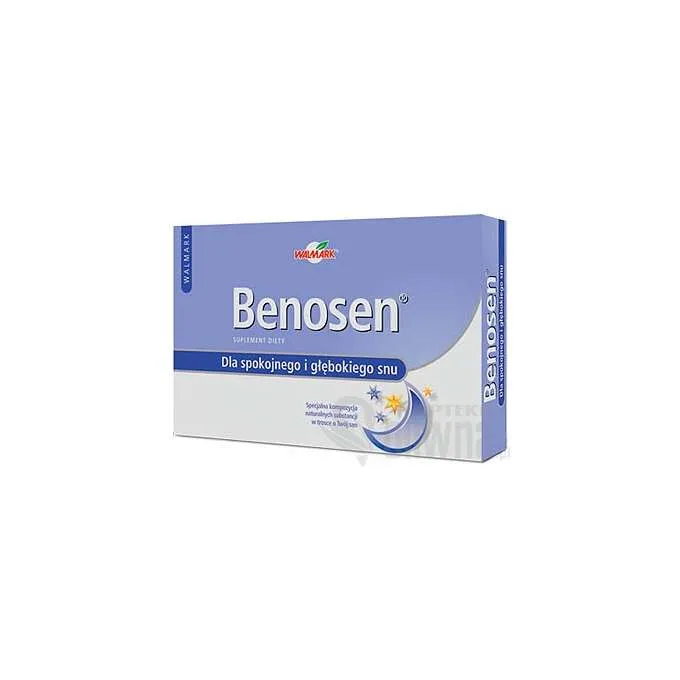
Table of Contents
Package leaflet: Information for the patient
Before starting to use this medicine, read the leaflet carefully and familiarize yourself with the
"Patient Information" included in the medicine package. To use the medicine safely, answer all the
questions contained in the Patient Information. This medicine is intended only for adult patients.
Benosen, 12.5 mg, coated tablets
Doxylamine hydrogen succinate
For use in adults
Please read this leaflet carefully before taking the medicine, as it contains important information for the patient.
This medicine should always be taken exactly as described in this patient leaflet or as directed by your doctor or pharmacist.
- Keep this leaflet for future reference.
- If you need advice or further information, consult your pharmacist.
- If you experience any adverse reactions, including any not listed in this leaflet, inform your pharmacist. See section 4.
- If there is no improvement after 7 days, or if your condition worsens, consult your doctor.
Leaflet contents
- What Benosen is and what it is used for
- Important information before taking Benosen
- How to take Benosen
- Possible side effects
- How to store Benosen
- Contents of the pack and other information
1. What Benosen is and what it is used for
Benosen is a medicine containing doxylamine hydrogen succinate as the active substance. It is a medicine with sedative properties (sedative/antihistamine).
Benosen is indicated for short-term, symptomatic treatment of occasional insomnia in adults aged over 18 years.
WARNING!
Not all conditions of restlessness, difficulty falling asleep, or sleep disturbances require pharmacological treatment, as they are often symptoms of physical or mental disorders that can be alleviated by other methods or by treating the underlying condition. Therefore, prolonged sleep disorders should not be treated with Benosen.
Before using Benosen, consult your doctor.
2. Important information before taking Benosen
When not to take Benosen
- If the patient is allergic to the active substance or to any of the other ingredients of this medicine (listed in section 6).
- If the patient is allergic to other antihistamine medicines.
- In case of severe asthma attack.
- If the patient has glaucoma (narrow-angle glaucoma).
- If the patient has a tumour of the adrenal gland (adrenal chromaffin tumour).
- If the patient has benign prostatic hyperplasia (enlarged prostate gland) with urinary retention, or if the patient has acute alcohol, sedative, analgesic or psychotropic drug intoxication (neuroleptics, tranquilizers, antidepressants, lithium),
- if the patient suffers from epilepsy,
- if the patient is taking medicines known as monoamine oxidase inhibitors (MAOIs) (medicines used to treat depression, Parkinson's disease or other conditions, such as moclobemide, phenelzine, tranylcypromine, isocarboxazid, linezolid, methylene blue, procarbazine, rasagiline and selegiline).
Warnings and precautions
Before starting to take Benosen, discuss this with your doctor or pharmacist.
Always take the medicine exactly as described in this Patient Information Leaflet or as directed by your doctor or pharmacist. Improper use of the medicine, including prolonged use or exceeding the recommended doses, may cause adverse effects. The patient should monitor their reaction to the medicine, including possible adverse effects (see section 4) or symptoms of overdose (see section 3 "If you take more Benosen than you should").
Do not exceed the recommended dose. Do not take Benosen for longer than 7 days unless otherwise advised by a doctor. Otherwise, symptoms of dehydration and heat stroke may worsen due to reduced sweating, especially during hot weather. Exercise caution, particularly in elderly patients.
The patient must inform the doctor before starting treatment if they have:
- impaired liver or kidney function,
- QT interval prolongation (heart problems),
- low potassium levels in the blood or other electrolyte imbalances,
- heart disease and high blood pressure,
- urinary retention,
- asthma, chronic bronchitis (persistent bronchial inflammation), or emphysema (lung disease causing breathing difficulties),
- peptic ulcer (erosion of the stomach or duodenal wall), pyloroduodenal stenosis (difficulty in food passage from the stomach to the intestine), or urethral obstruction (urinary tract disorder).
Exercise special caution when taking other medicines that may harm hearing, such as carboplatin or cisplatin (medicines used in cancer treatment), chloroquine (a medicine used to treat or prevent malaria), and certain antibiotics (used to treat infections) such as erythromycin or parenteral aminoglycosides, because Benosen may mask the ototoxic effects of these medicines. Therefore, periodic hearing tests should be performed.
Exercise special caution when using doxylamine in patients with neurologically evident cerebral cortex damage or a history of convulsions, as even small doses of doxylamine may trigger grand mal epileptic seizures.
Patients should ensure sufficient sleep time (at least 8 hours) to avoid reduced reaction ability the following morning.
If daytime drowsiness occurs, patients are advised to reduce the dose or take it earlier to ensure at least an 8-hour interval between taking the medicine and waking up.
Patients over 65 years of age may be more susceptible to adverse effects.
Benosen may worsen symptoms of dehydration and heat stroke due to reduced sweating.
Effect on diagnostic test results
This medicine may affect the results of skin tests performed to diagnose allergies; therefore, it is recommended to discontinue Benosen at least 3 days before the planned test.
Children and adolescents
Benosen should not be used in children and adolescents, as the safety and efficacy of doxylamine as a sleep aid have not been established in children and adolescents under 18 years of age.
Benosen with other medicines
Tell your doctor or pharmacist about all medicines you are currently taking or have recently taken, including those obtained without a prescription.
The effects of the following medicines may be increased when taken together with Benosen:
- centrally acting medicines (such as psychotropic medicines, sleeping pills, analgesics, anaesthetics, anticonvulsants),
- other medicines with anticholinergic effects (e.g. biperiden used in Parkinson’s disease, tricyclic antidepressants, and MAO inhibitors used in depression treatment), leading to life-threatening intestinal paralysis, urinary retention, or acute increase in intraocular pressure.
The effects of the following medicines may be reduced:
- phenytoin (used to treat seizures),
- neuroleptics (used to treat psychiatric disorders).
When Benosen is taken simultaneously:
- with centrally acting antihypertensive medicines (guanabenz, clonidine, alpha-methyldopa), increased fatigue and weakness may occur.
- early symptoms of inner ear damage caused by other medicines (e.g. aminoglycosides, antibiotics, certain analgesics, certain diuretics) may be masked. If the patient is taking other medicines causing ototoxicity, such as carboplatin or cisplatin (used in cancer treatment), chloroquine (used to treat or prevent malaria), or certain antibiotics (used to treat infections), such as erythromycin or parenteral aminoglycosides, whose toxic effects may be masked by Benosen, regular ear examinations should be performed.
- false-negative results in skin tests may occur; see section "Warnings and precautions".
- adrenaline (epinephrine) should not be administered (as it may cause vasodilation, lowered blood pressure, and increased heart rate).
- MAO inhibitors may lead to lowered blood pressure, increased central nervous system depression, and respiratory disturbances. Do not take Benosen together with MAO inhibitors. Avoid medicines affecting the heart (prolonging the QT interval), such as medicines used to treat arrhythmias, certain antibiotics, certain antimalarials, certain antihistamines, certain lipid-lowering medicines, or certain neuroleptics (medicines used to treat psychiatric disorders).
- avoid medicines that reduce the elimination of other medicines, such as azole derivatives or macrolides (cytochrome P-450 inhibitors), or medicines causing electrolyte imbalances such as hypokalaemia or hypomagnesaemia (e.g. certain diuretics).
- Benosen has additive (summing) effects with alcohol and other medicines acting depressively on the central nervous system (e.g. barbiturates, sleeping pills, tranquilizers, anxiolytics, opioid analgesics, antipsychotics, procarbazine).
Benosen and alcohol
During treatment with Benosen, alcohol consumption should be avoided.
Pregnancy, breastfeeding and fertility
If the patient is pregnant, breastfeeding, suspects she may be pregnant, or is planning to have a child, she should consult her doctor or pharmacist before using this medicine.
Benosen may be used during pregnancy only on a doctor's explicit recommendation. Breastfeeding should be discontinued during treatment, as the active ingredient passes into human milk.
Driving and operating machinery
Benosen has a major influence on the ability to drive and operate machinery.
Even when used as recommended, this medicine may impair reaction ability, causing disturbances in active participation in road traffic and operating machinery. Symptoms may be intensified especially when the medicine is taken together with alcohol. In such cases, rapid and effective reaction to unexpected situations is not possible.
Do not drive a car or other vehicles. Do not use electrical devices or machinery. Do not perform any tasks without secure support.
Benosen contains sodium
This medicine contains less than 1 mmol (23 mg) of sodium per tablet, meaning the medicine is considered "sodium-free".
3. How to take Benosen
This medicine should always be taken exactly as described in this patient leaflet or as directed by a doctor or pharmacist. If in doubt, consult a doctor or pharmacist.
Adults
The recommended dose is 1 to 2 tablets (12.5 mg to 25 mg) per day.
If daytime drowsiness occurs, it is recommended to reduce the dose to 1 tablet (12.5 mg) or to take the dose earlier, ensuring at least an 8-hour interval between taking the medicine and waking up.
Do not take more than 2 tablets (25 mg) per day.
Use in elderly patients
In patients over 65 years of age, other medical conditions are more likely, which may require a reduced dose. If adverse reactions occur, the dose should be reduced to 12.5 mg per day.
Use in patients with hepatic or renal impairment
In these patients, the doctor will determine an adjusted dose according to the severity of the disease.
Use in children and adolescents
Benosen is not indicated for use in children and adolescents under 18 years of age.
Route and method of administration
Oral use.
Take the tablets 30 minutes before going to bed, with a sufficient amount of liquid (preferably water).
Benosen can be taken with or without food.
The break line on the tablet is intended only to facilitate breaking the tablet if the patient has difficulty swallowing it whole.
Duration of treatment
Treatment should be as short as possible. Treatment usually lasts from a few days to one week. Do not use this medicine for longer than 7 days without consulting a doctor.
Overdose of Benosen
Initial symptoms of overdose may include anxiety, increased muscle reflexes, loss of consciousness, respiratory failure, and cardiac arrest. Other symptoms of overdose include dilated pupils, rapid heartbeat (tachycardia), fever, sensation of heat, skin redness, and dryness of mucous membranes. If these symptoms occur, contact a doctor immediately.
Additionally, rhabdomyolysis (breakdown of muscle fibres) has been reported following overdose. The doctor will decide on the appropriate management.
In case of gastrointestinal disturbances, central nervous system disorders, dry mouth, bladder emptying disorders (urinary disorders), or visual disturbances, the doctor will decide on the appropriate course of action depending on the symptoms.
Missed dose of Benosen
Do not take a double dose to make up for a missed dose.
Take the next dose at the usual time.
If you have any further doubts about the use of this medicine, consult your doctor or pharmacist.
4. Possible adverse effects
Like all medicines, this medicine can cause adverse effects, although they do not occur in everyone.
Adverse effects caused by doxylamine are generally mild and transient, and occur more frequently during the first few days of treatment.
Common adverse effects (occurring in less than 1 in 10 people): drowsiness and symptoms such as dry mouth, constipation, blurred vision, urinary retention, increased bronchial mucus secretion, central and labyrinthine dizziness (balance disorders), headache, upper abdominal pain, fatigue, insomnia, nervousness.
Uncommon adverse effects (occurring in less than 1 in 100 people): asthenia (feeling of tiredness), peripheral edema (hands and feet), nausea, vomiting, diarrhoea, skin rash, tinnitus (ringing in the ears), orthostatic hypotension (low blood pressure caused by changes in body position), diplopia (double vision), dyspepsia (indigestion), feeling of relaxation, nightmares and dyspnoea (breathing difficulty).
Rare adverse effects (occurring in less than 1 in 1,000 people): excitation (especially in children and elderly patients), tremor, convulsions, haematological disorders such as haemolytic anaemia, thrombocytopenia, leukopenia or agranulocytosis (reduced levels of certain types of blood cells).
Adverse effects with unknown frequency (frequency cannot be estimated from available data): malaise.
Other adverse effects which have occurred with antihistamine medicines, but have not been observed with doxylamine, include:
arrhythmia (heart rhythm disorders), palpitations, gastroesophageal reflux, liver function disorders (cholestatic jaundice), QT interval prolongation in electrocardiogram (a heart abnormality), decreased appetite, increased appetite, muscle pain, coordination disorders, extrapyramidal disorders (movement disorders), paraesthesia (abnormal sensations), psychomotor function impairment (sensory-motor coordination), depression, reduced bronchial secretion, alopecia, allergic dermatitis, excessive sweating, photosensitivity reaction or arterial hypotension (low blood pressure).
The severity and frequency of adverse effects can be controlled by reducing the daily dose.
Patients over 65 years of age are more susceptible to adverse effects, as they may have other underlying conditions or may be taking other concomitant medicines. These patients are also at increased risk of falls.
Reporting of adverse effects
If any adverse effects occur, including any not listed in this leaflet, inform your doctor or pharmacist. Adverse effects can be reported directly to the Department of Monitoring Adverse Effects of Medicinal Products at the Office for Registration of Medicinal Products, Medical Devices and Biocidal Products:
Al. Jerozolimskie 181C, 02-222 Warsaw
Tel.: + 48 22 49 21 301
Fax: + 48 22 49 21 309
Website: https://smz.ezdrowie.gov.pl
Adverse effects can also be reported to the marketing authorization holder.
Reporting adverse effects helps to provide more information on the safety of the medicine.
5. How to store Benosen
Keep this medicine out of sight and reach of children.
Do not use this medicine after the expiry date stated on the carton and blister pack after "Expiry date (EXP)" or "EXP". The expiry date refers to the last day of the stated month.
No special storage conditions apply.
Medicines must not be disposed of via wastewater or household waste. Ask your pharmacist how to dispose of medicines no longer required. Such measures help protect the environment.
6. Contents of the pack and other information
What Benosen contains
The active substance is doxylamine succinate.
Each tablet contains 12.5 mg of doxylamine succinate.
The other ingredients are:
Tablet core:
Mannitol (E421)
Microcrystalline cellulose
Sodium carboxymethyl starch (type A)
Colloidal anhydrous silica
Magnesium stearate
Tablet coating:
Hypromellose
Titanium dioxide (E 171)
Macrogol 400
Erythrosine, aluminium lake (E 127)
Iron oxide red (E 172)
Indigo carmine, aluminium lake (E 132)
What Benosen looks like and contents of the pack
Pink, oval, biconvex coated tablets (approximately 8.52 x 5.0 mm) with a score line.
The score line on the tablet is intended only to facilitate breaking the tablet for easier swallowing and does not guarantee an equal division into two doses.
Aluminium/Aluminium or Aluminium/PVC/PE/PVDC foil blisters in a cardboard box containing 7, 10, 14 or 20 coated tablets.
Not all pack sizes may be marketed.
Marketing Authorisation Holder and Manufacturer
STADA Arzneimittel AG
Stadastrasse 2-18
61118 Bad Vilbel
Germany
Manufacturer
Industria Quimica Y Farmaceutica Vir S.A.
Calle De La Laguna 66 68 70
Poligono Industrial Urtinsa II
28923 Alcorcon
Spain
Pharmex Advanced Laboratories S.L.
Carretera A-431 Km. 19
14720 Almodóvar del Río
Spain
Stada M&D S.R.L.
Strada Trascaului Nr 10
401135 Turda
Romania
For further information about this medicinal product, please contact the local representative of the Marketing Authorisation Holder:
Stada Pharm Sp. z o.o.
ul. Krakowiaków 44
02-255 Warszawa
Tel. +48 22 737 79 20
This medicinal product is authorised in the Member States of the European Economic Area under the following names:
Germany: Doxylamin STADA 12,5 mg Filmtabletten
Poland: Benosen