Apap extra
Poland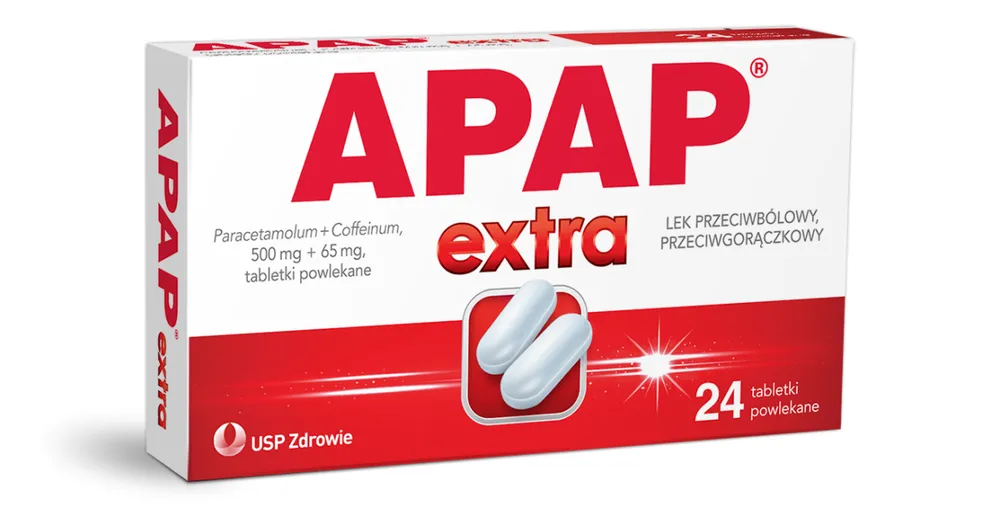
Table of Contents
Package leaflet: Information for the user
Apap Extra
500 mg + 65 mg
coated tablets
Paracetamolum + Coffeinum
Please read all of this leaflet carefully before taking this medicine, because it contains
important information for you.
This medicine should always be taken exactly as described in this patient leaflet or as
directed by your doctor or pharmacist.
- Keep this leaflet so that you can read it again if necessary.
- If you need advice or further information, please consult your pharmacist.
- If you experience any adverse reactions, including any possible adverse reactions not listed in this leaflet, inform your doctor or pharmacist. See section 4.
- If symptoms do not improve after 3 days or worsen, consult your doctor.
Contents of the leaflet
- What Apap Extra is and what it is used for
- Important information before taking Apap Extra
- How to take Apap Extra
- Possible side effects
- How to store Apap Extra
- Contents of the pack and other information
1. What Apap Extra is and what it is used for
Apap Extra is an analgesic and antipyretic medicine. It contains as active substances paracetamol
and caffeine. Caffeine enhances the analgesic effect of paracetamol. Additionally, caffeine exerts
a moderate stimulant effect on the central nervous system.
Apap Extra is indicated for the temporary relief of mild to moderate pain.
Indications for use include various types of pain: headache, including migraine, muscle pain, toothache, neuralgia, menstrual pain, musculoskeletal pain, postoperative and post-traumatic pain. The medicine also relieves symptoms of cold and flu, such as fever, sore throat, muscle and joint pain.
2. Important information before taking APAP Extra
When not to take APAP Extra:
- if the patient is allergic to the active substances or any of the other ingredients of this medicine (listed in section 6);
- if the following conditions are present: haemolytic anaemia, congenital deficiency of glucose-6-phosphate dehydrogenase or methemoglobin reductase, alcoholic disease, severe liver or kidney failure, cardiac arrhythmia;
- during treatment with MAO inhibitors and within 2 weeks after discontinuation of these drugs.
- Do not use in women during the first trimester of pregnancy and during breastfeeding.
- Do not use in children under 12 years of age.
Warnings and precautions:
Before starting APAP Extra, discuss this with your doctor or pharmacist.
- The medicine contains paracetamol. Due to the risk of overdose, check whether other medicines being taken also contain paracetamol.
- Use of the medicine in patients with liver impairment, alcohol abusers, or fasting patients may pose a risk of liver damage.
- Use with caution in patients with renal impairment, bronchial asthma, hyperthyroidism, or sleep disorders such as insomnia.
- Alcohol must not be consumed during treatment due to increased risk of liver damage.
- Particular risk of liver damage exists in fasting patients and those who regularly consume alcohol.
During treatment with Apap Extra, immediately inform your doctor if:
- the patient has serious medical conditions, including severe kidney dysfunction or sepsis (when bacteria and their toxins circulate in the blood, leading to organ damage), malnutrition, chronic alcoholism, or if the patient is also taking flucloxacillin (an antibiotic). In these situations, patients taking paracetamol regularly over a prolonged period or taking paracetamol together with flucloxacillin have experienced a serious condition called metabolic acidosis (abnormality in blood and body fluids). Symptoms of metabolic acidosis may include: severe breathing difficulties, including rapid deep breathing, drowsiness, nausea and vomiting.
Children:
Use in children under 12 years of age is contraindicated (see When not to take APAP Extra).
APAP Extra and other medicines:
Tell your doctor or pharmacist about all medicines currently used, recently taken, or planned to be used.
Do not take this medicine simultaneously with other medicines containing paracetamol and caffeine.
When taking oral antidiabetic drugs, anticoagulants (warfarin, coumarins), rifampicin (used in tuberculosis treatment), antiepileptic drugs, sedatives and hypnotics, MAO inhibitors (used e.g. in depression), zidovudine (an antiviral drug used in HIV infection), sympathomimetic drugs (decongestants, appetite suppressants, and amphetamine-like psychostimulants), non-steroidal anti-inflammatory drugs, thyroid hormones, oral contraceptives, cimetidine (used mainly in peptic ulcer disease), chloramphenicol (antibiotic), quinolones (bactericidal agents), or verapamil (used in heart diseases), consult your doctor before taking this medicine.
Inform your doctor or pharmacist if the patient is taking:
- flucloxacillin (antibiotic) due to the serious risk of blood and body fluid disorders (called metabolic acidosis), which require urgent treatment (see section 2).
Taking APAP Extra with food and drink:
Food does not reduce absorption of the medicine.
Pregnancy, breastfeeding and fertility:
If the patient is pregnant, breastfeeding, suspects she may be pregnant, or is planning to become pregnant, she should consult a doctor or pharmacist before using this medicine.
Do not use during the first trimester of pregnancy. During the second and third trimesters, consult a doctor before use.
Do not use during breastfeeding.
Driving and operating machinery:
Does not affect the ability to drive or operate machinery.
3. How to take APAP Extra
This medicine should always be taken exactly as described in the patient leaflet or as directed by a doctor or pharmacist. If in doubt, consult a doctor or pharmacist.
Adults and adolescents over 12 years of age:
1 or 2 tablets every 4 to 6 hours, up to a maximum of 8 tablets per day.
Do not use this medicine for longer than 3 days without medical advice.
Do not give to children under 12 years of age.
Method of administration
Oral use.
Overdose of APAP Extra:
Symptoms may include severe nausea, vomiting, excessive sweating, drowsiness or insomnia, general weakness, abdominal pain, increased diuresis, dehydration, and fever. More severe poisoning may manifest as cardiac arrhythmia and tonic-clonic seizures.
In case of overdose, seek immediate medical advice from a doctor or pharmacist.
Missed dose of APAP Extra:
This medicine is intended for temporary relief of symptoms.
Do not take a double dose to make up for a missed dose.
Discontinuation of APAP Extra:
If you have any further doubts regarding the use of this medicine, consult your doctor or pharmacist.
4. Possible adverse effects
Like all medicines, this medicine can cause adverse effects, although not everyone will experience them.
If any of the following symptoms occur, do not take the medicine and contact your doctor immediately.
These are life-threatening conditions.
- Rarely occurring – skin allergic reactions such as urticaria (hives), rash
- Very rarely occurring – severe skin reactions: blistering rash all over the body or erosions in the mouth, eyes, genital organs and on the skin, or rupturing giant blisters, peeling off large sheets of the epidermis, accompanied by weakness, fever and joint pain
Adverse effects occurring rarely (may affect less than 1 in 1,000 people):
- nausea, vomiting, abdominal pain
Adverse effects occurring very rarely (may affect less than 1 in 10,000 people):
- thrombocytopenia manifesting as petechiae and tendency to bruise, agranulocytosis (lack of one type of white blood cells manifesting as increased susceptibility to infections)
- dizziness
- renal papillary necrosis during long-term use; renal colic
Adverse effects with unknown frequency (cannot be estimated based on available data):
- serious condition which may lead to blood acidification (so-called metabolic acidosis) in patients with severe disease taking paracetamol (see section 2)
When a medicine containing caffeine is administered at the recommended dose in combination
with caffeine from dietary sources, the following adverse effects related to increased total
caffeine intake may be intensified:
Adverse effects with unknown frequency (cannot be estimated based on available data):
- cardiac arrhythmia
- insomnia, attention disturbances, muscle tremors, irritability, dizziness
Reporting of adverse effects
If any adverse effects occur, including any adverse effects not listed in this leaflet, inform your doctor or pharmacist.
Adverse effects can be reported directly to the Department of Monitoring Adverse Drug Reactions at the Office for Registration of Medicinal Products, Medical Devices and Biocidal Products
Al. Jerozolimskie 181C, 02-222 Warsaw
Tel: +48 (22) 49 21 301
Fax: +48 (22) 49 21 309
Website: https://smz.ezdrowie.gov.pl
Adverse effects can also be reported to the marketing authorization holder.
Reporting adverse effects helps to provide more information on the safety of the medicine.
5. How to store APAP Extra
Store below 25 °C.
Keep the medicine out of the sight and reach of children.
Do not use this medicine after the expiry date stated on the carton and immediate packaging (month/year).
Blister labelling used: EXP – expiry date, Lot – batch number.
6. Contents of the package and other information
What APAP Extra contains
The active substances are:
paracetamol 500 mg
caffeine 65 mg
The other ingredients are:
povidone, maize starch, methylcellulose, talc, calcium stearate;
the tablet coating contains: hypromellose 5, hypromellose 15, polyethylene glycol 3350.
What APAP Extra looks like and contents of the pack
White, oblong coated tablets.
Packaged in blisters or bottles, and presented in a cardboard box with a leaflet.
Available pack sizes:
2, 4, 6, 8, 10, 12, 24 tablets in blisters and 50, 60 tablets in bottles.
Not all pack sizes may be marketed.
Marketing authorisation holder and manufacturer:
US Pharmacia Sp. z o.o.
Ziębicka 40
50-507 Wrocław
For further information about this medicinal product, please contact:
USP Zdrowie Sp. z o.o.
Poleczki 35
02-822 Warsaw
tel.: +48 (22) 543 60 00.