Acitren
Poland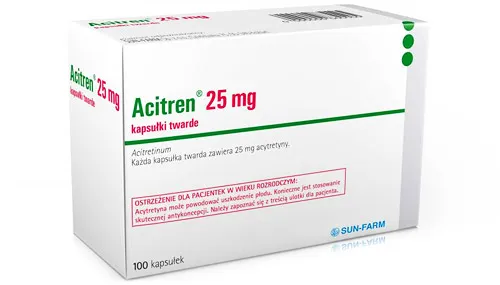
Table of Contents
Package leaflet: Information for the user
Acitren, 10 mg, hard capsules
Acitren, 25 mg, hard capsules
Acitretinum
WARNING
MAY CAUSE SEVERE HARM TO THE UNBORN CHILD.
Women must use effective contraception.
Do not use during pregnancy or if pregnancy is suspected.
Please read this leaflet carefully before taking this medicine, as it contains
important information for you.
- Keep this leaflet, as you may need to read it again.
- If you have any questions, please consult your doctor or pharmacist.
- This medicine has been prescribed for a specific individual. Do not pass it on to others. This medicine may harm other people, even if their symptoms are the same.
- If you experience any adverse effects, including any not listed in this leaflet, tell your doctor or pharmacist. See section 4.
Contents of the leaflet
- What Acitren is and what it is used for
- Important information before taking Acitren
- How to take Acitren
- Possible side effects
- How to store Acitren
- Contents of the pack and other information
1. What Acitren is and what it is used for
Acitretin, the active substance in Acitren, belongs to a group of substances known as retinoids, which are derivatives of vitamin A.
Acitren is used for symptomatic treatment of exceptionally severe keratinization disorders (dry, thickened, scaly skin) resistant to other standard treatments, such as:
- psoriasis (psoriasis vulgaris, especially erythrodermic and pustular forms),
- abnormal thickening of the horny layer of the skin on palms and soles (palmoplantar keratoderma),
- abnormal formation of pustules on palms and soles (palmoplantar pustulosis),
- ichthyosis (fish scale disease),
- Darier's disease,
- Devergie's disease (erythematous follicular psoriasis),
- lichen planus of the skin and mucous membranes.
Acitren may only be prescribed by a physician, preferably a dermatologist, experienced in the use of systemic retinoids and fully aware of the teratogenic risk associated with the use of Acitren.
2. Important information before taking Acitren
When not to take Acitren
- if the patient is pregnant or breastfeeding;
- if there is any risk that the patient may become pregnant, it is necessary to follow the precautions outlined in the Pregnancy Prevention Programme – see section "Warnings and precautions";
- if the patient is allergic to acitretin, other retinoids, or any of the other ingredients of this medicine (listed in section 6);
- if the patient has severe liver dysfunction;
- if the patient has severe kidney dysfunction;
- if the patient has very high levels of fats (lipids) in the blood;
- if the patient is taking medicines such as tetracyclines (used to treat infections) or methotrexate (used to treat skin diseases, inflammatory joint diseases, and cancers) – see "Acitren with other medicines";
- if the patient is taking vitamin A or other retinoid medicines (e.g. isotretinoin) – see section "Acitren with other medicines".
If any of the above apply to the patient, contact a doctor before starting treatment with Acitren.
Warnings and precautions
Acitretin often increases blood levels of fats such as cholesterol and triglycerides, which may be associated with pancreatitis.
Inform your doctor if you experience severe abdominal or back pain (possible symptoms of pancreatitis).
Discuss this with your doctor or pharmacist before starting Acitren.
Pregnancy Prevention Programme
Women who are pregnant must not take Acitren.
This medicine can severely harm the unborn child (it is "teratogenic"). It may cause serious malformations of the brain, face, ears, eyes, heart, and certain glands (thymus and parathyroid glands). It also increases the risk of miscarriage. These effects may occur even if Acitren is taken for only a short time during pregnancy.
- Do not take Acitren if you are pregnant or suspect you may be pregnant.
- Do not take Acitren while breastfeeding. The medicine is likely to pass into breast milk and may harm the infant.
- Do not take Acitren if you could become pregnant during treatment.
- Do not become pregnant for three years after stopping treatment, as the medicine may still remain in your body.
Acitren may be prescribed to women of childbearing potential only if strict conditions are followed,
due to the risk of severe birth defects in the unborn child.
The following conditions must be met:
- The doctor must explain to the patient the risk of fetal harm (birth defects); the patient must understand why pregnancy must be avoided and how to prevent it.
- The patient must discuss contraception (birth control methods) with the doctor. The doctor will provide information on effective contraceptive methods. The doctor may refer the patient to a specialist for contraceptive advice.
- Before starting treatment, the doctor will require a pregnancy test. The test must confirm that the patient is not pregnant at the start of Acitren treatment.
Women must use effective contraceptive methods before, during, and after treatment with Acitren
- The patient must agree to use at least one highly reliable method of contraception (e.g. intrauterine device or contraceptive implant) or two effective methods with different mechanisms (e.g. oral hormonal contraceptives and condoms). Discuss with your doctor which methods are most suitable for you.
- The patient must use contraception for one month before starting Acitren, throughout treatment, and for 3 years after stopping the medicine.
- The patient must use contraception even if she is not menstruating or not currently sexually active (unless the doctor determines it is unnecessary).
Women must agree to undergo pregnancy tests before, during, and after treatment with Acitren
- The patient must agree to regular follow-up visits with the doctor, ideally monthly.
- The patient must agree to regular pregnancy testing, ideally monthly during treatment and every 1 to 3 months for 3 years after stopping Acitren, as the medicine may still be present in the body (unless the doctor decides otherwise).
- The patient must agree to additional pregnancy tests as recommended by the treating doctor.
- The patient must not become pregnant during treatment or for 3 years after stopping Acitren, as the medicine may still be present in the body.
- The treating doctor will discuss all issues with the patient using a checklist and will ask the patient (or her parent or legal guardian) to sign it. This form confirms that the patient has been informed of the risks and agrees to follow the above rules.
If a patient becomes pregnant while taking Acitren, she must immediately stop taking the medicine
and contact her doctor. The doctor may refer her to a specialist for advice.
Additionally, a woman who becomes pregnant within 3 years after stopping Acitren should contact her doctor. The doctor may refer her to a specialist for advice.
The patient must not consume alcohol (contained in beverages, food, or medicines) during treatment with Acitren and for 2 months after stopping treatment, as alcohol may increase the risk of developmental abnormalities.
Advice for men
The amount of oral retinoids in the semen of men taking Acitren is too low to harm their partner's unborn child. However, this medicine must never be shared with anyone else, especially women.
Additional precautions
Never pass this medicine to another person. All unused capsules must be returned to the pharmacist
after treatment ends.
Do not donate blood while taking this medicine or for 3 years after stopping Acitren. If a pregnant woman receives your blood, she may give birth to a child with birth defects.
Pregnancy, breastfeeding, and fertility
For more information on pregnancy and contraception, see section 2 "Pregnancy Prevention Programme".
Warnings and precautions
Before starting Acitren, discuss the following with your doctor or pharmacist:
- if you have ever had mental health problems, including depression, aggression, mood swings, or psychotic symptoms (altered perception of reality, such as hearing voices or seeing things that are not there). This is because Acitren may affect your mood and mental health.
- if you have diabetes. Blood sugar levels should be monitored more frequently at the start of treatment with Acitren.
- if you are overweight or have high blood fat levels. Your doctor may order blood tests during treatment to monitor blood fat levels.
- if you have cardiovascular diseases. Closer monitoring may be needed; for example, your doctor may check your blood pressure more frequently.
- if you consume large amounts of alcohol.
- if you have liver dysfunction.
Additionally, consider the following during Acitren treatment:
- night vision may worsen (see also section "Driving and operating machinery" and section 4);
- increased intracranial pressure may occur. This requires immediate medical confirmation. See section 4 for detailed information on symptoms;
- Acitren may increase the skin's sensitivity to UV radiation. Before exposure to strong sunlight, apply a high-protection sunscreen (SPF 15 or higher) to exposed skin. Avoid unsupervised use of sunbeds and prolonged sun exposure;
- liver function and blood fat levels should be monitored regularly before and during treatment. Your doctor may also monitor bone health regularly, as Acitren may cause bone changes, especially during long-term treatment in children and elderly patients;
- high doses of Acitren may cause mood changes (including irritability, aggression, and depression);
- very rarely, a serious condition (capillary leak syndrome/retinoic acid syndrome) has been observed, in which small blood vessels (capillaries) leak. This may lead to severe hypotension (low blood pressure), swelling (fluid accumulation causing edema), and shock. See section 4 for additional information;
- very rarely, a severe skin reaction has been observed, with symptoms such as rash, blistering, or peeling of the skin (exfoliative dermatitis). See section 4 for additional information;
- due to the risk of harm to the unborn child, this medicine must not be passed to others. Unused or expired capsules must be returned to the pharmacy for disposal.
Mental health disorders
The patient may not notice certain changes in mood or behaviour, so it is important to inform friends and family members that this medicine may cause changes in behaviour and mood. They may notice such changes and help identify problems that need to be discussed with the doctor.
Long-term treatment (see section 3 "How to take Acitren")
The following precautions should be observed:
- Blood fat levels should be monitored regularly, at intervals not exceeding 3 months.
Children
In children, growth parameters and bone development should be closely monitored. Due to the risk of serious adverse effects during long-term treatment, the benefit-risk ratio of using the medicine should be carefully evaluated.
Acitren with other medicines
Tell your doctor or pharmacist about all medicines you are currently taking, have recently taken, or plan to take.
Do not take Acitren together with the following medicines (see also "When not to take Acitren"):
- vitamin A, due to the risk of vitamin A overdose;
- other retinoids (e.g. isotretinoin or tretinoin), due to the risk of vitamin A overdose;
- methotrexate (used to treat skin diseases, inflammatory joint diseases, and cancers), due to increased risk of both vitamin A overdose and liver inflammation;
- tetracyclines (used to treat bacterial infections), as they, like Acitren, may increase intracranial pressure.
When phenytoin (used to treat epilepsy) is taken together with Acitren, note that Acitren partially displaces phenytoin from its protein-binding sites. However, no such effect on protein binding has been observed when Acitren is taken with coumarin anticoagulants (blood thinners).
The contraceptive effect of low-dose progesterone-only preparations may be reduced by interaction with Acitren. Therefore, low-dose progesterone-only contraceptives ("mini-pills") should not be used for contraception.
No further interactions between Acitren and other substances or products (e.g. cimetidine, digoxin, combined oral contraceptives containing oestrogen and progestogen) are known.
Acitren with food and drink
Women of childbearing age must not consume alcohol during treatment with Acitren and for 2 months after stopping treatment (in beverages, food, or medicines).
Taking Acitren with alcohol may lead to the formation of a substance (etretinate) that may harm the unborn child. Since it cannot be ruled out that this substance may form even without alcohol and may remain in the body for a very long time before being completely eliminated, effective contraception must continue for 3 years even after stopping Acitren.
Pregnancy and breastfeeding
Acitren causes developmental abnormalities in the unborn child. Strictly follow the recommendations below, even if the patient has difficulty becoming pregnant (impaired fertility):
Do not take Acitren if you are pregnant, suspect you may be pregnant, could become pregnant during treatment, or within 3 years after stopping treatment.
See section 2 "Pregnancy Prevention Programme".
Do not take Acitren if you are breastfeeding.
If you become pregnant or suspect you may be pregnant during treatment with Acitren or within 3 years after stopping treatment, contact your doctor immediately.
For any further questions about these recommendations, consult your doctor or pharmacist before using Acitren.
Prescription
Prescriptions for women of childbearing age are limited to a 30-day supply. Continued treatment requires a new prescription. Isotretinoin should be dispensed within a maximum of 7 days of the prescription date. It is recommended that the pregnancy test, prescription issue, and pharmacy dispensing occur on the same day.
Driving and operating machinery
Exercise caution when driving or operating machinery.
Night vision may worsen during treatment. This may occur suddenly. In rare cases, visual disturbances may persist after treatment ends (see also "Warnings and precautions" and section 4 "Possible side effects").
Acitren contains sodium
The medicine contains less than 1 mmol (23 mg) of sodium per hard capsule, meaning it is considered "sodium-free".
Acitren contains glucose
This medicine contains glucose. If the patient has previously been diagnosed with intolerance to certain sugars, they should contact their doctor before taking this medicine.
3. How to take Acitren
This medicine should always be taken as directed by the physician. In case of doubts, consult
your doctor or pharmacist.
Recommended dosage:
The dosage depends on the clinical symptoms of the disease and the patient's tolerance to the medicine.
Dosage should be individually determined for each patient by the treating physician. The following
information may serve only as guidance.
Use in adults
The recommended initial daily dose is 25 mg acitretin (i.e. 1 capsule of Acitren 25 mg) or 30 mg acitretin
(i.e. 3 capsules of Acitren 10 mg), taken for 2 to 4 weeks. This dose may already provide satisfactory
therapeutic results. The maintenance dose should be adjusted according to therapeutic response and
tolerance. Usually, a daily dose of 25 mg to 50 mg acitretin taken for an additional 6 to 8 weeks allows
optimal therapeutic effect to be achieved. However, in some cases it may be necessary to increase
the dose up to a maximum of 75 mg acitretin per day (i.e. 3 capsules of Acitren 25 mg). This maximum
dose must not be exceeded.
In cases of keratinization disorders (dry, thickened and scaly skin), the maintenance dose should be
as low as possible (even less than 20 mg acitretin per day). In no case should the dose exceed
50 mg acitretin per day.
Use in children and adolescents
Due to the risk of severe adverse effects during long-term treatment, the benefit-risk ratio of using
Acitren should be carefully considered. Acitren should be used only when all other treatment
approaches have proven insufficient.
The physician will determine the dosage based on the patient's body weight.
The daily dose is approximately 0.5 mg acitretin per kg body weight. Higher doses of up to 1 mg
acitretin per kg body weight per day may be required in some cases for a limited treatment duration.
The maximum daily dose of 35 mg acitretin must not be exceeded.
The maintenance dose should be kept as low as possible due to the risk of long-term adverse effects.
Method of administration
Hard capsules must be swallowed whole with food, preferably with milk. The dose of Acitren prescribed
by the physician must be strictly observed.
Any additional topical therapies, including those of a supportive nature, should be discussed with the
treating physician during Acitren treatment.
Duration of treatment
The duration of treatment is determined by the physician, depending on the type of disease and
drug tolerance.
In patients with psoriasis, treatment with Acitren usually ends after resolution of disease lesions.
Long-term therapy with this medicine is not recommended in patients with psoriasis.
In the treatment of keratinization disorders (dry, thickened and scaly skin), experience with acitretin
covers treatment periods of up to 2 years. Disease relapses are treated in the same manner.
If you feel that the effect of Acitren is too strong or too weak, consult your doctor or pharmacist.
Women of childbearing potential
Treatment with Acitren should be started on the second or third day of the next menstrual period.
A pregnancy test must be performed within 3 days before starting treatment, and at regular intervals
during treatment and for 3 years after its completion. The test result must always be negative.
An effective and reliable method of contraception must be used continuously for at least 4 weeks
before starting Acitren, during treatment, and for 3 years after treatment ends; see also "Pregnancy and
breast-feeding".
If you take more Acitren than you should
If a patient takes more Acitren than prescribed, or if someone else takes several capsules, contact
the emergency department of the nearest hospital or a doctor immediately.
Symptoms of Acitren overdose may include headache, malaise, drowsiness, irritability, and skin
itching.
If you forget to take Acitren
If a patient accidentally takes less Acitren than prescribed or misses a dose, the medicine should be
taken as soon as possible. If the next dose is due soon, do not take the missed dose together with the
next one, but continue taking Acitren according to the prescribed schedule.
If you stop taking Acitren
Always consult your doctor before stopping treatment with Acitren or discontinuing it prematurely.
If you have any further questions about the use of this medicine, consult your doctor or pharmacist.
4. Possible adverse reactions
Like all medicines, this medicine can cause adverse reactions, although not everyone experiences them.
If any of the following adverse reactions occur, you must immediately inform your doctor and stop taking Acitren:
- Severe or prolonged headache, nausea, vomiting, and visual disturbances. These may be symptoms of increased intracranial pressure (very rare – may occur in no more than 1 in 10,000 people);
- Immediate allergic reaction with symptoms such as skin rash, swelling or itching of the skin, red and swollen eyes, severe nasal congestion, asthma, or wheezing. This reaction may range from mild to life-threatening (frequency unknown: cannot be estimated from available data);
- Yellowing of the skin and whites of the eyes, which may be symptoms of jaundice (very rare – may occur in no more than 1 in 10,000 people) or hepatitis (not common – may occur in no more than 1 in 100 people). Other symptoms may include loss of appetite, fever, general malaise, nausea, dark urine, and abdominal pain;
- Severe condition in which small blood vessels (capillaries) leak (capillary leak syndrome/retinoic acid syndrome). This may lead to severe hypotension (low blood pressure), edema (fluid accumulation causing swelling), and shock. Symptoms include swelling or edema, difficulty breathing, stomach cramps, muscle pain, excessive thirst, and general feeling of fatigue and weakness (frequency unknown);
- Severe skin reaction with symptoms such as rash, blisters, and skin peeling (exfoliative dermatitis) (frequency unknown).
Other adverse reactions include:
Very common adverse reactions (may occur in more than 1 in 10 people):
- Dry, irritated, or swollen eyes, and associated intolerance to contact lenses,
- Dry, irritated nasal mucosa, nasal discharge, nosebleeds,
- Dry mouth, thirst,
- Dryness or inflammation of the lips, which may be relieved by using a greasy ointment. Itching, hair loss, peeling of the skin on palms and soles, or even over the entire body,
- Liver function abnormalities (confirmed by blood tests),
- Increased blood lipid levels (confirmed by blood tests).
Common adverse reactions (may occur in no more than 1 in 10 people):
- Headache,
- Inflammation of the oral mucosa, abdominal pain, diarrhea, nausea, vomiting,
- Sensitive skin, sticky skin sensation or rash, dermatitis, changes in hair texture, brittle nails, nail fold inflammation, skin redness,
- Joint pain, muscle pain,
- Swelling of hands, feet, and ankles.
Uncommon adverse reactions (may occur in no more than 1 in 100 people):
- Drowsiness,
- Blurred vision,
- Gingivitis,
- Cracks, fissures, or erosions of the skin, e.g., around the mouth, skin blisters and dermatitis (bullous dermatitis), increased sensitivity of the skin to sunlight (photosensitivity).
Rare adverse reactions (may occur in no more than 1 in 1,000 people):
- Peripheral nervous system damage, including associated symptoms such as muscle weakness, numbness or tingling in hands and feet, and even burning, stabbing, or sudden sharp pains.
Very rare adverse reactions (may occur in no more than 1 in 10,000 people):
- Night vision deterioration, corneal inflammation (corneal ulceration),
- Bone pain, bone changes.
Frequency not known (frequency cannot be estimated from available data):
- Vaginal infections (also known as candidiasis or fungal infection),
- Hearing disturbances, tinnitus (ringing in the ears),
- Hot flushes,
- Changes in taste perception, rectal bleeding,
- Small, reddish nodules on the skin that bleed easily (pyogenic granuloma),
- Loss of eyelashes and lateral eyebrows (madarosis),
- Painless (rarely itchy) swelling of the skin, mucous membranes, and adjacent tissues,
- Urticaria,
- Skin thinning,
- Improvement or worsening of glucose tolerance in diabetic patients,
- Voice changes (dysphonia),
- Mood changes,
- Psychotic symptoms: altered perception of reality, such as hearing voices or seeing things that are not there.
An initial worsening of psoriasis symptoms may occur at the beginning of treatment.
Reporting of adverse reactions
If any adverse symptoms occur, including any adverse reactions not listed in this leaflet, inform your doctor or pharmacist. Adverse reactions can be reported directly to the Department of Monitoring of Adverse Drug Reactions of the Office for Registration of Medicinal Products, Medical Devices and Biocidal Products
Al. Jerozolimskie 181C
02-222 Warsaw
Phone: +48 22 49 21 301
Fax: +48 22 49 21 309
Website: https://smz.ezdrowie.gov.pl
Adverse reactions can also be reported to the marketing authorization holder.
Reporting adverse reactions helps provide more information on the safety of the medicine.
5. How to store Acitren
Keep this medicine out of sight and reach of children.
Do not use this medicine after the expiry date stated on the carton and blister pack following the abbreviation
"EXP". The expiry date refers to the last day of the stated month.
Do not store above 30°C. Store in the original packaging to protect from moisture.
Medicines must not be disposed of via wastewater or household waste. Ask your pharmacist how to dispose of medicines no longer required. Such measures will help protect the environment.
6. Contents of the pack and other information
What Acitren contains
The active substance is acitretin.
One hard capsule of Acitren 10 mg contains 10 mg of acitretin.
One hard capsule of Acitren 25 mg contains 25 mg of acitretin.
The other ingredients are:
Contents of the capsule:
- maltodextrin
- sodium ascorbate
- microcrystalline cellulose
Capsule shell (10 mg):
- gelatin
- sodium lauryl sulfate
- titanium dioxide (E 171)
- black iron oxide (E 172)
- red iron oxide (E 172)
- purified water
- shellac
- propylene glycol
Capsule shell (25 mg):
- gelatin
- sodium lauryl sulfate
- titanium dioxide (E 171)
- yellow iron oxide (E 172)
- black iron oxide (E 172)
- red iron oxide (E 172)
- purified water
- shellac
- propylene glycol
What Acitren looks like and contents of the pack
Acitren 10 mg capsule consists of a white to off-white body and a brown cap, marked with a black "A10" on the body. The capsules contain yellow powder.
Acitren 25 mg capsule consists of a yellow to light yellow body and a brown cap, marked with a black "A25" on the body. The capsules contain yellow powder.
The capsules are packed in blisters made of PVC/PVDC/Aluminium.
Pack sizes:
30, 50 and 100 hard capsules.
Not all pack sizes may be marketed.
Marketing Authorisation Holder and Manufacturer
Marketing Authorisation Holder
SUN-FARM Sp. z o.o.
ul. Dolna 21
05-092 Łomianki
tel. +48 22 350 66 69
Manufacturer
mibe GmbH Arzneimittel
Münchener Straße 15
06796 Brehna
Germany
SUN-FARM Sp. z o.o.
ul. Dolna 21
05-092 Łomianki
This medicinal product is authorised in the Member States of the European Economic Area under the following names:
Germany Acicutan 10 mg Kapseln
Acicutan 25 mg Kapseln
Poland Acitren
Acitren
Detailed and up-to-date information on this medicinal product is available by scanning the QR code on the package leaflet with a smartphone. The same information is also available at the website:
http://sunfarm.pl/library/2018/08/21/153483447808.pdf
‘Insert QR code’ + http://sunfarm.pl/library/2018/08/21/153483447808.pdf