Vivinduo for fever and nasal congestion
Italy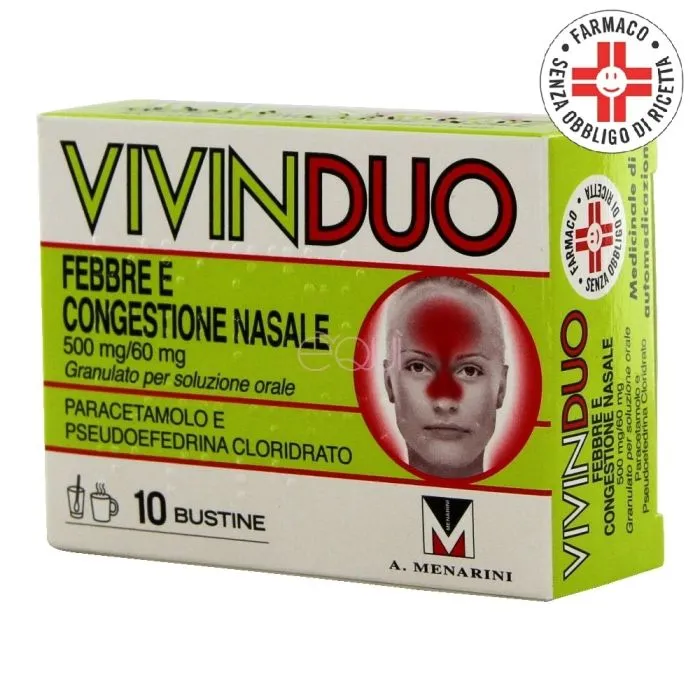
Table of Contents
- Package leaflet: Information for the user
- VIVINDUO FEVER AND NASAL CONGESTION
- 1. What VIVINDUO FEVER AND NASAL CONGESTION is and what it is used for
- 2. What you should know before taking VIVINDUO FEVER AND NASAL CONGESTION
- 3. How to take VIVINDUO FEVER AND NASAL CONGESTION
- 4. Possible side effects
- 5. How to store VIVINDUO FEVER AND NASAL CONGESTION
- 6. Package contents and other information
Package leaflet: Information for the user
VIVINDUO FEVER AND NASAL CONGESTION
500 mg/60 mg granules for oral solution
Paracetamol and pseudoephedrine hydrochloride
Generic medicine
Please read all of this leaflet carefully before you start taking this medicine because it contains important information for you.
Always take this medicine exactly as described in this leaflet or as your doctor or pharmacist has instructed.
- Keep this leaflet. You may need to read it again.
- If you need more information or advice, consult your pharmacist.
- If you experience any side effects, including those not listed in this leaflet, contact your doctor or pharmacist. See section 4.
- Contact your doctor if you do not notice any improvement or if you experience worsening of symptoms after a short period of treatment.
Contents of this leaflet:
- What VIVINDUO FEVER AND NASAL CONGESTION is and what it is used for
- What you need to know before taking VIVINDUO FEVER AND NASAL CONGESTION
- How to take VIVINDUO FEVER AND NASAL CONGESTION
- Possible side effects
- How to store VIVINDUO FEVER AND NASAL CONGESTION
- Contents of the pack and other information
1. What VIVINDUO FEVER AND NASAL CONGESTION is and what it is used for
VIVINDUO FEVER AND NASAL CONGESTION contains paracetamol, an analgesic that relieves pain and reduces fever, and pseudoephedrine, a decongestant that acts on the nasal mucosa to relieve nasal congestion.
VIVINDUO FEVER AND NASAL CONGESTION is an analgesic, antipyretic, and nasal decongestant medicine, used for the treatment of symptoms of cold and flu.
Consult your doctor if you do not feel better or if you feel worse after the maximum recommended treatment period, if the condition occurs repeatedly, or if you have noticed any recent changes in its characteristics.
2. What you should know before taking VIVINDUO FEVER AND NASAL CONGESTION
Do not take VIVINDUO FEVER AND NASAL CONGESTION:
- if you are allergic to paracetamol, hydrochloride pseudoephedrine, or any of the other ingredients of this medicine (listed in section 6)
- during pregnancy and breastfeeding (see section “Pregnancy and breastfeeding”)
- in children under 12 years of age
- if you have a deficiency of the enzyme glucose-6-phosphate dehydrogenase (which may lead to destruction of red blood cells in the blood)
- if you suffer from a severe form of the following conditions:
- coronary artery disease [chest pain (angina), previous heart attack];
- severe hypertension (if you have very high blood pressure) or uncontrolled hypertension by medication;
- arrhythmias (disorder of heart rhythm or heart rate);
- hepatic insufficiency (liver function abnormalities);
- renal insufficiency (kidney function abnormalities) or if you suffer from severe acute (sudden) or chronic (long-term) kidney disease;
- asthma;
- diabetes;
- urinary disorders caused by prostate enlargement (prostatic hypertrophy) or other diseases;
- hemolytic anemia (reduction in the number of red blood cells in the blood due to their destruction);
- hyperthyroidism (overactive thyroid gland);
- glaucoma and closed-angle glaucoma (increased pressure inside the eye);
- if you have a tumor of the adrenal gland known as pheochromocytoma
- if you are taking the following medicines:
- antidepressant drugs belonging to the class of tricyclic antidepressants
- heart or blood pressure medications belonging to the class of beta-blockers
- sympathomimetic drugs, used for treating low blood pressure or nasal congestion (see section “Other medicines and VIVINDUO FEVER AND NASAL CONGESTION”).
- if you are currently using or have used within the last 14 days medicines for depression and Parkinson’s disease belonging to the class of monoamine oxidase inhibitors (see section “Other medicines and VIVINDUO FEVER AND NASAL CONGESTION”).
Warnings and precautions
Talk to your doctor or pharmacist before taking VIVINDUO FEVER AND NASAL CONGESTION.
Consult your doctor before taking VIVINDUO FEVER AND NASAL CONGESTION:
- if you are elderly
- if you have kidney problems
- if you have liver problems, including hepatic insufficiency and acute hepatitis
- if you have a deficiency of an enzyme known as glucose-6-phosphate dehydrogenase (see section “Do not take VIVINDUO FEVER AND NASAL CONGESTION”)
- if you have a reduction in the number of red blood cells in the blood due to their destruction (hemolytic anemia)
- if you suffer from chronic malnutrition and dehydration
- if you have heart and/or blood vessel problems such as chest pain (angina), palpitations, or other heart rhythm disorders
- if you have diabetes mellitus
- if you have an enlarged prostate (prostatic hypertrophy) causing difficulty in urination
- if you have mental disorders (psychosis)
- if your thyroid gland is overactive (hyperthyroidism)
- if you have asthma
- if you have a disease characterized by high pressure inside the eye (glaucoma)
- if you have high blood pressure (hypertension)
- if you are alcohol-dependent (alcoholism) (see also section “VIVINDUO FEVER AND NASAL CONGESTION and alcohol”)
- if you are taking any other medicine (see section “Other medicines and VIVINDUO FEVER AND NASAL CONGESTION”), especially:
- other medicines that affect the liver (consult your doctor if you are unsure whether this applies to you)
- if you are taking oral anticoagulant medicines (blood thinners), because your doctor will assess whether the dose of the anticoagulant should be reduced.
Contact your doctor if, during treatment with VIVINDUO FEVER AND NASAL CONGESTION:
- pain or nasal congestion worsen or last longer than 5 days, or if symptoms do not improve within 5 days
- fever worsens or lasts more than 3 days
- you develop redness or swelling
- you experience new symptoms.
Take special care:
- VIVINDUO FEVER AND NASAL CONGESTION contains paracetamol; before using any other medicine, check that it does not contain paracetamol, as high doses of paracetamol may cause serious adverse effects, such as liver damage.
- do not take VIVINDUO FEVER AND NASAL CONGESTION with other medicines used to treat pain and fever, as serious adverse effects may occur.
- if you are scheduled for surgery, inform your doctor that you are taking VIVINDUO FEVER AND NASAL CONGESTION, as treatment with VIVINDUO FEVER AND NASAL CONGESTION should be stopped several days before surgery.
If you develop a generalized febrile erythema associated with pustules, stop taking VIVINDUO FEVER AND NASAL CONGESTION and contact your doctor or seek immediate medical assistance. See section 4.
With VIVINDUO FEVER AND NASAL CONGESTION, sudden abdominal pain or rectal bleeding may occur due to inflammation of the colon (ischemic colitis). If you experience these gastrointestinal symptoms, stop using VIVINDUO FEVER AND NASAL CONGESTION and contact your doctor or seek immediate medical assistance. See section 4.
With VIVINDUO FEVER AND NASAL CONGESTION, reduced blood flow to the optic nerve may occur. If sudden vision loss occurs, stop taking VIVINDUO FEVER AND NASAL CONGESTION and contact your doctor or a healthcare facility immediately. See section 4.
Cases of reversible posterior encephalopathy syndrome (PRES) and reversible cerebral vasoconstriction syndrome (RCVS) have been reported following the use of medicines containing pseudoephedrine. PRES and RCVS are rare conditions that may result in reduced blood supply to the brain. Stop using VIVINDUO FEVER AND NASAL CONGESTION immediately and seek immediate medical assistance if you develop symptoms that could indicate PRES or RCVS (see section 4 “Possible side effects” for symptoms).
Caution is also recommended in patients with a history of sensitivity to aspirin and/or non-steroidal anti-inflammatory drugs (NSAIDs).
One of the active substances in VIVINDUO FEVER AND NASAL CONGESTION, pseudoephedrine, may lead to abuse, and high doses of pseudoephedrine may be toxic. Continuous use may lead to taking more VIVINDUO FEVER AND NASAL CONGESTION than the recommended dose to achieve the desired effect, increasing the risk of overdose. The maximum recommended dose and duration of treatment must not be exceeded (see section 3).
Children
VIVINDUO FEVER AND NASAL CONGESTION is contraindicated in children under 12 years of age.
Other medicines and VIVINDUO FEVER AND NASAL CONGESTION
Inform your doctor or pharmacist if you are taking, have recently taken, or might take any other medicines.
Do not take VIVINDUO FEVER AND NASAL CONGESTION with the following medicines:
- monoamine oxidase inhibitors (medicines used to treat depression and Parkinson’s disease), even if treatment has been discontinued less than 14 days ago
- other sympathomimetics (medicines used to treat low blood pressure or nasal congestion)
- heart or high blood pressure medicines belonging to the class of beta-blockers
- antidepressant medicines belonging to the class of tricyclic antidepressants. See also section “Other medicines and VIVINDUO FEVER AND NASAL CONGESTION”.
Exercise particular caution and inform your doctor before taking VIVINDUO FEVER AND NASAL CONGESTION if you are already using or need to use one or more of the following medicines:
- any other medicine containing paracetamol, as serious adverse reactions may occur if this active ingredient is taken in high doses;
- analgesics, antipyretics, as concomitant use may increase the risk of serious adverse effects;
- medicines used to reduce blood clotting, e.g., warfarin;
- medicines for the treatment of tuberculosis: rifampicin, isoniazid; antacids: cimetidine, ranitidine;
- medicines for the treatment of epilepsy and/or mental disorders: glutethimide, phenobarbital, carbamazepine, phenytoin, lamotrigine;
- flucloxacillin (antibiotic), due to a serious risk of blood and fluid abnormalities (metabolic acidosis with elevated anion gap) requiring urgent treatment, which may occur particularly in cases of severe renal impairment, sepsis (when bacteria and their toxins circulate in the blood causing organ damage), malnutrition, chronic alcoholism, and when maximum daily doses of paracetamol are used;
- cytotoxic medicines, which inhibit and combat tumor development;
- domperidone and metoclopramide, primarily indicated for the treatment of nausea and vomiting;
- cholestyramine (a medicine to lower cholesterol); cholestyramine should be taken at least one hour after taking VIVINDUO FEVER AND NASAL CONGESTION;
- dihydroergotamine, as the combination may cause a dangerous increase in blood pressure;
- antibiotics: linezolid, chloramphenicol
- medicines used to treat high blood pressure, e.g.: debrisoquine, guanethidine, reserpine, methyldopa;
- midodrine, a medicine used to treat low blood pressure;
- zidovudine (a medicine used for AIDS)
- probenecid (a medicine for gout)
- medicines used to induce anesthesia (see also section “Warnings and precautions”);
- medicines to treat heart problems: digoxin, cardiac glycosides;
- medicines for the treatment of migraine: ergotamine, methysergide.
Laboratory tests
The paracetamol contained in this medicine may interfere with certain laboratory tests used to determine levels of uric acid in the blood (uricemia) and blood sugar (glycemia).
VIVINDUO FEVER AND NASAL CONGESTION with food, drinks and alcohol
Do not take VIVINDUO FEVER AND NASAL CONGESTION with alcoholic beverages because alcohol, when used together with paracetamol, increases the risk of liver damage.
During the use of VIVINDUO FEVER AND NASAL CONGESTION, it is recommended not to drink bitter orange juice, as it may trigger a severe hypertensive crisis (high blood pressure).
Pregnancy, breastfeeding and fertility
If you are pregnant, suspect you may be pregnant, planning a pregnancy, or breastfeeding, ask your doctor or pharmacist for advice before taking this medicine.
Pregnancy
Do not take VIVINDUO FEVER AND NASAL CONGESTION if you are pregnant, suspect you are pregnant, or are planning a pregnancy (see section “Do not take VIVINDUO FEVER AND NASAL CONGESTION”).
Breastfeeding
Do not take VIVINDUO FEVER AND NASAL CONGESTION if you are breastfeeding (see section “Do not take VIVINDUO FEVER AND NASAL CONGESTION”).
Driving and using machines
VIVINDUO FEVER AND NASAL CONGESTION may cause dizziness; if this occurs, you must not drive or operate machinery.
VIVINDUO FEVER AND NASAL CONGESTION contains sucrose, sorbitol and sodium.
This medicine contains sucrose. If your doctor has diagnosed you with an intolerance to certain sugars, contact him/her before taking this medicine.
This medicine contains 95.2 mg of sorbitol per sachet. Sorbitol is a source of fructose. If your doctor has told you that you (or the child) are intolerant to certain sugars, or if you have been diagnosed with hereditary fructose intolerance, a rare genetic disorder in which patients cannot metabolize fructose, speak with your doctor before you (or the child) take this medicine.
This medicine contains less than 1 mmol (23 mg) of sodium per sachet, i.e., it is essentially “sodium-free”.
For those engaged in sports activities
Using this medicine without therapeutic need constitutes doping and may lead to a positive anti-doping test.
3. How to take VIVINDUO FEVER AND NASAL CONGESTION
Take this medicine exactly as stated in this leaflet or as instructed by your
doctor or pharmacist. If you have any doubts, consult your doctor or pharmacist.
Use in adults:
The recommended dose is 2–3 sachets per day for a maximum of 5 days of treatment.
Use in adolescents over 12 years of age:
The recommended dose is 2–3 sachets per day for a maximum of 3 days of treatment.
The lowest effective dose for the shortest necessary duration should be used to relieve symptoms.
Use in children:
VIVINDUO FEVER AND NASAL CONGESTION is contraindicated in children under 12 years of
age.
How to take VIVINDUO FEVER AND NASAL CONGESTION
Dissolve the contents of the sachet in a glass of water. You may also use warm water.
Be careful not to exceed the recommended doses without medical advice and take this
medicine only for short periods.
Consult your doctor if you do not feel better or feel worse after the maximum recommended treatment period, if the condition recurs repeatedly, or if you have noticed any recent changes in its characteristics.
If you take more VIVINDUO FEVER AND NASAL CONGESTION than you should
If you accidentally take a higher dose than recommended, contact your doctor immediately or go to the hospital urgently.
The risk is higher in elderly patients, patients with liver problems, patients with chronic alcohol use, malnourished patients, and patients taking medicines that affect the liver.
The first symptoms caused by taking an excessive dose are:
- pallor
- nausea, vomiting, reduced or loss of appetite
- abdominal pain
Ingestion of an excessive dose may also cause:
- changes in heart rhythm (palpitations, arrhythmias)
- inflammation of the pancreas (pancreatitis)
- irritability, restlessness, excitement
- tremors
- seizures
- increased blood pressure
- difficulty urinating
- hallucinations
- severe liver toxicity
- severe kidney failure
- brain damage (encephalopathy)
- coma
- death
Your doctor will treat the ingestion of an excessive dose of VIVINDUO FEVER AND NASAL CONGESTION
according to your condition.
If you forget to take VIVINDUO FEVER AND NASAL CONGESTION
Do not take a double dose to make up for the forgotten dose.
If you stop treatment with VIVINDUO FEVER AND NASAL CONGESTION
If you have any doubts about using VIVINDUO FEVER AND NASAL CONGESTION, consult your doctor
or pharmacist.
4. Possible side effects
Like all medicines, this medicine can cause side effects, although not everybody gets them.
Rare side effects (may affect up to 1 in 1,000 people)
- allergic reactions (hypersensitivity), including swelling of the skin or mucous membranes (angioedema)
- nervousness, insomnia, anxiety, agitation, hallucinations; particularly in children
- dizziness
- headache
- tremors
- changes in heart rhythm (tachycardia, palpitations)
- increased blood pressure
- vomiting, nausea, dry mouth
- increased levels of certain liver enzymes, detectable by laboratory tests
- skin rash, erythema, urticaria, itching
- difficulty in urination, particularly in patients with increased prostate volume (prostatic hypertrophy)
Very rare side effects (may affect up to 1 in 10,000 people)
- decrease in the number of platelets in the blood (thrombocytopenia)
- decrease in the number of white blood cells (leucopenia, agranulocytosis)
- decrease in the number of all blood cells (pancytopenia)
- severe skin reactions
Side effects with unknown frequency (frequency cannot be estimated from the available data)
- serious conditions affecting the brain's blood vessels known as reversible posterior encephalopathy syndrome (PRES) and reversible cerebral vasoconstriction syndrome (RCVS). Immediately stop treatment with VIVINDUO FEVER AND NASAL CONGESTION and contact your doctor urgently if you develop symptoms that could indicate reversible posterior encephalopathy syndrome (PRES) or reversible cerebral vasoconstriction syndrome (RCVS). These include:
- severe headache with sudden onset
- nausea or vomiting
- confusion
- seizures
- changes in vision
- reduction in neutrophils, a type of white blood cells (neutropenia)
- decrease in red blood cells (haemolytic anaemia in patients with underlying glucose-6-phosphate dehydrogenase deficiency)
- severe and sudden allergic reaction (anaphylactic shock)
- severe skin reaction which may also be fatal (Stevens-Johnson syndrome)
- severe allergic reaction involving the skin and mucous membranes, which may also be fatal (toxic epidermal necrolysis)
- swelling of the vocal cords, preventing air from entering the lungs (laryngeal edema)
- confusion
- irritability
- movement disorder characterized by a significant loss of motor coordination (ataxia)
- seizures
- insomnia
- reduced blood flow to the optic nerve (ischaemic optic neuropathy)
- dilation of the pupils (mydriasis)
- a set of coronary symptoms occurring as a result of a hypersensitivity reaction, allergy, or anaphylaxis (Kounis syndrome)
- partial or complete blockage of a coronary artery (myocardial infarction)
- changes in heart rhythm (atrial fibrillation)
- hypertension
- hypotension
- premature heartbeats occurring earlier than normal contractions, originating from the ventricle (ventricular extrasystoles)
- chest pain in the area of the heart (precordial pain)
- inflammation of the colon due to insufficient blood supply (ischaemic colitis)
- bleeding from the stomach and intestine (gastrointestinal haemorrhage)
- stomach and intestinal reactions (gastrointestinal reactions)
- taste disturbances
- sudden onset of fever and skin redness associated with the appearance of numerous small pustules (possible symptoms of acute generalized exanthematous pustulosis - AGEP), which may occur within the first 2 days of treatment with VIVINDUO FEVER AND NASAL CONGESTION. See section 2
- skin disease resembling scarlet fever symptoms (pseudo-scarlatiniform eczema)
- skin reaction occurring after administration of a drug (drug fixed eruption)
- allergic reaction involving the skin and mucous membranes (erythema multiforme)
- kidney damage (nephrotoxicity)
- changes in kidney function (acute renal failure, interstitial nephritis (severe inflammation of the kidneys), haematuria (presence of blood in urine), anuria (absence or extreme reduction in the amount of urine produced over 24 hours))
- abnormal contraction of the smooth muscles of the bronchi causing narrowing (bronchospasm)
- lung infection (pneumonia)
Stop using VIVINDUO FEVER AND NASAL CONGESTION if you develop any of these symptoms and contact your doctor or seek immediate medical assistance.
Other side effects that may occur after taking VIVINDUO FEVER AND NASAL CONGESTION
- sweating
- thirst
- muscle weakness
- severe changes in heart rhythm (ventricular arrhythmia)
- anaemia
- changes in liver function, inflammation of the liver (hepatitis)
Following the instructions provided in this leaflet reduces the risk of side effects. These side effects are generally transient. However, if they occur, you should consult your doctor or pharmacist.
Reporting of side effects
If you experience any side effects, including those not listed in this leaflet, please inform your doctor or pharmacist. You can also report side effects directly via the national reporting system at www.aifa.gov.it/content/segnalazioni-reazioni-avverse.
By reporting side effects, you can help provide more information on the safety of this medicine.
5. How to store VIVINDUO FEVER AND NASAL CONGESTION
Keep this medicine out of the sight and reach of children.
Do not use this medicine after the expiry date stated on the label after Exp.
The expiry date refers to the last day of that month.
The expiry date refers to the product in its original, unopened packaging, correctly stored.
This medicine does not require any special storage conditions.
Do not dispose of medicines via wastewater or household waste. Ask your pharmacist how to dispose of
medicines you no longer use. This will help protect the environment.
It is important to always keep the medicine information available; therefore, retain both the packaging and
the package leaflet.
6. Package contents and other information
What VIVINDUO FEVER AND NASAL CONGESTION contains
- The active substances are: paracetamol and pseudoephedrine hydrochloride. Each sachet contains 500 mg of paracetamol and 60 mg of pseudoephedrine hydrochloride.
- The other components are: sucrose, lemon flavour, anhydrous citric acid, sorbitol, sucralose, polysorbate 20, beet red colour, riboflavin sodium phosphate colour.
Description of the appearance of VIVINDUO FEVER AND NASAL CONGESTION and contents of the
pack
VIVINDUO FEVER AND NASAL CONGESTION is a granular preparation for oral solution,
packaged in unit-dose sachets.
It is available in packs containing 8 or 10 sachets.
Marketing Authorisation Holder
A. Menarini Industrie Farmaceutiche Riunite s.r.l., via Sette Santi n. 3, Firenze
Manufacturer
E-Pharma Trento S.p.A. – Frazione Ravina, Via Provina 2 – 38123 Trento