Tantum Verde for gingivitis and stomatitis
Italy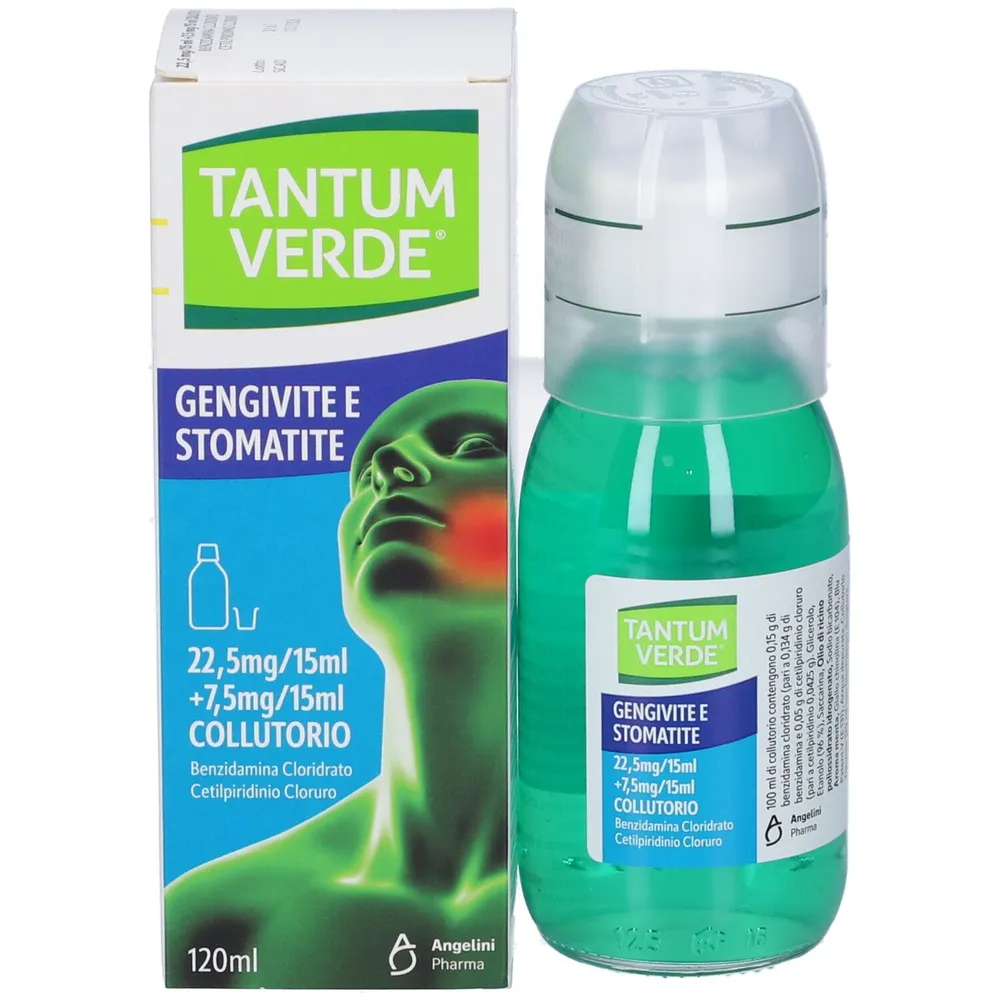
Table of Contents
- Package leaflet: Information for the user
- TANTUM VERDE GINGIVITIS AND STOMATITIS 22.5 mg/15 ml + 7.5 mg/15 ml mouthwash
- 1. What it is and what it is used for
- 2. What you need to know before taking
- 3. How to take it
- 4. Possible adverse reactions
- 5. How to store
- 6. Package contents and other information
Package leaflet: Information for the user
TANTUM VERDE GINGIVITIS AND STOMATITIS 22.5 mg/15 ml + 7.5 mg/15 ml mouthwash
Benzidamine hydrochloride / Cetylpyridinium chloride
Please read all of this leaflet carefully before taking this medicine because it contains important information for you.
Always take this medicine exactly as described in this leaflet or as your doctor or pharmacist has instructed you.
- Keep this leaflet. You may need to read it again.
- If you need more information or advice, consult your pharmacist.
- If any adverse reactions occur, including those not listed in this leaflet, contact your doctor or pharmacist. See section 4.
- Contact your doctor if you do not notice any improvement or if your symptoms worsen after 5–7 days of treatment.
Contents of this leaflet:
- What Tantum Verde is and what it is used for
- What you need to know before taking it
- How to take it
- Possible side effects
- How to store it
- Contents of the pack and other information
1. What it is and what it is used for
contains the active substances benzalkonium chloride (a
non-steroidal anti-inflammatory) and cetetylpyridinium chloride (an antiseptic).
It is used as an antiseptic, anti-inflammatory and analgesic in
irritations of the mouth and gums, in gingivitis and stomatitis (such as aphthae, mouth blisters,
inflammation caused by dentures). It is also indicated before and after dental extractions.
Consult your doctor if you do not feel better or if you feel worse after 5-7 days of treatment.
2. What you need to know before taking
Do not take
- if you are allergic to benzidamine hydrochloride, cetylpyridinium chloride, or any of the other ingredients of this medicine (listed in section 6).
Warnings and precautions
Talk to your doctor or pharmacist before taking
The use of , especially if prolonged, may lead to sensitization (allergic reactions). In such cases, stop treatment and consult your doctor to start appropriate therapy. See section 4 “Possible side effects”.
Other medicines and
Inform your doctor or pharmacist if you are taking, have recently taken, or might take any other medicines, including those without a prescription. Avoid the simultaneous use of other antiseptics.
Pregnancy and breastfeeding
If you are pregnant, suspect you may be pregnant, planning a pregnancy, or breastfeeding, consult your doctor or pharmacist before taking this medicine.
Do not use during pregnancy unless clearly necessary and as directed by your doctor. If treatment is required, the lowest dose for the shortest possible duration should be used.
During breastfeeding, this medicine should only be used under medical supervision.
Driving and using machines
The use of , at the recommended doses, does not affect the ability to drive or operate machinery.
contains hydrogenated polyoxyl castor oil and mint flavour
contains hydrogenated polyoxyl castor oil, which may cause localized skin reactions.
This medicine contains mint flavour, which in turn contains benzyl alcohol, cinnamyl alcohol, citral, citronellol, geraniol, isoeugenol, linalool, eugenol, and D-limonene. Benzyl alcohol, cinnamyl alcohol, citral, citronellol, geraniol, isoeugenol, linalool, eugenol, and D-limonene may cause allergic reactions.
3. How to take it
Take this medicine exactly as stated in this leaflet or as directed by your doctor or pharmacist. If you have any doubts, consult your doctor or pharmacist.
The recommended dose is 15 ml, 2–3 times daily.
Pour into the provided measuring cup up to the 15 ml mark.
Perform mouth rinses 2–3 times daily.
Caution: Do not exceed the recommended doses without medical advice.
It may be used, if necessary, at any time of the day.
Use for a maximum period of 5–7 days. For prolonged use, consult your doctor.
Consult your doctor if symptoms recur frequently or if you have noticed any recent changes in their characteristics.
If you take more than you should
If you take an excessive amount of this medicine or accidentally ingest a large quantity, contact your doctor or pharmacist immediately.
With local use of benzidamine hydrochloride and cetylpyridinium chloride, overdose effects have never been reported.
However, if benzidamine administered locally enters the bloodstream (systemic absorption), toxic symptoms of overdose may include: excitement, convulsions, sweating, ataxia (progressive loss of muscular coordination), tremors, and vomiting.
If you ingest large amounts of cetylpyridinium chloride (more than ten product packages), symptoms such as nausea, vomiting, dyspnea (difficulty breathing), cyanosis (insufficient oxygen in the blood), asphyxia (suffocation), decreased central nervous system activity, hypotension (low blood pressure), and coma (loss of consciousness and alertness) may occur.
If you forget to take a dose
Do not take a double dose to make up for a forgotten dose.
If you stop treatment
If you have any questions about using this medicine, consult your doctor or pharmacist.
4. Possible adverse reactions
Like all medicines, this medicine can cause adverse reactions, although not everyone experiences them.
The adverse reactions that may occur during use of ,
whose frequency is unknown, are:
Benzidamine:
- slight numbness in the mouth. This effect is typically associated with the local anaesthetic activity of benzidamine Cetylpyridinium:
- drug intolerance phenomena manifesting as mild and transient local burning or irritation. These effects do not require changes in treatment.
Following the instructions contained in this leaflet reduces the risk of adverse reactions.
Reporting of adverse reactions
If you experience any adverse reaction, including those not listed in this leaflet, talk to your doctor or
pharmacist. You may also report adverse reactions directly through the national reporting system at https://www.aifa.gov.it/content/segnalazioni-reazioni-avverse .
By reporting adverse reactions, you can help provide more information on the safety of this medicine.
5. How to store
Keep this medicine out of the sight and reach of children.
Store in the original packaging to protect the medicine from light and moisture.
Do not use this medicine after the expiry date stated on the carton. The expiry date refers to the last day of that month.
The shelf life of the medicine after first opening the bottle is 1 year.
Do not dispose of medicines via wastewater or household waste. Ask your pharmacist how to dispose of medicines you no longer use. This will help protect the environment.
6. Package contents and other information
What it contains
- The active substances are: benzidamine hydrochloride (100 ml of mouthwash contain 0.15 g of benzidamine hydrochloride, equivalent to 0.134 g of benzidamine) and cetalkonium chloride (100 ml of mouthwash contain 0.05 g of cetalkonium chloride, equivalent to 0.0425 g of cetalkonium).
- Other components are: glycerol, ethanol (96%), saccharin, polyoxyl 40 hydrogenated castor oil, peppermint flavour (see section “Contains polyoxyl 40 hydrogenated castor oil and peppermint flavour”), sodium bicarbonate, quinoline yellow (E 104), patent blue V (E 131), purified water.
Description of the appearance of the medicinal product and contents of the package
It is a mouthwash supplied in 120 ml or 240 ml bottles with a dosing cup.
Not all pack sizes may be marketed.
Marketing Authorization Holder
Angelini Pharma S.p.A., Viale Amelia 70, 00181 Rome, Italy
Manufacturer
A.C.R.A.F. S.p.A., Via Vecchia del Pinocchio, 22 - 60131 Ancona, Italy
N D E S
Inflammations affecting the gums, as well as the development of bad breath, may sometimes be related to the presence of bacterial plaque. Additionally, the gums and mouth may become red and painful following conservative dental treatments (e.g. treatment of dental caries), tooth extractions, or minor dental surgical procedures.
Certain environmental conditions, such as drops or fluctuations in temperature, increased humidity, etc., may cause inflammation of the upper respiratory tract (mouth, nose), as they favour the attack by germs that can lead to infections (pathogenic microorganisms). To avoid worsening symptoms such as burning and pain, it is advisable to avoid further irritating factors such as smoking, dry air, crowded places, etc.
All these conditions may be overcome more quickly by using a mouthwash that has specific activity against inflammation and pain, as well as local anaesthetic properties, and that simultaneously provides good efficacy against bacterial infections.