Stitilax
Italy
Table of Contents
Patient information leaflet
STITILAX 4.465 g / 0.45 g / 0.0645 g, rectal solution
Liquid sorbitol (crystallizable), sodium citrate, 70% sodium lauryl sulfacetate
Please read this leaflet carefully before using this medicine because it contains
important information for you.
Always use this medicine exactly as described in this leaflet or as your doctor or
pharmacist has instructed you.
- Keep this leaflet. You may need to read it again.
- If you need more information or advice, consult your pharmacist.
- If you experience any side effects, including those not listed in this leaflet, consult your doctor or pharmacist. See section 4.
- Consult your doctor if you do not notice improvement or if your symptoms worsen after a few days.
Contents of this leaflet:
- What STITILAX is and what it is used for
- What you need to know before using STITILAX
- How to use STITILAX
- Possible side effects
- How to store STITILAX
- Contents of the pack and other information
1. What STITILAX is
STITILAX belongs to a group of medicines called laxatives. It softens the stools and stimulates the evacuation reflex (defecation).
STITILAX is used for the treatment of occasional constipation.
This medicine is intended for use in adults only.
2. What you need to know before using STITILAX
Do not use STITILAX:
- If you are allergic to the active substances (sorbitol, sodium citrate, sodium lauryl sulfoacetate) or to any of the other ingredients of this medicine (listed in section 6).
- If you have abdominal pain of unknown cause.
- If you are taking cation-exchange resins such as calcium or sodium polystyrene sulfonate (orally or rectally), medicines used to treat hyperkalemia.
Warnings and precautions
Talk to your doctor or pharmacist before using STITILAX.
You must inform your doctor if:
- You suffer from hemorrhoids.
- You suffer from anal fissure (a lesion located in the anus which may cause persistent pain for several hours during defecation).
- You suffer from Crohn's disease or ulcerative colitis (conditions characterized by inflammation of the rectum and large intestine, presenting with symptoms such as stomach pain, diarrhea with mucus or blood, and often fatigue).
Other medicines and STITILAX
Tell your doctor or pharmacist if you are taking, have recently taken, or might take any other
medicine.
Do not use STITILAX together with calcium or sodium polystyrene sulfonate (orally or rectally).
Do not use other rectal medications concomitantly with STITILAX, as they may be expelled from the gastrointestinal tract and not absorbed.
Pregnancy, breastfeeding and fertility
If you are pregnant, suspect you may be pregnant, planning a pregnancy, or are breastfeeding, consult your doctor or pharmacist before using this medicine.
Driving and using machines
This medicine does not affect or affects negligibly the ability to drive or operate machinery.
STITILAX contains sorbic acid, glycerol and purified water.
3. How to use STITILAX
Use this medicine exactly as indicated in this leaflet or according to the instructions given by your doctor or pharmacist. If you have any doubts, consult your doctor or pharmacist.
Dosage:
The recommended dose is 1 tube with applicator per day.
Method of administration
This medicine is for rectal use. It is not necessary to lie down when administering this medicine or to wait for it to take effect.
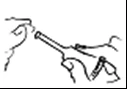
- Break off the tip, then gently press the tube until a drop appears.

- Lubricate the tip of the applicator with the drop that has come out.

- Insert the applicator fully into the rectum.

- Press the tube to empty all of its contents.

- Remove the applicator tip while continuing to press on the tube.
This medicine usually works within 5 to 20 minutes.
If you remain lying down for a long time, it may take longer (more than one hour).
Duration of treatment
Do not use this medicine for more than a few days without consulting your doctor.
4. Possible adverse reactions
Like all medicines, this medicine can cause adverse reactions, although not everybody will experience them.
The following adverse reactions have been reported with unknown frequency:
- Abdominal pain
- Anorectal discomfort
- Liquid stools
- Hypersensitivity reactions (urticaria)
Reporting of adverse reactions
If you experience any adverse reaction, including those not listed in this leaflet, contact your doctor or pharmacist. You may also report adverse reactions directly via the national reporting system at http://www.aifa.gov.it/content/come-segnalare-una-sospetta-reazione-avversa. By reporting adverse reactions, you can help provide more information on the safety of this medicine.
5. How to store STITILAX
This medicinal product does not require any special storage conditions.
Keep this medicine out of the sight and reach of children.
Do not use this medicinal product after the expiry date stated on the packaging. The expiry date refers to the last day of that month.
Do not dispose of any medicine via wastewater or household waste. Ask your pharmacist how to dispose of medicines no longer required. This will help protect the environment.
6. Package contents and other information
What STITILAX contains
The active substances are:
Sorbitol, liquid (crystallizable) ............................................................................4.4650 g
Sodium citrate ........................................................................................................0.4500 g
Sodium lauryl sulfosuccinate 70% ........................................................................0.0645 g
per 5 ml of rectal solution
The other components are sorbic acid, glycerol and purified water.
Description of the appearance of STITILAX rectal solution and contents of the pack
This medicine is presented as a rectal solution.
The rectal solution is a colourless, viscous solution containing small air bubbles, contained in a single-dose container.
Packs containing 4, 6, 12 or 50 single-dose containers.
It is possible that not all pack sizes are marketed.
Marketing Authorization Holder
Carlo Erba OTC S.r.l. – Via Ardeatina Km 23,500-00071 Santa Palomba Pomezia (Rome).
Manufacturer
Famar Orleans
5, Avenue De Concyr
45071 Orleans Cedex 2
France
This medicine is authorized in the EEA Member States under the following names:
| France | Sorbitol/Sodium Citrate/Sodium Lauryl Sulfoacetate Johnson & Johnson |
| Bulgaria | Microlax |
| Cyprus | Microlax |
| Croatia | Microlax |
| Greece | Microlax |
| Hungary | Microlax rectal solution |
| Poland | Microlax |
| Romania | Microlax |
| Slovakia | Microlax |
| Slovenia | Microlax |
CONSTIPATION INFORMATION
What you need to know
Constipation is defined as a reduction in bowel movement frequency to less than 3 times per week.
This definition is not an absolute rule. Indeed, the usual duration of intestinal transit (the passage of food through the intestine), and therefore the frequency of bowel movements, varies significantly from person to person. Consequently, it is important to consider the sensation of discomfort or problems associated with this slowed transit.
In the case of constipation, you may experience abdominal discomfort (bloating). Having a bowel movement can be difficult and even painful. The evacuation of stools may feel incomplete. The stools are hard and scanty. Cramps or bloating may also occur.
Occasional constipation is usually due to changes in daily habits (traveling abroad, changes in diet, stress, etc.) or to "holding back".
Dietary habits and lifestyle (physical inactivity) can also cause an imbalance in intestinal function, which may lead to prolonged periods of constipation (chronic constipation).
Other situations that may cause constipation include: certain medications (some painkillers, antidepressants, cough suppressants, aluminum-based antacids); in women: specific phases of the menstrual cycle, pregnancy, or menopause.
What you can do
Isolated episodes of constipation, although unpleasant, are generally insignificant.
In most cases, following some simple lifestyle advice can help facilitate intestinal transit and stool evacuation:
- Eat fiber-rich green vegetables and fresh fruit, which promote intestinal transit. You may also gradually and moderately consume bread or biscuits containing bran, or whole grain cereals.
- Avoid excessively fatty and overly sweet foods.
- Drink enough fluids regularly throughout the day (at least 1.5 liters/day): drink freely water, fruit juices, and soups.
- Go to the bathroom at a fixed time (usually 30–60 minutes after meals), without excessive straining to "push". Your body will adapt to a regular routine. It is also important to take the necessary time.
- Do not forget to engage in physical activity and exercise, such as walking; these are excellent ways to combat constipation.