Olevia
Italy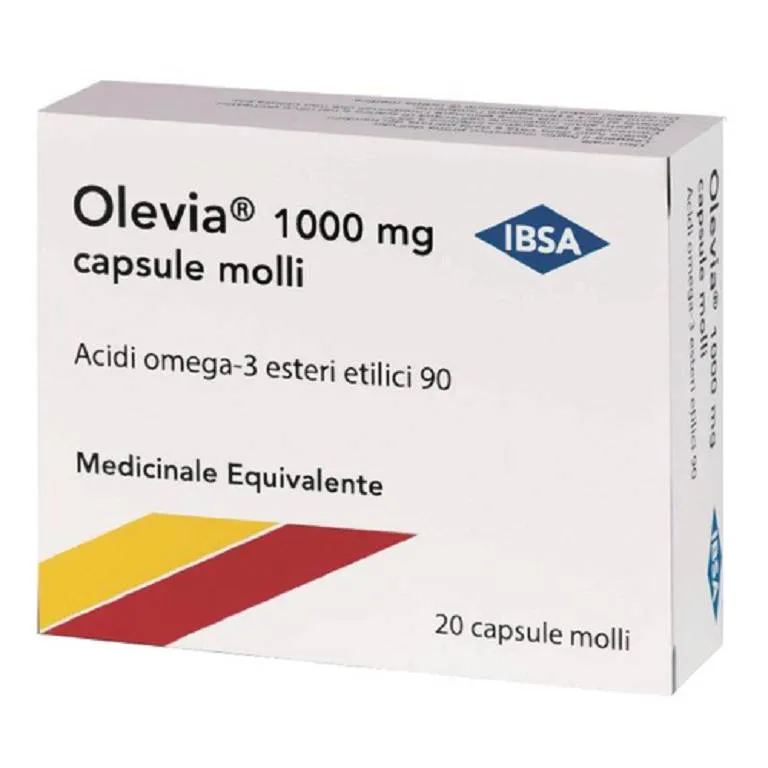
Table of Contents
Patient Information Leaflet
OLEVIA 1000 mg soft capsules
Omega-3 acid ethyl esters 90
Equivalent medicine
Please read this leaflet carefully before you start taking this medicine, as it
contains important information for you.
- Keep this leaflet. You may need to read it again.
- If you have any questions, ask your doctor or pharmacist.
- This medicine has been prescribed for you only. Do not give it to others, even if they have the same symptoms as you, because it could be harmful.
- If you experience any adverse reactions, including those not listed in this leaflet, consult your doctor or pharmacist. See section 4.
Contents of this leaflet:
- What OLEVIA is and what it is used for
- What you need to know before taking OLEVIA
- How to take OLEVIA
- Possible side effects
- How to store OLEVIA
- Contents of the pack and other information
1. What OLEVIA is and what it is used for
The active substances in OLEVIA are highly purified omega-3 fatty acid ethyl esters. OLEVIA
reduces certain blood fats (triglycerides).
OLEVIA is used to treat certain forms of elevated blood fats
(endogenous hypertriglyceridemia) after dietary changes and other non-pharmacological measures alone (e.g., physical activity) have not produced results.
2. What you need to know before taking OLEVIA
Do not take OLEVIA
- if you are allergic to omega-3 fatty acids, soybean lecithin, peanuts, or any of the other ingredients of this medicine (listed in section 6)
- if you are pregnant or breastfeeding.
Warnings and precautions
Talk to your doctor, pharmacist, or nurse before taking OLEVIA
- if you are scheduled for, or have recently undergone, a surgical procedure
- if you have recently suffered a traumatic injury
- if you have kidney problems
- if you have uncontrolled diabetes
- if you have or have had liver problems. Your doctor will order blood tests to monitor any potential liver-related effects of OLEVIA
- if you have or have had heart problems
- if you experience dizziness, weakness, palpitations, or shortness of breath, as these may be symptoms of an irregular and often very rapid heart rhythm (atrial fibrillation)
- if you are allergic to fish.
Children and adolescents
-
Due to lack of data on efficacy and safety, the use of OLEVIA is not recommended in children and adolescents.
Elderly -
There are no data on the use of OLEVIA in elderly patients over 70 years of age. Caution is advised when using OLEVIA in patients over 70.
Other medicines and OLEVIA
Inform your doctor or pharmacist if you are taking, have recently taken, or might take any other medicines, including those obtained without a prescription.
If you are taking OLEVIA together with a medicine that affects blood clotting (anticoagulant), an increased bleeding time may occur. Your doctor will closely monitor your treatment and, if necessary, adjust the dose of OLEVIA or the other medicine.
Pregnancy, breastfeeding and fertility
If you are pregnant, think you may be pregnant, are planning a pregnancy, or are breastfeeding, consult your doctor before taking this medicine.
Driving and using machines
No special precautions are required.
OLEVIA contains soybean lecithin
If you are allergic to peanuts or soy, do not take this medicine.
3. How to take OLEVIA
Take this medicine exactly as instructed by your doctor or pharmacist. If you have any doubts, please consult your doctor or pharmacist.
The recommended dose is 1 capsule 1–3 times daily, according to your doctor's prescription.
If you feel that the effect of OLEVIA is too strong or too weak, consult your doctor or pharmacist.
Instructions for use
- Swallow the capsules with a glass of water.
- Take the medicine for the duration of treatment prescribed by your doctor.
Use in the paediatric population
There are no data available on the use of OLEVIA in the paediatric population for the approved indications.
Use in elderly patients and patients with impaired kidney function
No dose adjustment is required in these patients.
Use in patients with impaired liver function
Your doctor will monitor your liver function during treatment, especially if you are taking high doses of OLEVIA (see section “Warnings and precautions”).
If you take more OLEVIA than you should
If you accidentally take more medicine than prescribed and experience adverse effects, contact your doctor immediately.
If you forget to take OLEVIA
Do not take a double dose to make up for the forgotten dose. Take the next dose as prescribed.
If you stop taking OLEVIA
Do not stop treatment without consulting your doctor.
If you have any questions about the use of this medicine, consult your doctor.
4. Possible side effects
Like all medicines, this medicine can cause side effects, although not everyone experiences them.
The following side effects may occur with the use of this medicine.
Common (may affect up to 1 in 10 people)
- stomach disorders and indigestion/digestive problems (dyspepsia)
- nausea
- rapid, irregular heartbeat
Uncommon (may affect up to 1 in 100 people):
- stomach ache, abdominal pain and upper abdominal pain
- stomach and/or intestinal disorders
- allergic reactions
- dizziness
- taste disturbances
- diarrhoea
- vomiting
Rare (may affect up to 1 in 1,000 people):
- headache
- acne
- itchy rash
- hyperglycaemia (high glucose levels)
- changes in liver function
- skin reactions
- intestinal inflammation
- stomach burning
- vertigo
- weakness
Very rare (may affect up to 1 in 10,000 people):
- presence of blood in the stools
- arterial hypotension (low blood pressure)
- dry nose
- itchy skin rash (urticaria)
- changes in the results of certain blood tests
Other side effects that have occurred in a very small number of people, but for which the frequency is unknown:
- pruritus (itching)
Reporting of side effects
If you experience any side effect, including those not listed in this leaflet, talk to your doctor or pharmacist.
You can also report side effects directly via the national reporting system at “http://www.agenziafarmaco.gov.it/content/come-segnalare-una-sospetta-reazione-avversa”.
By reporting side effects, you can help provide more information on the safety of this medicine.
5. How to store OLEVIA
Keep this medicine out of the sight and reach of children.
Do not use this medicine after the expiry date stated on the packaging. The expiry date refers to the last day of that month.
Do not use this medicine if you notice any visible signs of degradation.
Store below 25 °C.
Do not dispose of medicines via wastewater or household waste. Ask your pharmacist how to dispose of medicines you no longer use. This will help protect the environment.
6. Package contents and other information
What OLEVIA contains
- The active substances are omega-3 fatty acid ethyl esters 90, with a content of EPA and DHA of not less than 85% and in a ratio to each other of 0.9 - 1.5. Each capsule contains 1000 mg of omega-3 fatty acid ethyl esters 90.
- The other components are: D,L-rac-α-Tocoferolo, succinylated gelatin, glycerol, medium-chain triglycerides, traces of soy lecithin.
Description of the appearance of OLEVIA and package contents
This medicinal product is presented as soft, oblong, light yellow capsules containing a yellowish oil with a characteristic fishy odour.
The capsules are packaged in aluminium/PVC/PE/PVDC blisters containing 10 capsules each.
Pack sizes of 2 or 3 blisters.
Marketing Authorization Holder and Manufacturer
IBSA Farmaceutici Italia Srl, via Martiri di Cefalonia, 2, 26900 Lodi, Italy