Nirolex cough and bronchitis
Italy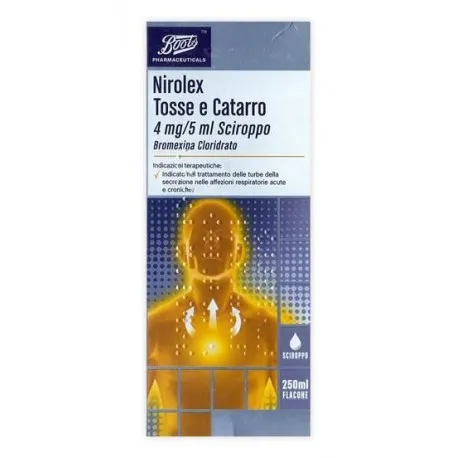
BEFORE USE
READ CAREFULLY ALL INFORMATION CONTAINED IN THIS LEAFLET
This is a self-medication product that you can use to treat mild and transient disorders which are easily recognizable and resolvable without medical intervention.
It may therefore be purchased without a prescription, but must be used correctly to ensure its effectiveness and minimize unwanted effects.
- For further information and advice, consult your pharmacist.
- Consult a doctor if the condition does not resolve after a short period of treatment.
NAME OF THE MEDICINAL PRODUCT
NIROLEX COUGH AND CATARRH 4 mg/5 ml syrup
Bromhexine Hydrochloride
WHAT IT IS
NIROLEX COUGH AND CATARRH syrup is a mucolytic agent: it liquefies thick mucus deposits in the respiratory tract and thus facilitates their elimination.
WHY IT IS USED
NIROLEX COUGH AND CATARRH syrup is used for the treatment of disorders related to secretion (e.g. presence of cough and phlegm) in acute and chronic respiratory conditions.
WHEN IT MUST NOT BE USED
Hypersensitivity to the active substance or to any of the excipients.
The medicine is contraindicated in children under 2 years of age.
Breast-feeding (see section "What to do during pregnancy and breast-feeding").
In case of inherited conditions that may be incompatible with one of the excipients (see section “Important information”).
PRECAUTIONS FOR USE
Treatment with NIROLEX COUGH AND CATARRH syrup increases bronchial secretion (which facilitates expectoration). Do not use for prolonged treatments. If there is no noticeable improvement after a short period of treatment, consult your doctor.
WHICH MEDICINES OR FOODS MAY AFFECT THE MEDICINE’S EFFECT
No interactions with other medicines have been reported.
If you are taking other medicines, please seek advice from your doctor or pharmacist.
IMPORTANT INFORMATION
Mucolytics may cause bronchial obstruction in children under 2 years of age. Indeed, the ability to drain bronchial mucus is limited in this age group due to the physiological characteristics of the respiratory tract.
Therefore, they must not be used in children under 2 years of age (see section “When it must not be used”).
Very rarely, serious skin reactions such as Stevens-Johnson syndrome and Lyell's syndrome have been observed during administration of mucolytic agents like bromhexine.
Most of these cases could be explained by the severity of underlying diseases or concomitant use of other medications.
If new skin or mucosal lesions occur, discontinue treatment with bromhexine as a precaution and consult your doctor.
When it should only be used after consulting a doctor
There are no absolute contraindications, but in patients with gastric or duodenal ulcers, use is recommended only after consulting a doctor.
Pregnancy (see section "What to do during pregnancy and breast-feeding").
It is also advisable to consult a doctor if such conditions have occurred previously.
What to do during pregnancy and breast-feeding
During pregnancy, NIROLEX COUGH AND CATARRH should only be used after consulting a doctor and carefully evaluating the risk-benefit ratio in your individual case.
NIROLEX COUGH AND CATARRH must not be used during breast-feeding.
Consult your doctor if you suspect you are pregnant or plan to become pregnant.
Ask your doctor or pharmacist for advice before taking any medicine.
Driving and use of machines
Bromhexine hydrochloride does not affect the ability to drive vehicles or operate machinery.
Important information about some excipients in NIROLEX COUGH AND CATARRH
This medicine contains sorbitol: if your doctor has diagnosed you with an intolerance to certain sugars, contact him before taking this medicine. The product may cause mild laxative effects. The caloric value of sorbitol is 2.6 kcal/g.
The product contains 3.7 vol% ethanol. A single dose may contain up to 0.3 g of ethanol per dose, equivalent to 7.4 ml of beer or 3 ml of wine per dose. It may be harmful for alcoholics. This should be taken into account in pregnant or breast-feeding women, children, and high-risk groups such as patients with liver disease or epilepsy.
For individuals engaged in sports, the use of medicines containing ethyl alcohol may lead to positive anti-doping test results, depending on the blood alcohol concentration limits set by certain sports federations.
HOW TO USE THIS MEDICINE
Dosage
The following doses are recommended unless otherwise prescribed by a doctor.
Adults: 1–2 teaspoonfuls (5–10 ml) three times daily.
At the beginning of treatment, the total daily dose may be increased up to 48 mg (60 ml), divided into three doses.
Children over 2 years of age: ½–1 teaspoonful (2.5–5 ml) three times daily.
The syrup is suitable for diabetics and children over 2 years of age and contains neither fructose nor sucrose.
Do not exceed the recommended doses.
When and for how long
It is recommended to take the medicine after meals.
Consult your doctor if symptoms recur frequently or if you have noticed any recent changes in their characteristics.
Caution: Use only for short-term treatment.
How to take
Administer orally.
WHAT TO DO IF YOU HAVE TAKEN AN EXCESSIVE DOSE
Cases of overdose have never been reported. In case of overdose, symptomatic treatment is required.
In the event of accidental ingestion of an excessive dose of NIROLEX COUGH AND CATARRH, contact your doctor immediately or go to the nearest hospital.
If you have any doubts about the use of NIROLEX COUGH AND CATARRH, consult your doctor or pharmacist.
UNDESIRABLE EFFECTS
Like all medicines, NIROLEX COUGH AND CATARRH can cause side effects, although not everyone experiences them.
Cases of diarrhea, nausea, vomiting, and other mild gastrointestinal disturbances have been reported. Cases of allergic reactions including skin rash (redness of the skin), urticaria, bronchospasm, angioedema, and anaphylaxis have also been reported. In such cases, discontinue treatment.
These side effects are generally transient. However, if they occur, it is advisable to consult your doctor or pharmacist.
Bronchial obstruction: frequency unknown.
Following the instructions in this leaflet reduces the risk of side effects.
If any of the side effects worsens, or if you notice any side effect not listed in this leaflet, inform your doctor or pharmacist.
EXPIRY DATE AND STORAGE
See the expiry date stated on the packaging.
The expiry date refers to the product in unopened packaging stored correctly.
Caution: Do not use the medicine after the expiry date stated on the packaging.
After first opening the bottle, the product should be used within 9 months if stored below 25°C; after this time, any remaining product should be discarded.
It is important to always keep the medicine information available; therefore, retain both the outer packaging and the leaflet.
Keep the medicine out of the reach and sight of children.
COMPOSITION
5 ml of syrup contain:
Active substance: bromhexine hydrochloride 4 mg (equivalent to 3.65 mg bromhexine).
(One teaspoonful, equal to 5 ml, contains: bromhexine hydrochloride 4 mg).
Excipients: tartaric acid, benzoic acid, sodium carmellose, glycerol, sorbitol liquid, ethanol (96%), tutti frutti flavor, sodium hydroxide, purified water.
PRESENTATION
NIROLEX COUGH AND CATARRH is available as a syrup. The pack contains 250 ml.
MARKETING AUTHORISATION HOLDER
Almus S.r.l. – Via Cesarea 11/10 – 16121 Genova (GE)
MANUFACTURER AND FINAL CONTROLLER
ABC FARMACEUTICI S.p.A. – Canton Moretti, 29 – 10090 San Bernardo d’Ivrea (TO)