Mepivacaine
Italy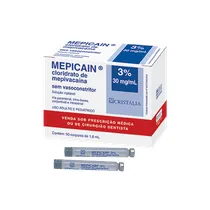
MEPICAIN 1% - 2% - 3%
INJECTABLE SOLUTION
ATC: N01BB03
mepivacaine hydrochloride
MEPICAIN 2% with ADRENALINE 1:200,000
INJECTABLE SOLUTION
ATC: N01BB53
mepivacaine hydrochloride
adrenaline bitartrate
COMPOSITION
| MEPICAIN | 1% | 2% | 3% | 2% with adrenaline 1:200,000 | |--------------|--------|--------|--------|-------------------------------| | Active substances: | | | | | | mepivacaine hydrochloride | 10 mg | 20 mg | 30 mg | 20 mg | | adrenaline bitartrate | / | / | / | 0.009 mg | | (equivalent to adrenaline) | / | / | / | 0.005 mg | | Excipients: | | | | | | sodium chloride | 5 mg | 5 mg | 3 mg | 5 mg | | sodium metabisulfite | / | / | / | 0.5 mg | | water for injection to | 1 ml | 1 ml | 1 ml | 1 ml |
PHARMACEUTICAL FORM AND CONTENT: Injectable solution.
MEPICAIN 1%: 10 ml vial.
MEPICAIN 2%: 2 ml and 10 ml vials.
MEPICAIN 3%: 2 ml vial.
MEPICAIN 2% with adrenaline 1:200,000: 2 ml and 10 ml vials.
THERAPEUTIC CATEGORY: Local anesthetics: amides.
MARKETING AUTHORISATION HOLDER, MANUFACTURER AND FINAL CONTROLLER: MONICO S.p.A. – Via Ponte di Pietra 7 – VENEZIA/MESTRE.
THERAPEUTIC INDICATIONS: Local anesthetic for use in all procedures including:
- General surgery (minor surgery)
- Obstetrics and gynecology
- Ophthalmology (retrobulbar block, etc.)
- Dermatology (removal of warts, cysts, dermoids, etc.)
- Sports medicine (muscle tears, meniscopathies, etc.)
- Otorhinolaryngology (tonsillectomy, rhinoplasty, middle ear surgery, etc.)
- Orthopedics (fracture and dislocation reduction, etc.)
- General medicine (causalgia, neuralgia, etc.)
MEPICAIN with adrenaline 1:200,000 is indicated when prolonged duration of regional anesthesia is desired or when surgery must be performed in a completely ischemic area.
CONTRAINDICATIONS
Hypersensitivity to any of the components. The product containing the vasoconstrictor is generally contraindicated in patients with cardiac disease, severe arteriopathies, hypertension, those with ischemic manifestations of any kind or essential migraine, nephropathic patients, hyperthyroid patients, diabetics, patients with prostatic hypertrophy or acute-angle glaucoma. The product is contraindicated in confirmed or suspected pregnancy.
PRECAUTIONS FOR USE
Mepicain must be used with extreme caution in patients undergoing treatment with MAO inhibitors or tricyclic antidepressants. Prior to administration, the physician must assess the circulatory status of the patient. Any overdose of anesthetic must be avoided, and two maximum doses must never be administered without an interval of at least 24 hours. The maximum daily dose is 1000 mg. However, the lowest effective doses and concentrations should always be used. The anesthetic solution must be injected cautiously in small amounts, following a preliminary aspiration after approximately 10 seconds. When infiltrating highly vascularized areas, it is advisable to wait approximately two minutes before performing the actual regional block. The patient must be kept under close monitoring, and administration must be immediately suspended at the first sign of alarm (e.g., alteration in consciousness). Immediate availability of emergency equipment, medications, and trained personnel is essential, as rare but serious, sometimes fatal, reactions have been reported following the use of local anesthetics, even in the absence of individual hypersensitivity in the patient's history.
INTERACTIONS
Administration of local anesthetics containing adrenaline to patients undergoing treatment with MAO inhibitors or tricyclic antidepressants may cause severe and prolonged hypertension. Concomitant use of these drugs should be avoided, and if administration is necessary, careful patient monitoring must be implemented.
SPECIAL WARNINGS
The product containing the vasoconstrictor includes sodium metabisulfite. This substance may cause allergic-type reactions and severe asthma attacks, particularly in sensitive individuals and especially in asthmatics.
DOSAGE, ROUTE AND TIME OF ADMINISTRATION
The maximum dose in a healthy adult (not pre-treated with sedatives), in a single administration or in repeated administrations within less than 90 minutes, is 7 mg/kg, without exceeding 550 mg. The total dose over 24 hours must never exceed 1000 mg. In pediatric patients, doses must not exceed 5–6 mg/kg.
RECOMMENDED DOSAGES
Surgery:
- Epidural and caudal block: up to 400 mg, achievable with 15–30 ml of a 1% solution or 10–20 ml of a 2% solution
- Paravertebral block: up to 400 mg with 1% solution for stellate ganglion block and autonomic blocks, 1–2% solution for paravertebral somatic nerve blocks
- Central, bronchial, intercostal, paracervical, pudendal and peripheral nerve blocks: up to 400 mg, achievable with 5–20 ml of 1% or 2% solution, depending on the area and extent of the block
- Infiltration: up to 400 mg depending on the surgical area, obtainable with variable volumes up to 40 ml of a 0.5–1% solution
Obstetrics:
- Paracervical block: up to 200 mg within a 90-minute period, obtainable with 10 ml of 1% solution per side
OVERDOSE
At the first sign of alarm, administration must be stopped, the patient placed in a horizontal position, and airway patency ensured, administering oxygen in case of severe dyspnea or performing artificial ventilation. The use of bulbar analeptics should be avoided to prevent worsening the condition by increasing oxygen consumption. Any seizures can be controlled with intravenous diazepam at a dose of 10–20 mg; barbiturates are not recommended as they may exacerbate bulbar depression. Circulation can be supported by intravenous administration of appropriate doses of corticosteroids; diluted solutions of alpha-beta stimulants with vasoconstrictor action (mephentermine, metaraminol, and others) or atropine sulfate may be added. Sodium bicarbonate, in appropriate concentrations, may be used intravenously as an antiacidotic agent.
UNDESIRABLE EFFECTS
Adverse effects associated with mepivacaine administration are similar to those observed with other amide-type local anesthetics. These are dose-dependent effects that may result from high plasma levels due to overdose, rapid absorption, accidental intravascular injection, or may be caused by hypersensitivity, idiosyncrasy, or reduced patient tolerance. Toxic and allergic reactions may occur to both the anesthetic and the vasoconstrictor. Toxic effects from overdose include central nervous system stimulation with excitation, tremors, disorientation, dizziness, mydriasis, increased metabolism and body temperature, and, at very high doses, trismus and convulsions. If the medulla oblongata is affected, cardiovascular, respiratory, and emetic centers may be involved, leading to sweating, arrhythmias, hypertension, tachypnea, bronchodilation, nausea, and vomiting. Peripheral effects may involve the cardiovascular system, causing bradycardia and vasodilation. Allergic reactions mostly occur in hypersensitive individuals, but many cases have been reported in patients without prior history of hypersensitivity. Local manifestations include various types of skin eruptions, urticaria, and pruritus; systemic reactions include bronchospasm, laryngeal edema, and even cardiorespiratory collapse due to anaphylactic shock. The vasoconstrictor, due to its circulatory effects, may cause various undesirable effects, especially in patients with pre-existing cardiovascular abnormalities: anxiety, sweating, respiratory distress, cardiac arrhythmias, hypertension (particularly severe in hypertensive and hyperthyroid patients), acute headache, photophobia, retrosternal and pharyngeal pain, and vomiting. Patients are advised to inform their physician or pharmacist of any adverse effect not described in this leaflet.
EXPIRY DATE AND STORAGE
Check the expiry date stated on the packaging.
The expiry date refers to the product stored unopened and under proper storage conditions.
Warning: Do not use the medicinal product after this date.
Keep the medicinal product out of the reach and sight of children.
REVISION OF THE PACKAGE LEAFLET BY AIFA
10 November 2007
MEPICAIN 3%
INJECTABLE SOLUTION
ATC: N01BB03
mepivacaine hydrochloride
MEPICAIN 2% with ADRENALINE 1:100,000
INJECTABLE SOLUTION
ATC: N01BB53
mepivacaine hydrochloride
adrenaline bitartrate
COMPOSITION
| MEPICAIN | 3% | 2% with adrenaline 1:100,000 | |--------------|--------|-------------------------------| | Active substances per 1 ml: | | | | mepivacaine hydrochloride | 30 mg | 20 mg | | adrenaline bitartrate | / | 0.0182 mg | | (equivalent to adrenaline) | / | 0.01 mg | | Excipients: | | | | sodium chloride | 3 mg | 5 mg | | sodium metabisulfite | / | 0.5 mg | | water for injection to | 1 ml | 1 ml |
PHARMACEUTICAL FORM AND CONTENT
Injectable solution
MEPICAIN 3%: 1.8 ml ampoule
MEPICAIN 2% with adrenaline 1:100,000: 1.8 ml ampoule
THERAPEUTIC CATEGORY
Local anesthetics: amides (ATC: N01BB)
MARKETING AUTHORISATION HOLDER, MANUFACTURER AND FINAL CONTROLLER
MONICO S.p.A – Via Ponte di Pietra 7 – VENEZIA/MESTRE
THERAPEUTIC INDICATIONS: Local anesthetic for dental use.
CONTRAINDICATIONS
Proven hypersensitivity to any of the components. The product containing the vasoconstrictor is generally contraindicated in patients with cardiac disease, severe arteriopathies, hypertension, those with ischemic manifestations of any kind or essential migraine, nephropathic patients, hyperthyroid patients, diabetics, patients with prostatic hypertrophy or acute-angle glaucoma. The product is contraindicated in confirmed or suspected pregnancy.
PRECAUTIONS FOR USE
Mepicain must be used with extreme caution in patients undergoing treatment with MAO inhibitors or tricyclic antidepressants. Prior to use, the physician must assess the circulatory status of the patient. The anesthetic solution must be injected cautiously in small doses following a preliminary aspiration after approximately 10 seconds. When infiltrating highly vascularized areas, it is advisable to wait approximately two minutes before performing the actual regional block. The patient must be kept under close monitoring, and administration must be immediately suspended at the first sign of alarm (e.g., alteration in consciousness). Immediate availability of emergency equipment, medications, and trained personnel is essential, as rare but serious, sometimes fatal, reactions have been reported following the use of local anesthetics, even in the absence of individual hypersensitivity in the patient's history.
INTERACTIONS
Administration of local anesthetics containing adrenaline to patients undergoing treatment with MAO inhibitors or tricyclic antidepressants may cause severe and prolonged hypertension. Concomitant use of these drugs should be avoided, and if administration is necessary, careful patient monitoring must be implemented.
SPECIAL WARNINGS
The product containing the vasoconstrictor includes sodium metabisulfite. This substance may cause allergic-type reactions and severe asthma attacks, particularly in sensitive individuals and especially in asthmatics.
DOSAGE, ROUTE AND TIME OF ADMINISTRATION
1–2 ml or more, depending on procedural requirements, for infiltration or peripheral nerve block.
OVERDOSE
At the first sign of alarm, administration must be stopped, the patient placed in a horizontal position, and airway patency ensured, administering oxygen in case of severe dyspnea or performing artificial ventilation. The use of bulbar analeptics should be avoided to prevent worsening the condition by increasing oxygen consumption. Any seizures can be controlled with intravenous diazepam at a dose of 10–20 mg; barbiturates are not recommended as they may exacerbate bulbar depression. Circulation can be supported by intravenous administration of appropriate doses of corticosteroids; diluted solutions of alpha-beta stimulants with vasoconstrictor action (mephentermine, metaraminol, and others) or atropine sulfate may be added. Sodium bicarbonate, in appropriate concentrations, may be used intravenously as an antiacidotic agent.
UNDESIRABLE EFFECTS
Adverse effects associated with mepivacaine administration are similar to those observed with other amide-type local anesthetics. These are dose-dependent effects that may result from high plasma levels due to overdose, rapid absorption, accidental intravascular injection, or may be caused by hypersensitivity, idiosyncrasy, or reduced patient tolerance. Toxic and allergic reactions may occur to both the anesthetic and the vasoconstrictor. Toxic effects from overdose include central nervous system stimulation with excitation, tremors, disorientation, dizziness, mydriasis, increased metabolism and body temperature, and, at very high doses, trismus and convulsions; if the medulla oblongata is affected, cardiovascular, respiratory, and emetic centers may be involved, leading to sweating, arrhythmias, hypertension, tachypnea, bronchodilation, nausea, and vomiting. Peripheral effects may involve the cardiovascular system, causing bradycardia and vasodilation. Allergic reactions mostly occur in hypersensitive individuals, but many cases have been reported in patients without prior history of hypersensitivity. Local manifestations include various types of skin eruptions, urticaria, and pruritus; systemic reactions include bronchospasm, laryngeal edema, and even cardiorespiratory collapse due to anaphylactic shock. The vasoconstrictor, due to its circulatory effects, may cause various undesirable effects, especially in patients with pre-existing cardiovascular abnormalities: anxiety, sweating, respiratory distress, cardiac arrhythmias, hypertension (particularly severe in hypertensive and hyperthyroid patients), acute headache, photophobia, retrosternal and pharyngeal pain, vomiting.
Patients are advised to inform their physician or pharmacist of any adverse effect not described in this leaflet.
EXPIRY DATE AND STORAGE
Check the expiry date stated on the packaging. The expiry date refers to the product stored unopened and under proper storage conditions.
Warning: Do not use the medicinal product after this date.
Keep the medicinal product out of the reach and sight of children.
9 AUGUST 2007