Magnesia S. Pellegrino
Italy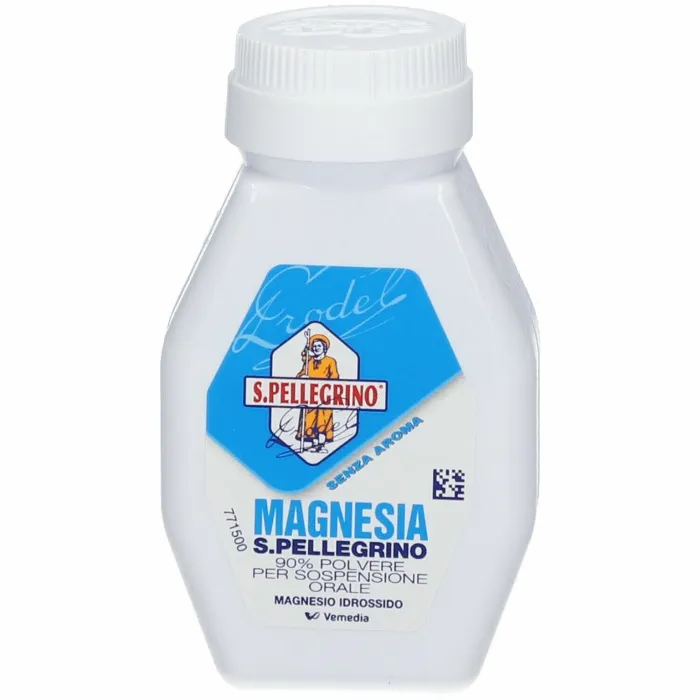
Table of Contents
- Package leaflet: Information for the patient
- Magnesia S. Pellegrino 45% effervescent powder
- 1. What Magnesia S. Pellegrino is and what it is used for
- 2. What you need to know before taking Magnesia S. Pellegrino
- 3. How to take Magnesia S. Pellegrino
- 4. Possible side effects
- 5. How to store Magnesia S. Pellegrino
- 6. Package contents and other information
- Patient Information Leaflet
- Magnesia S. Pellegrino 90% oral suspension powder
- 1. What Magnesia S. Pellegrino is and what it is used for
- 2. What you should know before taking Magnesia S. Pellegrino
- 3. How to take Magnesia S. Pellegrino
- 4. Possible side effects
- 5. How to store Magnesia S. Pellegrino
- 6. Contents of the package and other information
Package leaflet: Information for the patient
Magnesia S. Pellegrino 45% effervescent powder
Magnesium hydroxide
Please read carefully all this leaflet before taking this medicine because it contains
important information for you.
Always take this medicine exactly as described in this leaflet or as your doctor or
pharmacist has instructed.
- Keep this leaflet. You may need to read it again.
- If you need more information or advice, consult your pharmacist.
- If you experience any adverse reaction, including those not listed in this leaflet, contact your doctor or pharmacist. See section 4.
- Contact your doctor if you do not notice any improvement or if you notice worsening of symptoms after 7 days of treatment.
Contents of this leaflet:
- What Magnesia S. Pellegrino is and what it is used for
- What you need to know before taking Magnesia S. Pellegrino
- How to take Magnesia S. Pellegrino
- Possible side effects
- How to store Magnesia S. Pellegrino
- Contents of the pack and other information
1. What Magnesia S. Pellegrino is and what it is used for
Magnesia S. Pellegrino contains magnesium hydroxide.
It is indicated for the short-term treatment of occasional constipation and for the relief of heartburn (as an antacid).
Consult your doctor if you do not feel better or if you feel worse after 7 days.
2. What you need to know before taking Magnesia S. Pellegrino
Do not take Magnesia S. Pellegrino if:
- you are allergic to magnesium hydroxide or to any of the other ingredients of this medicine (listed in section 6);
- you have severely reduced kidney function (severe renal insufficiency);
- you have acute or unexplained abdominal pain, nausea or vomiting, intestinal blockage or narrowing (intestinal obstruction or stenosis), unexplained rectal bleeding, or severe dehydration;
- the child to be treated is under 6 years of age.
Warnings and precautions
Talk to your doctor or pharmacist before taking Magnesia S. Pellegrino:
- if you suffer from chronic or recurrent constipation. In such cases, medical intervention is always required for diagnosis and prescription of other medicines, as well as ongoing medical supervision during treatment.
- if you have kidney problems;
- if you are elderly. If the need for a laxative arises from a sudden change in previous bowel habits (frequency and characteristics of bowel movements) lasting more than two weeks, or if the use of a laxative fails to produce an effect, you must consult your doctor.
Abuse of laxatives (frequent or prolonged use, or excessive doses) may cause persistent diarrhoea, resulting in loss of water, electrolytes (especially potassium), and other essential nutrients.
In more severe cases, dehydration or low blood potassium levels (hypokalaemia) may occur, which can lead to heart, muscle, and nervous system disorders, particularly if you are also taking certain medicines used for heart problems (cardiac glycosides), medicines that increase urine production (diuretics), or medicines used to treat immune system disorders (corticosteroids).
Laxative abuse may lead to dependence (the need to progressively increase the dose), chronic constipation, and loss of normal intestinal function (intestinal atony).
Health education notes
It should first be noted that, in most cases, a balanced diet rich in water and fibre (bran, vegetables, and fruit) can provide a lasting solution to constipation.
Many people believe they suffer from constipation if they do not have a bowel movement every day. This is a misconception, as going less frequently is perfectly normal for many individuals.
Constipation should instead be considered when bowel movements become less frequent than your usual pattern and are associated with the passage of hard stools.
Consult your doctor if episodes of constipation recur frequently.
Children
In young children, the use of magnesium hydroxide may cause hypermagnesaemia, particularly if renal impairment or dehydration is present.
Other medicines and Magnesia S. Pellegrino
Inform your doctor or pharmacist if you are currently taking, have recently taken, or might take any other medicines, including those without a prescription.
Some medicines may be affected by magnesium hydroxide or may affect its action.
Inform your doctor or pharmacist if you are taking salicylates.
Laxatives may reduce the intestinal transit time, and therefore the absorption, of other medicines taken simultaneously by mouth.
After taking another medicine, wait at least 2 hours before taking the laxative.
Inform your doctor if you are being treated with:
- antacids (medicines used for stomach problems);
- antibiotics (tetracyclines, nitrofurantoin, lincomycin), used to treat bacterial infections;
- indometacin and dexamethasone (anti-inflammatory medicines);
- phosphorus;
- digitalis (medicines used for heart problems);
- quinidine (used for heart rhythm disorders);
- iron salts.
Magnesia S. Pellegrino with food and drinks
Milk may alter the effect of the medicine; wait at least one hour before taking the laxative.
Fertility, pregnancy and breastfeeding
If you are pregnant, suspect you may be pregnant, planning to become pregnant, or breastfeeding, consult your doctor or pharmacist before taking this medicine.
Pregnancy
Magnesia S. Pellegrino should be used only if necessary and only after consulting your doctor.
Breastfeeding
This medicine is considered compatible with breastfeeding.
Driving and using machines
Magnesia S. Pellegrino does not affect the ability to drive or operate machinery.
Magnesia S. Pellegrino contains sucrose
If your doctor has diagnosed you with an intolerance to certain sugars, contact him before taking this medicine.
Magnesia S. Pellegrino contains approximately 0.5 g of sodium (the main component of table salt) per 10 g of product taken. This corresponds to 28% of the maximum recommended daily dietary intake for an adult.
Magnesia S. Pellegrino 45% effervescent powder contains sodium salts.
This medicine contains:
- approximately 235 mg of sodium per 1 coffee spoon (about 4 g of product), equivalent to 11% of the maximum daily intake recommended by the WHO (2 g of sodium for an adult);
- approximately 0.5 g of sodium per 1 tablespoon (about 10 g of product), equivalent to 28% of the maximum daily intake recommended by the WHO (2 g of sodium for an adult).
Talk to your doctor or pharmacist if you need to take one or more tablespoons per day for a prolonged period, especially if you have been advised to follow a low-sodium diet.
3. How to take Magnesia S. Pellegrino
Take this medicine exactly as stated in this leaflet or as instructed by your doctor or pharmacist. If you have any doubts, consult your doctor or pharmacist.
The recommended dose is:
Adults: as an antacid: 1 coffee teaspoon;
as a laxative: 1 teaspoon;
as a purgative: 1 tablespoon.
Children between 6 and 12 years: half the adult doses.
When taking as a laxative, take the medicine preferably in the evening.
To open the 100 g bottle: remove the safety ring, lift the edge of the cap to open the bottle. To close, gently press the cap back onto the bottle.
Dissolve the powder in half a glass of water. Take together with an adequate amount of water (a full glass). A diet rich in fluids helps the medicine work effectively.
Do not exceed the recommended doses.
When using as a laxative, the correct dose is the smallest one that produces easy evacuation of soft stools. Initially use the lowest recommended doses. If necessary, increase the dose, but never exceed the maximum indicated dose.
Use laxatives as infrequently as possible and only for short treatment periods (no longer than seven days). Use for longer periods requires a prescription from your doctor following an appropriate evaluation of your condition.
Consult your doctor if the symptoms recur or if you have noticed any recent changes in their characteristics.
If you take more Magnesia S. Pellegrino than you should
In case of accidental ingestion/overdose of Magnesia S. Pellegrino, contact your doctor immediately or go to the nearest hospital.
Excessive doses may cause abdominal pain and diarrhoea.
If you forget to take Magnesia S. Pellegrino
Do not take a double dose to make up for the missed dose.
If you have any doubts about how to use this medicine, consult your doctor or pharmacist.
4. Possible side effects
Like all medicines, this medicine can cause side effects, although not everybody gets them.
The reported side effects are:
Very rare (may affect up to 1 in 10,000 people)
Hypermagnesaemia. This has been observed after prolonged administration in patients with
renal impairment.
Not known (frequency cannot be estimated from the available data)
Abdominal pain,
diarrhoea, stomach pains, sometimes with cramps or abdominal colic, more frequent in cases of
severe constipation.
Reporting of side effects
If you experience any side effect, including those not listed in this leaflet, talk to your doctor or pharmacist.
You can also report side effects directly via the national reporting system at:
www.agenziafarmaco.gov.it/content/come-segnalare-una-sospetta-reazione-avversa
By reporting side effects, you can help provide more information on the safety of this medicine.
5. How to store Magnesia S. Pellegrino
Keep this medicine out of the sight and reach of children.
Store below 25°C.
Do not use this medicine after the expiry date stated on the packaging after "Exp.".
The expiry date refers to the last day of that month.
Do not dispose of any medicine via wastewater or household waste. Ask your pharmacist how to
dispose of medicines you no longer use. This will help protect the environment.
6. Package contents and other information
What Magnesia S. Pellegrino contains
The active substance is magnesium hydroxide. 100 g of effervescent powder contain 45 g of
magnesium hydroxide.
The other components are:
lemon-flavoured powder – sucrose, tartaric acid, sodium bicarbonate, natural lemon flavour;
Description of the appearance of Magnesia S. Pellegrino and contents of the pack
The pack contains:
100 g bottle
Marketing Authorisation Holder and Manufacturer
VEMEDIA MANUFACTURING B.V.
Verrijn Stuartweg 60, 1112 – AX DIEMEN (The Netherlands)
Patient Information Leaflet
Magnesia S. Pellegrino 90% oral suspension powder
Magnesium hydroxide
Please read this leaflet carefully before taking this medicine as it contains
important information for you.
Always take this medicine exactly as described in this leaflet or as your doctor or
pharmacist has instructed you.
- Keep this leaflet. You may need to read it again.
- If you would like more information or advice, consult your doctor or pharmacist.
- If you experience any adverse reaction, including those not listed in this leaflet, consult your doctor or pharmacist. See section 4.
- Consult your doctor if you do not notice any improvement or if your symptoms worsen after 7 days of treatment.
Contents of this leaflet:
- What Magnesia S. Pellegrino is and what it is used for
- What you need to know before taking Magnesia S. Pellegrino
- How to take Magnesia S. Pellegrino
- Possible side effects
- How to store Magnesia S. Pellegrino
- Package contents and other information
1. What Magnesia S. Pellegrino is and what it is used for
Magnesia S. Pellegrino contains magnesium hydroxide.
It is indicated for the short-term treatment of occasional constipation and for the treatment of heartburn (as an antacid).
Consult a doctor if you do not feel better or if you feel worse after 7 days.
2. What you should know before taking Magnesia S. Pellegrino
Do not take Magnesia S. Pellegrino if:
- you are allergic to magnesium hydroxide or to any of the other ingredients of this medicine (listed in section 6);
- you have severe kidney function impairment (severe renal insufficiency);
- you have acute abdominal pain or of unknown origin, nausea or vomiting, intestinal blockage or narrowing (intestinal obstruction or stenosis), rectal bleeding of unknown origin, or severe dehydration;
- the child to be treated is under 6 years of age.
Warnings and precautions
Talk to your doctor or pharmacist before taking Magnesia S. Pellegrino:
- if you suffer from chronic or recurrent constipation. In such cases, medical intervention for diagnosis and prescription of other medicines, as well as medical supervision during treatment, is always necessary.
- if you have kidney problems;
- if you are elderly. When the need for a laxative arises from a sudden change in previous bowel habits (frequency and characteristics of bowel movements) lasting more than two weeks, or when the use of a laxative fails to produce an effect, you must consult your doctor. Abuse of laxatives (frequent or prolonged use, or excessive doses) may cause persistent diarrhoea, resulting in loss of water, mineral salts (especially potassium), and other essential nutrients. In severe cases, dehydration or low blood potassium levels (hypokalaemia) may occur, which can lead to heart, muscle, and nervous system dysfunction, particularly if you are also being treated with certain medicines used for heart problems (cardiac glycosides), medicines that increase urine production (diuretics), or medicines used to treat immune system disorders (corticosteroids).
Laxative abuse may lead to dependence (possible need to progressively increase the dose), chronic constipation, and loss of normal intestinal function (intestinal atony).
Health education notes
First of all, it should be noted that, in most cases, a balanced diet rich in water and fibre (bran, vegetables, and fruit) can permanently resolve constipation problems.
Many people believe they are constipated if they do not have a bowel movement every day. This is a misconception, as this condition is completely normal for many individuals.
Constipation should instead be considered when bowel movements become less frequent than your usual pattern and are associated with the passage of hard stools.
Consult your doctor if episodes of constipation occur repeatedly.
Children
In young children, the use of magnesium hydroxide may cause hypermagnesaemia, especially if renal impairment or dehydration is present.
Other medicines and Magnesia S. Pellegrino
Inform your doctor or pharmacist if you are taking, have recently taken, or might take any other medicines, including those not requiring a prescription.
Some medicines may be affected by magnesium hydroxide or may influence its effectiveness.
Inform your doctor or pharmacist if you are taking salicylates.
Laxatives may reduce the intestinal transit time, and thus the absorption, of other medicines taken simultaneously by mouth.
After taking another medicine, wait at least 2 hours before taking the laxative.
Inform your doctor if you are taking:
- antacids (medicines used for stomach disorders);
- antibiotics (tetracyclines, nitrofurantoin, lincomycin), used to treat bacterial infections;
- indomethacin and dexamethasone (anti-inflammatory medicines);
- phosphorus;
- cardiac glycosides (medicines used for heart problems);
- quinidine (used for heart rhythm disorders);
- iron salts.
Magnesia S. Pellegrino with food and drinks
Milk may alter the effect of this medicine; wait at least one hour before taking the laxative.
Fertility, pregnancy and breastfeeding
If you are pregnant, think you may be pregnant, are planning to become pregnant, or are breastfeeding, consult your doctor or pharmacist before taking this medicine.
Pregnancy
Magnesia S. Pellegrino should be used only if necessary and only after consulting your doctor.
Breastfeeding
This medicine is considered compatible with breastfeeding.
Driving and using machines
Magnesia S. Pellegrino does not affect the ability to drive or operate machinery.
Magnesia S. Pellegrino contains sucrose
This medicine contains sucrose. If your doctor has diagnosed you with an intolerance to certain sugars, contact him or her before taking this medicine.
3. How to take Magnesia S. Pellegrino
Take this medicine exactly as stated in this leaflet or as directed by your doctor or pharmacist. If you have any doubts, consult your doctor or pharmacist.
Recommended dose:
Adults: as an antacid: 1 coffee spoon;
as a laxative: 1 teaspoon;
as a purgative: 1 tablespoon.
Children between 6 and 12 years: half the adult doses.
When used as a laxative, take the medicine preferably in the evening.
To open the 100 g bottle: remove the safety ring, lift the edge of the cap to open the bottle. To close, gently press the cap back onto the bottle.
Dissolve the powder in half a glass of water. Swallow together with an adequate amount of water (a full glass). A diet rich in fluids enhances the effect of the medicine.
Do not exceed the recommended doses.
When using as a laxative, the correct dose is the smallest amount needed to produce an easy evacuation of soft stools. Initially use the lowest recommended dose. If necessary, increase the dose, but never exceed the maximum indicated dose.
Use laxatives as infrequently as possible and only for short treatment periods (no longer than seven days). Use for longer periods requires a prescription from your doctor following an appropriate evaluation of your condition.
Consult your doctor if the symptoms recur or if you have noticed any recent changes in their pattern.
If you take more Magnesia S. Pellegrino than you should
In case of accidental ingestion or overdose of Magnesia S. Pellegrino, contact your doctor immediately or go to the nearest hospital.
Excessive doses may cause abdominal pain and diarrhoea.
If you forget to take Magnesia S. Pellegrino
Do not take a double dose to make up for the missed dose.
If you have any questions about the use of this medicine, consult your doctor or pharmacist.
4. Possible side effects
Like all medicines, this medicine can cause side effects, although not everybody gets them.
The reported side effects are:
Very rare (may affect up to 1 in 10,000 people)
Hypermagnesaemia. This has been observed after prolonged administration in patients with
renal impairment.
Not known (frequency cannot be estimated from the available data)
Abdominal pain,
diarrhoea, stomach pains, sometimes with cramps or abdominal colic, more frequent in cases of
severe constipation.
Reporting of side effects
If you experience any side effect, including those not listed in this leaflet, talk to your doctor or pharmacist.
You can also report side effects directly via the national reporting system at
www.agenziafarmaco.gov.it/content/come-segnalare-una-sospetta-reazione-avversa
By reporting side effects, you can help provide more information on the safety of this medicine.
5. How to store Magnesia S. Pellegrino
Keep this medicine out of the sight and reach of children.
Store below 25°C.
Do not use this medicine after the expiry date stated on the packaging after “Exp.”.
The expiry date refers to the last day of that month.
Do not dispose of any medicine via wastewater or household waste. Ask your pharmacist how to
dispose of medicines you no longer use. This will help protect the environment.
6. Contents of the package and other information
What Magnesia S. Pellegrino contains
- The active substance is magnesium hydroxide. 100 g of plain powder contain 90 g of magnesium hydroxide.
- The other component is: unflavoured powder – sucrose;
Description of the appearance of Magnesia S. Pellegrino and contents of the pack
The pack contains one bottle with 100 g of powder.
Marketing Authorisation Holder and Manufacturer
VEMEDIA MANUFACTURING B.V.
Verrijn Stuartweg 60, 1112 – AX DIEMEN (The Netherlands)