Glycerol Afom
Italy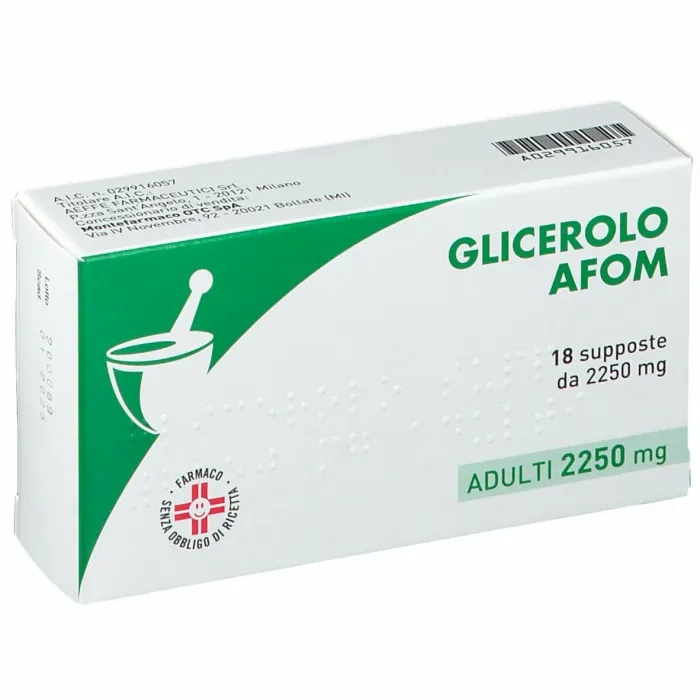
Table of Contents
- Package leaflet: Information for the user
- GLICEROLO AFOM children 1375 mg suppositories, adults 2250 mg suppositories
- 1. What GLICEROLO AFOM is and what it is used for
- 2. What you need to know before using GLYCEROL AFOM
- 3. How to use GLICEROLO AFOM
- 4. Possible side effects
- 5. How to store GLYCEROL AFOM
- 6. Package contents and other information
- GLYCEROL AFOM for early infancy 2.25 g rectal solution, children 4.5 g rectal solution, adults 6.75 g rectal solution
- 1. What GLICEROLO AFOM is and what it is used for
- 2. What you need to know before using GLICEROLO AFOM
- 3. How to use GLICEROLO AFOM
- 4. Possible side effects
- 5. How to store GLICEROLO AFOM
- 6. Package contents and other information
Package leaflet: Information for the user
GLICEROLO AFOM children 1375 mg suppositories, adults 2250 mg suppositories
Glycerol
Please read all of this leaflet carefully before using this medicine because it contains
important information for you.
Always take this medicine exactly as described in this leaflet or as your doctor or pharmacist has instructed you.
- Keep this leaflet. You may need to read it again.
- If you need more information or advice, consult your pharmacist.
- If you experience any side effects, including those not listed in this leaflet, contact your doctor or pharmacist. See section 4.
- Contact your doctor if you do not notice any improvement or if your symptoms worsen after 7 days.
Contents of this leaflet:
- What GLICEROLO AFOM is and what it is used for
- What you need to know before using GLICEROLO AFOM
- How to use GLICEROLO AFOM
- Possible side effects
- How to store GLICEROLO AFOM
- Contents of the pack and other information
1. What GLICEROLO AFOM is and what it is used for
GLICEROLO AFOM contains the active substance glycerol, which belongs to the group of
laxatives—medicines used to facilitate the expulsion of faeces. This medicine
is indicated for the short-term treatment of occasional constipation.
Consult your doctor if you do not notice any improvement or if your symptoms worsen after
7 days.
2. What you need to know before using GLYCEROL AFOM
Do not use GLYCEROL AFOM
- if you are allergic to glycerol or to any of the other ingredients of this medicine (listed in section 6);
- if you have acute abdominal pain or abdominal pain of unknown origin;
- if you have nausea or vomiting;
- if you have intestinal obstruction or narrowing (stenosis) of the intestine;
- if you have rectal bleeding of unknown origin;
- if you have acute hemorrhoidal crisis (swelling of blood vessels around the anus) with pain and bleeding;
- if you are severely dehydrated.
Warnings and precautions
Talk to your doctor or pharmacist before taking GLYCEROL AFOM.
If you are elderly and/or in poor general health, inform your doctor before using this medicine.
Use medicines that stimulate bowel evacuation (laxatives) as infrequently as possible and in any case for no longer than 7 days. Using laxatives for longer periods requires a doctor's prescription, following an appropriate assessment of the patient's condition.
If you suffer from constipation that lasts for long periods (chronic) or occurs frequently, always consult your doctor for diagnosis, prescription of medicines, and monitoring during treatment. Consult your doctor when the need for a laxative arises from a sudden change in previous bowel habits (frequency and characteristics of bowel movements) lasting more than two weeks, or when the use of the laxative fails to produce an effect.
Drink at least 6–8 glasses of water or other fluids daily to help soften stools while using laxatives.
If you excessively, frequently, or incorrectly use laxatives, you may develop prolonged diarrhea, resulting in loss of water, mineral salts (especially potassium), and other essential nutrients. In severe cases of abuse, excessive fluid loss (dehydration) or low potassium levels in the blood (hypokalemia) may occur, which can cause heart problems or affect muscle function, especially if you are taking cardiac glycosides, diuretics, or corticosteroids during treatment with this medicine.
Abuse of laxatives, particularly stimulant laxatives (contact laxatives), may lead to dependence (the need to continuously increase the dose), chronic constipation, and loss of normal intestinal function (intestinal atony).
In case of constipation, first correct your dietary habits by consuming an adequate amount of dietary fiber and fluids in your daily diet.
Children
Use GLYCEROL AFOM in children under 12 years of age only after consulting a doctor.
Other medicines and GLYCEROL AFOM
Inform your doctor or pharmacist if you are taking, have recently taken, or might take any other medicines.
There is no information available on interactions with other medicines.
Pregnancy and breastfeeding
If you are pregnant, think you might be pregnant, are planning a pregnancy, or are breastfeeding, consult your doctor or pharmacist before taking this medicine.
Take this medicine during pregnancy and breastfeeding only if necessary and always under direct medical supervision.
Driving and using machines
This medicine does not impair the ability to drive or operate machinery.
However, pay attention to your individual response to the medicine, as adverse effects may occur that could affect your ability to drive or use machinery.
3. How to use GLICEROLO AFOM
Use this medicine exactly as stated in this leaflet or as directed by your doctor or pharmacist. If you have any doubts, consult your doctor or pharmacist.
The recommended dose is the lowest dose sufficient to produce easy evacuation. Initially use the lowest recommended doses.
The recommended dose in adults and adolescents aged over 12 years is 1 adult suppository as needed, up to a maximum of 1 or 2 administrations per day.
In children aged between 2 and 11 years, the recommended dose is 1 children's suppository as needed, up to a maximum of 1 or 2 administrations per day.
Use laxatives as infrequently as possible and for no longer than seven days (see section Warnings and precautions).
Method of administration
Remove the suppository from its container and moisten it, if necessary, to facilitate rectal insertion.
If the suppositories seem too soft, place the containers in cold water before opening them.
If you use more GLICEROLO AFOM than you should
If you use this medicine too frequently, for too long, or in excessive amounts, abdominal pain and persistent diarrhoea may occur, leading to loss of fluids, electrolytes (especially potassium), and other essential nutrients that need to be replaced (see section Warnings and precautions).
Symptoms of imbalance in the body's electrolyte levels (electrolyte imbalance) include: thirst, vomiting, weakness, swelling (oedema), bone problems (osteomalacia), and decreased levels of the protein albumin in the blood (hypoalbuminaemia).
In more severe cases, dehydration or low blood potassium levels (hypokalaemia) may occur, which can cause heart and muscle problems, especially if you are also taking medicines for the heart (cardiac glycosides), medicines used to lower blood pressure (diuretics), or anti-inflammatory medicines (corticosteroids).
If you abuse this medicine, you may develop dependence (requiring progressively higher doses), chronic constipation, and loss of normal bowel function.
In case of accidental ingestion/overdose of GLICEROLO AFOM, contact your doctor immediately or go to the nearest hospital.
If you have any doubts about how to use this medicine, consult your doctor or pharmacist.
4. Possible side effects
Like all medicines, this medicine can cause side effects, although not everybody gets them.
The following side effects may occur:
Frequency not known (frequency cannot be estimated from the available data):
- Isolated cramp-like pains or abdominal colic and diarrhoea, with loss of fluids and mineral salts (electrolytes), more frequent in cases of severe constipation
- Rectal irritation
Reporting of side effects
If you experience any side effect, including those not listed in this leaflet, talk to your doctor or pharmacist. You can also report side effects directly via the national reporting system at https://www.aifa.gov.it/content/segnalazioni-reazioni-avverse. By reporting side effects, you can help provide more information on the safety of this medicine.
5. How to store GLYCEROL AFOM
Keep this medicine out of the sight and reach of children.
Do not use this medicine after the expiry date stated on the packaging after "Exp.". The expiry date refers to the last day of that month.
Store in the original packaging to protect the medicine from moisture and keep it away from direct sources of heat.
Do not dispose of medicines via wastewater or household waste. Ask your pharmacist how to dispose of medicines you no longer use. This will help protect the environment.
6. Package contents and other information
What GLICEROLO AFOM contains
GLICEROLO AFOM children 1375 mg suppositories
- The active substance is glycerol. Each suppository contains 1375 mg of glycerol.
- The other components are: sodium stearate, sodium bicarbonate.
GLICEROLO AFOM adults 2250 mg suppositories
- The active substance is glycerol. Each suppository contains 2250 mg of glycerol.
- The other components are: sodium stearate, sodium bicarbonate.
Description of the appearance of GLICEROLO AFOM and contents of the pack
GLICEROLO AFOM children 1375 mg suppositories. Box containing 6 suppositories.
GLICEROLO AFOM adults 2250 mg suppositories. Box containing 18 suppositories.
Marketing Authorization Holder
AEFFE FARMACEUTICI S.r.l. –
Via Carlo Porta, 49 – Gorgonzola (Mi)
Manufacturer
Industria Farmaceutica NOVA ARGENTIA S.p.A. - Via Pascoli, 1 - Gorgonzola (MI)
AEFFE FARMACEUTICI S.r.l. – Via Torino, 448 – Brandizzo (TO)
Marketing Authorization Holder and Distributor:
Montefarmaco OTC Spa
Via IV Novembre, 92 – 20021 Bollate (MI)
Health education notes
In most cases, a balanced diet rich in water and fiber (bran, vegetables, and fruit) can permanently resolve constipation. Many people believe they are constipated if they do not have a bowel movement every day. This is a mistaken belief, as going less frequently is entirely normal for many individuals. True constipation occurs when bowel movements are less frequent than usual for the individual and are associated with hard stools. If episodes of constipation recur frequently, a doctor should be consulted.
Package leaflet: information for the user
GLYCEROL AFOM for early infancy 2.25 g rectal solution, children 4.5 g rectal solution, adults 6.75 g rectal solution
Glycerol
Please read this leaflet carefully before using this medicine because it contains
important information for you.
Always take this medicine exactly as described in this leaflet or as your
doctor or pharmacist has instructed you to do.
- Keep this leaflet. You may need to read it again.
- If you need more information or advice, consult your pharmacist.
- If you experience any side effects, including those not listed in this leaflet, contact your doctor or pharmacist. See section 4.
- Contact your doctor if you do not notice any improvement or if your symptoms worsen.
Contents of this leaflet:
- What GLYCEROL AFOM is and what it is used for
- What you need to know before using GLYCEROL AFOM
- How to use GLYCEROL AFOM
- Possible side effects
- How to store GLYCEROL AFOM
- Contents of the pack and other information
1. What GLICEROLO AFOM is and what it is used for
GLICEROLO AFOM contains the active substance glycerol, which belongs to the category of
laxatives—medicines used to facilitate the expulsion of faeces. This medicinal product
is indicated for the short-term treatment of occasional constipation.
Consult your doctor if you do not notice improvement or if your symptoms worsen.
2. What you need to know before using GLICEROLO AFOM
Do not use GLICEROLO AFOM
- if you are allergic to glycerol or to any of the other ingredients of this medicine (listed in section 6);
- if you have acute abdominal pain or of unknown origin;
- if you have nausea or vomiting;
- if you have intestinal obstruction or narrowing (stenosis);
- if you have rectal bleeding of unknown origin;
- if you have acute hemorrhoidal crisis (swelling of blood vessels around the anus) with pain and bleeding;
- if you are severely dehydrated.
Warnings and precautions
Talk to your doctor or pharmacist before taking GLICEROLO AFOM.
If you are elderly and/or in poor health, inform your doctor before using this medicine.
Use medicines that stimulate bowel evacuation (laxatives) as infrequently as possible and in any case for no longer than 7 days. Using laxatives for longer periods requires a doctor's prescription, following an appropriate assessment of the patient's condition.
If you suffer from constipation that lasts for long periods (chronic) or occurs frequently, always seek medical advice for diagnosis, prescription of medicines, and monitoring during treatment. Consult your doctor when the need for a laxative arises from a sudden change in previous bowel habits (frequency and characteristics of bowel movements) lasting more than two weeks, or when use of the laxative fails to produce an effect.
Drink at least 6–8 glasses of water or other fluids daily to help soften stools when using laxatives.
If you overuse, frequently use, or misuse laxatives, you may develop persistent diarrhea, resulting in loss of water, mineral salts (especially potassium), and other essential nutrients. In severe cases of abuse, excessive fluid loss (dehydration) or low levels of potassium in the blood (hypokalemia) may occur, which can lead to heart problems or muscle dysfunction, particularly if you are taking cardiac glycosides, diuretics, or corticosteroids during treatment with this medicine.
Abuse of laxatives, especially stimulant laxatives (contact laxatives), may lead to dependence (the need to continually increase the dose), chronic constipation, and loss of normal intestinal function (intestinal atony).
If you are constipated, first correct your dietary habits by including an adequate amount of dietary fiber and fluids in your daily diet.
Children
Use GLICEROLO AFOM in children under 12 years of age only after consulting a doctor.
Other medicines and GLICEROLO AFOM
Inform your doctor or pharmacist if you are taking, have recently taken, or might take any other medicines.
There is no information available on interactions with other medicines.
Pregnancy and breastfeeding
If you are pregnant, think you may be pregnant, planning to become pregnant, or breastfeeding, consult your doctor or pharmacist before taking this medicine.
Take this medicine during pregnancy and breastfeeding only if necessary and always under direct medical supervision.
Driving and using machines
This medicine does not impair your ability to drive or operate machinery.
However, observe how you react to the medicine, as adverse effects may occur that could affect your ability to drive or use machinery.
3. How to use GLICEROLO AFOM
Use this medicine exactly as stated in this leaflet or as instructed by your doctor or pharmacist. If you have any doubts, consult your doctor or pharmacist.
The recommended dose is the lowest dose sufficient to produce easy bowel evacuation. Initially use the lowest doses indicated.
The recommended dose in adults and adolescents (12–18 years) is 1 single-dose container for adults containing 6.75 g as needed, up to a maximum of 1 or 2 administrations per day.
In children aged between 6 and 11 years, the recommended dose is 1 single-dose container for children containing 4.5 g as needed, up to a maximum of 1 or 2 administrations per day.
In children aged between 2 and 6 years, the recommended dose is 1 single-dose container for infants containing 2.25 g as needed, up to a maximum of 1 or 2 administrations per day.
Remove the cap from the single-dose container without ever touching the bulb, otherwise the medicine may leak out before use.
If necessary, use a drop of the medicinal solution to moisten (lubricate) the cannula before inserting it into the rectum, then squeeze the bulb. Withdraw the cannula while continuing to squeeze the bulb.
Use each container for a single administration only; discard any remaining medicine.
Use laxatives as infrequently as possible and for no longer than seven days (see section Warnings and precautions).
If you use more GLICEROLO AFOM than you should
If you use this medicine too frequently, for too long, or in excessive amounts, abdominal pain and persistent diarrhea may occur, leading to loss of fluids, electrolytes (especially potassium), and other essential nutrients, which must be replaced (see section Warnings and precautions).
Symptoms of altered body electrolyte balance (electrolyte imbalance) include: thirst, vomiting, weakness, swelling (edema), bone problems (osteomalacia), and decreased levels of the blood protein albumin (hypoalbuminemia).
In more severe cases, dehydration or low blood potassium levels (hypokalemia) may occur, which can cause heart and muscle problems, especially if you are also taking medicines for the heart (cardiac glycosides), medicines used to lower blood pressure (diuretics), or anti-inflammatory medicines (corticosteroids).
If you abuse this medicine, you may develop dependence (with progressive need to increase the dose), chronic constipation, and loss of normal bowel function.
In case of accidental ingestion/overdose of GLICEROLO AFOM, contact your doctor immediately or go to the nearest hospital.
If you have any doubts about how to use this medicine, consult your doctor or pharmacist.
4. Possible side effects
Like all medicines, this medicine can cause side effects, although not everybody gets them.
The following side effects may occur:
Frequency not known (frequency cannot be estimated from the available data):
- Isolated cramp-like pains or abdominal colic and diarrhoea, with loss of fluids and mineral salts (electrolytes), more frequent in cases of severe constipation
- Rectal irritation
Reporting of side effects
If you experience any side effects, including those not listed in this leaflet, talk to your doctor or pharmacist. You can also report side effects directly
through the national reporting system at the website https://www.aifa.gov.it/content/segnalazioni-reazioni-
avverse . Reporting side effects can help provide more information on the safety of this medicine.
5. How to store GLICEROLO AFOM
Keep this medicine out of the sight and reach of children.
Do not use this medicine after the expiry date stated on the packaging after "Exp.". The expiry date refers to the last day of that month.
Store in the original container tightly closed to protect the medicine from moisture and keep it away from direct sources of heat.
Do not dispose of any medicine via wastewater or household waste. Ask your pharmacist how to dispose of medicines you no longer use. This will help protect the environment.
6. Package contents and other information
What GLICEROLO AFOM contains
GLICEROLO AFOM first infancy 2.25 g rectal solution
- The active substance is glycerol. Each single-dose container contains 2.25 g of glycerol.
- The other components are: chamomile fluid extract, mallow fluid extract, potato starch, purified water.
GLICEROLO AFOM children 4.5 g rectal solution
- The active substance is glycerol. Each single-dose container contains 4.5 g of glycerol.
- The other components are: chamomile fluid extract, mallow fluid extract, potato starch, purified water.
GLICEROLO AFOM adults 6.75 g rectal solution
- The active substance is glycerol. Each single-dose container contains 6.75 g of glycerol.
- The other components are: chamomile fluid extract, mallow fluid extract, potato starch, purified water.
Description of the appearance of GLICEROLO AFOM and contents of the pack
Pack containing 6 single-dose containers of rectal solution.
Marketing Authorization Holder
AEFFE FARMACEUTICI S.r.l. – Via Carlo Porta, 49 - Gorgonzola (Mi)
Manufacturers
AEFFE FARMACEUTICI S.r.l. – Via Torino, 448 – Brandizzo (TO)
Marketing Authorization Holder (for sale):
Montefarmaco OTC Spa
Via IV Novembre, 92 – 20021 Bollate (MI)
Health education notes
In most cases, a balanced diet rich in water and fiber (bran, vegetables, and fruit) can permanently resolve constipation problems. Many people believe they suffer from constipation if they do not have a bowel movement every day. This belief is incorrect, as going less frequently is completely normal for many individuals. True constipation occurs when bowel movements are less frequent than usual and are associated with the passage of hard stools. If episodes of constipation occur repeatedly, a doctor should be consulted.